
Is a Pellet Stove the Right Heat Source for Your Home?
Best suited to homes with a safe vent route, dry fuel storage, reliable power and owners prepared to handle pellet bags and regular cleaning.
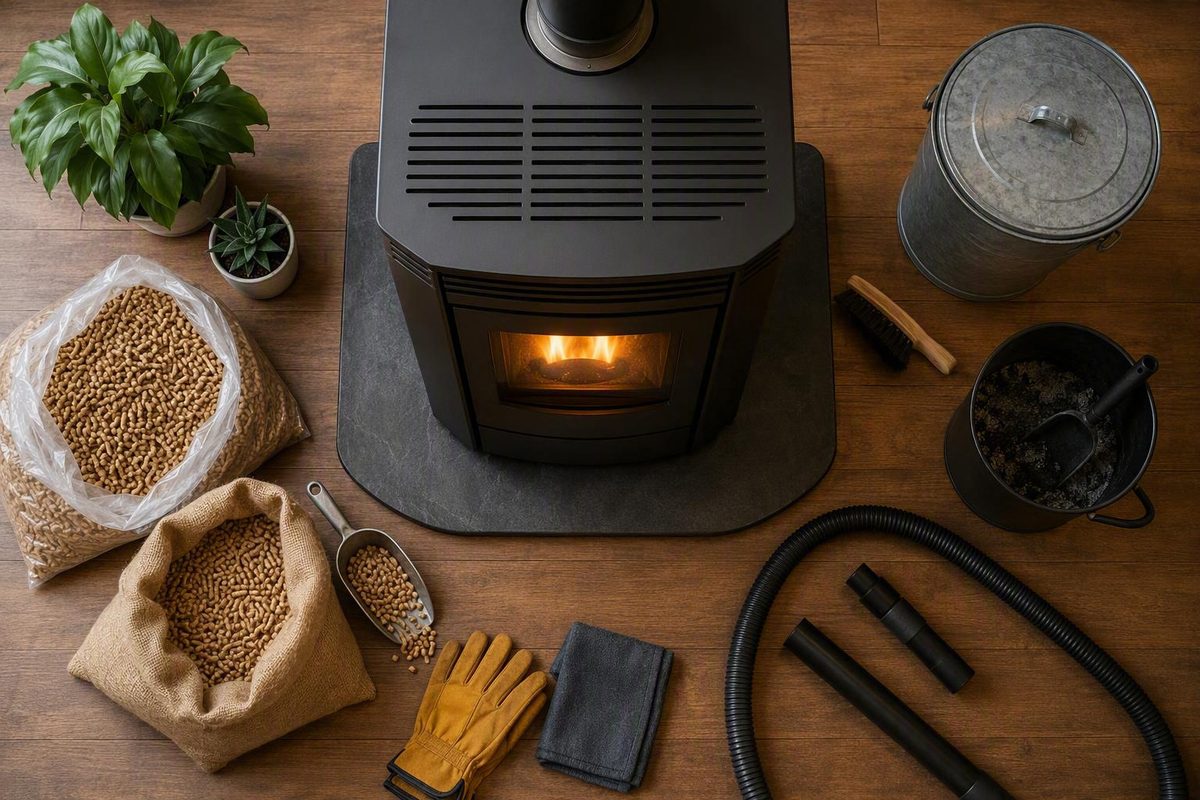
A pellet heater stove occupies the middle ground between a conventional wood stove and an automated heating appliance. It burns solid fuel and creates a visible fire, but it meters pellets from a hopper, manages combustion with fans, and usually responds to a thermostat. That can provide steady heat with less fire tending than cordwood, but it does not mean maintenance-free or outage-proof heating.
The right buying decision starts with the job the stove must perform. Heating an open living area is very different from serving as the primary heat source for a multistory house with closed bedrooms. Purchase price is only one part of the budget, alongside venting, hearth protection, electrical work, installation, fuel, cleaning, electricity, and repairs.
A pellet stove is most likely to work well when the home has a suitable vent route, the household has dry fuel storage, someone can handle pellet bags and routine cleaning, and qualified local service is available. Evaluate those conditions before comparing finishes, app controls, or advertised square-footage ratings.
How a pellet heater stove produces and controls heat
A pellet heater stove is a space-heating appliance that burns compressed wood or other approved biomass pellets. Fuel is poured into a hopper and usually moved by an electrically powered auger into a small combustion chamber called a burn pot.
A typical operating cycle looks like this:
- Pellets move from the hopper into the burn pot.
- An igniter starts the fire on automatic-ignition models.
- A combustion or exhaust fan controls airflow and moves combustion gases outdoors.
- Ash falls or is pushed into a collection area.
- A room blower moves heated air into the living space.
- Electronic controls adjust pellet delivery and airflow as heating demand changes.
Most models use an electronic thermostat or temperature sensor. Instead of asking the owner to add individual logs and adjust the fire manually, the control system increases or decreases the pellet-feed rate to approach the selected temperature. Depending on the appliance and operating mode, the fire may reduce to a low burn, cycle off, or restart automatically.
This automation is the principal difference from a conventional wood stove. A wood-stove owner ordinarily loads split logs, establishes the fire, and manages output through fuel loading and air control. A pellet-stove owner fills a hopper and selects a setting but accepts more motors, fans, sensors, switches, and electronic controls.
Those components make most pellet stoves dependent on electricity. The auger, igniter, control board, exhaust fan, and room blower ordinarily cannot perform their normal functions during an outage. Less-common gravity-fed, non-electric pellet stoves do exist, but they are a distinct category rather than representative examples of automated pellet appliances.
There are two principal installation formats:
- Freestanding pellet stoves stand in the room on approved floor protection and vent outdoors through a wall or roof.
- Pellet fireplace inserts fit into an existing fireplace and generally exhaust through a metal liner installed in the chimney.
Pellet stoves can also be top-fed or bottom-fed. In a top-fed design, pellets drop into the combustion area from above. A bottom-fed design introduces fuel from below and may push ash toward an ash pan. EPA archival guidance says top-fed combustion areas may accumulate more ash and debris, while bottom-fed systems can move ash into the collection pan automatically. The same guidance stresses that fuel compatibility, capacity, efficiency, and maintenance vary by appliance; its Burn Wise content is maintained as a historic record rather than a continuously updated program. See the EPA’s archived pellet-stove guidance.
“Automatic” should therefore be understood narrowly. A stove can automate ignition, fuel feeding, combustion airflow, and temperature response. It cannot carry bags, refill its hopper, remove ash, clean its heat exchanger, inspect its vent, or replace a failed igniter. A pellet stove reduces fire tending; it does not eliminate owner labor.
Can one stove heat the space you have in mind?
The first sizing question is not “How many square feet does this model heat?” It is “What role will this stove perform?”
A supplemental zone heater might warm a living room, kitchen, workshop, or frequently occupied part of the home while another system serves distant rooms. A primary heater must cover a much larger share of the building’s cold-weather load and maintain acceptable temperatures during unfavorable conditions.
Maximum BTU output and advertised coverage are useful screening figures, but they are not complete sizing methods. The actual heating requirement depends on:
- Local winter temperatures
- Insulation levels
- Air leakage
- Window area and performance
- Ceiling height
- Floor plan and door positions
- Number of stories
- Stove location
- Desired indoor temperature
- Whether the stove will provide supplemental or primary heat
Two homes with the same floor area can have very different heat losses. A compact, well-insulated house may require less heat than a smaller but drafty building with older windows and tall ceilings.
Heat distribution matters as much as raw output. A room appliance can perform well in an open-plan living area where warm air has a clear path. Closed bedrooms, long hallways, rooms around corners, and upper floors are harder to serve. Favorable airflow may improve distribution, but it does not turn every room heater into a central heating system.
Consumer Reports’ February 2025 buying guide says manufacturer square-footage estimates are too inconsistent to serve as the sole comparison method. It also identifies layout, insulation, climate, heat setting, pellet choice, and the intended heating role as important performance variables.
Rules of thumb can illustrate scale, but they are not recommendations for a particular property. For example, a 2022 EnergySage installation guide cited approximately 60,000 BTU per hour for an open-plan, 2,000-square-foot property as a rough estimate. That does not mean every stove with that rating will heat every home of that size; it says little about air leakage, closed rooms, low-fire operation, or the coldest local conditions. EnergySage labels the figure as a rule of thumb rather than a property-specific load calculation.
If the stove will provide primary heat, ask a qualified installer or heating professional for a property-specific load assessment. The discussion should cover both heat loss and heat delivery: where the stove will sit, which rooms require heat, what happens when doors are closed, and which existing system will remain available.
Do not size solely by choosing the largest maximum output. Too little capacity may leave the appliance unable to meet the cold-weather load, while excessive output can make the stove’s immediate room uncomfortable. Compare the appliance’s usable low-to-high output range with the home’s changing heating demand.
Typical scenarios illustrate the distinction:
- Open living area, supplemental use: Often a strong application. Prioritize controllable low-fire output, convenient loading, acceptable noise, and comfortable placement.
- Small, open, well-insulated home: Primary heating may be possible after a load and distribution assessment.
- Multistory home with closed bedrooms: One stove may heat the main zone effectively while another system serves upper floors and separated rooms.
- Drafty home in a severe climate: Air sealing or insulation may be the better first investment and could reduce the stove capacity required.
- Home needing dependable unattended heat: Consider hopper refilling, cleaning, outages, fault shutdowns, and continued operation when no one is available to tend the appliance.
The goal is not to make the appliance heat the largest theoretical area. It is to select an output range that suits the intended zone during both mild and severe weather.
Freestanding stove or fireplace insert?
A freestanding stove offers more placement flexibility because it does not require an existing fireplace. It normally stands on listed floor protection and vents through an exterior wall or through the roof. That flexibility comes at the cost of floor space and a visible vent route.
An insert uses an existing fireplace opening, preserving more usable floor area and creating a built-in appearance. It generally connects to a rigid or flexible metal liner routed through the existing chimney. Fireplace dimensions, chimney condition, liner routing, electrical access, and future service access can all constrain model choice.
| Consideration | Freestanding stove | Fireplace insert |
|---|---|---|
| Placement | Flexible within listed venting and clearance limits | Limited to a compatible existing fireplace |
| Floor-space use | Occupies room floor area | Fits largely within the fireplace opening |
| Exhaust route | Usually through an exterior wall or roof | Usually through a liner in the chimney |
| Floor protection | Listed hearth pad or approved construction | Existing hearth may need evaluation or alteration |
| Installation access | Usually open on several sides | Confined opening can complicate connections |
| Service access | Potentially easier if adequate space is retained | May require moving or partially withdrawing the insert |
| Existing fireplace required | No | Yes |
Freestanding readiness checklist
Before ordering a freestanding pellet heater stove, confirm:
- A location that serves the intended heating zone
- Manufacturer-listed clearances from combustible materials
- Approved hearth or floor protection
- A viable vent route and compliant outdoor termination
- Access to grounded electrical power
- Clearance for hopper loading and door operation
- Space for cleaning, component replacement, and annual service
- A practical route for moving the heavy appliance into the home
Insert readiness checklist
For an insert, confirm:
- The fireplace and chimney can be inspected and cleaned
- The opening accommodates the appliance and required connections
- Masonry, damper, and chimney conditions do not obstruct installation
- A compatible liner can run from the insert to the chimney top
- Electrical power can be provided safely
- The hearth and surrounding construction satisfy the appliance listing
- Installers can position, connect, seal, and commission the unit
- The insert can be accessed or removed for blower, auger, or control repairs
A typical project may involve vent pipe, elbows, connectors, supports, a wall thimble or chimney adapter, approved high-temperature sealant, mounting hardware, and an exterior cap. Insert projects normally add a chimney liner and top termination. These are project categories, not a universal shopping list.
Exact vent diameter, clearances, hearth dimensions, termination spacing, liner configuration, and approved materials are model- and jurisdiction-specific. A retailer-authored installation guide identifies common components while emphasizing manufacturer instructions, local codes, permits, and inspections. Review the installation components and model-specific constraints.
Before purchase, ask the local authority having jurisdiction whether a permit and inspection are required and whether local air-quality rules restrict operation. Ask the home insurer what installation documentation, professional commissioning, or notice it requires. Requirements vary, so obtain answers for the property and jurisdiction rather than relying on a generic online checklist.
Professional installation is the prudent choice for a consequential purchase. Pellet appliances can be heavy, and errors in placement, floor protection, venting, or sealing can create fire or combustion-gas hazards. Generic installation instructions should not be treated as a universal DIY procedure. The appliance’s listing and installation manual control, together with applicable local requirements.
What a pellet stove really costs to buy and run
The displayed stove price is not the project price. Build the budget in separate lines so omitted work does not appear later as a surprise.
| Budget item | What to include |
|---|---|
| Appliance | Base freestanding stove or insert |
| Factory options | Finish, trim, pedestal, surround, remote, sensors |
| Delivery | Freight, lift-gate service, indoor placement |
| Venting | Pipe, elbows, thimble, supports, termination |
| Insert liner | Liner, adapters, insulation if required, chimney cap |
| Hearth protection | Listed pad or constructed hearth work |
| Electrical work | Outlet, circuit work, suitable surge protection if specified |
| Labor | Installation, assembly, sealing, commissioning |
| Site work | Wall, roof, masonry, chimney, or structural changes |
| Permits and inspections | Applicable local fees |
| Taxes | Sales and other applicable taxes |
| Startup supplies | Approved pellets, cleaning tools, cold-ash equipment |
| Fuel | Bags or bulk delivery for the heating season |
| Electricity | Ignition, controls, auger, exhaust fan, room blower |
| Service | Inspection and deep cleaning |
| Repairs | Igniter, gaskets, motors, sensors, blowers, control board |
| Owner labor | Refilling, carrying fuel, cleaning, ash disposal |
As dated market context, Consumer Reports’ February 2025 guide estimated appliance prices from just under $1,000 to more than $5,000 before installation and cited a broad freestanding installation estimate of approximately $1,000 to $3,500. It also described pellets as commonly sold in 40-pound bags, with one bag per day or roughly three tons during colder months presented as usage scenarios rather than universal forecasts. The guide reported a then-available federal credit of 30% of qualifying appliance and installation costs, capped at $2,000, but that historical figure should not be used for a 2026 budget without checking current official rules and exact model eligibility. See the dated Consumer Reports cost and ownership context.
Difficult venting, chimney repairs, electrical changes, permits, structural work, travel charges, and premium labor can push a project beyond broad installation estimates.
Retail listings show why “starting at” needs careful interpretation. One collection displayed starting MSRPs from $2,479 to $6,069 for certain Harman and Quadra-Fire stoves and inserts. Those figures were not complete installed prices and may have changed; options, venting, delivery, labor, hearth protection, permits, and taxes may be additional. See the retailer’s listed starting MSRPs.
Request a written installed quote that identifies both inclusions and exclusions. For an insert, ask whether chimney inspection, cleaning, liner materials, top termination, electrical work, and access for future service are included. For a freestanding unit, confirm vent length, wall or roof penetrations, hearth protection, exterior termination, electrical work, and commissioning.
Estimating seasonal fuel cost
Do not begin with a national pellet price and assume it represents your winter. Start with local delivered prices and calculate at least two scenarios:
Seasonal pellet cost = expected bags or tons used × local delivered price
If estimating by day:
Daily cost = expected pounds burned ÷ bag weight × delivered bag price
Use a low-use and high-use case. Climate, insulation, air leakage, stove settings, pellet quality, desired temperature, floor plan, and whether the appliance supplies primary or supplemental heat can change consumption substantially.
Also determine whether a quoted fuel price includes:
- Delivery
- Pallet or packaging charges
- Minimum quantities
- Seasonal surcharges
- Carry-in or storage service
- Taxes
- Return or replacement terms for damaged fuel
Savings cannot be inferred from pellet price alone. Compare the complete annual cost with the heating energy actually displaced:
- Pellet fuel
- Stove electricity
- Inspection and deep cleaning
- A repair allowance
- Owner handling and cleaning time
- Remaining oil, propane, electricity, cordwood, or heat-pump use
- Upfront installation cost spread over a reasonable ownership period
A stove that heats only the main living area should not be credited with replacing the entire existing heating bill. Conversely, targeted zone heating may reduce use of an expensive system even when it does not serve the whole house.
Treat incentives as a possible adjustment, not guaranteed money. Before including any rebate or credit, verify the current tax year, eligible cost categories, efficiency criteria, filing requirements, and exact model through current official government resources. A retailer’s “qualifies” label or an older buying guide is not sufficient confirmation.
The specifications that matter before you choose a model
Begin with heating performance and serviceability rather than cosmetic features. A useful buyer checklist should cover:
- Usable low-to-high heat-output range
- Property-specific heating load
- Certified efficiency and emissions data
- Freestanding or insert format
- Hopper capacity
- Minimum and maximum fuel-consumption rate
- Ignition and continuous electrical demand
- Thermostat and control options
- Noise information
- Cleaning access
- Warranty, parts, and local service
- Complete installed cost
Maximum BTU output matters, but minimum stable output can be equally important. A useful operating range allows the appliance to respond to mild afternoons and colder nights without being selected solely for its highest advertised setting.
Distinguish certified records from manufacturer and retailer descriptions. Consumer Reports tests freestanding pellet stoves rather than fireplace inserts and says it does not independently test the efficiency or emissions figures displayed on its model pages; those figures are supplied by manufacturers.
Hopper size and runtime
A larger hopper can reduce refill frequency, but capacity alone does not guarantee runtime. Actual duration depends on:
- Minimum and maximum burn rates
- Outdoor conditions
- Indoor temperature setting
- Building heat loss
- Stove operating mode
- Pellet quality
- How much fuel can be loaded and fed reliably
These are conditional examples, not promises for a specific model or home. Consumer Reports documents the contrast while warning that actual results vary.
Ask the dealer to show runtime as a range derived from hopper capacity and disclosed burn rates. If those burn rates are unavailable, treat a single “hours per fill” claim cautiously.
Controls and convenience
Available controls may include:
- Built-in thermostats
- External thermostat support
- Remote controls
- Programmable schedules
- Wireless temperature sensors
- Eco or cycling modes
- Wi-Fi and app operation
These features can make a stove easier to use, but they do not prove that it will heat the intended space. Evaluate thermostat placement, temperature swing, restart behavior, scheduling limitations, and which functions remain available without an internet connection.
Ask for model-specific ignition wattage and continuous electrical draw. Those figures affect operating cost and backup-power planning. Do not assume two similarly sized stoves have the same startup demand, running demand, waveform requirements, or shutdown behavior.
Noise, cleaning, and repairability
Pellet stoves have moving parts. Listen to the room blower at several speeds, the exhaust fan, pellet drops, and the auger cycle. Without comparable sound measurements, an in-person demonstration is more useful than a generic claim that a stove is “quiet.”
Inspect cleaning access before buying:
- Can the burn pot be removed or cleared easily?
- Is the ash pan large enough and simple to seal?
- Can the heat exchanger be reached without awkward disassembly?
- Is glass cleaning straightforward?
- Are internal passages and vent connections serviceable?
- Must an insert be pulled forward for common repairs?
Repairability deserves the same attention as efficiency. Ask about warranty exclusions, labor coverage, technician travel charges, and local availability of igniters, auger motors, blowers, sensors, switches, control boards, and door gaskets. A feature-rich stove is a poor bargain if no nearby technician will service it.
Use this shortlist worksheet:
| Item | Model A | Model B | Model C |
|---|---|---|---|
| Low-to-high output range | |||
| Calculated heating load served | |||
| Certified efficiency data | |||
| Certified emissions data | |||
| Hopper capacity | |||
| Minimum/maximum burn rate | |||
| Ignition/running power | |||
| Thermostat and controls | |||
| Noise demonstrated or documented | |||
| Cleaning access | |||
| Parts stocked locally | |||
| Warranty and labor coverage | |||
| Qualified local service | |||
| Complete installed quote | |||
| Price and specifications checked on |
Fuel, storage, refilling, and the maintenance calendar
Use only fuel approved for the particular appliance. Some pellet stoves accept wood pellets only; others are designed and listed for additional biomass fuels. The fact that pellets can be made from wood byproducts, corn, or nutshells does not mean every stove can burn those fuels interchangeably.
Recognized certification programs identified in EPA archival guidance include PFI Standards, ENplus, and CANPlus. Certification does not replace the stove manual, but it offers a more meaningful starting point than selecting fuel solely by whether the bag says hardwood or softwood.
Pellet quality can affect:
- Heat output
- Ash volume
- Fine dust
- Fuel-feed reliability
- Burn-pot deposits
- Glass cleanliness
- Cleaning frequency
EPA’s archival guidance associates higher-quality pellets with cleaner burning and less ash, while lower-quality fuel may provide less heat or create more fine dust. Review the EPA’s archived fuel-quality guidance.
Handling and storage
A standard pellet bag creates a practical test that showroom shopping can obscure. Someone must move each bag from the vehicle or delivery pallet, place it in dry storage, carry it to the stove, lift it, and pour the contents into the hopper.
Before buying, consider:
- Whether household members can safely manage the bag weight
- Whether smaller transfer containers would help
- Stairways, snow, narrow doors, and other handling obstacles
- The space required for a partial or full season’s supply
- Delivery access for pallets
- Protection from leaks, ground moisture, and condensation
- Dust created when bags are opened and poured
Keep them protected in a dry location appropriate for the product and building.
A flexible maintenance calendar
No single schedule applies to every stove. Cleaning frequency varies with appliance design, usage, burn setting, ash-pan size, vent layout, and pellet quality. The appliance manual governs.
A practical framework is:
Frequently or as directed by the manual
- Inspect the burn pot.
- Clear deposits and obstructed combustion-air holes using the approved procedure.
- Watch flame and startup behavior.
- Check the hopper for excessive fines or foreign material.
On a recurring in-season schedule
- Remove cold ash.
- Clean the viewing glass as directed.
- Clean accessible heat-exchanger surfaces.
- Inspect door gaskets and visible seals.
- Look for soot or abnormal deposits.
Periodically
- Clean accessible internal passages.
- Inspect and clean the vent system at the required interval.
- Check blowers and accessible mechanical areas.
- Examine vent connections and the exterior termination.
At least as often as the manufacturer requires professional service
- Arrange a complete inspection and deep cleaning.
- Clean areas not covered by routine owner maintenance.
- Inspect the vent, exhaust path, fans, seals, sensors, and wear components.
- Address unusual noises, ignition delays, or declining output before the next heating season.
A commercial maintenance guide suggests cleaning the stove and venting after roughly one ton of fuel, while acknowledging that pellet quality and the appliance manual affect the interval. Treat that figure as a checkpoint to discuss, not a universal rule. See the guide’s model-dependent maintenance advice.
For applicable service, allow the appliance to cool as instructed and disconnect power. Use equipment designed for cold ash rather than an ordinary household or shop vacuum. Place removed ash in a metal container away from combustible materials until it is fully cold. Do not generalize brand-specific instructions—such as servicing a burn pot while a stove is operating—to another model.
Possible signs that cleaning or professional service is needed include:
- A weak, lazy, or unusually yellow flame
- Soot on surfaces that normally remain relatively clean
- Repeated ignition trouble
- Failure to maintain the selected temperature
- Abnormal fan or auger noise
- Smoke leakage or a persistent unusual odor
- More ash or deposits than normal with the same fuel and setting
Cleaning may correct some symptoms, but repeated faults can indicate a component, seal, venting, or fuel problem. Do not treat every fault as a reason to keep adding pellets.
Electricity, outages, startup, and safe operation
Most pellet stoves stop normal operation when electrical power fails. Their auger, igniter, electronic controls, exhaust fan, and room blower require electricity.
Before selecting a battery, inverter, uninterruptible power supply, or generator, obtain:
- Ignition wattage and startup behavior
- Continuous draw at low and high settings
- Required voltage and waveform
- Grounding requirements
- Behavior when incoming power is lost
- Power needed for a controlled shutdown
- Manufacturer-approved backup arrangements
Without those specifications, it is not responsible to recommend a backup capacity or promise a runtime.
If electricity-free heat is essential, a listed gravity-fed, non-electric pellet stove may deserve consideration. Evaluate it as a different appliance category with its own controls, certification, fuel requirements, venting, operating procedures, and heat-regulation characteristics.
Preparing an automatic-ignition stove
At a high level, safe preparation includes:
- Confirm that installation, venting, and commissioning are complete.
- Read the model’s operating manual.
- Inspect and clear the burn pot as instructed.
- Confirm that internal parts are installed correctly.
- Close doors, ash pans, and latches properly.
- Remove combustible objects from required clearance areas.
- Load only approved fuel.
- Verify power and alarm operation.
- Follow the manufacturer’s exact startup sequence.
During normal shutdown, pellet feeding usually stops first while one or more blowers continue temporarily. This cooling and exhaust period is part of the shutdown process.
Failure to ignite, substantial smoke, or excessive odor calls for a complete shutdown, cooling, and manual-based troubleshooting. Lowe’s high-level automatic-ignition guidance likewise advises shutting down and allowing the appliance to cool when ignition fails or substantial smoke develops. Review the startup and shutdown safety guidance.
An operating-safety checklist should include:
- Working carbon-monoxide alarms
- Working smoke alarms
- Manufacturer-listed clearances
- Secure, correctly assembled vent connections
- An unobstructed outdoor termination
- Approved floor protection
- Correct door and ash-pan seals
- Safe storage of fuel and removed ash
- Inspection and deep cleaning at the specified intervals
- A written outage and backup-heat plan
Confirm alarm placement, inspection requirements, clearances, and venting rules with the appliance manual and the relevant local authority. Never bypass vacuum switches, temperature sensors, door switches, seals, control-board protections, or other safety devices. A fault that prevents startup is a reason to diagnose the system, not defeat it.
Pellet stove, wood stove, or heat pump: choosing by household fit
A pellet stove is not automatically the best alternative to oil, propane, cordwood, electric resistance heat, or a heat pump. Each option shifts cost, labor, maintenance, and outage risk into different categories.
Pellet stove versus conventional wood stove
A pellet stove offers automatic fuel feeding, thermostat control, and generally less manual fire tending. Uniform bagged fuel can also be easier to meter than irregular cordwood.
A conventional wood stove does not ordinarily need an auger, electronic control board, or room blower to sustain a basic fire. It may therefore offer greater independence from electricity, depending on the installation, but requires log handling, fire building, reloading, and direct combustion control.
The central tradeoff is automation versus mechanical complexity:
| Pellet stove | Conventional wood stove |
|---|---|
| Hopper-fed fuel | Hand-loaded logs |
| Thermostat-responsive operation | Manual fire management |
| Usually electrically dependent | Basic combustion may be non-electric |
| Fans and auger create noise | Often quieter without blowers |
| More motors, sensors, and controls | Fewer automated components |
| Regular ash and internal cleaning | Ash and chimney maintenance |
| Bagged, uniform fuel | Split, seasoned cordwood |
Pellet combustion generally produces less pollution than a traditional fireplace or conventional wood stove, but it is not emissions-free. It can create more local air pollution than gas or electric heating, and local authorities may restrict solid-fuel burning during poor-air-quality periods. Avoid environmental claims that describe pellet heat as harmless or pollution-free.
Pellet stove versus heat pump
A pellet stove produces concentrated heat by burning fuel in or near the occupied room. A heat pump transfers heat using electricity and may distribute it through indoor units or ductwork. Many heat-pump systems provide both heating and cooling; an ordinary pellet stove provides heat only.
Both generally depend on electricity, but their electrical requirements and outage behavior differ by equipment. Backup power should therefore be designed for the actual system rather than assumed to work interchangeably.
Other differences include:
- Fuel storage: Pellet heat requires dry storage and regular refilling; a heat pump does not store solid fuel.
- Local combustion: A pellet stove burns fuel in the home; a heat pump does not.
- Maintenance: Pellet ownership includes ash, burn-pot, heat-exchanger, and vent cleaning. Heat pumps require equipment and filter maintenance but no ash handling.
- Distribution: A stove heats most strongly near its location. A properly designed multi-zone or ducted heat-pump system may serve separated rooms more directly.
- Cooling: Heat pumps may provide air conditioning; pellet stoves do not.
- Noise: Pellet stoves have combustion and room fans plus an auger. Heat pumps have indoor and outdoor fan and compressor noise.
- Operating attention: Pellet stoves require fuel deliveries, refilling, and cleaning. Heat pumps do not require daily fuel handling.
There is no universal operating-cost winner. A defensible comparison requires local delivered pellet prices, electricity rates, climate, equipment performance, installation cost, maintenance, and the amount of existing heat each system will displace.
Hybrid use may be practical. A pellet heater stove can provide concentrated warmth in a heavily used living area while a heat pump or central system serves bedrooms, distant rooms, cooling needs, and periods when nobody is available to refill or clean the stove.
A pellet stove is more likely to fit if you have
- A safe, code-compliant vent location
- A realistic and well-defined heating zone
- Dry space for seasonal fuel
- The ability and willingness to handle pellet bags
- Tolerance for blower, auger, and pellet-drop noise
- Willingness to perform recurring cleaning
- Reliable electricity or a model-specific backup plan
- Access to qualified local service and replacement parts
- Another heat source where distribution or outages require one
Skip or reconsider the purchase if you have
- No safe or practical vent route
- No dry pellet-storage area
- No workable way to lift or transfer fuel
- No willingness to clean the appliance regularly
- Frequent outages and no model-approved backup plan
- Strict local burn restrictions
- No nearby technician or dependable parts supply
- An expectation that one room appliance will heat every closed room
- A requirement for unattended primary heat without fuel handling
Before making a deposit, complete this sequence:
- Calculate the home’s heating load and define the intended zone.
- Choose between freestanding and insert formats.
- Confirm placement, venting, hearth, electrical, permit, and inspection feasibility.
- Obtain complete written installed quotes with exclusions identified.
- Verify certified output, efficiency, emissions, and electrical specifications.
- Check current incentive rules and exact model eligibility.
- Confirm warranty terms, parts availability, and local technical support.
- Price locally delivered fuel and verify adequate dry storage.
- Plan routine cleaning, periodic service, backup heat, and outage response.
Frequently asked questions
Can a pellet heater stove heat an entire house?
It can serve as primary heat in some homes, particularly compact, well-insulated buildings with open layouts and manageable heating loads. It may not distribute heat effectively to closed bedrooms, distant rooms, or upper stories.
Do not rely solely on advertised square footage or maximum BTU output. For primary heating, obtain a property-specific load assessment and determine how heat will reach each required room. A multistory or compartmentalized home may still need a central system, additional zones, or another supplemental heater.
Will a pellet stove work during a power outage?
Most pellet stoves will not operate normally without electricity because the auger, igniter, controls, exhaust fan, and room blower require power. A backup system may support a specific stove, but compatibility and runtime depend on that model’s ignition demand, continuous draw, waveform requirements, and shutdown behavior.
Obtain those specifications before choosing a battery, inverter, or generator. Less-common gravity-fed pellet stoves can operate without electricity, but their controls, venting, certification, and operating characteristics differ from typical automated models.
How often does a pellet stove need to be cleaned?
Cleaning frequency depends on the model, fuel quality, burn setting, usage, ash capacity, and vent arrangement. Burn-pot inspection or scraping may be frequent, while ash, glass, heat-exchanger, interior, and vent cleaning occur at different intervals.
Follow the appliance manual rather than adopting one universal daily, weekly, or monthly schedule. Changes in flame appearance, soot, ignition performance, heat output, or operating noise may indicate that cleaning or professional service is due.
How many pellets does a stove use in a day or heating season?
There is no dependable universal figure. Daily and seasonal consumption depends on climate, heating load, insulation, desired temperature, stove output, operating schedule, pellet quality, and whether the appliance supplies supplemental or primary heat.
Estimate low- and high-use cases using local conditions and dealer-provided burn rates. Multiply those scenarios by the local delivered price, then confirm that storage and handling are practical at the high end.
Is a freestanding pellet stove better than a fireplace insert?
Neither format is inherently better. A freestanding stove offers more placement flexibility and may be easier to access for maintenance, but it occupies floor space and requires an approved vent route and floor protection.
An insert preserves floor space and uses an existing fireplace location, but it requires a compatible opening, chimney inspection, suitable liner route, electrical access, and room for installation and future service. Choose according to heating-zone placement, installation feasibility, complete cost, and maintenance access—not appearance alone.
The bottom line
A pellet heater stove is most compelling for a household that wants steady, thermostat-controlled zone heat and accepts the work attached to it. The household needs a suitable vent route, dry fuel storage, the ability to handle pellet bags, tolerance for mechanical noise, and a commitment to cleaning and repair. Reliable electricity—or a properly designed, model-specific outage plan—is also essential.
It is not a universal replacement for central heat. Before buying, obtain a heating-load assessment, compare freestanding and insert requirements, request a complete installed quote, verify certified specifications and current incentive eligibility, check local parts and service support, and calculate fuel costs from locally delivered pellet prices.