
What CAMPel9 Backers Need to Verify Before Pledging
Review CAMPel9’s Kickstarter specs, pledge prices, runtime math and unresolved certification questions before backing the pellet heater project.
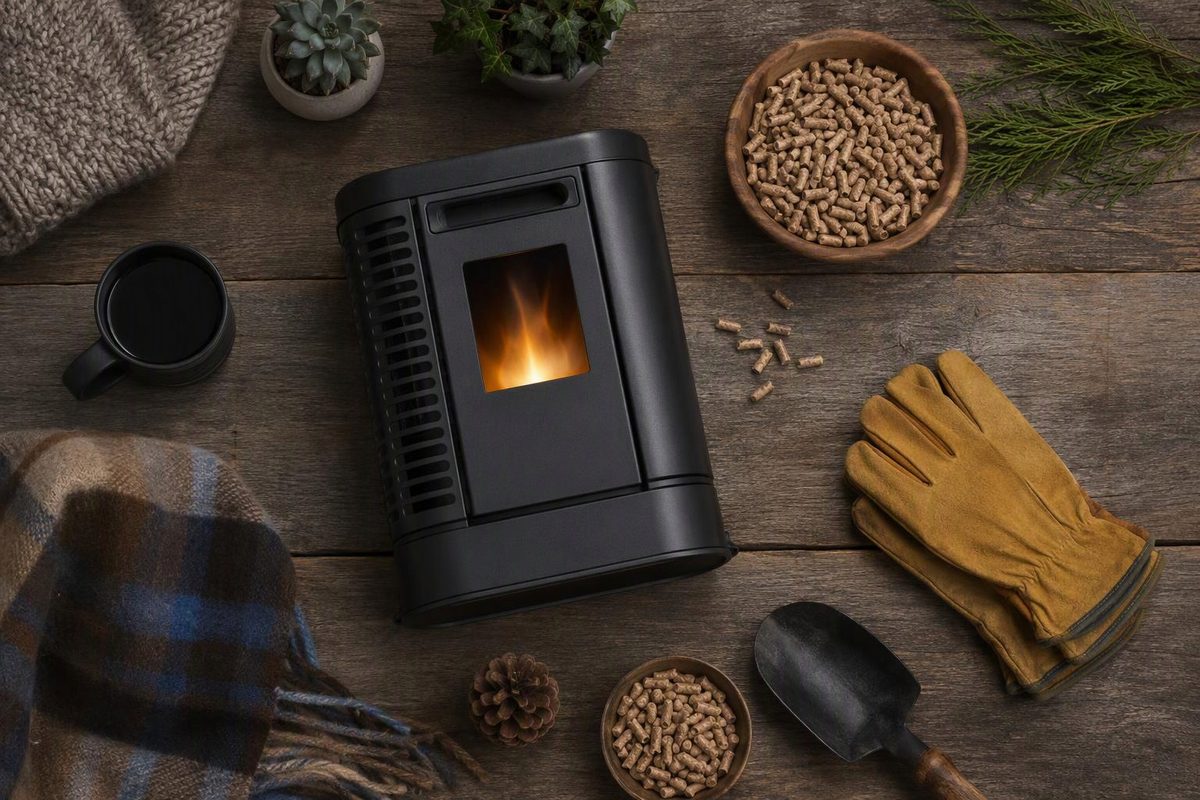
CAMPel9 is not yet a prudent choice for assured winter heat, a documented RV installation or operation while occupants sleep. It is a crowdfunded, pre-production pellet heater without an established ownership record, completed U.S. safety listing or published heat-output figure. Its self-generating concept may interest experienced early adopters, but the performance and safety statements remain maker claims until final documentation and independent compliance evidence are available.
Choose a hopper, burn rate and desired runtime to check the campaign’s fuel arithmetic.
CAMPel9 Hopper Runtime Calculator
The result uses the campaign’s listed hopper capacities and pellet-consumption range.
Calculated Result
~8.6 hoursmaximum hopper runtime at the selected rateA 10-hour run needs ~15.4 lb of pellets, which is ~2.2 lb more than this hopper holds.
Source: CAMPel9 campaign-listed capacities of 13.2 and 17.6 lb and consumption of 1.54–1.98 lb/hour. Results are arithmetic estimates, not tested runtime.
The Campaign Remains a Crowdfunding Risk
The Kickstarter campaign had raised $15,969 of its $30,000 all-or-nothing goal from 21 backers when checked on September 30, 2026. It is scheduled to close October 24, 2026, and lists estimated delivery in September 2027.
That delivery date is an estimate rather than a purchase guarantee. Kickstarter describes backing as support for a creative process, not a conventional store purchase, and says rewards are not guaranteed (Kickstarter Help Center).
CAMPel9 Uses Powered Feed and Forced Air
CAMPel9 burns wood pellets using an auger, exhaust fan and warm-air blower. The distinguishing feature of the self-generating version is a thermoelectric generator intended to turn combustion heat into enough electricity to operate the heater. The wired version uses a 12V adapter.
The maker announced the campaign for camping, RVs, camper vans and tiny homes in a September 22 company-issued press release. Those proposed uses are not installation approvals. The final manual, completed compliance documentation and rules for the particular tent, vehicle or building would still need to permit the installation.
The campaign lists these specifications:
| Item | Maker-Listed Specification |
|---|---|
| Dimensions | 16.7 × 9.2 × 19.1 inches |
| Self-generating weight | 38.6 lb |
| Wired-model weight | 35.3 lb |
| Standard hopper | 13.2 lb (6 kg) |
| Expanded hopper | 17.6 lb (8 kg) |
| Pellet consumption | 1.54–1.98 lb/hour |
| Electrical consumption | Approximately 8 watts |
| Claimed coverage | Approximately 213 ft² |
| Listed noise | Around 40 dB |
A full hopper changes the portability calculation. The self-generating unit would weigh about 52 pounds with 6 kg of pellets or 56 pounds with 8 kg, before adding its pipe, duct, carrying bag and other gear.
Hopper Runtime Works on Paper
Dividing the listed hopper capacities by the listed fuel-consumption range produces these theoretical runtimes:
- 6 kg hopper: about 6.7 to 8.6 hours
- 8 kg expanded hopper: about 8.9 to 11.4 hours
That arithmetic broadly supports the advertised seven-to-eight-hour standard runtime and up-to-11-hour expanded runtime. Actual runtime would depend on feed rate, pellet characteristics and operating conditions.
Ten hours at the listed consumption would require roughly 15 to 20 pounds of pellets. That is a substantial fuel load to transport and keep dry, especially when the heater, venting and other equipment must also be carried.
Published Coverage Cannot Replace Heat Output
The approximately 213-square-foot coverage claim is not enough to size the heater. The campaign does not pair that figure with published BTU-per-hour output, tested efficiency or defined outdoor-temperature and heat-loss assumptions.
A well-insulated camper and a drafty tent with the same floor area present very different heating loads. Until quantified output and test conditions are published, the coverage claim does not establish how CAMPel9 would perform in a particular space or climate.
Pledge Prices Depend on the Power System
The campaign’s reward page listed pledges for what it calls the “AC-powered” model at $620, $670 and $770, against a stated planned retail price of $1,000. Although the rewards use the AC-powered description, they include a 12V adapter and the heater itself is the wired 12V version.
Self-generating pledges were listed at $871 and $1,001, against a stated planned retail price of $1,300. All of these rewards listed September 2027 as the estimated delivery month.
The wired model is the more straightforward option where dependable external power is already available. The self-generating model is the novel option, but it places more importance on the thermoelectric module, onboard battery, controls and cold-start procedure.
Before pledging for that version, ask for a step-by-step account of startup, shutdown and operation following a battery or thermoelectric-system fault. For comparison, a gravity-fed non-electric pellet stove avoids powered feed and blower components, although it has its own limits involving heat control, venting and documented installation suitability.
Complete Safety Documentation Is Still Missing
The campaign makes unusually absolute statements, including “zero risk of backfire,” and uses language suggesting that users can sleep through the night. Those are promotional claims, not substitutes for test reports, a final manual or enforceable safe-use rules.
In its risks section, the creator says CE work is in progress and UL/ETL compliance is under review for the U.S. market. The campaign therefore does not present the complete heater as already carrying a completed U.S. safety listing.
Certification and transport documents for a low-voltage battery would not establish the combustion, venting, hot-surface or carbon-monoxide safety of the complete appliance.
This is particularly consequential because the product is promoted for tents, campers and vehicles. The U.S. Consumer Product Safety Commission says people die from carbon-monoxide poisoning after using portable camping heaters, lanterns or stoves in those spaces. It advises people not to use portable heaters while sleeping in enclosed tents, campers or vehicles (CPSC guidance).
A powered exhaust is not a reason to disregard that guidance or restrictions in the eventual manual.
Eight Points Need Answers Before Pledging
Ask the creator to publish or identify:
- The final manual, approved installation locations and prohibited uses.
- The completed appliance listing or compliance reports for the destination country, not only battery transport documents.
- Tested heat output at each setting, efficiency, carbon-monoxide results and particulate results.
- Required vent diameter, termination, clearances, combustion-air provisions and suitable wall or tent-jack components.
- Hot-surface temperatures and required separation from people, bedding and combustibles.
- Safe behavior after loss of electrical generation, a blocked vent, a failed exhaust fan or a depleted battery.
- Warranty terms, service arrangements and sources for model-specific replacement parts.
- Total delivered cost, including shipping, duties, taxes and installation components not included in the reward.
CAMPel9 Is Suitable Only for Risk-Tolerant Backers
CAMPel9 may appeal to an experienced early adopter who understands crowdfunding risk and wants to support development of low-power, forced-air pellet heat. Its fuel-capacity arithmetic is internally consistent, and an approximately 8-watt operating load would be notable if production units deliver it reliably.
A sensible threshold before relying on the heater would be publication of a production manual, completed compliance evidence relevant to the intended location, quantified heat and emissions testing, and a credible parts-and-warranty plan. Until those exist, the discounted pledge price is compensation for risk rather than proof of value.