
Heat Without the Grid—But Not Without Hands-On Work
Whether one fits depends on the building's heat loss, proposed vent, tolerance for manual operation and the exact model's current documentation.
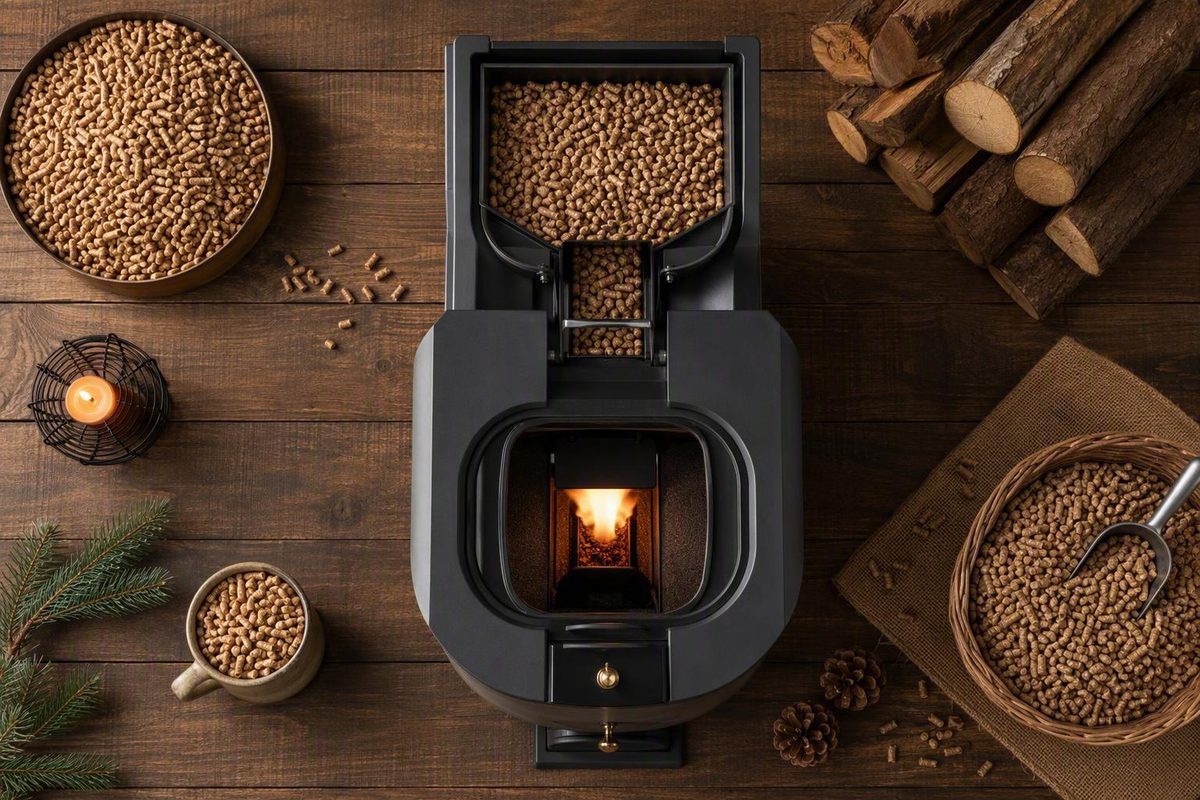
A non electric pellet stove is not a conventional pellet stove with its power cord removed. It is a different kind of solid-fuel heater: pellets move toward the burn area by gravity, combustion depends on natural chimney draft, and the operator assumes many of the tasks normally handled by motors, sensors, and electronic controls.
That distinction determines whether one belongs in your home or cabin. Electrical independence can be valuable during prolonged outages or at an off-grid property. But independence from the grid does not mean independence from a capable operator, a suitable chimney, dry fuel, regular cleaning, local approval, or replacement parts.
The practical buying question is therefore not simply, “Which stove heats the most square feet?” It is whether the building’s heat loss, the proposed vent system, the household’s tolerance for manual operation, and the exact model’s current documentation all align.
Updated August 11, 2026. This guide distinguishes manufacturer and seller claims from owner anecdotes. Product claims have not been independently tested here, and the available evidence does not include current exact-model manuals or official certification records. Verify those documents before purchase or installation.
What a non-electric pellet stove is—and what it is not
Non-electric pellet stoves do exist. The principal designs identified in the available U.S. market evidence are gravity-fed appliances. Instead of using an electric auger to meter pellets into a burn pot, they arrange the hopper and fuel path so pellets descend under their own weight. Natural chimney draft draws combustion air through the stove and carries exhaust out of the building.
The Alliance for Green Heat identifies WiseWay, the Independent Stove GAP 2020, and the Flame Innovation Mini Me among the gravity-fed or non-electric pellet stoves available or announced in the United States. That is a useful starting list, not proof that they are the only products or that every model remains available in every region. Model status, ownership, distribution, and certification can change, so verify the market at the time of purchase through the Alliance’s pellet-stove technology overview.
A conventional pellet stove normally uses several powered systems:
- An auger meters pellets from the hopper into the burn area.
- A combustion fan manages airflow through the fire.
- Electronic controls coordinate ignition, feed rate, and operating functions.
- A thermostat or temperature sensor adjusts output in response to room conditions.
- A room-air blower pushes heat away from the appliance.
A gravity-fed stove replaces that operating chain with a sloped hopper, a manually regulated fuel path, natural draft, and manual air controls. Heat reaches the room mainly through radiation from hot stove surfaces and natural convection as room air warms and rises. Some models use exposed tubing, baffles, or directional ports to increase heat transfer, but they do not necessarily have a powered room blower.
That produces a clear tradeoff.
What the buyer gains:
- Pellet feed and combustion that do not inherently depend on grid electricity
- No powered auger or conventional control board in the basic operating system
- Heating potential during an outage, provided the stove can be started and operated correctly
- A possible resilience option for cabins and properties where backup electricity is difficult to maintain
What the buyer gives up:
- Push-button or automatic ignition
- Thermostat-driven room-temperature control
- Automated correction for changing draft or fuel conditions
- Forced-air heat distribution
- Some of the low-attention convenience associated with a conventional pellet stove
A manual damper can make a fire burn more or less aggressively, but it is not a thermostat. It does not measure room temperature or automatically compensate for a warmer afternoon, colder night, changing wind, or open door.
This category therefore makes the most sense as a specialized resilience, off-grid, or manually operated heating option. A household that prioritizes precise temperature control and low operator involvement may be better served by a conventional pellet stove supported by a properly designed battery or generator system.
How gravity feed and natural draft sustain the fire
Exact operating procedures differ by model. Conceptually, however, a gravity-fed stove requires the operator to:
- Confirm that the exact-model manual is available and the appliance is ready for use.
- Load only fuel approved by the manufacturer.
- Prepare the burn area as the manual directs.
- Use the specified ignition or preheating method.
- Establish the required natural draft.
- Release pellets into the burn area.
- Adjust combustion air and, where applicable, pellet flow.
- Remain with the appliance while the fire stabilizes.
- Monitor and refuel it according to the instructions.
- Shut it down and clean it using the prescribed procedures.
This is an operating outline, not a substitute for a manual. Ignition equipment, control positions, draft requirements, shutdown procedures, and responses to abnormal operation must come from the current documentation for the exact model.
The GW1949 provides the clearest documented example. US Stove describes preheating the burn chamber and flue with a propane torch before opening the pellet flow. The same page describes gravity feed, natural draft, manually adjustable fresh-air controls or a damper, heat-transfer tubing and rear baffles, a 60-pound hopper, and standard 3-inch pellet venting with stated transition potential into a larger chimney system. These remain manufacturer specifications and instructions, not universal guidance for other stoves or installations, as shown in US Stove’s GW1949 product documentation.
Preheating matters in the documented GW1949 procedure because a cold flue may not yet provide the draft needed for its intended combustion path. Once the flue gases warm, their upward movement helps draw fresh air through the appliance. A conventional electric pellet stove can use a combustion fan to move air actively. A non-electric design must obtain the necessary airflow from its vent and chimney.
The chimney is therefore part of the combustion system, not merely a pipe that removes exhaust. Its diameter, vertical rise, horizontal sections, bends, termination, wind exposure, and relationship to the building may affect the fire.
These variables help explain why a mechanically simple stove may still require substantial operator learning. If draft changes, the fire can change with it. If ash restricts airflow or pellets stop moving consistently, combustion may become unstable. There is no electronic controller continuously adjusting an exhaust fan or feed motor to compensate.
Manual air controls regulate combustion indirectly. The operator observes the appliance and room conditions, changes the control setting, and waits for the stove’s thermal mass and fire to respond.
Heat distribution is similarly passive. Hot surfaces radiate energy toward nearby occupants and objects, while natural convection moves warmed air upward.
Do not respond to draft or control problems by copying unauthorized owner modifications, drilling components, changing prescribed clearances, or improvising a vent. Use only current exact-model instructions and approved components.
The daily operating reality during an outage
A correctly installed gravity-fed stove may continue producing heat without utility power because pellet movement and combustion airflow do not depend on a powered auger or blower. That is genuine outage capability.
It is not automatic emergency heat.
Someone still has to confirm that the stove is ready, ignite it, establish draft, adjust the fire, observe its behavior, replenish fuel, manage ash, and shut it down correctly. If the household is away when the power fails, a manually ignited stove does not start itself. If no one present can safely use the specified ignition method or recognize abnormal operation, removing electrical dependence does not solve the larger resilience problem.
A realistic operating cycle may include:
Before startup: Consult the manual, inspect the areas it identifies, and confirm that approved, dry pellets are available.
Startup: Use only the prescribed lighting method. For the GW1949, the manufacturer describes preheating the burn chamber and flue with a propane torch before releasing pellets.
Draft establishment: Remain with the appliance while the fire develops and follow the manual’s indicators for stable operation.
Initial adjustment: Set the manual air or damper control as directed. Expect the stove and chimney to respond gradually as they warm.
Routine operation: Observe the flame and the areas identified in the manual. Refuel and address ash only in the approved manner.
Changing conditions: Recognize that weather, ventilation, fuel, deposits, and building pressure may affect a natural-draft fire. Use the manual rather than improvisation when operation changes.
Shutdown: Stop fuel flow and follow the exact shutdown sequence. Cleaning and internal handling must wait until the instructions say the appliance is ready.
The absence of a thermostat matters most during changing weather and low-output operation. A setting that is comfortable during a cold evening may overheat the stove room after outdoor temperatures rise. Reducing the fire too far may produce unstable combustion or extinction. The appliance’s practical minimum output may also be too high for a small or well-insulated room.
Owner accounts illustrate the variability without establishing expected performance. Some GW1949 users have described satisfactory off-grid heating. Others have reported excessive heat at stronger settings, extinction at lower settings, ash-related interruptions, or difficulty regulating output. One owner reported approximately 28–30 hours from a hopper under that installation’s conditions. These are conflicting anecdotes, not performance guarantees, as the accounts in a Hearth.com discussion of non-electric pellet-stove ownership demonstrate.
Owner-reported appliance temperatures, consumption rates, room-temperature changes, and runtimes depend on the measurement point, vent, weather, building, pellets, control setting, cleaning condition, stove version, and operator technique.
The available evidence does not establish that any model is suitable for unattended or overnight operation. Hopper capacity and claimed runtime are not permission to leave a fire unobserved. The current manual, exact listing, local requirements, insurer, and qualified installer must determine acceptable operation.
GW1949, GAP 2020, and Mini Me: a verification-first comparison
The table below is not a ranking. It distinguishes published claims from unresolved questions and makes the evidence limitations explicit.
Price note: The supplied listings were reviewed for this article on August 11, 2026, but the evidence does not identify their original capture dates. The displayed amounts below are therefore historical reference points, not verified current quotes. Recheck price, stock, freight, promotions, and model status immediately before publication or purchase.
| Comparison point | WiseWay GW1949 | Independent Stove GAP 2020 | Flame Innovation Mini Me |
|---|---|---|---|
| Operating method | Manufacturer describes gravity feed, natural draft, and manual air adjustment | Seller describes gravity feed without electricity | Manufacturer describes gravity feed, natural convection, and manual damper control |
| Listed hopper capacity | 60 lb | 88 lb | 40 lb |
| Claimed output or coverage | Manufacturer claims up to 40,000 BTU and 2,000 sq. ft.; a retailer lists 48,000 BTU | Seller claims coverage above 2,000 sq. ft.; no BTU figure is supplied | Manufacturer claims 200–1,000 sq. ft. on one page and presents 200–800 sq. ft. on another |
| Listed vent information | Standard 3-inch pellet venting, with stated transition potential into a 4- or 6-inch chimney | Not established in the available evidence | Retailer associates the stove with 4-inch vent components; the complete required system is not established |
| Published dimensions | Conflicting listings: 18 × 54 × 32 inches with axes unclear, versus 24 W × 15 D × 52 H inches. Neither set should be used for hearth, doorway, clearance, or vent planning without the current manual. | Seller lists 32 W × 12 D × 38 H inches and a cooking surface reportedly 20 inches high | Retailer identifies it as a 19-inch model; complete dimensions are not established |
| Special features | Exposed heat-transfer tubing, rear baffles, and manual fresh-air control or damper | Seller lists a 32-inch-wide cooking surface | Manufacturer lists a removable fire pot, viewing window, directional air ports, and an unspecified “safety shutoff system” whose operation is not established by the available evidence |
| Displayed appliance price | $1,149.99 on the manufacturer page; $1,535.85 at another retailer | $2,859 sale price | $1,369.95 sale price |
| Certification or approval language | Manufacturer says EPA certified and UL listed; official exact-model records were not supplied | Seller labels it mobile-home approved; supporting documentation was not supplied | Manufacturer sources claim EPA certification, while a secondary overview reports additional listings; official exact-model records were not supplied |
| Evidence quality | Manufacturer specifications, one conflicting retailer listing, and several years of conflicting owner reports | Primarily one seller page with an inconsistent page title and missing technical documentation | Manufacturer marketing plus retailer accessory information; several critical specifications remain absent |
| Specification conflicts | Output, dimensions, and claimed runtime conflict among listings and owner reports | Page title and content are inconsistent; no BTU, efficiency, emissions, or runtime data are provided | Advertised coverage varies between 200–1,000 and 200–800 sq. ft. |
| Unresolved questions | Authoritative output and dimensions, minimum stable output, draft requirements, official listing records, current manual, and wear-part supply | Output range, efficiency, emissions, runtime, vent requirements, clearances, listing records, warranty, and service network | Output range, tested efficiency, complete dimensions, exact vent system, clearances, official listing records, minimum stable output, and meaning of the claimed safety feature |
| Evidence basis | Manufacturer and retailer listings; manufacturer claims remain unverified where official records are absent | Seller’s GAP 2020 listing; all specifications and approval language are unverified seller assertions | Manufacturer’s Mini Me overview; performance, safety, and certification language remains unverified |
WiseWay GW1949
The GW1949 has the deepest documentation of the three, but it also demonstrates why buyers should not use a single product listing as an installation plan. US Stove lists a 60-pound hopper, output “up to” 40,000 BTU, coverage “up to” 2,000 square feet, and a displayed price of $1,149.99. Its page mentions both 30 and 36 hours in different places. A separate retailer lists 48,000 BTU, different dimensions, and a displayed price of $1,535.85.
Because these figures conflict, neither 40,000 nor 48,000 BTU should be treated as the definitive current output. The listed dimensions are likewise unsuitable for ordering a hearth pad, checking doorway access, placing the appliance, or locating a vent penetration.
This is the logical model to investigate if you want the largest available body of owner discussion and a manufacturer-documented gravity-feed concept. The remaining work is substantial: obtain the current manual, reconcile specifications, verify official records, confirm parts availability, and have the proposed vent professionally evaluated.
Independent Stove GAP 2020
The GAP 2020 seller page lists an 88-pound hopper, dimensions of 32 inches wide by 12 inches deep by 38 inches tall, a 32-inch-wide cooking surface, claimed coverage above 2,000 square feet, and a displayed sale price of $2,859. It also labels the stove mobile-home approved.
These are seller assertions, not verified technical specifications. The listing’s title refers to a different product while the URL and page content describe the GAP 2020, which makes independent confirmation especially important. Unless the seller can provide exact-model documentation, the GAP 2020 should be treated as a lead for further investigation rather than a fully documented purchase option.
A large hopper and integrated cooking surface may appeal to some buyers. An unconditional recommendation would still require verified output, efficiency and emissions data, required draft, approved vent configuration, clearances, runtime, listing records, warranty terms, and service support.
Flame Innovation Mini Me
Flame Innovation states that the Mini Me has a 40-pound hopper and markets it for smaller spaces. One manufacturer page claims coverage of 200–1,000 square feet. Another presents a 200–800-square-foot application and says the stove is not recommended for a 1,400-square-foot cabin.
A retailer identifies it as a 19-inch non-electric stove, displays a price of $1,369.95, and offers associated 4-inch vent and chimney components. Accessory availability does not establish the approved vent system for a particular installation.
The Mini Me may merit investigation when a smaller physical format is the priority. Verified BTU output, minimum output, full dimensions, clearances, exact vent requirements, installation instructions, and official certification records should come before purchase. Buyers should also ask the manufacturer to explain the operation and limitations of its marketed “safety shutoff system.”
Across all three models, the displayed appliance price is not the installed price. Freight, lift-gate service, taxes, venting, building work, professional labor, permits, hearth protection, and service can materially change the total.
Size the building, not the marketing claim
“Up to 2,000 square feet” is not a heating design. It is a maximum manufacturer or seller claim that does not describe your climate, building envelope, floor plan, or desired indoor temperature.
A credible sizing process should account for:
- Local design outdoor temperature
- Desired indoor temperature
- Wall, ceiling, and floor insulation
- Air leakage and ventilation
- Window area, type, condition, and orientation
- Ceiling height and total heated volume
- Exposure to wind and sun
- Open versus divided floor plan
- Stove placement
- Heat movement between rooms and floors
- Whether the stove will provide primary, supplemental, or emergency heat
Two 1,000-square-foot buildings can have radically different heat requirements. A compact, air-sealed cabin with insulated floors and modern windows may need much less heat than a drafty older house with high ceilings, single-pane windows, and exposed foundation walls. Floor area alone does not capture those differences.
Distribution matters almost as much as total output.
Manufacturer qualifications reinforce the point. Flame Innovation promotes a broad small-space range for the Mini Me but specifically says it does not recommend that model for a 1,400-square-foot cabin in its gravity-fed versus electric pellet-stove comparison. Even the seller does not treat advertised coverage as universally transferable.
Owner anecdotes can identify variables, but they cannot size your building. In a 2013 account, one GW1949 owner described warming an office in an older Washington ranch during relatively mild outdoor conditions. The house had age-related insulation and largely single-pane windows, and the owner generally planned shorter morning and evening burns. That report illustrates useful localized heat in one setting, not whole-house or severe-cold performance, as the bounded circumstances in the owner’s Wiseway experience report make clear.
Before choosing a model:
- Obtain a room-by-room or whole-building heat-loss assessment.
- Decide whether the stove must carry the full design load or maintain one occupied zone during an outage.
- Obtain verified minimum and maximum output data for the exact model.
- Consider whether the lowest stable output could overheat the stove room during milder weather.
- Map how heat can reach the rooms that matter.
- Plan separate heat where passive distribution is unlikely to be sufficient.
Verified output information is missing or conflicting for some gravity-fed models. That absence is itself a buying signal. If a seller cannot supply the documentation needed to compare the stove with a professional heat-loss assessment, do not substitute an optimistic square-foot claim.
Venting, approvals, and installation checks before ordering
With a natural-draft stove, the vent is an active performance component. An existing wall opening that appears to be the right size does not establish compatibility.
US Stove specifies standard 3-inch pellet venting for the GW1949 and says it can transition into a 4-inch or 6-inch chimney. That statement does not determine where a transition belongs, how much vertical rise is required, how many bends are allowable, or whether an existing chimney is suitable.
One GW1949 owner reported using outside air, 3-inch pellet vent, two 45-degree elbows, and approximately 15 feet of total chimney height. That is an anecdotal description of one installation—not a design template. Altitude, building pressure, roofline, wind exposure, termination location, appliance revision, and local requirements may differ.
A retailer also offers 4-inch vent components and design assistance alongside the Mini Me. The accessory list includes pipe, elbows, supports, flashing, an adapter, a cap, and related components. It does not prove that every item is approved, required, or sufficient for a particular installation; it establishes only what the retailer associates with the Mini Me listing.
Before paying for a stove or accepting a freight quote, ask the manufacturer, installer, local authority, and insurer to verify:
- The current manual for the exact model and revision
- Approved fuel type and grade
- Required vent diameter and vent classification
- Required operating draft, if specified
- Permitted chimney configurations
- Limits on horizontal runs and bends
- Rules for transitions between vent or chimney sizes
- Approved termination type and location
- Whether outside combustion air is required or permitted
- Appliance, connector, and chimney clearances
- Floor and hearth-protection requirements
- Altitude limitations or adjustment guidance
- Inspection and cleaning access
- Exact-model abnormal-operation and shutdown instructions
- Current EPA certification status, where applicable
- Current safety-listing record and exact model number
- Permit and inspection requirements
- Installer qualifications
- Insurer acceptance
- Availability of qualified local service
Certification language deserves special care. A manufacturer, seller, or overview may call a stove EPA certified, UL listed, CSA approved, or mobile-home approved. Verify the current official record by exact model rather than assuming the marketing summary applies to the unit being shipped. Model suffixes, revisions, installation conditions, and jurisdictional requirements can matter.
The GAP 2020 seller’s mobile-home label is therefore an assertion to investigate, not an approval to rely on. Ask for the applicable listing documentation and installation manual, then confirm acceptance with the local authority and insurer.
Do not infer tiny-home, mobile-home, or RV approval from photographs or phrases such as “ideal for small spaces.” The appliance listing, permitted application, clearances, combustion-air provisions, vent termination, local rules, and insurance requirements must all align.
Confirm those points before arranging freight. A stove that cannot receive local approval, fit a documented vent system, or obtain insurance acceptance is not a bargain.
Fuel, cleaning, durability, and parts support
Removing an auger motor, circuit board, and powered blower eliminates several components found in conventional pellet stoves. It does not eliminate maintenance.
Pellets still produce ash and deposits. Material can accumulate in the burn area and alter airflow. Internal passages and venting need inspection. Handles, seals, dampers, baskets, chambers, and other components can wear, loosen, distort, or fail.
A model-specific care program may need to cover:
- Ash removal and disposal
- Cleaning of the burn pot, basket, or primary burn area
- Inspection of pellet pathways for obstruction
- Cleaning and inspection of internal heat passages
- Inspection of vent and chimney components
- Checks of doors, latches, handles, seals, and manual controls
- Examination of high-temperature components for deterioration
- Professional inspection and service where required
Flame Innovation recommends ash cleaning, component checks, and use of recommended fuel for the Mini Me. The available marketing material does not establish universal intervals, so frequency must come from the current manual and the observed behavior of the installed appliance.
GW1949 reports illustrate how sharply maintenance experiences can differ. A customer review displayed on the manufacturer’s page described fly-ash attention after roughly six to eight operating hours because buildup could slow or interrupt the burn. A separate forum owner reported cleaning after a week or more. Fuel, draft, control setting, vent design, stove version, and different meanings of “cleaning” may account for some of the variation. The forum account remains an individual experience, not a maintenance schedule.
Pellet characteristics are another variable. One forum owner reported poor results with hardwood pellets and better results with a particular softwood brand. That does not establish that softwood pellets are categorically better for gravity-fed stoves.
Ask the manufacturer or dealer for:
- The exact pellet specification
- Permitted pellet grades or compositions
- Any limits on pellet dimensions, fines, or moisture exposure
- Signs of fuel bridging or clinker formation
- Approved procedures for addressing an interrupted fuel path
Durability evidence is similarly mixed. Some GW1949 owners described effective off-grid heat. Reviews displayed by US Stove also included reports of burn-chamber or basket deterioration after one or two heating seasons, defective or missing handle components, back-ordered parts, and weak communication. These are conflicting customer anecdotes, not proof of typical service life, but they justify careful questions about support on the manufacturer’s GW1949 product and review page.
Use this parts-and-support checklist:
- What does the warranty cover, and for how long?
- Does labor coverage differ from parts coverage?
- Are the burn chamber and basket classified as wear parts?
- What do those parts cost?
- Are they stocked or made only after an order?
- What lead and shipping times should the buyer expect?
- Are seals, handles, dampers, glass, and fasteners sold separately?
- Can the manufacturer ship directly to the owner?
- Is there an authorized dealer or technician nearby?
- Will a local chimney professional service the model?
- What documentation is needed for a warranty claim?
- What support remains if the appliance is discontinued?
Mechanical simplicity is valuable only when the remaining components are supportable. A stove with no circuit board can still become unusable if a proprietary high-temperature component fails and no replacement is available.
Total cost and when another heating option fits better
The appliance price is the most visible cost and often the least complete one. Build a total-installed-cost worksheet before comparing alternatives.
| Cost category | What to price |
|---|---|
| Stove | Current appliance quote, included accessories, and taxes |
| Delivery | Freight, residential surcharge, lift-gate service, remote-area fees, and appointment charges |
| Handling | Moving the stove from curbside delivery to its final location |
| Venting | Approved connector, chimney, adapters, supports, flashing, cap, thimbles, and cleanouts |
| Combustion air | Outside-air components and approved termination, if required |
| Building work | Wall or roof penetration, framing changes, and weatherproofing |
| Hearth protection | Approved pad or site-built noncombustible assembly |
| Approval | Permit, plan review, and inspection fees |
| Labor | Installer, chimney specialist, and any required contractor |
| Fuel handling | Initial pellet supply, dry storage, pallets, bins, and scoops |
| Maintenance | Tools, professional inspection, and cleaning |
| Repairs | Basket, chamber, seals, handles, glass, dampers, and shipping |
| Resilience planning | Approved ignition supplies and a separate backup-heating contingency |
Captured appliance prices do not include all these costs. The GW1949 page describes pallet delivery by freight carrier and warns that shipping cost may change after address confirmation. The GAP 2020 seller assigns drop-shipping charges to the customer. Recheck both terms when requesting a written delivered-price quote.
A fair comparison considers complete systems, not stove prices alone.
Gravity-fed stove versus conventional pellet stove with backup power: The gravity-fed appliance avoids dependence on a powered fuel feed and combustion blower. A conventional pellet stove generally offers automatic ignition, thermostat control, and powered heat distribution when electricity is available. A correctly designed battery or generator may support it during some outages, but the backup system adds cost, maintenance, and runtime constraints. For more context on the everyday tradeoffs of an ordinary powered appliance, see this discussion of conventional pellet-stove pros and cons.
Gravity-fed pellet stove versus wood stove: Both can avoid grid power, but they are not interchangeable. Pellets are bagged fuel that must be stored dry and lifted into a hopper. Cordwood and compressed wood products involve different storage, loading patterns, combustion controls, and sourcing. Each appliance has its own installation and chimney requirements. Neither option should be assumed cheaper, cleaner, safer, or more efficient without model-specific data and local fuel costs.
Gravity-fed pellet stove versus propane or another non-electric heater: Compare local fuel availability, storage requirements, practical runtime, controllability, installation approval, maintenance, and the length of outage you want to cover. The better fit depends on the property and approved equipment, not on a universal fuel hierarchy.
A gravity-fed stove deserves investigation when:
- Prolonged outages are common
- Pellet fuel is consistently available
- Dry storage exists
- A compliant natural-draft vent appears feasible
- Household members accept manual ignition and adjustment
- Verified output aligns with the building’s heat loss
- Local officials and the insurer accept the proposed installation
- Wear parts and local service are obtainable
An alternative deserves stronger consideration when:
- Precise room-temperature control is a priority
- Automatic ignition is important
- The heater must operate with minimal attention
- A suitable chimney is impractical
- The building has a divided layout
- Minimum output may overheat the immediate room
- Pellet bags cannot be handled or stored conveniently
- Exact-model documentation cannot be verified
- Replacement components have uncertain availability
Before buying, complete this checklist:
- [ ] A heat-loss assessment supports the verified output range.
- [ ] The minimum output suits milder weather and the stove room.
- [ ] A qualified professional has confirmed chimney feasibility.
- [ ] The current exact-model manual is available.
- [ ] Draft, vent configuration, clearances, and hearth requirements are documented.
- [ ] Certification and safety-listing records have been verified by exact model.
- [ ] Permits and local approval are obtainable.
- [ ] The insurer has accepted the proposed appliance and installation.
- [ ] Every expected operator can manage manual ignition and adjustment.
- [ ] Dry pellet storage is available.
- [ ] Bag lifting, hopper height, and ash handling are manageable.
- [ ] Freight, installation, inspection, and service costs are included.
- [ ] Warranty terms are in writing.
- [ ] Burn chambers, baskets, seals, handles, and other parts are obtainable.
- [ ] A separate contingency exists if the stove cannot be started or operated.
Frequently asked questions
Can a pellet stove really run through a power outage?
A gravity-fed, natural-draft pellet stove can operate without grid electricity when it is correctly installed, fueled, started, and manually managed. Pellet movement does not depend on an electric auger, and combustion airflow does not depend on an electric exhaust fan.
That does not mean every pellet stove works during an outage. Conventional models generally require electricity for their feed, airflow, controls, ignition, or heat distribution and therefore need compatible backup power to continue operating.
A non-electric stove also does not start automatically when the power fails. Someone must use the approved ignition procedure, establish draft, adjust combustion, monitor the appliance, refill it, and maintain it.
Do non-electric pellet stoves have thermostats or automatic heat control?
The gravity-fed models discussed here use manual combustion controls rather than conventional thermostat-driven regulation. An air intake or damper can alter the burn rate, but it does not continuously measure room temperature and coordinate pellet feed and airflow.
Room temperatures may therefore fluctuate more, and the operator may need to make adjustments as outdoor conditions or heat demand change. Verify the exact model rather than assuming every non-electric design uses identical controls.
How long will a hopper of pellets last in a gravity-fed stove?
There is no universal runtime. Hopper size is only one variable; burn setting, draft, pellet characteristics, ash accumulation, weather, building demand, and operator technique also matter.
For the GW1949, the manufacturer page contains conflicting claims of up to 30 and up to 36 hours, while one forum owner reported approximately 28–30 hours under that owner’s conditions. The Mini Me manufacturer has claimed up to 16 hours, but the available evidence does not independently verify that figure. None of these maximums establishes safe unattended operation.
Ask for the current manual and documented consumption range, then learn the installed stove’s behavior under supervision rather than building an outage plan around a maximum marketing claim.
Does a non-electric pellet stove need a chimney?
It needs the vent or chimney system approved for the exact appliance. Natural draft moves combustion air and exhaust when there is no powered combustion fan, so vent design directly affects operation.
The correct diameter, vertical rise, bends, transitions, termination, clearances, and outside-air arrangement depend on the stove, building, and jurisdiction. The GW1949 manufacturer’s reference to standard 3-inch pellet venting and possible transition into a larger chimney does not define the correct layout for a particular property.
Have the proposed system checked against the current manual before ordering the appliance.
Can I install one in a mobile home, tiny home, or RV?
Not based on size or marketing language alone. A stove promoted for cabins or compact spaces is not automatically approved for a manufactured home, tiny house, or RV.
The GAP 2020 seller labels that model mobile-home approved, but buyers should obtain the applicable listing documentation and confirm that the local authority and insurer accept the exact model and proposed installation. Mini Me marketing mentions small or mobile spaces, but that does not establish RV approval.
Verify the appliance listing, permitted application, clearances, floor protection, combustion-air provisions, vent termination, local code treatment, permits, and insurance acceptance. If those points cannot be confirmed for the exact structure, do not proceed on the strength of a retailer description.
The buying decision
A non-electric pellet stove can be a credible option for prolonged outages or off-grid heating, but it is not an automated pellet stove with the cord removed. Gravity feed and natural draft shift responsibility from motors and electronics to the chimney, fuel, documentation, and operator.
Shortlist a model only after completing a heat-loss assessment, confirming a workable vent system, checking exact-model certification and local approval, pricing the full installation, and verifying replacement-part support.
If those checks align—and manual ignition, observation, and adjustment are acceptable—the category may provide useful grid-independent heat. If precise control and low-attention operation matter more, a conventional pellet stove with backup power or a different approved heating system may be the better fit.