
Look Past the Cast-Iron Finish Before Choosing a Pellet Stove
Verify which parts are cast, then compare EPA records, tested output, efficiency, emissions, power needs, venting, service, and installed price.
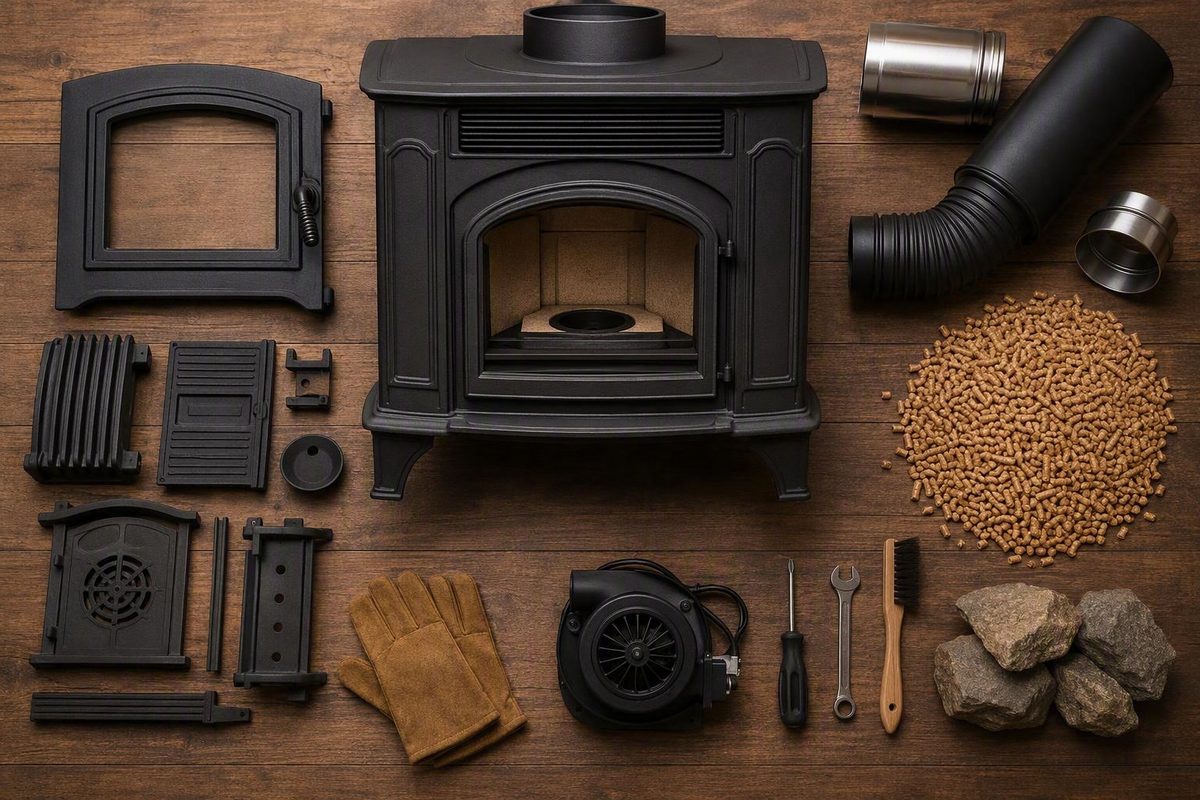
A cast iron pellet stove is not necessarily made entirely from cast iron, and the label does not establish better performance. Before buying, verify exactly what is cast, then compare the exact model’s EPA record, tested output and efficiency, emissions, electrical demand, installation manual, vent route, maintenance requirements, service support, and complete installed price.
What “cast iron pellet stove” actually tells you
The phrase describes how an appliance is marketed, not necessarily how every part is constructed. A product name, retailer category, or cast-stove collection is not a component-level materials specification.
Manufacturer pages and manuals identify appliances such as the Deerfield, Meridian Cast Iron, PelPro Cast Iron, and Cleveland Iron Works H130W as cast or cast-iron products. Those descriptions generally do not identify the material used in every structural and functional part.
Treat construction and appearance separately from performance. Cast panels may provide the shape and surface finish you want, but they do not establish:
- Usable heat output
- Tested efficiency
- Particulate-emissions rate
- Electrical demand
- Cleaning frequency
- Installation suitability
- Local parts and service availability
The available evidence does not prove that cast iron inherently improves pellet-stove efficiency, emissions, durability, safety, heat distribution, or fuel consumption. Those conclusions require model-level testing or construction documentation, not a material word in the product name.
Ask the manufacturer or dealer one direct question: Which parts are cast iron, and what materials are used for the firebox, heat exchanger, exterior panels, and door? Request a written answer or locate the information in an official technical sheet, parts diagram, or current manual.
How a pellet stove works—and why the material is not the whole story
Pellet stoves burn compressed biomass pellets loaded into a hopper and fed automatically into the appliance. Most pellet stoves require electricity, so they generally cannot be treated like conventional, non-electric wood stoves during an outage.
Before purchase, find the candidate model’s maximum electrical demand and its startup, normal-operation, and shutdown requirements. Decide whether losing the stove during an outage is acceptable or whether the household needs a manufacturer-approved backup-power plan. Do not assume a particular battery, inverter, uninterruptible power supply, or generator will be compatible without confirmation from both equipment manufacturers.
A practical shortlist should compare:
- Tested heat-output range
- Overall higher heating value, or HHV, efficiency
- Particulate-emissions rate and certified fuel
- Maximum and normal electrical demand
- Hopper capacity and approved pellet type
- Control range and thermostat behavior
- Required vent type, diameter, and route
- Access for cleaning and component replacement
- Local dealer, technician, and parts support
Be careful with square-foot heating claims. They are screening estimates, not guarantees. Use verified output figures to discuss the home’s actual heat load with an installer rather than choosing solely because an advertised coverage number resembles the home’s floor area.
Documented cast-iron models: a comparison without a ranking
The published figures below establish only what the identified pages or manuals report. They do not make the models directly comparable because test conditions, reporting methods, product generations, and certification status may differ.
| Model | Source of cast-iron designation | Published performance | Important unknowns |
|---|---|---|---|
| Lopi Deerfield | Manufacturer calls it a large-capacity cast-iron pellet stove | 10,652–37,391 BTU; efficiency and maximum demand not verified | Exact cast components, emissions, hopper capacity, dimensions, price, availability, current certification |
| Enviro Meridian Cast Iron | Dealer-hosted copy of the manufacturer’s owner’s manual identifies a freestanding pellet appliance | 12,000–45,000 BTU/hr tested heat delivery; 78% stated efficiency; 520 W maximum demand, under the document’s conditions. The efficiency basis is not established in the supplied material. | Current production and certification; complete construction details; comparability with verified HHV figures |
| PelPro Cast Iron, PPC90/TSC90 | Installation and owner’s manual covering those model identifiers | Complete output, efficiency, emissions, and electrical figures not available in the supplied material | Exact cast components and complete performance specifications |
| Cleveland Iron Works H130W | Manufacturer collection lists an H130W Cast Iron Pellet Stove | No comparison figures supplied | Construction, output, efficiency, emissions, electrical demand, dimensions, price, availability, certification |
The Deerfield page describes European-style castings but does not establish the material used in every part. Its output range should not be treated as evidence of efficiency, low emissions, or suitability for a particular house.
The Meridian document provides the most complete performance snapshot in this group, but its figures belong to that documented appliance and its stated test conditions. Do not transfer them to another Meridian generation or compare the stated 78% directly with an overall HHV figure unless the efficiency basis and test method are confirmed.
The PelPro manual establishes the appliance identity and supplies detailed installation instructions, but it does not support a complete performance comparison from the available material. The H130W collection listing is likewise a lead to further documentation rather than a finished specification sheet.
Retail listings for the Enviro M55 Cast Iron, Regency Hampton GC60 Cast, and Breckwell Classic Cast are also only leads. Verify each one through current manufacturer documentation, the appliance label, and EPA records. A retailer title alone cannot establish complete construction, certification, production status, or availability.
Verify certification and performance before accepting a dealer claim
Record the exact manufacturer and model number shown on the appliance documentation.
The EPA room-heater database provides searchable fields including manufacturer, model, emission rate, heat output, overall HHV efficiency, certified fuel, test method, and related models. Search by the exact manufacturer and model rather than relying on a generic results page. The 151 records displayed in the supplied search are not 151 cast-iron pellet stoves; the database does not classify that result set by cast construction.
Use a three-way check:
- Find the exact model in the EPA database.
- Compare the entry with the permanent certification label on the appliance.
- Match both to the current manufacturer manual, including suffixes and applicable serial-number ranges.
Covered stoves sold in the United States must carry a permanent EPA certification label, but a label or database entry must still match the exact appliance under consideration. An older manual’s statement that a stove met 2015 limits does not, by itself, establish current certification under the 2020 rule. EPA’s regulatory fact sheet explains the phased standards and permanent-label requirement for covered stoves. Review the EPA requirements before relying on a seller’s certification claim.
An EPA entry documents regulatory and tested-performance information. It does not establish the stove’s construction materials, current availability, suitability for the house, installation feasibility, or long-term reliability.
Run an installation-readiness check before requesting quotes
Complete this check for the exact model and proposed location:
- [ ] Stove position and heat-distribution plan
- [ ] Approved pellet-vent type
- [ ] Required vent diameter
- [ ] Total horizontal and vertical vent run
- [ ] Number and type of elbows
- [ ] Required vertical rise
- [ ] Hearth-pad material and dimensions
- [ ] Clearances to walls, furniture, and other combustibles
- [ ] Outside-combustion-air provisions
- [ ] Suitable electrical outlet and circuit arrangement
- [ ] Access to the ash pan, exhaust path, and service panels
- [ ] Building or fire permit requirements
- [ ] Insurance requirements
- [ ] Final inspection by the authority having jurisdiction
- [ ] Mobile-home listing and special provisions, if applicable
- [ ] Bedroom or sleeping-room restrictions
The selected stove’s manual, the vent manufacturer’s instructions, local code, and the authority having jurisdiction control the installation. Never copy venting rules, hearth dimensions, or clearances from another model.
As a bounded example, the PelPro PPC90/TSC90 manual requires approved 3- or 4-inch Type L or PL pellet vent and specifies 4-inch vent when the flue height exceeds 15 feet or the installation elevation exceeds 3,000 feet. Its U.S. hearth illustration calls for protection extending 2 inches at each side, 2 inches at the back, and 6 inches at the front. The manual also strongly recommends professional installation and prohibits placing the stove in a sleeping room. These are PelPro-specific requirements, not a universal pellet-stove template.
Hiring an installer does not replace required permits or inspections. Outside-air and mobile-home provisions also vary by appliance and setting. Confirm that the exact stove is listed for the proposed use before ordering it.
Use this final buyer decision table
| Outcome | Use it when | Next action |
|---|---|---|
| Proceed to quotes | Construction details, current EPA record, current manual, output range, electrical requirements, vent plan, clearances, local service, and written pricing are available | Obtain comparable itemized quotes and confirm permits |
| Keep researching | The appliance is merely listed as cast iron, key specifications are missing, or current production and certification remain unconfirmed | Request manufacturer documents, label photos, an exact EPA match, and service details |
| Reject the candidate | Installation conflicts with the manual, clearances cannot be met, approved venting is impractical, local parts or service cannot be identified, or there is no acceptable outage plan | Choose another model or heating approach |
Require each quote to itemize:
- Stove and required controls
- Vent components and termination
- Hearth work
- Installation labor
- Permits and inspection fees
- Electrical work
- Delivery and placement
- Startup and owner orientation
- Annual service
- Warranty coverage and exclusions
- Availability of common replacement parts
Ask what pellet type is approved, where a dry supply will be stored, how ash is removed, how the exhaust path is accessed, how much blower and feed-system noise to expect, and what happens during a power failure. A showroom flame does not answer those ownership questions.
Cleaning intervals must come from the selected model’s manual. The Meridian documentation, for example, recommends inspecting and cleaning its exhaust semi-annually or after every two tons of pellets, and it prohibits installation of that model in a bedroom. Those are model-specific instructions, not a universal schedule or room rule. Check the Meridian manual against the exact appliance and label.
A cast-iron finish may suit the room, but it cannot substitute for verified performance or an installable design. Shortlist only models whose construction, current EPA record, manual, electrical needs, vent plan, service support, and complete quote can be checked. If a field is missing, leave it marked unknown rather than turning seller language into evidence.