
How to Keep Your Pellet Stove Running When the Grid Goes Down
A stove averaging 100 W may still need 500 W or more during ignition. Size output and usable AC watt-hours separately, then verify waveform and transfer behavior.
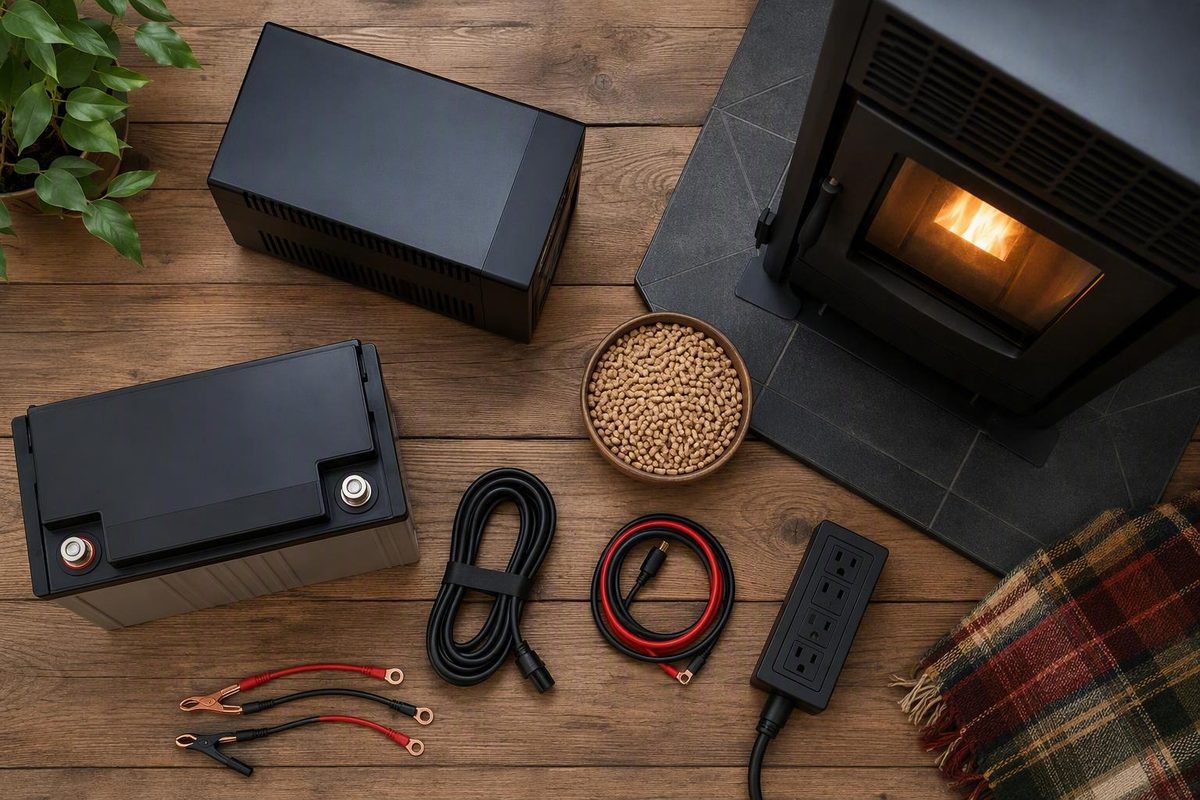
A pellet stove battery backup system should be selected for a specific stove and a clearly defined outage plan. A “UPS” label, a large volt-amp rating, or an advertised runtime does not prove that a system can ignite your stove, keep its controller stable, or provide heat overnight.
Start with two separate questions:
- Can the backup supply the stove’s highest required electrical load?
- Does it provide enough usable energy for the desired operating time?
Then verify voltage, frequency, waveform, grounding requirements, transfer behavior, battery compatibility, charging, and manufacturer approval. A system can appear adequate in watts and watt-hours yet still cause the stove to reset, fault, or shut down.
The practical approach is model-first: define the job, document the stove’s electrical behavior, calculate the energy requirement with transparent assumptions, verify compatibility, and test the complete arrangement before heating season. Manufacturer documentation should control; vendor guides and forum reports are useful only as secondary planning evidence.
Start With the Job: Shutdown, Short Bridge, Overnight Heat, or Longer Resilience
A pellet stove burns fuel, but its normal operation depends on electricity. Electrical components may include the igniter, pellet-feed auger, combustion and convection blowers, thermostat, sensors, exhaust fan, and electronic controls. Pellet Finder’s author reports that the auger, igniter, and blowers on his own stove stop during an outage unless backup power is available, illustrating this dependence through 12 winters of personal pellet-stove use.
When utility power fails, the auger and fans generally stop. Pellets already in the burn pot may continue burning or smoldering. What follows depends on the stove, combustion state, venting, installation, and available natural draft.
“Keep my pellet stove safe during an outage” is therefore not a complete buying objective. Decide which of the following four jobs the backup must perform before comparing products.
1. Controlled shutdown
The smallest job is providing enough power for the stove to complete its normal shutdown sequence. This may require keeping the controller and combustion or exhaust fan operating while the remaining fuel burns down.
A shutdown-oriented UPS is not intended to heat the house for hours. Its purpose is to avoid an abrupt loss of electrical support and give the stove time to stop as designed. Confirm that the stove supports this use and determine the maximum expected shutdown duration and load.
2. Brief automatic bridge
A bridge carries the stove through momentary interruptions or provides time to start another compatible power source. It may keep the stove operating during a short outage or support an orderly shutdown if utility power does not return.
Automatic transfer can matter when the stove is burning and nobody is standing beside it. It can also bridge the delay while another source is made ready. However, “automatic” or “fast” transfer does not establish that every stove controller will continue without resetting. The backup’s documented transfer interruption must be considered alongside the stove’s tolerance.
3. Several hours or overnight heat
Continued heating requires much more stored energy than controlled shutdown. The system must support the average operating load for the target period and still accommodate ignition if the stove starts or relights while running on backup.
An eight-hour objective is not simply a request for a larger UPS. It is an energy-storage project with separate requirements for output, runtime, transfer behavior, and model-specific compatibility.
4. Multi-day resilience
For outages lasting a day or more, battery capacity can become large and slow to recharge. A generator or battery-generator hybrid may be more practical when the household also needs refrigeration, pumps, lighting, or communications.
A hybrid concept uses a compatible battery or UPS for immediate bridging and another source for the longer outage. Implementation must follow the stove and power-equipment manuals. Fixed wiring, source interconnection, transfer equipment, and other work beyond approved plug-and-play arrangements should be evaluated by an appropriately qualified professional. This guide does not provide generator connection or installation instructions.
Before shopping, document:
- Your usual outage duration
- A realistic worst-case outage duration
- Whether outages occur while nobody is home
- Whether the stove must keep heating or only shut down correctly
- Whether the stove is the only required backup load
- Whether the backup must support ignition or relighting
- Whether unattended operation is permitted by both manufacturers
- Whether another power source is available
- How quickly the battery must recharge before another outage
The concise decision is:
- Controlled shutdown or brief bridging: consider a compatible UPS-style system.
- Hours of continued heat: choose substantially more usable battery capacity while preserving enough output for ignition.
- Long or multi-load outages: consider generator support or a properly designed hybrid, subject to model compatibility and the applicable equipment instructions.
Measure the Stove Before Shopping
Generic pellet-stove wattage ranges can help with preliminary budgeting, but they should not determine the final purchase. Begin with the manual for the exact manufacturer, model, and controller revision. If the documentation is unclear, ask the manufacturer or an authorized dealer for written guidance.
Build a worksheet before reviewing backup products:
| Stove information | Value |
|---|---|
| Manufacturer | |
| Exact model and revision | |
| Rated input voltage | |
| Rated frequency | |
| Ignition watts or amps | |
| Highest sustained operating watts | |
| Average watts at low heat | |
| Average watts at normal heat | |
| Average watts at high heat | |
| Shutdown load and duration | |
| Required or accepted waveform | |
| Transfer-time guidance | |
| Grounding requirements | |
| Behavior after a brief interruption | |
| Behavior after low-voltage shutdown | |
| Automatic-restart behavior | |
| Expressly approved backup systems |
Commercial guides commonly estimate approximately 300–500 watts during ignition and 60–150 watts during steady operation, while emphasizing that demand varies by model and heat setting. These are planning ranges, not specifications for every stove; exact documentation and permitted measurements should control. Anker presents both ranges in its vendor-authored pellet-stove outage guide.
Ignition is often the highest-demand period because the electric igniter operates alongside other components. A backup may support an already-burning stove yet overload when the controller calls for ignition. A runtime calculation based on a 100-watt average load therefore does not justify buying a 100-watt inverter.
Where the stove instructions permit it, use an appropriate plug-in energy meter to observe:
- Startup from a cold stove
- Steady operation at several heat settings
- Cycling or modulation that changes the average load
- The normal shutdown sequence
- Total energy consumed over a representative period
Measure long enough to capture changing auger and fan behavior. A single display reading is less useful than an average over a realistic operating cycle.
If the manual lists a higher demand than the meter displays, do not assume the lower number is safe. Ask the manufacturer which value should govern and whether additional output headroom is required.
Model variation can be substantial. In one forum discussion, an Englander 25-PDVC owner quoted manufacturer figures of 668 watts during ignition and 368 watts during continuous operation. These are user-supplied, model-specific figures rather than universal specifications, but they illustrate the risk of sizing from a generic range alone. The figures appear in a pellet-stove power discussion.
Repeated ignition can also change the energy budget. A stove that cycles through several ignition periods may consume more energy than one that operates steadily. Do not bypass thermostat controls, manually light the stove, or alter normal operation merely to avoid igniter use unless the stove manufacturer expressly permits that procedure.
Understand Watts, VA, Watt-Hours, and Amp-Hours
Backup listings often place unlike measurements beside one another. Understanding the units prevents an output rating from being mistaken for battery capacity.
Continuous watts: Can it carry the sustained load?
This rating must cover the stove’s highest required sustained load under the conditions in which the system will operate.
Do not compare the backup only with the lowest observed reading. Account for higher heat settings, fans, and any other documented sustained condition.
Surge or peak watts: Can it handle short high demand?
It may be relevant during ignition or another documented high-demand event.
A high rating available only momentarily may not support an igniter operating for several minutes. Ask for both the output magnitude and the duration for which it can be supplied.
Volt-amps: Not the same as usable watts
A 1,500 VA UPS is not automatically a 1,500-watt system. The product documentation should separately state usable watts. Neither VA nor output watts reveals how much energy the battery stores, so a VA rating alone cannot establish whether the stove will run for minutes or hours.
Watt-hours: The runtime unit
Watt-hours measure energy. A 100-watt average load operating for eight hours consumes:
100 W × 8 h = 800 Wh
That is the ideal load energy before accounting for reserve, conversion losses, temperature effects, or other adjustments.
A baseline battery conversion is:
Nominal watt-hours = nominal battery volts × amp-hours
A nominal 12-volt, 100-amp-hour battery therefore represents:
12 V × 100 Ah = 1,200 Wh nominal
This does not mean the stove will receive 1,200 Wh through the AC outlet. Delivered energy depends on permitted depth of discharge, reserve settings, inverter losses, standby consumption, battery condition, temperature, protective cutoffs, and the conditions under which capacity was rated.
Amp-hours: Incomplete without voltage
“100 Ah” is not an energy specification by itself. A 12-volt 100 Ah battery and a 24-volt 100 Ah battery bank do not contain the same nominal watt-hours.
When evaluating a complete backup, prefer a documented figure for usable AC energy: the energy the system can deliver through its AC inverter under stated conditions. Keep that separate from:
- Nominal battery capacity
- Usable battery-side capacity
- Usable energy delivered at the AC outlet
Advertised capacity versus delivered energy
The largest number printed on a battery or power station may represent nominal stored energy. The stove may receive less because of:
- Battery reserve settings
- Depth-of-discharge restrictions
- Inverter conversion losses
- Inverter standby consumption
- Wiring and connection losses
- Low-temperature performance
- Battery aging
- Protective low-voltage shutdown
- Battery-management-system limits
That is why these headline descriptions cannot be compared directly:
- A 550-watt external-battery inverter mainly describes output; runtime depends on the separate battery.
- A 1,024 Wh integrated power station mainly describes stored energy; output, usable AC energy, waveform, and transfer behavior still require verification.
- A VA-rated computer UPS mainly advertises apparent-power capability; usable watts, battery energy, waveform, and runtime are separate specifications.
Three-part buying check
- Output watts answer: Can the system carry the load?
- Usable AC watt-hours help answer: Approximately how long can it carry the load?
- Waveform and transfer behavior help answer: Will the stove accept the power and continue operating as intended?
Calculate Battery Capacity and Realistic Runtime
Begin with the measured average power at the heat setting you expect to use:
Ideal load energy = average running watts × target hours
For preliminary planning, this guide uses:
Preliminary planning target = average running watts × target hours × 1.20
The 1.20 multiplier is only a coarse buffer. Anker’s commercial guide recommends adding 15%–25% for factors such as conversion losses, battery aging, cold conditions, and possible relighting, but this is vendor guidance rather than a universal engineering standard. It should not replace product-specific calculations.
Adding 20% is also not mathematically identical to compensating for a known 20% loss. If documented system efficiency is 80%, for example, the load energy would be divided by 0.80 before applying any separate reserve or temperature derating:
Required source energy = load energy ÷ documented efficiency
When adequate product data are available, calculate conversion efficiency, permitted depth of discharge, reserve, and temperature effects separately. Use the simple 1.20 multiplier only for early comparison when those details are unavailable.
Example at a 100-watt average load
| Target runtime | Ideal load energy | Preliminary target with 20% buffer | Rounded shopping target |
|---|---|---|---|
| 4 hours | 400 Wh | 480 Wh | About 500 Wh |
| 8 hours | 800 Wh | 960 Wh | About 1,000 Wh |
| 12 hours | 1,200 Wh | 1,440 Wh | About 1,500 Wh |
| 24 hours | 2,400 Wh | 2,880 Wh | About 3,000 Wh |
The rounded column is preliminary shopping guidance, not a runtime guarantee. It avoids implying more precision than the assumptions support.
EcoFlow’s commercial guide presents the same baseline arithmetic for a 100-watt load: 800 Wh for eight hours and 2.4 kWh for 24 hours, before real-world adjustments. It also directs owners to check the exact stove’s requirements in its pellet-stove backup overview.
Example at a 150-watt average load
For eight hours:
150 W × 8 h = 1,200 Wh
Using the coarse preliminary buffer:
1,200 Wh × 1.20 = 1,440 Wh
A buyer might round that to approximately 1,500 Wh as an initial target. Before buying, determine whether the listed capacity is nominal battery energy, usable battery energy, or documented usable AC energy.
Keep output sizing separate from runtime sizing
These examples size stored energy. They do not size the inverter.
A stove averaging 100 watts may still require 500 watts or more during ignition. The backup’s continuous and time-limited peak output must satisfy the documented demand. A large battery connected to an undersized inverter does not solve an output problem.
What shortens runtime?
Actual runtime can be reduced by:
- Higher firing levels
- Multiple ignition or relighting cycles
- Additional connected loads
- Inverter standby consumption
- Battery or inverter thermal-management loads
- Cold battery temperatures
- Battery aging
- Conservative low-battery cutoffs
- Battery-management-system protection events
- High discharge rates
- Lower-than-assumed conversion efficiency
An “up to eight hours” claim is not meaningful without the stove model, operating level, battery capacity, usable depth of discharge, temperature, battery condition, losses, and test method. Treat it as a scenario-dependent ceiling, not a household guarantee.
Runtime worksheet
| Input | Your value |
|---|---|
| Measured average running watts | ____ W |
| Target runtime | ____ hours |
| Ideal energy: watts × hours | ____ Wh |
| Preliminary planning allowance | ____% |
| Preliminary planning target | ____ Wh |
| Documented ignition demand | ____ W |
| Backup continuous output | ____ W |
| Backup peak output and duration | _ W for _ |
| Advertised nominal capacity | ____ Wh |
| Documented usable battery capacity | ____ Wh |
| Documented usable AC energy | ____ Wh |
| Expected operating temperature | ____ |
| Recharge time from expected source | ____ hours |
Keep both the unrounded calculation and the rounded shopping target. Update them if measurements or product documentation change.
Verify Compatibility Beyond the Wattage
A correctly sized battery can still be incompatible with a pellet stove. Evaluate the stove and backup as a complete electrical system.
Compatibility checklist
- [ ] Correct AC voltage
- [ ] Correct frequency
- [ ] Adequate continuous output
- [ ] Adequate peak output and duration
- [ ] Accepted waveform
- [ ] Grounding arrangement consistent with both manuals
- [ ] Transfer behavior within the stove’s documented tolerance
- [ ] Ignition and relighting supported
- [ ] Defined behavior at low-battery shutdown
- [ ] Supported battery voltage and chemistry
- [ ] Correct charger profile
- [ ] Adequate battery-management-system limits
- [ ] Manufacturer-approved cables and expansion equipment
- [ ] Stove-manufacturer or dealer approval where required
- [ ] Backup-equipment approval for the intended appliance load
Waveform: verify rather than generalize
Commercial guides commonly recommend pure-sine-wave output for pellet stoves with electronic controls and motors. The available evidence does not establish that every pellet stove requires it.
A modified-sine-wave system should not automatically be accepted because it is marketed for pellet stoves, nor automatically rejected without checking the exact stove documentation. Model-specific requirements should decide.
The SEC America SF512 illustrates the issue. Its manufacturer lists 550-watt capacity, a five-amp continuous appliance limit, modified-sine-wave output, and a requirement for a separately purchased deep-cycle marine battery. Those specifications show why the product category alone cannot establish compatibility; they must be compared with the stove’s requirements. See the manufacturer’s SF512 specifications.
Transfer time and controller behavior
Automatic transfer is useful when the stove is burning or the owner is absent. But a vendor’s claim of rapid or uninterrupted transfer does not establish that a particular controller will avoid a reset, fault, or shutdown.
Ask:
- What transfer interruption does the backup document?
- Does the stove manual state a maximum tolerated interruption?
- Does the controller reset or enter shutdown during a permitted test?
- Can the stove ignite while operating from backup?
- Can it relight after transfer?
- Is unattended restart permitted by both manufacturers?
- What happens when the battery reaches low-voltage shutdown?
The last question matters because battery power may end while pellets remain in the burn pot. A long-runtime system still needs documented end-of-runtime behavior.
Manufacturer-specific approvals stay specific
Forge & Flame reports that several Tripp Lite systems were tested and approved for certain Harman pellet stoves and inserts. It also says dealer setting changes are required for two named inverter/charger systems. These claims apply only to the identified Harman applications and should not be extended to another brand, model, controller revision, or later product version. The reported approvals appear in the retailer’s Harman-focused outage guidance.
When an approval exists, record:
- Stove model
- Serial-number or control-board range
- Backup model
- Required settings
- Who confirmed the match
- Date of confirmation
“Approved for pellet stoves” is less useful than a documented model-to-model match.
Battery chemistry is a system decision
Do not assume an AGM-to-LiFePO4 replacement is a drop-in upgrade. Validate:
- Charger voltage and charging stages
- Battery-management-system charge and discharge limits
- Inverter input-voltage range
- Low- and high-voltage cutoffs
- Required protective equipment
- Manufacturer-approved cables and connectors
- Low-temperature charging restrictions
- Battery location and environmental limits
- Monitoring and state-of-charge behavior
One unresolved forum case reported overvoltage alarms after an AGM bank was replaced with a lithium battery while other system components were retained. Participants proposed several possible explanations, but the root cause was not conclusively established. The lithium-conversion discussion is not proof of a particular failure mechanism; it illustrates why the battery, charger, BMS, inverter, transfer equipment, and protection must be evaluated together.
Compare the Main Backup-System Designs
Compare complete systems by service level, output, stored energy, waveform, transfer behavior, charging, expansion, noise, exhaust, maintenance, and ability to power other loads. Price alone cannot establish whether a system will perform the required job.
Computer UPS
A computer UPS may suit brief interruptions or controlled shutdown if its output and transfer behavior are compatible with the stove. Larger systems differ materially from small desktop units, so the category has no universal runtime.
Check:
- Output watts, not VA alone
- Waveform
- Internal usable battery capacity
- Runtime at the measured stove load
- Transfer specification
- Support for the documented igniter and motor loads
- Whether external battery expansion is manufacturer-approved
- Recharge time after deep discharge
Do not modify a UPS for external batteries unless the manufacturer expressly supports the configuration. Unauthorized changes can affect charging, thermal protection, wiring, runtime calibration, and warranty coverage.
Dedicated pellet-stove backup
This is commonly an inverter, charger, and automatic-transfer arrangement intended for heating appliances. Some systems use a separate battery, allowing capacity to be selected or replaced independently.
Confirm what the package includes. “Battery backup system” may refer only to the electronics. The battery, expansion cables, enclosure, protection equipment, or installation may be separate.
A dedicated label does not override the stove’s waveform, grounding, output, or approval requirements.
Portable power station
A portable power station combines a battery, inverter, charger, controls, and outlets in one enclosure. It is exhaust-free at the point of use and may offer quiet battery operation when installed and used according to its instructions.
Transfer behavior is often the unresolved issue. Some units provide an EPS or UPS-like mode; others require manual reconnection or behave differently depending on load and charging state. Verify:
- Whether continuous connection is supported
- The documented transfer interruption
- Whether the stove remains stable
- Usable AC energy
- Recharge time
- Expansion options
- Operating-temperature limits
- Whether expansion batteries alter output or transfer behavior
Custom external-battery inverter system
A custom system can provide flexible capacity, replaceable components, and substantial output. It also creates more design responsibility.
The battery, charger, BMS, inverter, transfer equipment, cables, connectors, enclosure, and protection must be treated as one system. This article does not provide wiring, cable-sizing, fusing, grounding, or battery-bank instructions. Work beyond manufacturer-approved plug-and-play directions should be handled using the applicable equipment documentation and appropriate professional expertise.
Generator
A generator may be practical for longer outages and multiple loads because operation can continue while its required operating resources remain available. It may also recharge a compatible battery system.
Sufficient wattage does not prove that the power is acceptable to a specific stove. Confirm compatibility with the stove manufacturer and follow the current generator manual.
The evidence available for this article does not include an authoritative generator-safety source or a complete installation standard. Accordingly, this guide does not provide placement, fuel-handling, grounding, connection, or operating instructions. Obtain current guidance directly from the generator manufacturer and the relevant public-safety and electrical authorities before use.
Hybrid battery and generator
A hybrid concept uses a compatible battery or UPS for immediate transfer, followed by a generator for extended operation or recharging. It can combine automatic bridging with longer runtime.
Safe implementation is not necessarily simple. Source interaction, transfer equipment, charging, and fixed electrical connections are outside this guide’s scope. Use current equipment instructions and appropriately qualified assistance.
Buyer comparison worksheet
Populate this table with current documentation for the exact models under consideration:
| Criterion | Computer UPS | Dedicated stove backup | Portable power station | Custom inverter system | Generator or hybrid |
|---|---|---|---|---|---|
| Intended service level | |||||
| Continuous watts | |||||
| Peak watts and duration | |||||
| Usable AC watt-hours | |||||
| Waveform | |||||
| Transfer time | |||||
| Battery included? | |||||
| Battery chemistry | |||||
| Recharge time | |||||
| Expansion supported? | |||||
| Noise or exhaust considerations | |||||
| Maintenance | |||||
| Other loads supported? | |||||
| Inverter warranty, verified date | |||||
| Battery warranty, verified date | |||||
| Stove-manufacturer approval |
The category-level decision tree is straightforward:
- Choose shutdown protection for brief interruptions when continued heat is unnecessary.
- Choose larger battery storage for quiet, automatic, hours-long operation.
- Consider generator support for long outages or multiple household loads.
- Consider a hybrid when immediate bridging and extended runtime are both priorities.
Implementation remains model-specific.
How to Evaluate Product Listings Without Falling for Runtime Claims
There is no defensible universal “best pellet stove battery backup system” in the available evidence. Most product information is vendor-authored, several listings omit critical technical details, and independent comparative testing is absent.
Instead of accepting rankings, audit each listing.
Example: reading an external-battery backup listing
SEC America’s SF512 page lists:
- 550-watt capacity
- A five-amp continuous appliance limit
- Modified-sine-wave output
- Automatic transfer to battery
- Automatic return to utility power and battery recharging
- Included battery cables
- A separately purchased deep-cycle marine battery
The listing does not state runtime, which is understandable because the battery is separate. Estimating runtime would also require the battery voltage, amp-hour rating, usable depth of discharge, age, condition, temperature, inverter losses, and measured stove load.
This demonstrates why output and runtime cannot be inferred from one another. A 550-watt inverter rating describes output capability; runtime depends on the selected battery and actual load.
Any warranty, price, stock, or shipping information should be freshly verified and date-stamped before publication or purchase rather than treated as evergreen.
Example: a retailer collection with insufficient specifications
One retailer collection lists APC Back-UPS products but, in the supplied category text, omits the output watts, waveform, stored energy, runtime, transfer behavior, and model-specific compatibility limits needed for a purchase decision. Product names and prices are not substitutes for an electrical data sheet. The omissions are visible on the retailer’s pellet-stove backup collection page.
If critical values are absent, request the current manual and specification sheet. Do not fill the gaps with data from a similarly named product.
Example: same category, different intended job
Forge & Flame identifies the Tripp Lite APS700HF and APS750 at 700 watts and 750 watts, respectively, and says both require 12-volt deep-cycle batteries. It also repeats an “up to eight hours” claim without providing all the battery, stove, operating-level, condition, and test assumptions required to reproduce that runtime.
The same source presents a 750 VA, 450-watt standby UPS for shutdown support rather than continued heating. The distinction is useful: VA, watts, battery capacity, and intended service level describe different parts of the buying decision. These figures and intended uses are reported in Forge & Flame’s cited Harman guidance above and should be reverified against current first-party documentation before purchase.
Questions to ask before buying
- Is the battery included?
- Is the stated capacity nominal or usable?
- What usable AC energy is documented?
- Can the inverter carry the stove’s ignition demand?
- What is the continuous output?
- What is the peak output, and for how long?
- What waveform does the unit produce?
- What voltage and frequency does it maintain?
- What transfer interruption is documented?
- Has the exact stove manufacturer confirmed compatibility?
- Can the stove ignite or relight on backup?
- Is unattended operation permitted by both manufacturers?
- What happens at low-battery shutdown?
- How long does a full recharge take?
- Can capacity be expanded with approved accessories?
- What loads are supported while the unit is charging?
- What operating-temperature restrictions apply?
- What warranties apply separately to the inverter and battery?
- Who provides support if the stove and backup interact badly?
- What test conditions support any runtime claim?
Prices, inventory, shipping terms, warranties, and availability change. Verify and date-stamp all such information when making a purchase.
Outage Safety and the Pre-Winter Test
Loss of electrical power can stop forced exhaust while fuel remains burning or smoldering. Depending on the stove design, combustion state, installation, venting, and natural draft, smoke, soot, or fumes may enter the room. A battery backup may reduce the chance of an abrupt electrical stop when it functions as intended, but it does not guarantee prevention of smoke intrusion, backdraft, fire damage, or controller interruption.
Anker’s vendor-authored guidance says to keep stove doors closed, avoid unnecessary firebox opening, monitor smoke and carbon-monoxide alarms, and follow the household emergency plan and stove instructions if an alarm activates or symptoms occur. Because this is commercial guidance rather than an authoritative emergency standard, current instructions from the stove manufacturer and relevant public-safety authorities should control.
The evidence available for this article does not include authoritative generator, electrical-code, or emergency-response documentation. For that reason:
- Do not treat this article as generator operating or placement guidance.
- Follow the current manuals for the stove, backup, battery, charger, and any other power source.
- Do not improvise fixed wiring, source interconnection, or transfer arrangements.
- Seek appropriately qualified assistance for work beyond approved plug-and-play instructions.
- Follow the household emergency plan and applicable public-safety instructions when alarms activate or smoke is present.
Pre-winter test sequence
Perform tests only as allowed by the stove and backup manufacturers. Do not intentionally create an unsafe combustion condition.
- Inspect the system. Check the battery, enclosure, manufacturer-approved cables, plugs, connectors, clearances, and visible condition.
- Confirm charge. Verify the expected state of charge and check for reported faults.
- Review settings. Confirm the operating mode, reserve level, charging settings, and any required stove settings.
- Start with normal operation. Run the stove at a representative heat setting.
- Simulate utility loss as permitted. Use the manufacturer-approved test method rather than improvising a disconnection procedure.
- Observe transfer. Watch for a reset, blank display, fault code, fan interruption, unusual auger behavior, or shutdown.
- Test steady operation. Confirm that the backup carries the stove without overload alarms or unstable behavior.
- Test ignition only if expressly permitted. Verify cold ignition or relighting only when both manufacturers allow it.
- Verify controlled shutdown. Confirm that the system can support the normal shutdown sequence.
- Observe warnings. Check documented low-battery indicators without deliberately creating an unsafe end-of-runtime condition.
- Restore utility power. Verify transfer back to normal operation.
- Confirm charging. Check that charging resumes without faults, abnormal heat, or unusual odor.
- Measure recharge time. A backup that cannot recover before another likely outage may not satisfy the resilience plan.
Stop the test and follow the applicable manufacturer and emergency instructions if you observe:
- Controller errors
- Unexpected fan or auger behavior
- Smoke or alarm activation
- Inverter overload
- Battery-management-system trips
- Abnormal heat
- Burning or chemical odor
- Damaged or discolored connections
- Runtime materially shorter than calculated
Record the test date, stove setting, ignition behavior, average watts, elapsed runtime, remaining battery percentage, recharge time, transfer behavior, and fault codes. Repeat the checks before each heating season and after battery replacement, firmware changes, charger changes, expansion, or any other system modification.
Frequently Asked Questions
Can I use a regular computer UPS with a pellet stove?
Possibly, but only if its continuous watts, peak capability, waveform, transfer behavior, grounding requirements, and usable battery capacity are compatible with the exact stove.
A small UPS may be suitable for a brief bridge or controlled shutdown. A larger system may run a stove longer, but the label “computer UPS” does not define runtime. Check output in watts rather than VA alone, and verify support for the documented ignition and motor loads.
Do not connect larger external batteries or modify a UPS unless the manufacturer expressly supports that configuration.
How long will a 100 Ah battery run a pellet stove?
Amp-hours alone cannot answer the question. You also need battery voltage, permitted depth of discharge, inverter efficiency, stove load, temperature, battery condition, and reserve settings.
For a nominal 12-volt, 100 Ah battery:
12 V × 100 Ah = 1,200 Wh nominal
At an assumed 100-watt load, dividing nominal energy by load gives an ideal arithmetic result of 12 hours:
1,200 Wh ÷ 100 W = 12 hours ideal
That is not an expected runtime. The result becomes shorter when the full nominal capacity is unavailable or energy is lost through the inverter, standby consumption, temperature effects, battery aging, and protective cutoffs. A 150-watt average load would also run for less time, and repeated ignition could shorten it further.
Use documented usable AC watt-hours whenever possible.
Does a pellet stove require a pure-sine-wave inverter?
Not universally, based on the available evidence. Pure-sine-wave output is commonly recommended in commercial guidance, particularly for appliances with electronic controls and motors, but the exact stove documentation should decide.
Some products marketed for pellet stoves use modified-sine-wave output. That does not prove compatibility with every stove, nor does it establish that modified-sine-wave power will damage every model.
Ask the stove manufacturer to confirm the accepted waveform for the exact model and control-board revision. Then verify the backup’s actual specification rather than relying on labels such as “appliance compatible.”
Can a generator power a pellet stove during a long outage?
Potentially, if it has sufficient capacity, produces power accepted by the exact stove, and is used according to its current instructions.
Do not assume compatibility merely because the generator’s wattage exceeds the stove’s load. Voltage, frequency, waveform, grounding requirements, transfer behavior, and controller tolerance may matter.
This article does not provide generator placement, connection, fuel-handling, or operating instructions. Consult the generator manufacturer, stove manufacturer, relevant public-safety authorities, and an appropriately qualified electrical professional where the arrangement extends beyond approved plug-and-play use.
What should I do if the power fails while pellets are still burning?
Follow the stove manufacturer’s outage instructions and the household emergency plan. Vendor guidance cited above recommends keeping the stove doors closed, avoiding unnecessary firebox opening, and monitoring installed alarms.
Do not assume a battery backup guarantees exhaust operation or uninterrupted control. If a compatible backup is already installed, observe whether it transferred normally and check for alarms or fault codes without bypassing protective features.
After the event, determine whether the problem involved insufficient output, depleted capacity, transfer incompatibility, a battery or charger fault, or the stove itself. Correct the cause and complete a manufacturer-approved test before relying on the system again.
The final buying sequence is model-first:
- Define whether you need controlled shutdown, brief bridging, overnight heat, or longer resilience.
- Verify or measure the stove’s ignition and operating demand.
- Calculate energy for the desired runtime using transparent assumptions.
- Distinguish nominal capacity from documented usable AC energy.
- Confirm voltage, frequency, waveform, grounding requirements, transfer behavior, and manufacturer approval.
- Compare complete specifications rather than headline ratings.
- Test the installed arrangement before winter.
A modest shutdown UPS, an overnight battery system, and a generator-backed resilience plan solve different problems. No single design is automatically best for every pellet stove or outage pattern.