
Buy the Rating You Can Verify, Not the Biggest Brochure Number
See why 87.5% and 76% claims may not be comparable, then check EPA records, heat output, emissions, runtime, electricity, and ownership costs.
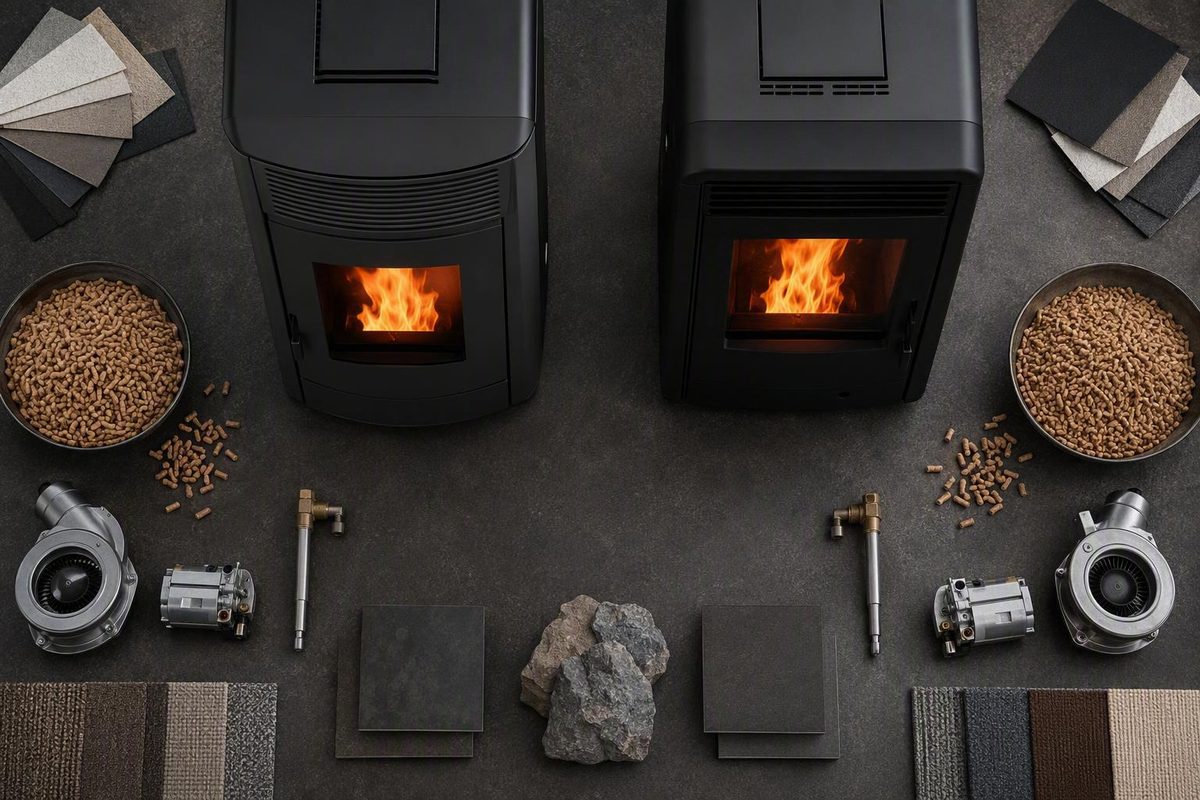
The best high-efficiency pellet stove is the one with a verifiable overall HHV efficiency, documented emissions, and an output range matched to your home’s heat loss—not necessarily the model with the largest percentage, BTU rating, hopper, or square-foot claim. Verify the exact model in EPA’s current database, calculate runtime from realistic burn rates, and account for electricity, installation, cleaning, noise, fuel storage, service, and parts before buying.
This is a comparison method, not a ranked list of currently available stoves. The named models below illustrate how differently efficiency claims can be documented. Confirm current availability, specifications, certification records, and the manual that applies to the unit being quoted before making a purchase.
The short answer: what to look for in a high-efficiency pellet stove
Start with this checklist:
- Overall HHV efficiency: Compare percentages only when they use the same higher-heating-value basis.
- Exact EPA model match: Confirm the manufacturer and complete model designation, not merely the brand or product family.
- Useful output range: Match tested delivered heat to a room-by-room or whole-home heat-loss calculation.
- Particulate-emissions rate: Record the model-specific figure and its test method.
- Realistic runtime: Divide usable hopper capacity by expected fuel consumption at low, medium, and high demand.
- Electrical requirements: Check normal operating watts, peak ignition demand, voltage, surge protection, and backup-power compatibility.
- Manageable maintenance: Read the manual’s cleaning procedures before deciding that you can live with them.
- Installation and service support: Confirm venting, outside-air requirements, clearances, warranty coverage, local technicians, and parts availability.
The evidence considered here does not establish one universal percentage at which every pellet stove becomes “high efficiency.” Thresholds used by a particular program or promotion may depend on the date and measurement method. For purchase comparisons, rank models only after confirming that their percentages represent overall HHV efficiency under comparable test conditions.
The terminology matters:
- An undefined percentage should remain unverified until its basis and test method are identified.
Efficiency must also remain separate from other performance categories. High heat output does not prove high efficiency. Low particulate emissions do not prove high efficiency. A large hopper can extend the interval between refills, but it does not improve heat conversion. A long maximum runtime may simply reflect operation at the lowest feed setting.
Circle qualifiers before accepting any brochure number: “up to,” “at the lowest setting,” “under test conditions,” and “manufacturer-reported.” Each limits what the number tells you about normal operation.
Verify the exact model—not just the EPA-certified label
EPA certification primarily concerns compliance with applicable particulate-emissions standards. It does not by itself prove exceptional thermal efficiency, low operating cost, quiet operation, reliability, or suitability for a particular home.
Use this workflow for every stove on your shortlist:
- Open the EPA Certified Wood Heater Database.
- Search the exact manufacturer and model name.
- Compare the complete model designation with the rating label, current manual, manufacturer page, and written dealer quote.
- Record the listed efficiency and its measurement basis.
- Record the particulate-emissions rate and any carbon-monoxide value shown.
- Confirm the fuel type.
- Confirm whether the listing identifies the heater as meeting the 2020 Step 2 limits.
- Save the result and record the lookup date.
EPA’s database supports searches by manufacturer, model, heater type, efficiency, emissions rate, carbon-monoxide values, fuel type, and Step 2 status. Because product families can contain similar names or revisions, a brand-level result is not enough.
Next, reconcile the EPA record with the current owner’s manual, manufacturer page, rating plate, and dealer listing. A difference does not automatically mean one source is false: a page may describe another revision, an old manual may remain online, or a retailer may have copied an outdated specification. Do not buy until the seller identifies which documentation and serial range apply to the actual unit.
Red flags
- “EPA certified” with no exact model-specific database result
- An EPA-style image badge used instead of a searchable record
- A retailer category such as “high heat” or “optimal performance”
- An efficiency percentage with no HHV, LHV, or test-method disclosure
- A model name that differs among the product page, manual, rating plate, and EPA entry
- A dealer who cannot provide the current manual or explain conflicting figures
An unknown specification is not necessarily evidence of poor performance. It is simply unverified and should remain unverified in your comparison rather than being treated as zero or confirmed.
Worked comparison: two very different efficiency claims
The ComfortBilt HP42-Alpine and Ashley AP5622 illustrate why two large efficiency figures cannot automatically be turned into a ranking. They are documentation examples, not endorsements or claims that both models are currently available.
| Attribute | ComfortBilt HP42-Alpine | Ashley AP5622 | Evidence status |
|---|---|---|---|
| Efficiency | Up to 87.5% HHV at the lowest heat setting | 76% under specified EPA test conditions | Promotional claim vs. manual test figure |
| Source and conditions | Manufacturer product page; low-setting maximum | Owner’s manual; specified laboratory conditions using pellet fuel | Direct comparability not established |
| Heat output | Up to 42,000 Btu/hr | 13,640–32,591 Btu/hr delivered heat | Manufacturer maximum vs. tested range |
| Particulate emissions | Not supplied on the cited product page | 1.5 g/hr | Unverified here vs. documented |
| Hopper | 120 lb | 170 lb | Manufacturer specifications |
| Listed burn rate | Not supplied on the cited product page | 2.1–5 lb/hr | Unverified here vs. manual specification |
| Maximum runtime | Up to 80 hours under low-burn conditions | Manual lists 80 hours at the lowest setting; calculated full-hopper range is about 34–81 hours | Conditional claim vs. manual claim and calculation |
| Electrical demand | Not supplied on the cited product page | About 175 W operating; 425 W with igniter | Unverified here vs. manual specification |
The HP42-Alpine figures in the table come from ComfortBilt’s manufacturer product page. The cited page does not provide a model-specific EPA database result, particulate-emissions rate, or efficiency at medium and maximum settings. Its 87.5% figure should therefore be recorded as a conditional manufacturer claim, not extended across the stove’s full operating range.
The AP5622 figures come from its owner’s instruction and operation manual, which reports 76% efficiency under specified EPA test conditions, particulate emissions of 1.5 g/hr, delivered heat of 13,640–32,591 Btu/hr, a 170-pound hopper, and a fuel-burn range of 2.1–5 lb/hr.
Using the manual’s nominal hopper capacity and burn-rate range, theoretical full-hopper runtime is:
- At 5 lb/hr: 170 lb ÷ 5 lb/hr = 34 hours
- At 2.1 lb/hr: 170 lb ÷ 2.1 lb/hr = about 81 hours
The manual separately lists an 80-hour burn time at the lowest setting. Neither the manual claim nor the calculation guarantees household runtime: the manual says pellet size can affect feed rate and burn time and that feed rates may vary by as much as 20%. Operating conditions and usable hopper capacity can also change the result.
The proper conclusion is not that 76% beats 87.5%, or vice versa. The figures have different documentation and conditions. A buyer would still need exact, current EPA records and matching test methodologies before treating them as directly comparable.
Size for heat loss, then estimate runtime at realistic demand
Advertised square-foot coverage is a weak primary sizing method. Two homes with equal floor area can have very different heating requirements because of climate, insulation, air leakage, ceiling height, window area, layout, and exposure. Stove location and intended use matter too: supplemental heat in an open living area is a different job from primary heating across a divided floor plan.
Obtain a room-by-room or whole-home heat-loss calculation, then look for a tested output range that can meet the design heating demand without requiring the stove to spend most of its operating time at one extreme. Manufacturer square-footage estimates can be inconsistent, and actual output needs depend on the building and intended heating role, as the Consumer Reports pellet-stove buying guide also cautions.
Keep output and efficiency separate:
- BTU output describes the rate at which heat is delivered.
- Efficiency describes the share of fuel energy converted into useful heat.
- A higher-output stove may burn more fuel while having the same or lower efficiency.
- The useful question is whether the tested output range fits the home’s calculated demand.
For runtime, use this worksheet:
Usable hopper pounds ÷ expected pounds burned per hour = estimated runtime
Ask the dealer or manufacturer for burn rates at low, medium, and high settings. A maximum low-burn runtime alone does not tell you how often you will refill during ordinary winter weather.
| Demand scenario | Usable hopper | Expected burn rate | Estimated runtime |
|---|---|---|---|
| Mild weather | ___ lb | ___ lb/hr | ___ hours |
| Typical winter day | ___ lb | ___ lb/hr | ___ hours |
| Design-cold conditions | ___ lb | ___ lb/hr | ___ hours |
A large hopper reduces refill frequency. It does not raise thermal efficiency, and it can increase the stove’s dimensions, placement constraints, and quantity of fuel stored inside the appliance.
For the HP42-Alpine, the cited manufacturer page lists coverage of up to 2,800 square feet and runtime of up to 80 hours under low-burn conditions. Treat both as conditional manufacturer claims, not guaranteed outcomes for a particular house.
Rated efficiency survives only with the right fuel, airflow, and cleaning
A pellet stove operates as a chain:
- Pellet characteristics and auger feed determine how much fuel reaches the fire.
- Combustion airflow supports a clean, stable burn.
- The burn pot must remain open enough for air to reach the fuel.
- Clean heat-exchanger surfaces transfer heat into the room.
- Clear exhaust passages and correctly installed venting allow combustion products to leave as designed.
A restriction or mismatch at one point can affect the rest. Excessive ash and clinkers can obstruct burn-pot airflow. Inadequate combustion air can contribute to soot on the glass, heat exchanger, and exhaust path. Dirty heat-transfer surfaces can reduce useful room heat while the stove continues consuming pellets.
Fuel requirements are model-specific. For example, the Enviro EF4 owner’s manual recommends dry, clean pellets with no more than 1% fines, bulk density of at least 40 lb/ft³, moisture no higher than 8%, and heat content of approximately 8,200 Btu/lb or more.
Those numbers belong to the EF4 manual and should not be transferred automatically to another stove. Use each candidate’s current manual to determine approved fuel, adjustment procedures, and cleaning intervals.
Common owner tasks include:
- Inspecting and cleaning the burn pot
- Removing ash from the specified chambers and pan
- Operating or cleaning heat-exchanger components as directed
- Inspecting door and ash-pan gaskets
- Keeping combustion and room-air blowers clear
- Inspecting and cleaning exhaust passages and venting
- Arranging qualified service for inaccessible components or unresolved problems
There is no single correct schedule for every pellet stove. Frequency varies with the appliance, pellet quality, firing rate, ash production, and amount of fuel burned. The EF4 manual, for example, calls for daily burn-pot-liner inspection and exhaust-vent inspection or cleaning semiannually or after every two tons of pellets.
Before changing feed trim, damper position, or control settings, follow the model-specific manual. A symptom can have more than one cause, and safety-related faults should not be diagnosed solely from a general table.
| Symptom | Possible areas to check | First response |
|---|---|---|
| Lazy or small flame | Dirty burn pot, restricted airflow, feed mismatch | Shut down if required; clean and inspect as the manual directs |
| Soot or blackened glass | Low airflow, dirty stove, prolonged low burn | Check cleaning and operating instructions |
| Excessive clinkers | Pellet ash, blocked burn-pot holes, air leaks | Inspect fuel, burn pot, venting, and gaskets |
| Low room heat | Dirty exchanger, low feed, weak blower, high building heat loss | Clean first, then compare operation with the manual |
| Ignition trouble | Dirty pot, igniter fault, air-to-fuel imbalance | Stop repeated attempts and follow the model’s troubleshooting procedure |
| Unburned pellets | Feed or airflow imbalance, shutdown issue | Clean and inspect; obtain qualified service if unresolved |
Account for electricity, outages, installation, and ongoing work
Standard pellet stoves normally use electricity for the auger, igniter, combustion blower, room blower, and controls. Without compatible backup power, they generally will not provide normal heat during an outage.
Backup power must handle both peak demand and continuous demand. The AP5622 manual lists approximately 425 watts with the igniter operating and approximately 175 watts during normal operation. It also specifies a grounded 110–120-volt, 60-hertz supply and a surge protector, and states that the heater will not operate during a power outage.
Do not assume that one battery, inverter, or generator suits every stove. Confirm:
- Nominal voltage and frequency
- Peak ignition or startup wattage
- Normal operating wattage
- Required surge protection
- Battery or generator compatibility
- Inverter waveform requirements
- Desired backup duration
- Safe-shutdown behavior
- Whether automatic relighting is supported after power returns
Installation can outweigh a favorable efficiency rating. The stove must fit the proposed location while meeting the manufacturer’s hearth protection, clearances, vent configuration, combustion-air provisions, and electrical requirements. Local permits, restrictions, and inspections may also apply. Obtain a written installed quote rather than budgeting from the stove price alone.
Use a complete ownership-cost worksheet:
| Cost item | Local input | Timing |
|---|---|---|
| Stove and selected options | $___ | Purchase |
| Venting and termination | $___ | Installation |
| Outside-air components | $___ | Installation |
| Hearth protection | $___ | Installation |
| Labor and delivery | $___ | Installation |
| Permits and inspections | $___ | Installation |
| Electrical work and surge protection | $___ | Installation |
| Backup power | $___ | Purchase/replacement |
| Pellets | $___ | Per ton or year |
| Electricity | $___ | Per year |
| Owner cleaning supplies | $___ | Initial/annual |
| Professional service | $___ | Annual or as required |
| Replacement parts | $___ | Annual reserve |
| Total first-year cost | $___ | Calculated |
| Estimated later annual cost | $___ | Calculated |
Then consider the work that does not fit neatly into a price field: blower and auger noise, room for dry pellet storage, lifting and pouring bags, ash handling, cleaning access, and the availability of technicians and replacement parts.
Pellet Finder’s twelve-winter ownership account says its stove still compares favorably with the propane system it replaced after fuel, parts, and cleaning time are considered. That is one owner’s experience, not proof that pellet heat will beat propane or another heating system in every market or household.
A final decision table for comparing candidate stoves
Assign one evidence label to every value:
- EPA: Official model-specific EPA record
- MANUAL/TEST: Current manufacturer manual or identified standardized test
- PROMO: Manufacturer product page, brochure, dealer, or retailer claim
If a value is unknown, enter Unknown—not zero and not an estimate disguised as fact.
| Criterion | Candidate A: value + label | Candidate B: value + label | Decision note |
|---|---|---|---|
| Overall HHV efficiency and source | ___ | ___ | Same basis and conditions? |
| Exact EPA model match | ___ | ___ | Full designation confirmed? |
| Particulate-emissions rate | ___ | ___ | Test method identified? |
| Tested output range | ___ | ___ | Meets design heat loss? |
| Home heat-loss requirement | ___ | ___ | ___ Btu/hr |
| Low burn rate | ___ | ___ | ___ |
| Medium burn rate | ___ | ___ | ___ |
| High burn rate | ___ | ___ | ___ |
| Hopper capacity | ___ | ___ | Usable or nominal? |
| Estimated low-demand runtime | ___ | ___ | ___ |
| Estimated typical runtime | ___ | ___ | ___ |
| Estimated high-demand runtime | ___ | ___ | ___ |
| Normal operating watts | ___ | ___ | ___ |
| Ignition or peak watts | ___ | ___ | ___ |
| Vent requirements | ___ | ___ | Fits proposed route? |
| Outside-air requirements | ___ | ___ | Included or extra? |
| Cleaning access | ___ | ___ | Demonstrated? |
| Normal operating noise | ___ | ___ | Heard in person? |
| Warranty terms | ___ | ___ | Labor included? |
| Local service | ___ | ___ | Technician identified? |
| Parts availability | ___ | ___ | Lead times checked? |
| Installed price | ___ | ___ | Written quote? |
| Annual pellet input | ___ | ___ | Local price and usage |
| Annual electricity input | ___ | ___ | Local rate and kWh |
| Annual service/parts input | ___ | ___ | Realistic reserve |
| Backup-power cost | ___ | ___ | Required runtime met? |
Eliminate a candidate if it cannot meet the home’s calculated heat loss, cannot be installed according to its requirements, lacks practical service support, or creates an unmanageable outage, storage, noise, or maintenance burden.
Before committing, request:
- The current owner’s and installation manual
- The exact model-specific EPA record
- A written installed quote with venting and options itemized
- Complete warranty terms
- Replacement-parts information
- Names of local service providers
- A demonstration of normal operating noise, if possible
Choose the stove with the strongest verified efficiency and emissions data among the models that also fit the home’s heat demand, installation, budget, service market, outage plan, and daily ownership routine. Leave any model with unresolved essential specifications off the shortlist.