
How to Choose a Hopper That Fits Your Heating Routine
Bigger does not always mean longer between refills: a larger-hopper stove can run for less time when it burns pellets at a higher feed rate.
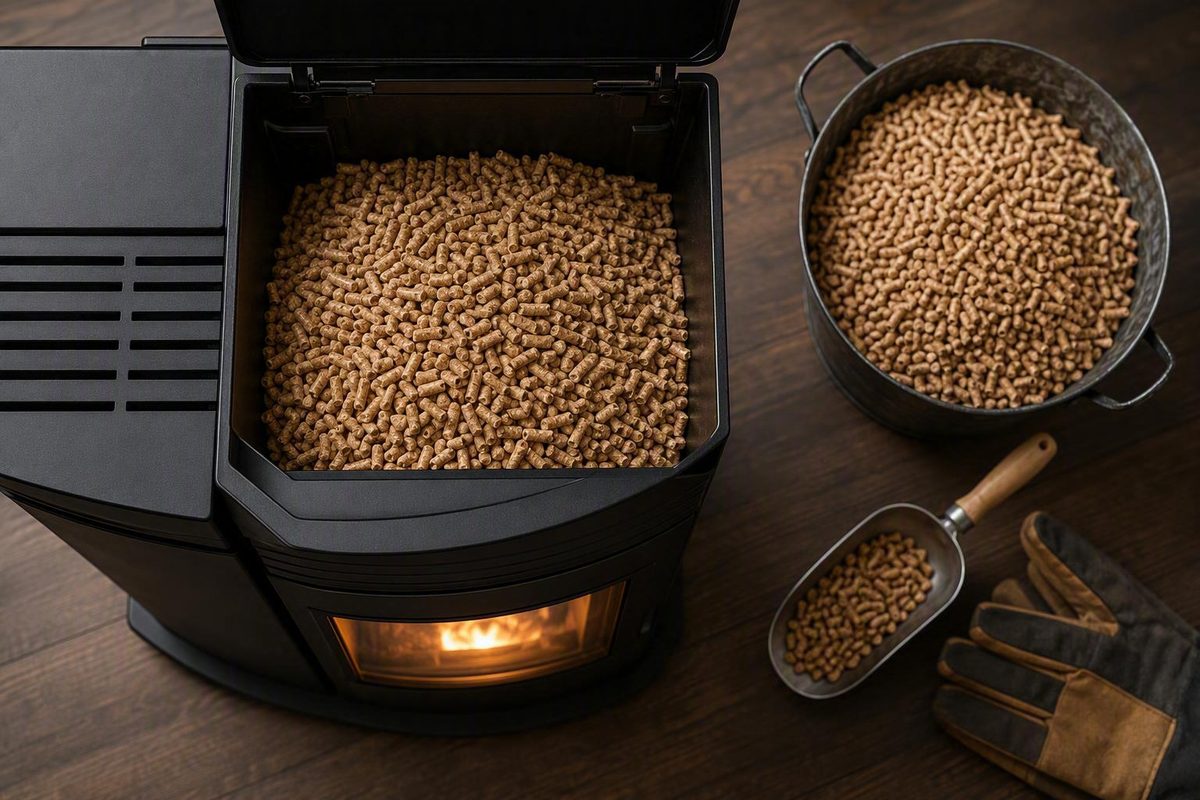
A pellet stove hopper is easy to reduce to one number: capacity. Yet capacity does not reveal how powerful a stove is, how efficiently it burns, or exactly how long it will operate. The hopper is primarily a fuel-storage and convenience feature. Its practical value depends on the stove’s pellet-consumption rate, your preferred refill schedule, reliable fuel handling, and exact appliance compatibility.
Choose the stove’s heat-output range for the building first, then compare hopper capacities among suitable models. Estimate runtime from model-specific feed rates rather than a general “hours per bag” promise. If you are considering an extension, replacement, or conversion hopper, documented compatibility matters more than apparent physical fit.
Specifications, availability, and prices can change.
What a pellet stove hopper does
The hopper is the compartment that stores wood pellets before combustion. It may be built into the top or rear of a freestanding stove, integrated into an insert, or attached to a specialized heating system.
In a conventional pellet stove, the fuel path is:
- Pellets are loaded into the hopper.
- They settle toward the feed area.
- A motorized auger advances measured amounts of fuel.
- The pellets drop into the burn pot.
- An igniter starts combustion while fans manage combustion air and distribute heat.
Electronic controls commonly regulate pellet delivery and airflow according to the selected heat level or thermostat demand. Depending on the design, a stove may modulate between feed rates, cycle on and off, or combine both strategies. A pellet-stove buying guide from Fyre Direct describes this conventional hopper-to-auger-to-burn-pot arrangement.
The hopper does not burn the pellets, and it does not independently determine heat output. Two stoves can have the same hopper capacity but different feed-rate ranges, controls, combustion systems, and outputs. A high-output stove may also consume a full hopper quickly when operated at a high setting.
Most conventional pellet stoves depend on electricity for the auger, fans, igniter, and electronic controls. That makes electrical reliability and manufacturer-compatible backup power separate buying considerations. Gravity-fed, non-electric pellet systems exist, but they are specialized exceptions rather than the normal operating model for a thermostatically controlled pellet stove.
The simplest useful definition is:
A pellet stove hopper stores fuel so the stove’s feed mechanism can deliver pellets to the burn pot at a controlled rate.
Capacity tells you how much fuel can wait in that system. It does not tell you how much fuel the stove will consume each hour.
Built-in hoppers, extensions, replacements, and conversion systems
“Pellet hopper” can refer to several materially different products. Identify the product category before comparing capacity or price.
Built-in hopper: The original fuel compartment incorporated into a complete pellet stove. Its stated capacity is normally the nominal amount of pellets it is designed to hold.
Hopper extension: An accessory mounted above or onto an existing hopper to increase storage. Its advertised capacity may be the amount added, not the new combined capacity.
Replacement hopper or component: An enclosure, lid, seal, switch assembly, or related part intended to replace original equipment.
Pellet-conversion hopper: Part of a system that enables another compatible heater to burn pellets. It may include a feed tube, grate, valve, or adapter and should not be confused with a conventional stove’s replacement hopper.
Boiler or burner working hopper: Larger fuel storage used with a central-heating appliance. It may feed a burner directly or connect through another transfer system.
Actual products show why these distinctions matter.
ComfortBilt lists an HP50 hopper extension as adding 30 pounds of pellet capacity and restricts it to HP50 Series stoves. Its stated dimensions are 9.5 inches deep, 19.5 inches wide, and 10 inches high. It is a model-specific capacity addition, not a universal hopper or a complete stove. See the ComfortBilt HP50 Series extension listing.
The Liberator Generation 2 product belongs to another category. The seller describes it as a gravity-fed conversion accessory for compatible Liberator Rocket Heaters. It accepts one 40-pound bag and requires a heater fitted with an outside-air-intake adapter. The included-parts list names the hopper, feed tube, pellet shutoff valve, and burn grate but does not identify the required outside-air adapter as included. These details make it a specialized conversion system, not a generic pellet-stove hopper. The seller also publishes conflicting runtime claims of more than 10 and more than 12 hours, so neither should be treated as independently verified. Check the Liberator Generation 2 product page for its current configuration.
At a much larger scale, Pellergy describes a manually filled working hopper with a 550-pound capacity for specified pellet-burner or boiler arrangements. It can feed a Pellergy burner directly, while use with the company’s Alpha boiler requires an automatic-feed vacuum system. This is central-heating storage, not a residential stove-top accessory, as the Pellergy working-hopper description makes clear.
Marketplace searches can obscure these differences. A category labeled for pellet hoppers may mix complete stoves described by hopper capacity with accessories or other components. Search placement does not establish that a product is a replacement part, fits a particular stove, or is approved for a proposed installation.
Before comparing products, answer four questions:
- Is this a complete stove, original hopper, extension, replacement component, conversion kit, or boiler-system hopper?
- Is the stated capacity total capacity or added capacity?
- Which exact appliances are named as compatible?
- What other components or installation work are required?
Until those answers are clear, price and capacity comparisons are premature.
What hopper capacity means—and what it does not
Hopper capacity is the nominal weight of pellets the hopper is designed to hold. It is usually stated in pounds in the United States and kilograms in many other markets.
Capacity is principally a measure of:
- Stored fuel
- Potential time between refills
- Refilling convenience
- Pellet weight carried by the hopper and appliance
It is not, by itself, a measure of:
- Maximum or minimum heat output
- Combustion efficiency
- Heating coverage
- Pellet quality
- Feed-system reliability
- Guaranteed runtime
A larger hopper generally allows less frequent refilling when two otherwise comparable stoves consume pellets at the same rate. If the larger-hopper stove burns fuel faster, however, it can run for less time than a smaller-hopper stove operating at a lower feed rate.
Pellets are commonly sold in 40-pound bags, which allows a rough capacity comparison. Commercial fuel guidance identifies 40 pounds as a standard bag size, although that does not mean every hopper should receive a complete bag at each refill. Pellet Heat’s fuel-use guide also emphasizes that consumption varies with the home and how the stove is used.
| Nominal hopper capacity | Approximate number of 40-pound bags |
|---|---|
| 40 lb | 1 bag |
| 80 lb | 2 bags |
| 120 lb | 3 bags |
These are bag-count comparisons, not loading instructions. Check the existing fuel level, the rated capacity, and the applicable manual before adding pellets.
Nominal capacity should also be distinguished from the amount you choose to use in a planning calculation. You may voluntarily deduct a refill allowance so the estimate does not assume that you will wait until the hopper is empty. That allowance is a personal operating choice unless the manufacturer specifies otherwise; it should not be presented as a verified amount of unusable capacity.
As a model-specific retail snapshot, selected listings show residential stove hoppers of 25, 47, 52, 55, 80, and 120 pounds. Those figures apply only to the displayed models and do not establish an industry-wide minimum, maximum, or typical range. See the Lowe’s pellet-stove listings for the cited examples.
Use this order when comparing stoves:
- Estimate the building’s heat demand.
- Identify models with an appropriate tested heat-output range and suitable controls.
- Compare hopper capacities among those viable models.
- Calculate how each model’s capacity and feed rates fit your refill schedule.
Reversing that order can leave you with ample fuel storage attached to a stove that is poorly matched to the building.
How to estimate full-hopper runtime
The basic calculation is:
Estimated runtime = planning capacity ÷ pellet consumption per hour
Use matching units: pounds divided by pounds per hour, or kilograms divided by kilograms per hour.
“Planning capacity” may be the full nominal capacity or the nominal capacity minus a refill allowance you deliberately choose. If the manufacturer specifies a different method, use the manufacturer’s instructions.
Obtain the candidate stove’s low and high pellet feed rates from its owner’s manual, specification sheet, technical documentation, or a written manufacturer response. Do not substitute an industry-wide assumption when model-specific information is available.
Because consumption changes with operating level, calculate a range:
- Longer theoretical runtime: planning capacity ÷ documented low feed rate
- Shorter theoretical runtime: planning capacity ÷ documented high feed rate
A published metric example uses a 15-kilogram hopper and an illustrative consumption range of 0.6 to 2 kilograms per hour. The resulting theoretical runtime is 25 hours at 0.6 kg/h and 7.5 hours at 2 kg/h, before any voluntary refill allowance. The source presents the feed range as an example, not a universal pellet-stove specification. See the StoveBoss hopper-capacity guide.
Runtime worksheet
| Input or result | Your figure |
|---|---|
| Nominal hopper capacity | _____ lb or kg |
| Voluntary refill allowance, if any | − _____ lb or kg |
| Planning capacity | = _____ lb or kg |
| Documented low feed rate | _____ lb/h or kg/h |
| Documented high feed rate | _____ lb/h or kg/h |
| Runtime at low feed rate | planning capacity ÷ low rate = _____ hours |
| Runtime at high feed rate | planning capacity ÷ high rate = _____ hours |
| Estimated runtime range | _ to ___ hours |
The high-setting calculation gives the shorter end of the range, while the low-setting calculation gives the longer end. If thermostat control allows the stove to cycle off, elapsed time between refills may exceed a continuous-burn estimate because the appliance is not consuming pellets continuously.
Actual runtime can vary with:
- Thermostat cycling and modulation
- Selected heat level
- Outdoor temperature and wind
- Insulation and air leakage
- Building heat loss
- Floor plan and movement of warm air
- Stove location and sizing
- Primary versus supplemental use
- Pellet condition
- Maintenance and combustion condition
Comparative testing illustrates the possible spread without creating a universal benchmark. In one test group, a Quadra-Fire ran for nearly 50 hours on low, while a Ravelli’s smaller hopper supported about eight hours at its highest setting. Those results apply only to the tested appliances and settings. The project also recorded substantial differences in hourly pellet feed rates among models. See the nonprofit project’s heat-output and feed-rate results.
Owner reports show similar variation but should be treated as anecdotes. Some users report adding a bag nightly, while others refill twice daily or every other day. These households use different stoves, settings, fuels, buildings, and supplemental heat sources, so their routines are not directly comparable. A Hearth.com discussion of owner refill schedules demonstrates that range without providing controlled test results.
Seller runtime claims deserve equal caution. A capacity number plus a headline burn time is not enough unless the feed rate, operating setting, test conditions, and calculation method are also clear.
Choosing capacity around your refill routine
Hopper selection becomes easier when it is separated from stove sizing.
Decision one: How much heat does the building need? Consider heat loss, climate, insulation, layout, stove placement, and whether the appliance will provide primary or supplemental heat. Choose an appropriate output range and control strategy.
Decision two: How often do you want to handle pellets? After identifying suitable stoves, compare their planning capacities and documented feed rates with the periods when you want uninterrupted operation.
Useful planning windows include:
- Overnight: Does the calculated range cover your sleeping period, including the shorter high-consumption estimate?
- A workday: Can the stove cover the time between departure and return without requiring a precisely timed refill?
- A full day: Does the range suit the household’s ordinary schedule?
- Multi-day low-output use: Does the documented low-rate calculation support it, and what happens when heating demand rises?
There is no universal hopper capacity for any of these windows. “Overnight” cannot automatically be translated into a 40-, 60-, or 80-pound hopper. Run the calculation for each candidate model.
Greater capacity has one primary benefit: when fuel consumption is otherwise equal, more stored pellets mean fewer required refills. That can be useful for long workdays, once-daily loading preferences, or households that want to reduce repeated fuel handling.
The tradeoffs include:
- Greater appliance or extension height
- More stored pellet weight
- A higher or less convenient fill point
- Increased lifting and pouring effort
- More space needed to open and reach the lid
- Possible interference with maintenance access
- Longer exposure of stored pellets to ambient moisture
Before buying, perform a loading-access check:
- Determine the stove’s final installed height, including any extension.
- Confirm from the installation documentation that the proposed location provides the required access and clearances.
- Check whether the lid can open fully.
- Consider overhead and side access, not just floor space.
- Decide whether the intended user can manage a typical 40-pound bag safely.
- If not, ask whether the manufacturer permits a suitable scoop or smaller loading container.
- Confirm that routine service panels remain accessible.
Use a compact table to compare shortlisted models:
| Desired refill window | Planning capacity | Low feed rate | High feed rate | Estimated runtime range | Approx. 40-lb bag count | Loading constraints |
|---|---|---|---|---|---|---|
| Overnight | _____ | _____ | _____ | _–___ h | _____ | _____ |
| Workday | _____ | _____ | _____ | _–___ h | _____ | _____ |
| Full day | _____ | _____ | _____ | _–___ h | _____ | _____ |
| Multi-day, low output | _____ | _____ | _____ | _–___ h | _____ | _____ |
Do not let an impressive hopper number outweigh heat-output range, thermostat behavior, operating noise, electrical dependence, approved fuel, maintenance access, or service support. For a broader view of these tradeoffs, see Pellet Stove Pros and Cons: What Twelve Winters Taught Me.
The best hopper is attached to a stove that suits the building and that the household can operate, load, and maintain.
Loading pellets and caring for the hopper
The owner’s manual for the exact stove is the controlling source for approved fuel, refilling, shutdown, cleaning, and maintenance. It should also determine whether the hopper may be opened or filled during operation. Instructions for another stove cannot establish the correct procedure for yours.
Before adding fuel, use the manual to confirm:
- The hopper’s rated capacity
- Whether the stove may remain in operation
- How the lid should be opened and supported
- Whether a lid switch affects operation
- Permitted loading tools or containers
- Required shutdown or cooling steps
Check the existing pellet level before adding a complete bag. An 80-pound hopper does not have room for two new 40-pound bags if fuel remains inside. Pellets caught around the lid perimeter can also prevent complete closure.
Some stoves use a hopper-lid switch that affects the auger or ignition sequence, but the behavior varies by model. A third-party demonstration involving a Lopi AGP describes an 80-pound hopper, two 40-pound bags, and the need to keep pellets clear of the lid perimeter. It is an illustration rather than manufacturer authority; the applicable manual must govern the procedure. The demonstration can be viewed at the publisher’s canonical YouTube page.
Keep pellets dry. Retailer guidance notes that moisture can make pellets swell, deteriorate, break apart, and feed poorly.
Use only the maintenance procedure specified for the stove. Do not improvise with tools or cleaning equipment where the manual does not authorize them.
There is no universal hopper-cleaning interval. Appropriate frequency depends on:
- Hopper and feed-system design
- Pellet durability and dust content
- Fuel consumption
- Storage and humidity conditions
- Manufacturer instructions
Inspect according to the manual rather than copying another owner’s calendar. If the manual does not address accumulating fines or deteriorated pellets, ask the manufacturer or servicing dealer.
Advice about filling a warm or operating stove is inconsistent. Do not infer permission from a retailer article, forum post, or video involving another appliance. If the manual does not clearly authorize loading during operation, obtain model-specific guidance from the manufacturer or dealer before doing so.
Finally, keep packaging and other foreign material out of the hopper. Open bags in a controlled way and account for loose plastic strips, tags, ties, and torn fragments.
Why pellets stop feeding: a troubleshooting sequence
A hopper can contain pellets while the burn pot receives little or no fuel. Several conditions can produce similar symptoms, so begin with the stove’s diagnostic and shutdown instructions. Do not begin an inspection until the manual-prescribed safe condition has been reached.
One possible condition is bridging: pellets form an arch or stable mass instead of falling toward the feed area. The upper hopper may appear full even though fuel is not reaching the outlet. Retailer guidance also identifies moisture, fines, and lid closure as factors that can affect feeding, while emphasizing that procedures are model-specific. See the StoveBoss discussion of bridging and hopper care.
Use this non-invasive, manual-led sequence:
1. Record the display information. Note any error code or warning before clearing the display. Then follow the prescribed shutdown procedure.
2. Make only authorized visual checks. Once the stove is in the condition required by its manual, inspect only areas the owner is instructed to inspect.
3. Examine visible fuel condition. Look for damp, swollen, crumbling, or clumped pellets. If the fuel appears damaged, follow the manufacturer’s directions rather than improvising a removal method.
4. Check for visible fines. If fines have accumulated in an owner-serviceable area, remove them only through the method specified for that model.
5. Check the pellet level and lid perimeter. Overfilling or pellets around the rim can prevent full closure. Correct these conditions only as directed by the manual.
6. Check model-specific indications. If the display reports a lid-switch or feed-system condition, use the documented diagnostic process. Do not bypass an interlock.
7. Escalate an unresolved fault. If the authorized checks do not identify the problem, contact the manufacturer, dealer, or a qualified service provider.
A Hearth.com participant reported an auger jam after pellet dust had accumulated for almost two weeks. That is an owner anecdote, not proof that fines cause every jam. Damp pellets, foreign material, switches, motors, sensors, and controls can produce similar symptoms.
It helps to distinguish prevention from repair.
Prevention may include, when consistent with the manual:
- Keeping pellet bags dry
- Rejecting visibly moisture-damaged fuel
- Preventing packaging from entering the hopper
- Keeping the lid perimeter clear
- Removing fines through the approved procedure
- Following the specified maintenance schedule
Repair work may include:
- Removing or dismantling an auger
- Testing motors, switches, sensors, or wiring
- Opening electrical or drive-system compartments
- Changing the feed path
- Bypassing an interlock
Stop at the boundary established by the appliance documentation. Before contacting service, record the manufacturer, exact model, serial number, error code, pellet condition, recent maintenance, operating setting, and what happened immediately before feeding stopped.
Buying an extension or replacement: compatibility comes first
The available evidence does not support treating pellet-stove hopper extensions or replacements as universal-fit products. Exact compatibility should be the first purchasing test, not an issue left until installation.
Start by recording:
- Appliance manufacturer
- Exact model number
- Model series
- Serial number and production range
- Appliance configuration: freestanding stove, insert, heater, boiler, or burner
Then determine what the listing actually describes. Is it a complete hopper, an add-on extension, a replacement enclosure, a lid or switch component, a conversion kit, or an entire stove? Marketplace and retailer categories may not supply enough information to answer that question.
Clarify the capacity language in writing:
- Is the stated figure total assembled capacity?
- Is it additional capacity above the original hopper?
- Does it assume the original hopper is empty?
- Does installation change the loading instructions?
- Is a manufacturer-specified operating allowance required?
Pre-purchase compatibility checklist
Physical fit and fuel path
- Do the mounting points match the exact stove?
- What are the opening dimensions?
- Are required seals, gaskets, and fasteners included?
- Does the feed opening align without modification?
- Is the original lid retained or replaced?
- How is the original lid switch accommodated?
- Can the lid open fully after installation?
- How much height does the accessory add?
- Will filling and maintenance access remain available?
Weight and structure
- What does the empty accessory weigh?
- How much pellet weight does it add?
- Does the manufacturer approve that combined load on the specified appliance?
- Are braces or other supports required?
Operation and required components
- Are adapters, tubes, grates, valves, switches, or wiring required?
- Which required components are included?
- Does the system retain powered-auger operation or convert to gravity feed?
- Are control changes required?
- Does installation change cleaning, inspection, or shutdown procedures?
Documentation and approvals
Ask the appliance manufacturer—not only a marketplace seller—whether the proposed accessory raises model-specific questions involving:
- Warranty coverage
- Appliance certification or approval
- Permitted clearances
- Structural loading
- Professional installation
- Replacement-part availability
- Serial-number restrictions
These are unresolved checks, not effects that should be assumed in advance.
Narrow compatibility is normal. ComfortBilt’s extension is explicitly listed as adding 30 pounds only to HP50 Series stoves. The manufacturer’s product page is more useful for that decision than a generic retail category that merely labels an item as a hopper extension.
The Liberator example is narrower still: it is a conversion accessory for compatible Liberator Rocket Heaters and requires an outside-air-intake adapter. Because the required adapter is not identified in the included-parts list, a buyer who compares only the 40-pound capacity or headline price could miss an essential component. Verify the complete configuration with the manufacturer’s current listing.
Compare complete delivered cost rather than accessory price alone. Include:
- Hopper or extension
- Required adapters and hardware
- Seals, switches, or replacement components
- Tax
- Parcel shipping or freight
- Payment surcharges
- Installation labor
- Required inspection or service work
Prices, inventory, freight terms, and specifications can change. Date written quotes and ask the seller to identify every required component.
Before modifying an appliance, preserve the manufacturer’s written compatibility confirmation, installation instructions, parts list, and correspondence identifying the exact model and serial number. Apparent dimensional fit is not a substitute for documented operational compatibility.
Frequently asked questions
How long will a 40-pound pellet stove hopper last?
There is no universal runtime for a 40-pound hopper. Divide the capacity you plan to use by the model’s documented pellet-consumption rate:
Runtime = planning capacity ÷ feed rate
Calculate both the low- and high-feed results rather than publishing one promised duration. A commercial guide suggests that one 40-pound bag can provide around a day of heat, but it also says consumption changes with home size, weather, temperature preference, and primary-versus-supplemental use. Treat that as a broad illustration, not a guarantee.
Does a larger pellet hopper make the stove produce more heat?
No. A larger hopper stores more fuel. It does not by itself increase heat output, combustion efficiency, or heating coverage.
Heat production depends on the stove’s feed rate, combustion design, airflow, controls, and operating setting. Greater capacity can extend the interval between refills when consumption is otherwise equal, but it does not make the fire more powerful.
Can I add a hopper extension to any pellet stove?
No. Do not assume that an extension is universal, even if its dimensions appear close to those of the existing hopper.
Confirm the manufacturer, exact model, series, and serial range. Obtain written information about mounting points, feed-path alignment, seals, lid-switch arrangements, added height, supported pellet weight, required components, and maintenance access. Ask the appliance manufacturer whether the extension is approved for that exact stove and whether qualified installation is required.
Can I refill a pellet stove hopper while the stove is running?
Only follow the instructions for the exact appliance. Hopper lids, switches, feed controls, and loading procedures vary by model.
If the manual does not clearly authorize refilling during operation, do not rely on a demonstration or instructions for another stove. Ask the manufacturer or servicing dealer for model-specific guidance.
Why are pellets not dropping from the hopper into the auger?
Possible causes include pellet bridging, damp or deteriorated fuel, accumulated fines, overfilling, incomplete lid closure, a lid-switch condition, or a mechanical or electrical feed-system fault.
Begin with the stove’s display, diagnostic instructions, and prescribed shutdown. Perform only the visual checks and owner maintenance authorized by the manual. If those checks do not identify the problem, contact the manufacturer, dealer, or a qualified service provider rather than dismantling the feed system or bypassing an interlock.
Choose the stove for the building’s heat demand first and the hopper for the household’s refill routine second. Calculate a realistic runtime range from model-specific feed rates, keep pellets dry, follow the appliance manual for loading and maintenance, and treat every extension or replacement as a model-specific modification requiring written compatibility and installation guidance.