
Identify Your American Harvest Stove Before You Buy, Install or Repair It
Compare the 6033, 6039, 6041 and 6500 by appliance type, documented specs, approved fuel, installation rules, controls and components.
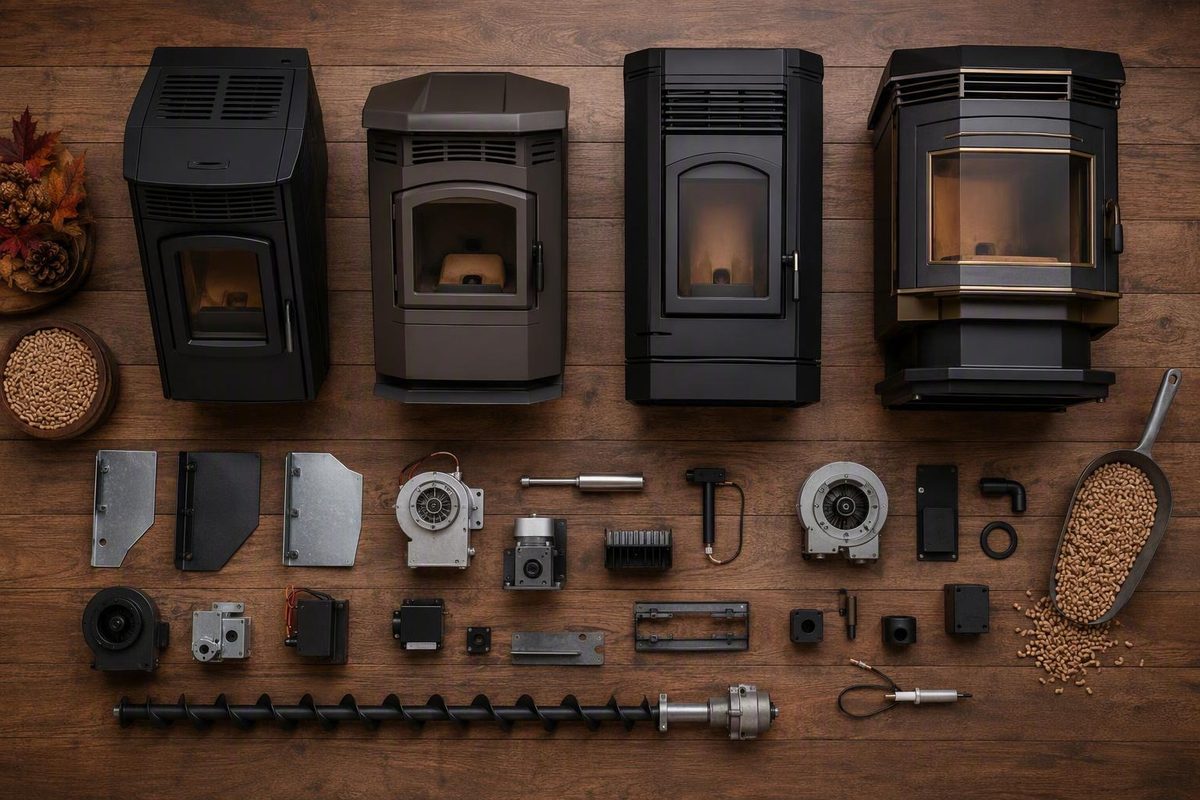
Find the appliance’s data plate and record the exact model and serial number before downloading a manual, planning an installation, diagnosing a fault, or ordering a part. American Harvest is not one interchangeable pellet-stove design: the 6033, 6039 family, 6041 family, and 6500 furnace differ in appliance type, approved fuel, specifications, installation rules, controls, and components.
Start here: identify the exact American Harvest model
Do not identify an older stove from its color, door shape, control panel, or an online photograph alone. Find the data plate and photograph it clearly enough to read the model, serial number, electrical information, and listing details.
| Model or family | Documented identity | What distinguishes it |
|---|---|---|
| 6033 | Multifuel room stove | Freestanding or alcove installation; documented for several qualifying fuels |
| 6039 / 6039T | Corn-and-pellet multifuel room stoves | Covered together by a 6039/6039T owner’s manual |
| 6039i | Model referenced in owner discussions | Treat it as a separate identity unless its data plate and matching manual establish otherwise |
| 6041 | American Harvest room heater tested with wood pellets | Subject of a 2019 laboratory certification test |
| 6041I / SP6000 | Variants discussed in the 6041 test report | Differences in dimensions, branding, or appearance do not prove universal parts compatibility |
| 6500 | Multifuel furnace | Intended for primary-furnace, add-on-furnace, or stand-alone shop-heating applications |
The 6500 distinction is especially important. Its hopper, electrical load, ducting context, controls, and installation requirements belong to a furnace, not an ordinary room stove. The Model 6500 owner’s manual identifies primary, add-on, and stand-alone shop-heating applications.
The 6041 laboratory report also discusses 6041I and SP6000 variants of the tested design. That discussion addresses design and emissions performance; it does not establish that every dimension, control, motor, connector, or service part is interchangeable across those names.
When inspecting a used or nonworking appliance, photograph:
- The complete data plate
- The control board and its label
- Wiring plugs and connector positions
- Auger, agitator, and blower motor labels
- Sensor markings
- Numbers printed or stamped on removed components
- Door-glass shape and dimensions
- The firepot, auger, and agitator arrangement
Do not transfer specifications, installation limits, fuel approvals, troubleshooting procedures, or parts from one American Harvest model to another. Similar-looking appliances may have different revisions, wiring, controls, or safety requirements.
What the documented specifications actually show
Owner’s manuals, retailer listings, and controlled laboratory tests answer different questions. A listed maximum, an advertising claim, and measured laboratory heat output are not automatically comparable.
| Model | Appliance type | Documented dimensions or capacity | Source and limitation |
|---|---|---|---|
| 6033 | Multifuel room stove | 28 in. wide, 33 in. high, 28 in. deep; 60-lb capacity; 50,000 BTU/hr listed maximum | The owner’s manual says output varies with fuel brand and moisture. |
| 6039 | Multifuel room stove | Retailer-described as a 52,200-BTU heater | The retailer does not define the figure as input, maximum output, or delivered heat. |
| 6041 | Room heater tested with wood pellets | 29 in. high, 27.75 in. wide, 29.25 in. deep; 3-in. lower-rear exhaust | Laboratory description of the tested design, not a specification for every American Harvest model |
| 6500 | Multifuel furnace | 320-lb hopper; 250-lb appliance weight; 5–13 lb/hr listed burn rate | Furnace figures only; not applicable to room-stove models |
The 6033 owner’s manual lists the dimensions, 60-pound fuel capacity, and 50,000-BTU-per-hour maximum above. The figure is not a promise of typical delivered heat because the manual says actual output varies with fuel and moisture.
The Model 6500 manual lists rated input of 50,000–105,000 BTU/hr, a 320-pound hopper, a 5–13-pound-per-hour burn rate, 250-pound appliance weight, and approximately 1,150 maximum operating watts. Burn rate may vary by as much as 20%, and output depends on fuel characteristics. These numbers apply only to the furnace.
The strongest controlled performance data are from a 2019 PFS-TECO test of one Model 6041 specimen using specified wood-pellet fuel. The six-hour integrated test, conducted after 50 hours of conditioning, reported:
- Particulate emissions: 1.28 g/hr
- Overall higher-heating-value efficiency: 57.6%
- Overall reported heat output: 10,214 BTU/hr
- Segment heat output: 21,811 BTU/hr high, 8,311 BTU/hr medium, and 7,540 BTU/hr low
The PFS-TECO Model 6041 report states that the tested specimen met the 2020 particulate limit of no more than 2.0 g/hr. These are test-specific results, not a long-term household fuel-use study or evidence about the 6033, 6039, or 6500.
Why BTU numbers can mislead
An advertised maximum BTU figure may describe fuel input, a peak firing rate, or another sales convention. Laboratory heat output is measured under a defined operating cycle. A retailer’s 52,200-BTU description of the 6039 therefore cannot be compared directly with the 6041’s 10,214-BTU overall laboratory result unless both numbers are defined on the same basis.
The 6039 parts retailer supplies the 52,200-BTU description, but does not substantiate it as usable room heat. Likewise, Home Depot advertised the 6041 as heating up to 2,000 square feet. That is a coverage claim, not a guarantee: climate, insulation, ceiling height, floor plan, installation, fuel, and operating setting all affect the area a stove can heat.
Pellets, corn and other fuels: follow the exact manual
“Multifuel” is a model-specific approval, not permission to burn any biomass that fits through the hopper.
For the 6039 and 6039T, the manual documents dry shelled corn, qualifying wood pellets, and certain other pelletized fuels. It specifies corn moisture of no more than 14%, with 11–12% described as preferable, and pellet ash content of 1% or less. It also warns against seed corn and unsuitable high-wax corn. Fuel outside the stated specifications can reduce performance and may affect warranty coverage, according to the 6039/6039T owner’s manual.
The 6033 manual lists shelled corn, cherry pits, qualifying wood pellets, and other qualifying pelletized fuels. Cordwood is prohibited. It also prohibits seed corn and high-wax corn. These approvals belong to the 6033 and do not establish what a 6039i or 6041 may burn.
Model 6500 has a separate fuel system and control arrangement. Its manual documents shelled corn, wood pellets, or a 50/50 mixture. The control uses a corn setting for corn, a pellet setting for pellet-only operation, and says the corn setting generally works best for the mixture. Seed corn and high-wax corn are prohibited by the 6500 furnace manual.
Fuel quality affects more than nominal heat output:
- Corn characteristics can change airflow needs and clinker formation.
A retailer’s broad biomass list for the 6041 does not establish complete fuel approval for that model, much less the entire American Harvest line. Use an intact owner’s manual matching the exact model and revision shown on the data plate.
Installation and power requirements are model-specific
The values below are orientation points, not installation instructions. Installation must be governed by an intact manual for the exact appliance and revision, current local codes, permit and inspection requirements, and a qualified installer. Manual mirrors and extracted summaries may be incomplete or contain transcription errors, so verify all safety-critical values before work begins.
The documented 6033 and 6039-family stoves operate under negative pressure. Their applicable manuals require airtight, sealed vent connections, listed Type PL pellet vent, and no connection to a chimney flue serving another appliance.
For the 6039 and 6039T only, the reproduced manual limits horizontal venting to 48 inches. It requires outside combustion air in mobile homes and describes it as required for newer or tightly insulated homes. Floor protection, clearances, service space, vent arrangement, and termination requirements must be checked in the complete diagrams for the exact appliance. These model-specific provisions appear in the 6039/6039T manual reproduction.
The 6033 has separate floor-protection, clearance, elevation, and venting rules. Its manual requires outside air in mobile homes and tightly insulated newer homes. Those values must not be substituted for 6039, 6041, or 6500 requirements.
Verify all of the following before installing or reconnecting an appliance:
- Vent diameter and listed vent type
- Required vertical rise and maximum horizontal run
- Elevation-related changes
- Number and arrangement of elbows
- Termination location
- Outside-combustion-air requirements
- Hearth dimensions and materials
- Clearances from walls and combustibles
- Mobile-home restrictions
- Access for cleaning and removal of motors or control panels
These appliances depend on electricity for their controls, feed systems, or blowers. The 6500 manual expressly states that the furnace does not operate during a power outage. Plan suitable outage support or separate backup heat rather than assuming an electrically dependent appliance can remain the home’s only heat source.
Pre-installation checklist
- [ ] Data plate photographed; model and serial number recorded
- [ ] Complete manual obtained for the exact model and revision
- [ ] Safety-critical values checked against an intact manual
- [ ] Local permit and inspection requirements confirmed
- [ ] Correct listed pellet vent selected
- [ ] Outside-air requirement evaluated
- [ ] Hearth dimensions and combustible clearances measured
- [ ] Grounded outlet available
- [ ] Manual or installer guidance on appropriate surge protection checked
- [ ] Smoke-alarm and carbon-monoxide-alarm requirements confirmed under current code
- [ ] Cleaning and motor-removal access preserved
- [ ] Power-outage and backup-heat plan established
Cleaning and troubleshooting: check airflow before replacing parts
Shut the appliance down, let it cool completely, and disconnect electrical power before cleaning, opening service panels, or inspecting components. Do not conduct energized electrical testing or bypass a vacuum switch, high-limit device, door switch, or other safety control.
A practical 6039-family maintenance schedule, subject to the exact manual, is:
| Interval | Work |
|---|---|
| Daily or frequently while burning | Check the firepot, remove clinkers as needed, observe flame quality, and watch for abnormal ash buildup |
| Weekly | After shutdown and complete cooling, clean the firepot, ash areas, accessible heat-exchange surfaces, and identified internal passages |
| As the exact manual and fuel require | Remove accumulated fines and sawdust from the hopper and feed area |
| End of season | Complete firebox, hopper, feed-path, blower-area, and vent cleaning; inspect gaskets and moving components |
The 6039-family manual calls for daily checks, weekly cleaning, and extensive end-of-season cleaning. It directs users to cool ashes and place them in a covered metal container. The manual also supports checking vent blockages and exhaust-blower operation before concluding that a vacuum switch has failed.
The six-to-eight-bag hopper-vacuum interval sometimes quoted for American Harvest appliances appears in the 6033 and 6500 manuals. It should not be transferred automatically to a 6039. Follow the cleaning interval in the manual matching the exact stove and adjust only as that manual allows for dusty or poor-quality fuel.
| Symptom | Manual-supported or basic first checks |
|---|---|
| Vacuum-switch warning | Blocked venting or an exhaust-blower problem |
| High-limit warning | Prolonged high-heat operation, room-blower failure, or loose wiring |
| Poor feeding or jams | Fuel fines, unsuitable fuel, an obstruction, or visibly worn feed components |
| Squealing or grinding | Foreign material or wear in the auger, shaft, or bushings |
| Weak heat or dirty flame | Firepot blockage, accumulated ash, restricted exhaust flow, or unsuitable fuel |
For a 6039-family vacuum warning, do not immediately order a vacuum switch. The switch may be reporting inadequate draft as intended. After shutdown and cooling, inspect and clean the exhaust path and have combustion-blower operation checked using the model manual.
For a high-limit warning, let the appliance cool, disconnect power, and identify the cause. Repeated resetting without addressing prolonged high operation, room-blower trouble, or loose wiring defeats the purpose of the warning.
Understanding the component sequence helps narrow the fault:
- The auger moves fuel from the hopper toward the burn area.
- The agitator, where fitted, stirs fuel and helps manage clinker formation.
-
The combustion blower creates draft and moves exhaust through the vent.
-
The control board coordinates feed timing, airflow, startup, operation, and shutdown.
A parts retailer says worn auger flights or bushings may be associated with jams, squealing, or grinding. Treat that as diagnostic context, not proof that a noisy stove needs a new auger. Inspect the mechanism only after complete shutdown and compare the findings with model-specific service information.
American Harvest 6039 replacement-parts checklist
Retail catalogs show that many 6039 components have been sold, but a catalog title does not guarantee fit across every serial number or revision.
| System | Retailer-listed 6039 identifiers or items | What to verify |
|---|---|---|
| Controls | Circuit board 80507 | Label, revision, connectors, mounting, and wiring |
| Feed and agitation | Burn pot 891297-AMP; auger coupler 891136-AMP | Shape, shaft size, length, mounting, and function |
| Airflow | Exhaust blower 80473; distribution blower 80472 or 80472A | Housing, wheel, flange, voltage, connector, gasket, and rotation |
| Temperature protection | Low-limit sensor 80381/80381-AMP; high-limit sensor 80455/80455-AMP | Rating, mounting, terminals, and exact application |
| Door and glass | Glass 891131, listed as 14 3/8 × 8 7/8 × 3/16 in. | Shape, corner profile, measurements, and gasket arrangement |
| Gaskets | Listed 5/8-in. door rope; separate 8-ft gasket-and-cement kit | Diameter, length, density, adhesive, and model fit |
| Firebox | Ceramic brick, agitator, burn pot, retainers, and hardware | Dimensions, holes, material, and appliance revision |
These identifiers come from a third-party 6039 catalog. Availability, price, and compatibility can change, so use the numbers as search and verification aids rather than guarantees.
Motor speed and direction are critical. Retail listings include a 1-RPM counterclockwise motor and an approximately 4-RPM clockwise motor for different functions. A motor may physically bolt into place yet feed at the wrong rate or rotate in the wrong direction.
Before ordering:
- Record the full model and serial number.
- Read the identifier from the old component.
- Photograph each connector before unplugging it.
- Compare mounting holes, shaft size, housing, and dimensions.
- Confirm voltage, RPM, and rotation direction.
- For glass, trace the removed pane and measure its thickness and complete profile.
- Ask the seller to confirm the exact model or revision in writing.
- Save the confirmation with the receipt.
Two similar retailer catalogs substantially duplicate one another, so their agreement does not independently prove compatibility. Retailers may help locate unlisted items, but stock, lead time, price, and application must be checked when ordering. One 6039 parts retailer lists a 5/8-inch rope gasket and a separate kit with eight feet of gasket and cement; neither should be treated as universally compatible.
Do not assume that a 6041, Ashley, Breckwell, generic US Stove, or visually identical aftermarket component fits a 6039. Require confirmation for the exact application from the manufacturer or seller.
Is a used American Harvest stove a sensible buy?
A used American Harvest stove can be workable, but the decision depends less on its purchase price than on whether you can document, install, maintain, and repair that particular unit.
| Decision check | A promising sign | A reason to pause |
|---|---|---|
| Exact documentation | Readable data plate and complete matching manual | Missing plate, uncertain model, or mismatched manual |
| Safe installation path | Acceptable vent route, hearth, clearances, outlet, permit, and inspection plan | Improvised venting, corrosion, damaged wiring, or no compliant location |
| Service or repair ability | Qualified local help or an owner equipped for routine mechanical diagnosis | No service access and no willingness to clean or troubleshoot |
| Verified parts access | Critical board, motors, sensors, glass, and gaskets identified | Reliance on “probably fits” cross-brand parts |
Owner reports are mixed anecdotes, not reliability data. Unidentified forum participants discussing 6039, 6039i, and 6041-family appliances have praised heat, multifuel operation, cleaning access, and DIY repair. Others have reported noise, feed trouble, high fuel use, inadequate heating, or difficult service experiences. One participant identified operating noise as a concern near sleeping areas, but no standardized noise measurement is available.
In one American Harvest owner discussion, a participant who described servicing a stove said a vacuum-switch fault proved to be a plugged vent. That unidentified participant’s account does not establish the cause of other vacuum warnings; it illustrates why airflow and cleaning checks should precede speculative parts replacement.
Ask to see the appliance operate from a cold start only if it is already connected through a verified safe installation and is operated by a competent seller, installer, or technician. Confirm that it feeds fuel, establishes draft, runs its blowers, responds to controls, and shuts down normally.
If a safe demonstration is unavailable, treat the appliance as unverified. Do not improvise temporary venting or wiring to test it. Price the possibility of inspection, cleaning, electrical repair, motors, glass, gaskets, or a control board into the decision, and consider making the purchase conditional on documentation and parts verification.
Inspect the venting, firepot, door and glass, wiring, hopper, auger area, ash passages, and signs of corrosion or overheating. Obtain the complete manual and price professional installation or inspection rather than assuming an existing setup can be reused.
Current warranty coverage, manufacturer support, recall status, technician availability, local installation legality, and official parts interchangeability must be investigated directly. An older sales page or forum discussion does not establish any of them.
An older American Harvest appliance may suit a hands-on owner who has exact documentation, verified parts access, a safe installation path, regular cleaning habits, and backup heat. The available evidence does not support a blanket recommendation for or against the line.
Use a model-first action plan:
- Photograph the data plate.
- Obtain the complete manual for that exact model and revision.
- Verify current code, permit, venting, hearth, and clearance requirements.
- Inspect and clean the exhaust path before diagnosing replacement parts.
- Confirm every component by identifier, connectors, dimensions, speed, and rotation.
Did the American Harvest 6041 officially replace the 6039?
No official model succession is established by the cited manufacturer materials. A third-party retailer describes the 6039 as an older model replaced by the 6041 series, while forum participants call the 6041 an updated version. Those statements do not define the engineering changes or prove parts compatibility.
Are American Harvest 6039 and 6041 parts interchangeable?
Do not assume so. Similar appearance, shared branding, or a retailer cross-reference is insufficient. Verify each component by exact model, serial-number range, original part number, connectors, dimensions, mounting, motor RPM, and rotation. Use a 6041 or cross-brand part in a 6039 only when the manufacturer or seller confirms the exact application.