
How to Identify an Englander Stove Before You Buy, Install, or Repair It
Match the rating plate and serial number to legacy models, aliases, manuals, installation rules, EPA records, and replacement-part compatibility.
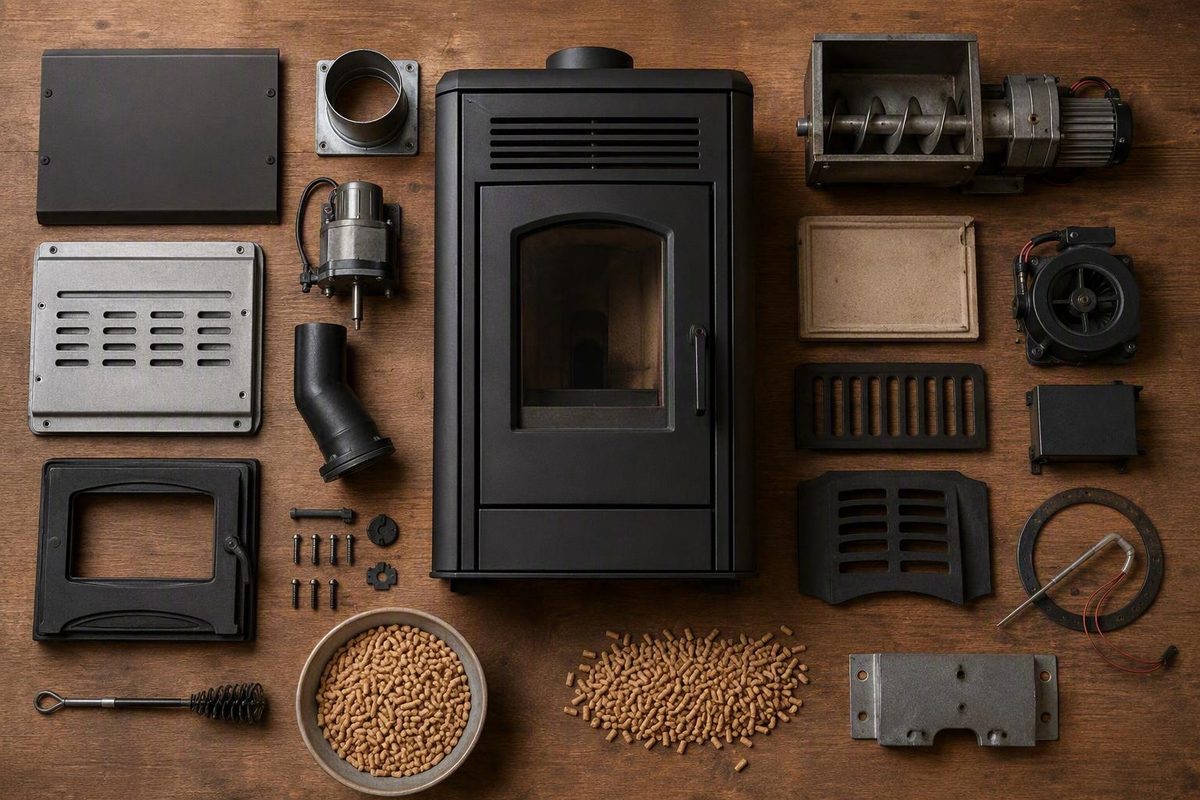
Evaluate an Englander pellet stove by its identification plate—not its cabinet, brand name, or seller’s description. Before buying, installing, or repairing one, photograph the rating plate, record the complete model and serial number, and obtain the manual covering that model and production revision. Those details determine which installation rules, certification records, and replacement parts apply.
This is primarily a guide to documented legacy models. The available evidence does not establish a current Englander lineup, current prices, warranty coverage, or comparative reliability.
Start here: identify the exact stove and treat availability as unresolved
Use this four-item identification checklist:
- Photograph the entire rating plate. Make sure certification marks, alternate model numbers, and small-print suffixes are legible.
- Record the complete model number. Do not omit prefixes, suffixes, or another model number printed on the plate.
- Record the serial number. Instructions and parts compatibility may depend on the applicable production range.
- Find the matching manual. Confirm that it covers both the plate model and the relevant production revision or serial-number range.
Historically documented identification leads include the 25-PDV, 25-PDVC, 25-CBEP, and 25-EP families. These should not be read as a list of models currently sold new.
The manufacturer’s pellet-stove category says Englander products have been made in the United States since 1976, but the page reviewed for this guide also displays “No results.” That does not establish whether any particular model is currently available, discontinued, or replaced. It also provides no usable current pricing information. Check the official Englander pellet-stove category when shopping, but verify the individual listing and documentation rather than relying on the category filters.
A manufacturer manual dated October 7, 2013 identifies England’s Stove Works, Inc. as the manufacturer of the 25-PDV, 55-SHP22, and 55-TRP22. That document is authoritative for the models and revision it covers, but it is not a current product catalog or a universal manual for Englander stoves.
The source type matters:
- Manufacturer manuals are the starting point for model-specific installation, operation, and maintenance, although older editions may not reflect later revisions or current local requirements.
- EPA records address certification or laboratory emissions, not reliability, installed cost, or whether a stove will heat a particular house.
- Retailer and parts-catalog pages can provide useful identification leads, but their compatibility, availability, and promotional claims need confirmation.
- Current product status remains uncertain unless supported by a current first-party model listing.
Model and alias lookup for manuals and parts
A commercial parts retailer says Englander stoves were also sold under the Summer’s Heat and TimberRidge names. This can explain why similar appliances carry different plate numbers, but an alias is only a lookup lead.
The following mappings are reported by that retailer; they are not manufacturer confirmation that every component works across every production revision.
| Englander family | Reported Summer’s Heat alias | Reported TimberRidge alias |
|---|---|---|
| 25-PDV | 55-SHP22 | 55-TRP22 |
| 25-PDVC | 55-SHP10 or 55-SHP10L | 55-TRP10 |
| 25-CBEP | 55-SHPCBEP | 55-TRPCBEP |
| 25-EP | 55-SHPEP | 55-TRPEP |
These mappings and categories for motors, igniters, control boards, switches, sensors, gaskets, and other components appear in the retailer’s Englander parts-by-model catalog.
Before ordering a replacement part, match:
- The model printed on the rating plate
- The serial number or stated production range
- Manufacturer documentation covering that revision
- The replacement component’s exact part number and specifications
A shared family name or retail alias does not establish compatibility. If a seller cannot connect the proposed part to the stove’s plate information and applicable documentation, treat the fitment as unverified.
What can be verified about the 25-PDVC and 25-CBEP
Published information for these models comes from sources serving different purposes. The 25-PDVC details are retailer advertising, while the 25-CBEP figures describe the appliance used in an EPA research project.
| Model | Supported detail | Source type | Limitation |
|---|---|---|---|
| 25-PDVC | Advertised for “up to 1,500 sq. ft.”; digital heat-output and blower controls; outside-air hookup; double-auger feed system | Retailer page | Promotional description without sizing assumptions or independent performance results |
| 25-CBEP | Rated output of 7,918–15,318 Btu/hr; approximate 3.7 lb/hr burn rate; 45 lb hopper | EPA research presentation | Specifications for one tested appliance, not the brand generally |
The retailer’s 25-PDVC description does not turn “up to 1,500 square feet” into a dependable sizing answer. The page does not state the assumptions or test conditions behind its coverage claim.
The 25-CBEP specifications come from an EPA research presentation and describe the tested stove. They should not be transferred to another Englander model, retail alias, or production revision.
Current price, availability, certified efficiency, warranty, dimensions, and real-world hopper runtime are not established for either model by these sources. Hopper capacity alone is not a runtime figure; the available evidence does not provide the operating assumptions needed to calculate one responsibly.
Documented installation rules for the 25-PDV family
The measurements and restrictions below apply specifically to the October 7, 2013 manual for the 25-PDV, 55-SHP22, and 55-TRP22. Do not transfer them to a 25-PDVC, 25-CBEP, 25-EP, or another family.
For those three covered models, the manual states:
- Outside combustion air is mandatory.
- Approved 3-inch pellet vent is specified, increasing to 4-inch vent above 4,000 feet or when the vent reaches 15 feet.
- Horizontal vent runs should not exceed 4 feet.
- The stated maximum vertical flue height is 35 feet.
- Mobile-home or doublewide installation is conditional on connecting outside combustion air and meeting the manual’s other requirements.
- Installation in a sleeping room is prohibited.
- A stove installed in the same room as a central-furnace cold-air return must be at least 20 feet from that return.
- On a combustible floor, the 25-PDV floor protector must extend at least 1 inch behind the stove, 4 inches on each side, and 6 inches in front.
These requirements appear in the manufacturer-hosted 25-PDV, 55-SHP22, and 55-TRP22 installation and operation manual. Because that manual is dated 2013, also obtain the documentation applicable to the stove’s exact revision and follow current local codes, permit and inspection requirements, and the vent manufacturer’s instructions.
Before approving an installation plan, document:
- Exact plate model and applicable manual revision
- Installation altitude
- Vent diameter, route, horizontal length, and vertical rise
- A feasible outside-air route
- Combustible or noncombustible floor construction
- Whether the proposed location is a sleeping room
- The location of any central-system cold-air return
- Local permit requirements
- Final inspection requirements
A seller’s claim that a stove “just vents through the wall” is not an installation design. The complete route must work for the identified appliance, the chosen vent system, the building, and current local requirements.
Fuel, cleaning, outages, and smoke-back
For the 25-PDV, 55-SHP22, and 55-TRP22 covered by the 2013 manual:
- The specified fuel is nominal 1/4-inch wood pellets.
- Pellets longer than 2 inches may bind the auger.
- Before each restart, remove ash from the burn-pot area and clear the air holes in the wear plate.
- Maintenance is organized into daily, semi-weekly, monthly, and annual categories.
- If smoke enters the room, do not open the hopper or door and do not unplug the stove. The subsequent procedure depends on whether electrical power has failed.
- The manufacturer does not recommend these pellet stoves as the home’s only heat source.
Follow the exact procedures in the manual for the covered models, rather than substituting a generic cleaning, smoke-back, or power-outage routine. Access points and required tasks can differ among stove families.
The warning against relying on these stoves as the only heat source makes an outage plan important. That plan should identify an alternative source of heat and the model-specific steps to follow if the stove loses power or begins releasing smoke into the room.
What EPA certification and one 25-CBEP test actually show
EPA certification demonstrates that an exact appliance complied with an applicable particulate-emissions limit under specified laboratory testing. It does not establish reliability, operating cost, safe installation, suitability for a particular house, or the emissions a household will experience under different fuel, maintenance, venting, and operating conditions.
EPA’s Burn Wise program content is now archival. To check an appliance, search the current EPA-certified wood-heater database using the exact model on the rating plate. Do not assume that certification transfers automatically to another Englander family or retail alias.
EPA researchers also conducted a narrower laboratory study involving one England’s Stove Works 25-CBEP. The stove was tested in 2022 with PFI-certified low-ash hardwood pellets and three replicates. Reported particulate-matter emission factors differed substantially by operating phase:
| Operating phase | PM emission factor | CO and total speciated VOC pattern |
|---|---|---|
| Startup | 14.20 g/kg | Substantially higher than medium and high fire |
| High fire | 1.61 g/kg | Lower |
| Medium fire | 1.18 g/kg | Lower |
| Low fire | 11.47 g/kg | Substantially higher than medium and high fire |
The EPA presentation on residential biomass emissions likewise reported substantially higher carbon-monoxide and total speciated-VOC emission factors during startup and low fire than during medium and high fire.
This was preliminary laboratory research involving one stove, one pellet product, and three replicates. It cannot characterize every Englander model, fuel, installation, or household operating pattern, and it should not be converted into universal advice to operate a stove at a particular setting.
A practical buy-or-keep decision checklist
Base the decision on identity and compatibility rather than the asking price alone.
| Outcome | When it fits | Next step |
|---|---|---|
| Proceed to inspection | Plate and serial number are readable; the matching manual is available; EPA status can be checked where relevant; the installation can be reviewed against current requirements | Arrange an inspection by someone familiar with pellet appliances and local permitting requirements |
| Request more documentation | The seller provides only an alias, square-foot claim, claimed runtime, or uncertain model year | Request plate photos, serial number, matching manual, certification label, service history, and installed-part numbers |
| Price in repairs | Identity is confirmed, but likely wear components need replacement | Confirm current availability and exact compatibility of igniters, motors, control boards, switches, sensors, and gaskets before negotiating |
| Walk away or pause | The plate is missing; a substituted control board is unverified; smoke damage is unexplained; or intended venting conflicts with the manual or local requirements | Do not buy or install the stove until the conflict can be resolved authoritatively |
An aftermarket component is not automatically unsuitable, but its fitment should be documented for the exact model and applicable production range.
The available evidence does not support a current Englander price guide, comparative reliability ranking, installed-cost estimate, or recommendation of a “best” Englander model. Those judgments would require current first-party listings, local installation quotes, warranty terms, model-specific parts availability, and consistently collected ownership data.
The durable rule is model first: evaluate an Englander only after matching the plate model, retail alias, serial number, manual revision, EPA record, installation conditions, and replacement-part compatibility. Historical records are useful for legacy ownership—especially for the documented 25-PDV family—but current availability, price, warranty, and model comparisons require current first-party confirmation.
Is Englander the same as Summer’s Heat or TimberRidge?
Those names can identify related stove families. A commercial parts catalog maps several Englander models to Summer’s Heat and TimberRidge numbers, including 25-PDV to 55-SHP22 and 55-TRP22. The alias alone does not prove that a replacement part fits every serial range or production revision.
Can an Englander 25-PDV be installed in a mobile home?
The cited 2013 manual permits mobile-home or doublewide installation for the covered 25-PDV family only when outside combustion air is connected and the manual’s other requirements are satisfied. Confirm the stove’s revision and obtain any required local permit and inspection before installation.
Can an Englander pellet stove be installed in a bedroom?
Do not assume that it can. The cited 2013 manual prohibits installing the 25-PDV, 55-SHP22, or 55-TRP22 in a sleeping room. Requirements for another model must come from that model’s applicable manual and current local rules.
Does EPA certification mean an Englander stove will heat my home efficiently?
No. EPA certification addresses compliance with an applicable particulate-emissions standard under defined testing. It does not prove that the stove is properly sized for your house, economical to operate, reliable, safely installed, or efficient under your household’s actual conditions. Use the exact model’s EPA record alongside its current specifications and a home-specific heating assessment.