
Keep an Old Whitfield Running Without Buying the Wrong Part
Serial breaks for Profile and Advantage, which Whitfield manuals are missing, seller part numbers to check, and when an old stove stops being worth fixing.
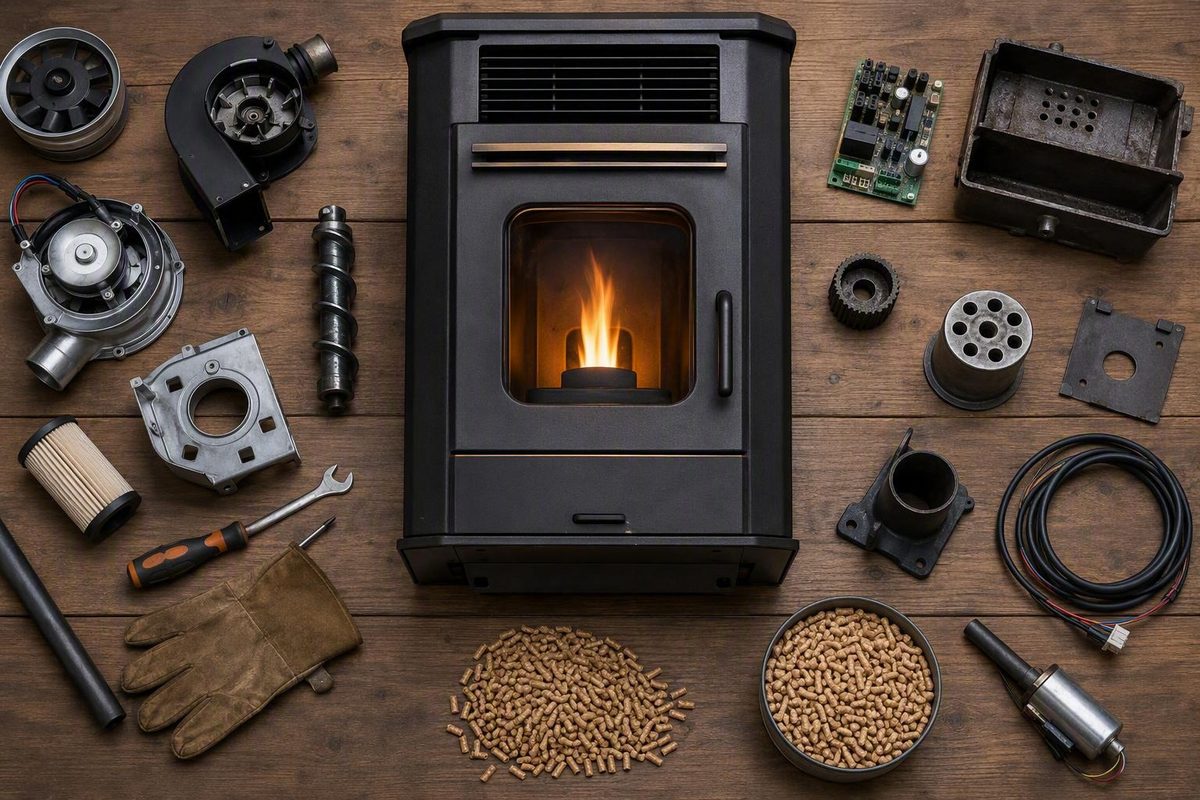
A Whitfield pellet stove is still worth keeping alive if you can do three things: read the complete model name and serial number off the plate, find documentation that matches that exact revision, and buy parts against the numbers on the old component rather than a seller’s model claim. Third-party retailers still advertise Whitfield combustion and convection blowers, auger motors, igniters, burn pots, gaskets, snap discs, pressure switches, control boards and glass, and a repair-service library carries tutorials for the Advantage, Profile, Traditions and Optima families. What you cannot do is treat “Advantage” or “Profile” as a part number: Profile 20 and Profile 30 each split into revisions at a specific serial, and one manual directory openly marks eleven variants as having no manual at all. If the firebox or heat exchanger is suspect, or the venting and wiring need major correction, stop buying parts and price a replacement.
Pick your model family and tick what you have already recorded; the model card and readiness check update below.
Whitfield Model Lookup and Ordering Readiness
| Family | Serial break / variants | Manual (directory) | Parts / videos noted |
|---|---|---|---|
| Advantage | II-T: 1990–2000, serial 18145+ | Unavailable for I, II, III, Plus FS, Plus INS | 12056010 blower; 12145903 pressure-switch kit; board, auger, proof-of-fire videos |
| Cascade | — | Listed | — |
| Explorer | — | Unavailable | — |
| Frontiersman | — | Unavailable | — |
| Legend | — | Unavailable | — |
| Optima | — | Listed; Optima 3 INS unavailable | Component videos |
| Prodigy | Prodigy 1, Prodigy 2 | Unavailable for both | — |
| Profile | 20 FS/FS-2 at 7494/7495; 30 FS/FS-2/INS/INS-2 at 11904/11905 | Listed | Component videos |
| Quest | Quest vs Quest Plus: chute shape, control board (forum report) | Listed; forum-shared Quest service manual, unauthenticated | 12145903 pressure-switch kit |
| Renaissance | — | Listed | — |
| Traditions | — | Listed | Component videos |
Sources: serial breaks from a commercial Whitfield identification directory; manual status from a third-party manual directory (“Listed” means an entry exists, not a verified PDF); part numbers are one seller's fitment claims (burn pot 12150700 for serials 7217–43377 is listed without a model). None are manufacturer-verified. — = not stated in our sources.
Read the Full Model and Serial Before Touching a Catalog
Write down the whole designation, suffix included. FS, INS, II-T and FS-2 are not decoration; they mark freestanding versus insert format and revision. Record the serial exactly as printed, note whether the stove is freestanding or a fireplace insert, and photograph the control panel, door, hopper, feed chute, burn pot and every label on the installed components. One parts seller says the identification may be on a rear panel or door. Treat that as a place to look, not a rule for every model, and do not dismantle or tip the stove to find it.
The family name alone is not enough. Third-party resources cover Advantage, Cascade, Explorer, Legend, Optima, Prodigy, Profile, Quest, Renaissance and Traditions, and at least two of those families split into revisions at specific serial numbers.
| Model | Reported break | Why it matters |
|---|---|---|
| Advantage II-T | 1990–2000, serial 18145 and up | A generic Advantage search returns other revisions |
| Profile 20 FS / FS-2 | Serials 7494 / 7495 | Suffix and serial must be read together |
| Profile 30 FS, FS-2, INS, INS-2 | Serials 11904 / 11905 | Format and revision both change the documentation |
These ranges come from a commercial Whitfield model-identification directory, not from manufacturer production records. Use them as leads and confirm against the plate and the parts list.
If the plate is missing or unreadable, send the full photo set — front, sides, rear, controls, door, hopper, feed opening, burn pot and every part label — to a pellet-stove specialist and ask for an identification before you order. Looking like a photo online does not establish the revision.
Which Whitfield Manuals Exist and Which Ones Are Missing
“Manual” covers four different documents, and they are not interchangeable.
| Document | What it gives you | What it lacks |
|---|---|---|
| Owner / operation | Startup, shutdown, fuel, cleaning, user troubleshooting | Electrical diagnostics |
| Installation | Venting, clearances, floor protection, outside air | Component tests |
| Service / technical | Diagnostic sequences, wiring, component tests | Basic operating instructions |
| Parts list | Assemblies, diagrams, original part numbers, revision breaks | How to test anything |
A parts list identifies a control board without telling you how to test it. A service manual assumes you already know how to run the stove. An owner’s manual will not carry a wiring diagram.
One third-party Whitfield manual directory has pages for Advantage, Cascade, Optima, Profile, Quest, Renaissance and Traditions variants. It also explicitly marks manuals unavailable for Advantage I, II and III; Advantage Plus FS and INS; Explorer; Frontiersman; Legend; Optima 3 INS; and Prodigy 1 and 2. That contradicts the page’s own claim that manuals exist for all models, and an entry without the “unavailable” label does not prove a complete, authentic PDF is downloadable today. It is a starting point.
Forums sometimes turn up what search does not. In one Whitfield Quest thread, participants reported sharing a complete Quest service manual and said Quest and Quest Plus can be told apart by chute shape and control board. The file was stated to be for Quest, not Quest Plus. None of that is authenticated; the visual tell is a clue, not a substitute for the plate.
Before following any technical procedure from a found document, check that its title page names your model and format, that the controls and diagrams match your stove, and that its part numbers match an illustrated parts list. If provenance is missing or the file looks abbreviated, have a specialist confirm it applies.
Check Fitment Against the Old Part, Not the Listing
Start with the component in the stove. Record the original part number and every marking, the dimensions and mounting pattern, voltage and connector type where relevant, and motor speed and rotation for anything that turns. Then compare that to the seller’s written model and serial range, the warranty terms, and the return policy including restocking and return shipping.
Seller listings show how narrow the checks get. One retailer lists 12056010 as an Advantage combustion blower, 12150700 as a burn pot for serials 7217–43377, and 12145903 as an Advantage/Quest pressure-switch kit. Its auger-motor listing applies only to stoves that need 1 rpm, clockwise rotation. The same seller tells buyers to measure certain burn grates before ordering. These are the seller’s fitment statements, not manufacturer confirmation, so check the stated Whitfield part specifications against the installed component and get the fitment in writing.
| Evidence | If it is missing |
|---|---|
| Model, revision, serial, format | Stop and identify the stove |
| Old part number and markings | Photograph it and ask a specialist |
| Dimensions, connectors, voltage, rpm, rotation | Do not infer them |
| Written fitment range | Ask before paying |
| Warranty and return terms | Pick a seller that offers them |
A part that can be physically set in the same spot is not thereby compatible. Resolve every discrepancy through matching documentation, written seller confirmation, or professional identification.
Troubleshoot by System, Not by Guessing the Part
Write down exactly what the stove does and when, then work through the correct manual, inspecting only what that document covers.
Power and controls first: does the display light, do the lamps, switches or fans respond? A dark panel does not by itself prove a dead control board. Then separate the two air paths. If the stove lights and holds a fire but no warm air moves into the room, the problem is on the convection side, and the convection blower is a different part from the combustion blower.
The Whitfield repair-video index lists tutorials for Advantage control boards, auger motors and proof-of-fire sensors, plus Profile, Traditions and Optima components. The topics are confirmed; whether each procedure is right for your revision is not.
Energized electrical testing, altering safety controls, smoke leaking into the room, damaged wiring and combustion that does not look right are technician jobs. So is anything not clearly covered by authenticated documentation for your model.
Advantage Series Fuel, Shutdown and Cleaning Rules
Everything in this section comes from an abbreviated, older reproduction of the Whitfield Advantage operating instructions. It covers the Advantage Series only, is not a complete manual, and is not current installation authority. Do not apply it to Profile, Quest, Optima or any other Whitfield.
Fuel: wood-residue pellets and certain non-wood pellets up to 3% ash are permitted; agricultural pellets such as corn and alfalfa are prohibited, as is dirty, wet or high-sodium fuel. Premium pellets are described as 1% ash or less, standard as up to 3%, and the document’s practical point is that higher-ash fuel means more frequent cleaning. Routine cleaning covers the burn grate, heat-exchanger tubes, ash pan, ash traps and baffles, on a cool stove with the power disconnected.
Operation: initial auger priming takes roughly 10–15 minutes. Manual lighting uses an approved fire starter, never a flammable liquid. A normal flame is bright yellow with no soot at the tip. On shutdown, pellet feed stops but the blowers may run up to 45 minutes. The covered Advantage generally does not restart on its own after a power outage. After an overheat shutdown, wait 45 minutes before relighting by hand. Solid-state thermostats are not approved for this series.
The reproduction also carries old clearance and venting dimensions. Ignore them for any installation decision; use the exact applicable manual, current local requirements and a qualified installer.
Where Whitfield Parts Actually Come From
Four routes, each good for something different.
| Route | Best for | Weak point |
|---|---|---|
| Specialist retailer | Model-organized catalogs, identification help | Fitment claims are still commercial |
| Broad marketplace | Old stock, used parts, multiple sellers | Condition, provenance and fit vary |
| Repair-video library | Seeing where components sit | Video may show another revision |
| Forum or archive | Legacy documents, model clues | Uploads may be incomplete or unauthenticated |
Specialist retailers advertise blowers, auger motors, snap discs, gaskets, control boards and burn pots, and some take parts requests by phone or email. Useful when a number has changed, but a confident voice on the phone is not documented fitment.
Marketplaces carry Whitfield auger motors, fans, igniters, blowers, thermostats, inserts and odd lots. The current Whitfield marketplace listings show activity, not verified stock, OEM status, condition, compatibility or stable pricing.
Buy from the listing that has a traceable part number, an explicit model, revision or serial range, documented dimensions and electrical specs, a clear condition statement, a warranty, and a return policy that still makes sense after shipping and restocking.
When to Stop Fixing a Whitfield
Age alone does not condemn the stove, and a lit fire does not save it. The decision turns on structure, a correct diagnosis, parts support, how many failures are stacking up, and the installation.
| Factor | Keep investigating repair | Price a replacement |
|---|---|---|
| Structure | Firebox and heat exchanger sound after competent assessment | Firebox or heat-exchanger damage suspected |
| Parts | Exact compatible component verified | Structural or model-specific part unavailable |
| Failures | One identified repair fixes it | Major or repeated failures stacking up |
| Installation | Continued use can be validated | Wiring, venting, clearances or floor protection need major correction |
This is a framework, not an inspection. The available sources give no reliable method for judging structural integrity and no realistic parts-and-labor cost model, so I will not invent one. Suspected firebox, heat-exchanger, wiring or venting damage goes to a professional.
A retailer’s Whitfield repair-versus-replacement piece draws the same line between wear parts and structural problems. Its suggested new stoves are sales recommendations, not evidence that any of them is a drop-in Whitfield replacement.
Do not assume the existing vent carries over to a new stove. Vent diameter, liner requirements, clearances, floor protection and electrical needs all get checked again against the new appliance’s manual.
Are Whitfield Parts Still Available?
Retailers and marketplaces still advertise blowers, auger motors, igniters, burn pots, gaskets, sensors, pressure switches, boards, electrical components and glass. That is not the same as a compatible part existing for your stove; availability depends on model, serial range, revision, component and what is in stock this week.
Can Every Whitfield Manual Be Downloaded?
No. The directory cited above marks manuals unavailable for several Advantage variants, Explorer, Frontiersman, Legend, Optima 3 INS and both Prodigy models. An unlabeled entry is not proof of a complete, authentic PDF either.
Can a Whitfield Advantage Burn Corn or Alfalfa Pellets?
Not under the reproduced Advantage instructions, which prohibit agricultural pellets for that series. Do not carry that answer to another Whitfield model without its own manual.
Will an Advantage Restart After a Power Outage?
The reproduction says the covered Advantage generally will not restart automatically when power returns. Controls vary by model and revision, so confirm the relight procedure for your stove before touching it.
The order of work: photograph and record the full model, serial, revision and format; find the matching owner, installation, service and parts documents; record the old component’s number, dimensions, connectors and electrical or motor specs; get fitment in writing with usable return rights; and call a pellet-stove professional when diagnosis, structure, wiring, combustion, venting or installation is in doubt.