
What Your Pellet Stove’s Symptoms Are Telling You
Match no power, failed ignition, no feed, shutdowns, pellet buildup, and soot to owner-safe checks—and know when to stop and call for service.
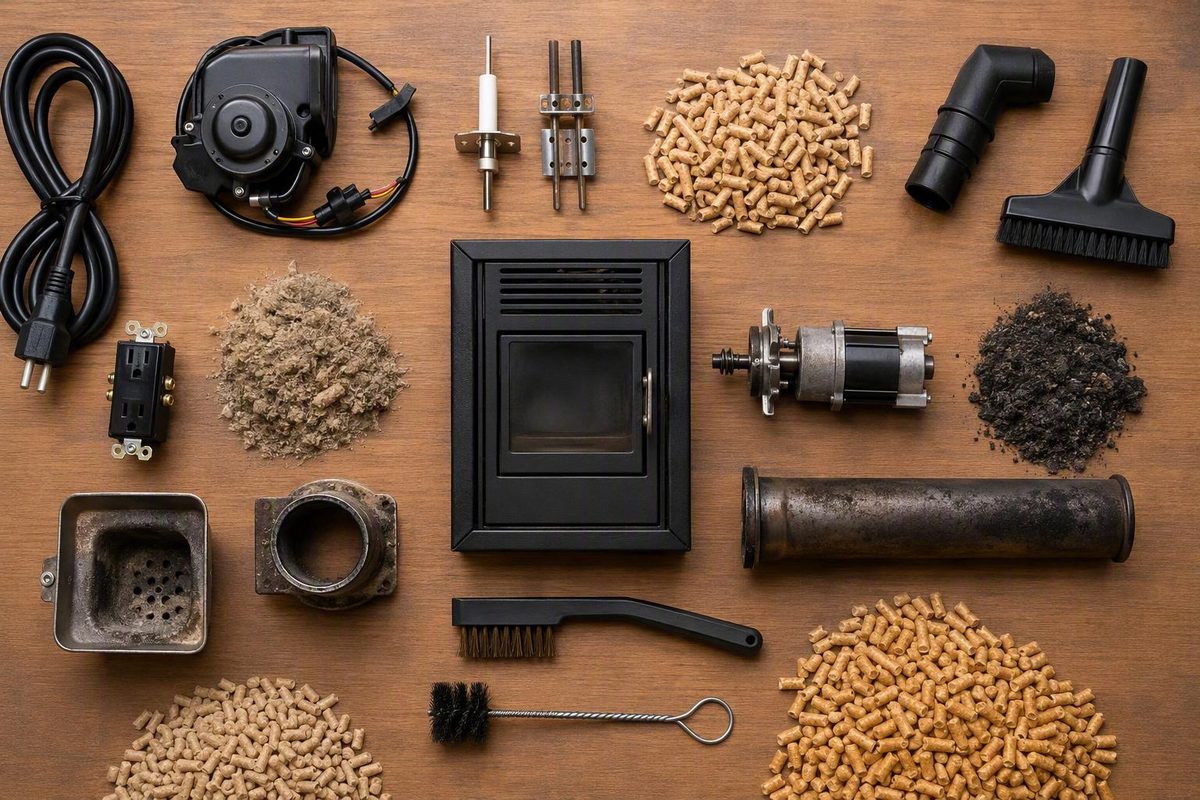
Problems with a pellet stove are easiest to narrow down in operating order: power, airflow and draft confirmation, pellet feed, ignition, then proof of fire. Begin with observations that do not require opening the appliance. Once the stove has completed shutdown and is fully cool, the pellets left in the burn pot can provide useful clues.
Stop using the stove if you find smoke leakage, abnormal heat, electrical damage, a failed blower, or repeated safety shutdowns. A glowing exterior component can indicate overfiring; the Harman Absolute63 manual, for example, explicitly warns about this condition, although its instructions apply only to that model (Harman Absolute63 owner’s manual).
If there is an active fire, continuing smoke in the room, or another immediate danger, leave the area and contact emergency services. Otherwise, use the stove’s normal shutdown sequence when it is safe to do so, stop further operation, and arrange qualified service.
Start here: match the symptom to the safest next step
Before changing anything, record the stove’s make, model, serial number, displayed error code, and burn-pot condition. These details help you locate the correct manual and give a service technician a more useful starting point.
| Symptom | Owner-safe observations | Manual-dependent step | Stop or call for service |
|---|---|---|---|
| No power | Check the outlet, household breaker, heat setting, doors, and hopper closure | Review alarms, reset instructions, and any owner-serviceable fuse | Internal fuse, wiring, control-board, or recurring power fault |
| Power but no ignition | Confirm dry approved pellets, a closed door, and no visible blockage in burn-pot holes | Clean approved areas and use the specified reset procedure | Pellets accumulate, resets fail, or igniter testing is required |
| No pellet feed | Check fuel level, bridging, pellet dust, and visible obstructions without reaching into the mechanism | Follow the manual’s hopper and feed checks | Auger, motor, switch, sensor, or wiring diagnosis |
| Shutdown soon after ignition | Note whether a flame formed, when shutdown occurred, and what remained in the burn pot | Read the error code and model-specific proof-of-fire guidance | Repeated vacuum, high-limit, or other safety shutdowns |
| Pellets piling up | Stop restarting; note whether pellets are raw, partly burned, or sooty | Remove excess fuel and clean only as directed after cooldown | Unresolved ignition, draft, feed, or combustion fault |
| Lazy or sooty combustion | Inspect pellet condition, door and ash-pan closure, glass darkening, and visible burn-pot holes | Perform cooled, approved cleaning and specified air adjustments | Smoke leakage, persistent soot, or suspected vent obstruction |
| Failed blower | Shut down through the normal controls if that can be done safely | None beyond manual-authorized checks | Stop use and arrange qualified service |
| Glowing exterior parts | Do not continue normal operation | Follow the model’s overfire or emergency instructions | Stop use and obtain qualified help |
Perform manual-approved cleaning and ash handling only when the appliance is off and fully cool. Disconnect power when the manufacturer instructs you to do so. Never reach into an energized or moving feed mechanism, and never bypass a door, hopper, vacuum, pressure, or high-limit safety control. Model-specific manuals may prohibit modifications and assign installation or repair work to qualified service.
Follow the startup sequence to locate the failure
Designs vary, but many pellet stoves start in roughly this order:
- The exhaust or combustion blower starts.
- A pressure or vacuum control confirms sufficient draft.
- The feed system delivers pellets.
- The igniter starts the fire.
- A proof-of-fire device detects sufficient heat and allows operation to continue.
A commercial troubleshooting guide describes an approximately 15-to-30-minute startup window for detecting sufficient heat. Treat that as a diagnostic reference, not a universal timer: timing, sensors, controls, and shutdown behavior vary by manufacturer and model (pellet-stove startup and proof-of-fire guide).
The point where startup stops can narrow the possibilities:
- No response at all: begin with household power, normal controls, closures, displayed alarms, and model-authorized fuse checks.
- The blower runs but pellets do not feed: draft may not have been confirmed, a safety control may be open, or the feed system may be obstructed or faulty.
- Pellets feed but no flame forms: consider pellet condition, ignition, combustion airflow, and venting.
- A flame forms and the stove then shuts down: consider failure to establish or detect proof of fire, unstable draft, interrupted fuel delivery, or another safety trip.
Proof-of-fire methods are not standardized. Use the error-code, startup, and reset instructions for the exact stove rather than applying a universal reset sequence.
No power or power but no ignition
For a stove with no power, begin outside the appliance:
- Confirm that the outlet works and check the household breaker.
- Make sure the thermostat or normal operating control is calling for heat.
- Close the firebox door and hopper lid properly.
- Read any displayed alarm or status indicator.
- Consult the manual before checking or replacing an owner-serviceable fuse.
A tripped high-limit control, blown controller fuse, or surge-related controller damage is possible, but access and reset procedures vary. Do not remove panels or probe electrical circuits unless the manufacturer explicitly assigns that procedure to the owner. Internal wiring and control-board diagnosis require qualified service.
If the stove has power but will not ignite, check that:
- The hopper contains dry pellets approved for the stove.
- The firebox door is fully closed.
- Visible burn-pot openings and owner-accessible air paths are clear.
- The burn pot is seated as the manual specifies.
- You have followed the manufacturer’s normal reset procedure.
Damp pellets, residue buildup, an improperly closed door, or a blocked smoke outlet can interfere with ignition. Ecoforest’s general guidance recommends using the manufacturer’s reset procedure and contacting technical service when the fault persists (Ecoforest pellet-stove ignition guidance).
Deeper causes can include a failed igniter, inadequate draft, obstructed venting, an exhaust-blower problem, or failure to detect proof of fire. Because these faults can produce similar symptoms, pellets failing to light does not by itself prove that the igniter needs replacement.
Do not keep initiating startup cycles when unburned pellets are accumulating. Each attempt may add fuel without correcting the original fault. Let the stove cool, then remove excess pellets only as its manual directs. Refer unresolved resets, igniter testing, control-board work, and internal wiring to qualified service.
No pellet feed or repeated shutdowns: read the burn pot
After the stove has completed shutdown and is fully cool, examine what remains in the burn pot. The conditions below are clues, not definitive diagnoses.
| Burn-pot condition | What it may suggest | Safest next step |
|---|---|---|
| Empty | Empty hopper, pellet bridging, excess pellet dust, an obstruction, interrupted motor power, or a slowing feed system | Check fuel and visible owner-accessible areas; do not reach into the auger |
| Full of unburned pellets | Failed ignition, unsuitable draft, interrupted feeding, wind affecting the fire, or a safety-control event | Stop restart attempts; remove excess fuel as the manual directs |
| Partially burned pellets | Power loss, failure to confirm proof of fire, high-limit activation, or unstable combustion | Record the alarm and shutdown timing; inspect approved cleaning areas |
Pellet bridging occurs when fuel hangs up in the hopper rather than falling consistently into the feed system. Do not put your hands or tools near the auger unless the manual provides a specific de-energized procedure.
If the stove starts, develops a visible fire, and then shuts down while the fire remains, a dirty or failed proof-of-fire device is one possibility. It is not a diagnosis: weak draft, low heat output, inconsistent fuel delivery, or another safety event can produce a similar result.
Auger disassembly, motor testing, sensor work, and electrical diagnosis are technician tasks unless the manufacturer provides an explicit owner procedure. A safety switch that interrupts feeding may be responding to a real draft or temperature problem; bypassing it conceals the warning instead of correcting the cause.
Pellets piling up, lazy flame, soot, or weak combustion
Pellets pile up when fuel arrives faster than the stove can ignite and burn it. Restricted combustion airflow is one possible cause. Ash may block burn-pot holes, collect in air passages, or obstruct the route through the appliance and exhaust vent. A weak exhaust blower can create a similar symptom.
Other possibilities include:
- Damp pellets or fuel not approved for the stove
- Inconsistent pellet delivery
- An incorrect air-to-fuel balance
- Leakage around the door, ash pan, or another firebox opening
- Obstructed venting
- Draft affected by installation conditions or wind
Air leaks do not necessarily provide useful combustion air.
A lazy orange flame, heavy soot, or glass that darkens rapidly can suggest inadequate combustion air. Flame appearance alone does not prove a particular fault, however. The expected flame pattern and correct air or feed adjustment are model-dependent, so do not copy settings from another stove without checking the correct manual.
Once the stove is off and fully cool, inspect pellet condition and perform only the cleaning assigned to the owner. Depending on the model, that may include scraping the burn pot, clearing its visible holes, vacuuming accessible cold ash, or cleaning designated ash traps. Do not remove fixed panels or disturb gaskets, wiring, sensors, blowers, or vent joints unless the manual specifically permits it.
A clean-looking burn pot does not rule out an airflow problem. Fine ash and fly ash can collect in designated internal passages, vent elbows, and horizontal vent sections. That is why cleaning the visible pot may improve combustion without resolving a recurring vacuum alarm or shutdown.
Prevent recurring problems with a manual-led maintenance routine
The appliance manual, actual fuel consumption, and observed ash accumulation control the maintenance schedule. The intervals below are planning examples from a commercial maintenance guide, not universal requirements (Forge & Flame pellet-stove troubleshooting guide).
| Area | What to inspect or clean | Example timing—not universal | Who should do it |
|---|---|---|---|
| Burn pot | Carbon, ash, blocked holes, correct seating | Daily or as needed | Owner, if the manual allows |
| Firebox and glass | Loose ash, soot, glass deposits | Weekly or as needed | Owner, after full cooldown |
| Ash traps and air passages | Ash in designated access points | Per manual and observed buildup | Owner or technician |
| Door and ash-pan seals | Damage, debris, poor seating | Monthly or as needed | Visual owner check; repair as specified |
| Blowers | Dust, noise, weak operation, damage | Annual or as needed | Usually a technician |
| Electrical components | Wiring, controls, sensors, connections | Annual or as needed | Qualified service |
| Exhaust venting | Fly ash, soot, obstruction, joint or installation problems | Annual or as needed | Qualified stove or vent service |
A stove burning heavily may need cleaning sooner than the example intervals suggest. Another model may specify different access points, procedures, or service requirements.
Soot and fly ash can collect beyond the firebox, particularly in vent elbows and horizontal runs. Cleaning the visible burn pot therefore may not resolve a fault caused by accumulation elsewhere in the exhaust path.
Ash handling must also follow the model manual. The Harman Absolute63 manual says to vacuum only when the stove is cold and to place ashes in a tightly covered steel container away from combustible materials until all cinders are thoroughly cool. Those are instructions for that specific model; use your own stove’s manual for its required procedure (Harman Absolute63 owner’s manual).
Consider professional pre-season or periodic inspection for blowers, exhaust venting, electrical controls, safety devices, and passages the owner cannot access. Forge & Flame recommends professional maintenance before the heating season, while the Absolute63 manual separately calls for at least annual inspection by qualified service for that model.
Know when the problem requires service or a recall check
Stop owner troubleshooting and obtain qualified service for:
- Internal electrical faults or damaged cords and connections
- Control-board or sensor diagnosis
- Auger or blower motor replacement
- Unresolved ignition failures
- A failed exhaust or convection blower
- Repeated high-limit, vacuum, or pressure faults
- Suspected venting defects
- Smoke leakage or abnormal heat
- Any exterior component beginning to glow
Manufacturer troubleshooting guidance generally directs unresolved ignition and internal repair problems to professional service rather than continued owner repair attempts (Ecoforest pellet-stove ignition guidance).
Do not disable safety switches, modify the appliance, install unapproved parts, or burn fuel the manufacturer does not permit. These actions can interfere with combustion and overheat protection. Exact restrictions, approved parts, and approved fuels remain model-specific.
Use the normal shutdown control rather than unplugging a running stove or deliberately exhausting its pellet supply.
A recall check is worthwhile when buying a used stove, inheriting an installed unit, or investigating an unusual failure:
- Find the exact model and serial number on the appliance label.
- Search current U.S. Consumer Product Safety Commission records.
- Check the manufacturer’s current support or recall page.
- Follow the current stop-use, repair, or replacement instructions.
- Verify contact details rather than relying on an old manual or archived notice.
As a bounded example, CPSC recall 16-109, announced in 2016, covered about 2,300 England’s Stove Works Smartstove units, model 55-SHSSP01, with serial numbers 101 through 2513. CPSC said ash-related smoke buildup could cause the door glass to break and instructed affected owners to stop using the stove until repaired (CPSC Smartstove recall notice).
That recall does not apply to pellet stoves generally or to every England’s Stove Works product. Confirm both the model and serial number, and verify old contact details or repair arrangements against current manufacturer and CPSC information.
Use the operating-order checklist for the final decision: verify power and closures, inspect the supply of dry approved pellets, note where startup stops, examine the cooled burn pot, and clean only what the manual assigns to the owner. If the stove repeatedly trips a safety control, leaks smoke, overheats, loses a blower, or requires internal electrical, sensor, auger, or vent work, stop troubleshooting and arrange qualified service using the exact model and serial number.