
How to Identify, Check, and Replace the Right Blower
Voltage alone does not prove fit: the motor can still have the wrong function, rotation, wheel, connector, mounting plate, controller relationship, or dimensions.
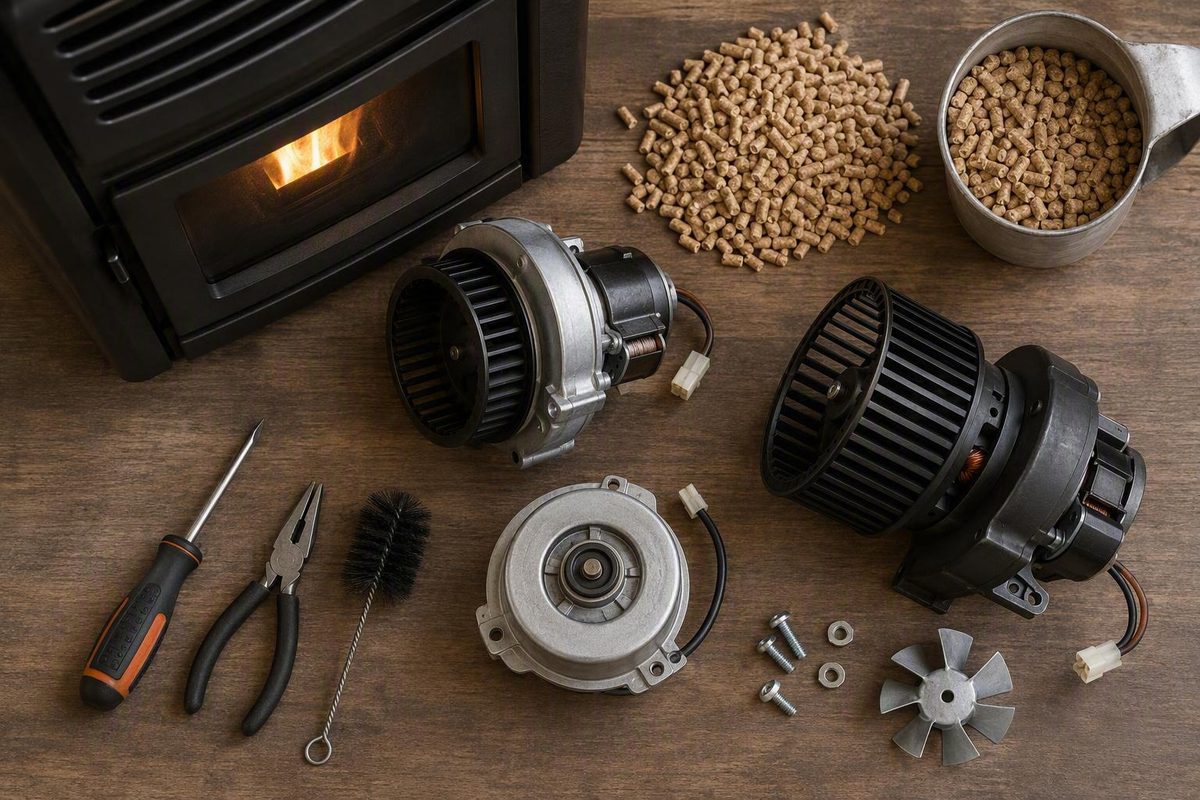
A search for a “pellet stove blower motor” can lead to several fundamentally different parts. One circulates warm air through the room. Another manages combustion airflow and exhaust. A third motor turns the pellet-feed auger but is not a blower at all. Retail catalogs often place these components in neighboring—or even shared—categories.
That distinction matters before troubleshooting and before buying. A motor with the right voltage or a familiar brand name can still have the wrong function, rotation, wheel, connector, mounting plate, controller relationship, or physical dimensions.
This guide covers identification, safe preliminary inspection, and replacement-part selection. It does not provide a universal installation procedure: removal, wiring, sealing, and post-installation checks depend on the exact stove and blower assembly.
The reliable approach is to:
- Identify the motor’s function.
- Perform only the power-off inspection and cleaning permitted by the stove manual.
- Record the stove and original-part details before comparing replacements.
- Determine whether you need a bare motor, a motor kit, or a complete blower assembly.
- Match electrical, control, and physical specifications rather than treating higher airflow or speed as an upgrade.
Shut the stove down and obtain qualified service rather than continuing to operate it or swapping parts speculatively; general pellet-stove troubleshooting guidance likewise treats overheating, airflow problems, and unresolved electrical faults as reasons for professional diagnosis rather than routine owner repair.
First identify which pellet-stove motor you need
Pellet stoves commonly use two blowers with separate jobs:
- Convection blower: Also called a distribution, room-air, or circulating blower. It draws room air through or around the stove’s heat-exchange surfaces and returns heated air to the living space.
- Combustion blower: Also called an exhaust blower, smoke fan, draft inducer, or combustion-air blower. It manages airflow through the combustion system and moves exhaust toward the vent.
- Auger motor: A slow feed motor that turns the auger and delivers pellets from the hopper toward the burn pot. It is not a blower motor, even though stores may group auger and blower products together.
Specialty-retailer categories illustrate the naming problem: they separate combustion and exhaust blowers from distribution and convection blowers while also placing auger motors and other pellet-stove components within the same broad catalog structure on their pellet-blower category pages.
Use the symptom location to choose an investigation path:
| Primary symptom | System to investigate first | What it does not prove |
|---|---|---|
| Little or no heated air entering the room | Convection or distribution side | That the room-air motor itself has failed |
| Normal fire but weak room circulation | Convection blower, air passages, wheel, controls, or wiring | That a more powerful blower is needed |
| Smoke, poor draft, abnormal flame behavior, or vacuum error | Combustion-air and exhaust system | That the exhaust motor is the only failed part |
| Pellets do not feed | Hopper, auger, feed motor, safety controls, or obstruction | That either blower is defective |
| Stove starts but repeatedly shuts down | Airflow, fuel delivery, sensors, controls, or safety system | That replacing one motor will resolve the shutdown |
| Noise near the front or room-air outlet | Convection-blower area | That the combustion blower is functioning normally |
| Noise near the exhaust-blower housing | Combustion side | That the noise is definitely internal motor damage |
These are investigation paths, not diagnoses. Weak room airflow could result from accumulated debris, a blocked passage, a wheel rubbing the housing, a slow blower, loose wiring, a control problem, or a sensor condition. A vacuum error may involve the combustion blower, but it can also reflect another problem affecting pressure, seals, or exhaust flow.
Do not assume the two blowers are interchangeable. They perform different jobs and may use different wheels, housings, mounting plates, speeds, controls, and electrical arrangements.
The auger motor is easier to distinguish once you know what to look for. It connects to the pellet-feed mechanism and normally turns much more slowly than a blower. If pellets are not reaching the burn pot, investigate the feed system rather than ordering a product simply labeled “pellet stove motor.”
What blower symptoms do—and do not—tell you
Blower symptoms are useful, but most are not specific enough to identify a failed motor on their own. The same noise or airflow loss can arise from the motor, wheel, mounting, housing, wiring, controls, sensors, or contamination.
| Symptom | Plausible areas to investigate | Important qualification |
|---|---|---|
| No room airflow | Convection blower, obstruction, wiring, controller, sensor, switch, connector, or damaged wheel | No airflow does not prove motor failure |
| Reduced room airflow | Dust, ash, hair, restricted passages, slow motor, dirty wheel, wheel contact, or control issue | Cleaning may help, but improvement is not guaranteed |
| Humming or buzzing | Motor, stalled wheel, loose part, electrical supply, controller, or capacitor where used | Sound alone is not a conclusive diagnosis |
| Screeching at startup | Bearing wear, wheel contact, motor alignment, or foreign material | Bearing wear is plausible but not the only explanation |
| Vibration | Dirty or bent wheel, loose set screw, uneven mounting, damaged gasket, housing contact, or motor wear | Replacing only the motor may leave the cause untouched |
| Blower fails to start | Obstruction, motor, wiring, connector, control, sensor, switch, or applicable capacitor | Model-specific control logic must be considered |
| Blower fails to stop | Controller, thermostat input, temperature sensor, wiring, switch, or normal cooldown logic | Some stoves intentionally run a blower during cooldown |
| Overheating or shutdown | Insufficient airflow, blocked passages, blower trouble, sensor response, or another fault | Repeated events require escalation |
| Smoke | Combustion or venting problem, inadequate draft, seal issue, blockage, or exhaust-blower trouble | Shut down and obtain qualified service |
| Vacuum error | Exhaust restriction, pressure-sensing issue, seal problem, or blower trouble | Do not assume the motor is the sole cause |
Likewise, an illuminated blower indicator does not establish that the shaft and wheel are physically turning.
A Hearth.com discussion involving a Harman Accentra II illustrates this limitation. The owner reported an illuminated blower indicator but no distribution-blower movement in test mode. Participants discussed motor drag, wiring, controls, contamination, and stove-specific ESP behavior, but the thread did not reach a confirmed final diagnosis in the Harman blower discussion. It is a useful caution against applying generic thermodisc or control-board assumptions to every stove.
Noise also needs context. A high-pitched screech that is most noticeable at startup can be consistent with bearing wear. Vibration, however, may come from a dirty or warped wheel, loose set screw, uneven bracket, impeller contact, housing problem, or missing or damaged gasket. If the cause is external to the motor, installing a bare replacement may not correct it.
With the stove fully cooled and disconnected from power, a wheel that cannot move freely deserves attention. Look for a foreign object, accumulated debris, contact between the wheel and housing, or obvious mechanical damage. Stiffness is a warning sign, not a universal pass-or-fail motor test. Wheel designs, motor designs, and access arrangements vary, and forcing the wheel may cause damage.
A blower that continues running is not necessarily stuck. Pellet stoves may operate one or more blowers during cooldown. If operation continues beyond what the model-specific manual describes, possible areas include temperature sensing, thermostat input, wiring, controls, or the blower circuit. Do not bypass a sensor or safety switch to test that theory.
The dividing line is the consequence of the symptom. Smoke, repeated high-temperature shutdowns, vacuum errors, damaged wiring, or uncertain combustion-blower operation are escalation signals.
Safe checks to make before ordering a replacement
Before opening an access panel, cleaning around a blower, or touching a wheel:
- Follow the stove’s normal shutdown procedure.
- Let the stove and exhaust components cool completely.
- Disconnect the stove from electrical power.
- Locate the owner’s manual for the exact model and production version.
- Confirm which panels and components the manual permits an owner to access.
General troubleshooting guidance instructs owners to shut down and unplug a pellet stove before blower inspection or cleaning and recommends professional help for electrical repairs. The manual for the exact stove remains controlling because panel removal, cleaning access, and service boundaries vary by model.
Once power is disconnected, limit the initial inspection to visible and accessible conditions:
- Dust, ash, lint, or pet hair on the convection-blower wheel
- Debris or foreign objects inside an accessible housing
- Blocked room-air intake or outlet paths
- An impeller rubbing against its housing
- Loose mounting screws, brackets, or visible fasteners
- A wheel that appears bent, displaced, or out of alignment
- A plainly visible loose connector
- Burned, cracked, pinched, or abraded visible wiring
- A wheel that does not move freely when the manual permits it to be checked
- Heavy buildup in an owner-accessible airflow passage
Dust, ash, hair, and lint can load room-air blower blades and reduce airflow. Buildup can also unbalance the wheel or narrow an airflow path, creating symptoms that resemble a weak motor. Cleaning is therefore a reasonable preliminary step when low heat output or weak room circulation is the complaint.
Use a soft brush and vacuum only where the manual permits access. Do not apply a universal teardown procedure. Some stoves provide straightforward blower access; others require removal of wiring, exhaust components, gaskets, or assemblies intended for trained service personnel.
Do not bend blades, force a wheel, pull on wires, or disturb a sealed exhaust connection simply to determine whether cleaning helps. After permitted cleaning, reassemble the stove exactly as the manual requires before restoring power. Do not operate it with panels, guards, exhaust components, or safety devices removed.
Unless the manufacturer’s service documentation expressly assigns the work to the owner—and the owner has the necessary training—leave the following tasks to a technician:
- Measuring energized voltage at a blower
- Bypassing a vacuum switch, temperature switch, interlock, or safety device
- Testing a capacitor
- Energizing a motor while it is exposed or removed
- Bench-testing a blower
- Modifying connectors or wiring
- Diagnosing a control board
- Substituting a fuse or protection device
- Operating the stove with a blower disconnected
- Disturbing combustion-blower seals or exhaust joints without the required inspection and resealing procedure
These tasks combine electrical, moving-part, heat, and combustion-system hazards. Generic online instructions may also assume a control arrangement that the stove does not use.
Stop troubleshooting if you find burned or damaged wiring, cannot identify the blower, or cannot restore the stove to its documented configuration. The same applies if smoke enters the room, the stove overheats, it repeatedly shuts down on a safety condition, it reports a vacuum error, or there is doubt about combustion-blower operation.
A suitable service provider should have pellet-appliance or manufacturer-authorized experience and be able to work from the model, serial number, wiring diagram, and official service documentation. Do not infer that a stove is safe to run because the fire still lights or because one blower continues to work.
Build a fitment record from the stove and old blower
Do not begin replacement shopping with only the stove brand and a description such as “rear fan” or “115-volt blower.” Build a fitment record before removing or ordering anything.
Stove identification worksheet
| Field | Record |
|---|---|
| Stove manufacturer | |
| Exact model name and number | |
| Serial number | |
| Production year, if documented | |
| Applicable serial-number range | |
| Freestanding stove or insert | |
| Controller generation or display type | |
| Owner’s-manual revision | |
| Parts-diagram revision | |
| Blower function: convection or combustion | |
| Original blower assembly number | |
| Original motor number | |
| Officially documented superseded or alternate number |
The preferred fitment authority is the manufacturer’s owner’s manual, illustrated parts list, service documentation, or an authorized parts lookup tied to the model and serial number. A seller’s title can help with discovery, but it is not independent confirmation.
Production details can materially change fitment. My Fireplace Blower, for example, separates an Englander PU-4C442 convection blower for pre-2002 models from a PU-4C447 listing for 2002-and-later models in its pellet-stove catalog. This retailer example does not independently verify fitment, but it shows why “fits Englander” is insufficient.
Generation and controller type can matter as well. Fireplace Blowers Online restricts Quadra-Fire SRV7000-193 to the original pre-AE Mt. Vernon and ties Harman 1-00-02275 compatibility to stoves or inserts equipped with an Easy-Touch controller on the hopper lid in its combustion-blower listings. These are seller-provided examples, not substitutes for official documentation.
Electrical and performance worksheet
Record only values shown on the original label or in reliable documentation:
| Specification | Original part | Candidate replacement |
|---|---|---|
| Voltage | ||
| Frequency | ||
| Amperage | ||
| RPM | ||
| CFM, if documented | ||
| Horsepower, if provided | ||
| Number of speeds | ||
| Variable-control compatibility | ||
| Capacitor value and type, if applicable | ||
| Connector style | ||
| Number and arrangement of wire leads |
Physical-fit worksheet
| Feature | Original part | Candidate replacement |
|---|---|---|
| Overall motor dimensions | ||
| Shaft diameter and length | ||
| Shaft flats, threads, or keying | ||
| Rotation | ||
| Rotation viewing direction | ||
| Wheel diameter and width | ||
| Wheel position on shaft | ||
| Single or dual wheel | ||
| Housing shape and outlet orientation | ||
| Mounting-hole pattern | ||
| Mounting-plate dimensions | ||
| Bracket design | ||
| Gasket shape and dimensions | ||
| Connector location | ||
| Wire length and routing |
Rotation deserves special care. Do not infer rotation from a product photo, which may be mirrored, taken from the opposite side, or show a wheel that obscures orientation.
Before disassembly, photograph:
- The stove data plate
- The complete original blower in place
- The motor label
- Every connector before separation
- Wire colors and terminal positions
- Wire routing and clips
- The bracket and mounting plate
- The wheel and its orientation
- The housing and outlet direction
- Gasket placement
- Grounding connections
- Screw locations and spacers
Photographs do not replace documentation, but they reduce the risk of losing orientation and routing information during removal.
If a seller describes a new number as superseding the original, ask whether it is a direct replacement. “Replaces part number X” does not automatically mean that the bare motor drops into the old assembly.
When an old label is unreadable, do not guess from appearance. Give the manufacturer, authorized lookup service, or experienced parts provider the model, serial number, production details, controller type, measurements, photographs, and any legible fragments of the original number. Prefer a provider willing to confirm fitment in writing from those details.
Motor only, motor kit, or complete blower assembly?
The phrase “blower motor” does not tell you what is in the box. Products generally fall into three scopes.
Bare motor
A motor-only product may exclude the:
- Blower wheel
- Housing
- Bracket
- Mounting plate
- Gasket
- Capacitor
- Connectors
- Fasteners
- Installation instructions
This option assumes the reusable parts are compatible and serviceable—and that the old motor can be separated without damaging the wheel, bracket, or housing.
Motor kit
A kit may combine the motor with selected supporting parts, such as a capacitor, leads, connector, bracket, mounting hardware, adapter, or gasket. “Kit” is not standardized, so check the included-parts list item by item.
Complete blower assembly
A complete assembly generally includes more of the airflow structure, but the term is not perfectly consistent. Depending on the listing, it may contain the motor, wheel, housing, mounting plate, bracket, leads, connectors, capacitor, gasket, and hardware—or only some of them.
ComfortBilt’s J238-112 page shows why listing details matter. Despite the room-blower wording, the product is described as motor-only; the fan, housing, and bracket are excluded. ComfortBilt also warns that some bracket designs may make replacement of only the motor difficult or impossible on the J238-112 product page.
A motor-only replacement is most practical when all of the following are true:
- The existing housing is sound.
- The wheel is clean, straight, balanced, and compatible with the new shaft.
- The bracket and mounting plate can be reused.
- The old motor can be separated without bending the wheel or damaging the bracket.
- The replacement has the documented electrical and control characteristics.
- Rotation, shaft dimensions, and wheel position match.
- Required connectors, capacitor, gasket, and hardware are available.
- The manufacturer permits motor-level service of the assembly.
It can also avoid transferring a worn wheel or compromised mounting component to a new motor.
That does not make a complete assembly universally better. It may cost more, and its housing, plate, connector, mounting holes, and outlet orientation still must match.
Included-parts checklist
Before ordering, require a clear answer for every item:
- [ ] Motor
- [ ] Blower wheel or impeller
- [ ] Complete housing
- [ ] Mounting bracket
- [ ] Mounting plate
- [ ] Gasket
- [ ] Capacitor, if applicable
- [ ] Wire leads
- [ ] Correct connectors
- [ ] Ground lead or terminal
- [ ] Fasteners
- [ ] Spacers or adapters
- [ ] Installation instructions
Confirm separately whether a new gasket is required and whether it is included. There is no universal gasket rule. A motor-only repair may not disturb a sealed housing joint, while removal of a combustion-blower assembly may involve model-specific inspection and sealing requirements.
Also consider the required tools and service information. A lower-priced bare motor is not economical if the old wheel seizes on the shaft, the bracket cannot be separated, or the repair ultimately requires an additional assembly and gasket.
How to compare replacement specifications without creating an unsafe upgrade
A compatible pellet stove blower motor must satisfy two categories at once:
- Electrical and control compatibility
- Physical and airflow compatibility
Matching only one category is not enough.
Electrical and control fields include:
- Voltage
- Frequency
- Amperage
- RPM
- Horsepower, where specified
- Number of speeds
- Variable-speed or controller compatibility
- Capacitor requirements
- Connector type
- Wire-lead count and arrangement
- Grounding provisions
Physical and airflow fields include:
- CFM, when documented
- Rotation and defined viewing direction
- Motor dimensions
- Shaft diameter, length, and shape
- Wheel type, diameter, width, and position
- Housing shape and discharge direction
- Mounting-hole pattern
- Plate size
- Bracket configuration
- Gasket interface
- Clearance around moving parts
Retail listings show how widely specifications can vary. One McCombs Supply catalog includes examples labeled at 30, 131, 160, and 200 CFM among its blower-motor listings. A separate combustion-blower catalog includes a 105 CFM two-speed listing and a Regency example specified at 115 V, 0.98 A, and 3000 RPM. These seller-listed figures illustrate variation; they do not establish cross-model interchangeability.
Do not treat higher CFM, RPM, amperage, or horsepower as an upgrade unless the stove manufacturer explicitly authorizes the substitution. More airflow is not automatically better.
A motor with a higher nominal rating may still produce the wrong result when installed in a different housing or attached to a different wheel.
The opposite mistake is assuming that matching voltage proves compatibility. One generic marketplace listing advertises a pellet-stove motor as 115 V, 0.6 A, 3000 RPM, and 1/50 hp in its product title. Those numbers do not identify the correct stove model, blower function, rotation, shaft, wheel, housing, mounting pattern, connectors, or controller relationship.
Speed control requires special attention.
Use this comparison order:
- Confirm whether the part is for the convection or combustion system.
- Match the exact original part or an officially documented supersession.
- Verify the model, serial range, production year, and controller generation.
- Match voltage, frequency, current, speed arrangement, and capacitor requirements.
- Match rotation using the stated viewing direction.
- Match the shaft and wheel arrangement.
- Match the housing, bracket, plate, holes, and outlet orientation.
- Match connectors and wire routing.
- Verify every included component.
- Resolve every missing specification before buying.
If a candidate listing omits rotation, dimensions, connector details, or included parts, ask the manufacturer or a parts provider capable of checking the model, serial number, controller generation, and original part number. Missing information is not permission to assume a match.
OEM versus aftermarket: compare documentation, not marketing
Both OEM-positioned and aftermarket blowers appear in pellet-stove parts catalogs. Neither label, by itself, resolves compatibility or quality.
An OEM part may offer a more direct part-number path, but the buyer still needs to confirm the correct model, production period, serial range, and controller. An aftermarket product may be suitable when its fitment and specifications are fully documented, but a broad seller claim does not independently establish interchangeability.
Evaluate both options using the same criteria:
| Criterion | What to verify |
|---|---|
| Fitment authority | Manufacturer documentation, exact model, serial or production range, and controller |
| Part-number mapping | Original number, replacement number, and supersession details |
| Blower function | Convection or combustion |
| Electrical specifications | Voltage, current, RPM, speeds, capacitor, connectors, and leads |
| Physical specifications | Rotation, shaft, wheel, dimensions, housing, bracket, plate, and holes |
| Product scope | Bare motor, kit, or complete assembly |
| Installation requirements | Gasket, adapter, wiring changes, housing changes, or special hardware |
| Warranty | Duration, exclusions, claim process, and provider |
| Return policy | Restocking fees and treatment of installed or electrically tested parts |
| Support | Ability to interpret model, serial-number, controller, and production fitment |
Read exclusions as carefully as fit claims. ComfortBilt lists J238-112 for several HP-series models and Alpine HP40 while explicitly excluding Alpine HP41 and HP42. That is stronger information than a vague claim that a product “fits ComfortBilt,” but the existing bracket and assembly design still need to be checked.
Broad brand coverage is weak evidence. “Fits Harman,” “for Quadra-Fire,” or “compatible with US Stove models” does not address changes by model year, serial range, controller generation, mounting design, or original part number.
Promotional phrases such as “high quality,” “durable,” “smooth,” “quiet,” or “premium” should not replace measurable specifications and documented fitment. The available retailer evidence does not establish that OEM blowers are always more durable or that aftermarket blowers are inherently quieter or better value.
Before buying an electrical part, review the seller’s current return and restocking terms. Ask:
- Can an installed motor be returned?
- Does connecting it to power make it nonreturnable?
- Is a motor with mounting marks considered used?
- Who pays return shipping after a fitment error?
- Is there a restocking fee?
- Does the seller guarantee fitment from a model and serial number?
- Who handles the warranty claim?
- Is labor covered, or only the part?
Return practices are not uniform. If fitment is uncertain, resolve it in writing before installation or testing.
Price, service life, and maintenance expectations
Blower prices vary because the products being compared are often not equivalent. A low figure may buy only a motor. A higher figure may include a wheel, housing, bracket, capacitor, wiring, mounting plate, gasket, or manufacturer-specific assembly.
Price labels also differ. One page may show a sale price, another a current selling price, and another an MSRP. Stock status, shipping, and prices can change after a page is captured.
In the supplied retailer examples, visible selling prices started at approximately $48.83 in one blower-motor catalog. That figure was a captured retailer price, not a current market minimum or an average.
A separate pellet-stove catalog showed a Harman distribution blower at $171.80 on its captured product page. The two amounts should not be treated as directly comparable without confirming product scope, price type, and included components.
For a useful cost comparison, create a normalized quote:
| Cost element | Option A | Option B |
|---|---|---|
| Bare motor, kit, or assembly | ||
| Wheel included | ||
| Housing and plate included | ||
| Bracket included | ||
| Capacitor included | ||
| Gasket included | ||
| Connectors or adapter required | ||
| Shipping | ||
| Return or restocking exposure | ||
| Professional installation | ||
| Total expected repair cost |
There is no defensible universal lifespan for a pellet-stove blower motor. A retailer article published in 2019 recounts a customer’s informal calculation of 43,000 operating hours for one Englander exhaust blower and says many blowers encountered by the retailer were around ten years old in its blower-replacement discussion. Neither statement is a manufacturer durability rating or controlled service-life study.
Actual service life can be affected by:
- Annual operating hours
- Heat exposure
- Corrosion
- Dust, ash, hair, and lint
- Maintenance history
- Wheel balance and mounting condition
- Component quality
- Stove and controller design
- Repeated starts and stops
- Electrical conditions
- Whether airflow passages remain clear
Maintenance guidance also varies. General troubleshooting guidance recommends cleaning convection and exhaust blowers annually or as needed, while the 2019 retailer article recommends visually inspecting the convection system a couple of times per year and cleaning tangential blowers at least annually. These are general baselines, not universal schedules.
Follow the stove manual first. Increase inspection frequency when the stove runs heavily, the home has pets or substantial airborne debris, or visible buildup returns quickly. A lightly used stove in a clean environment may not accumulate contamination at the same rate as a primary heater operating continuously.
Routine inspection can reveal:
- Debris collecting on blades
- Restricted wheel movement
- New rubbing or scraping
- A change in startup sound
- Increasing vibration
- Loose mounting
- Damaged visible wiring
- Declining room airflow
Maintenance cannot prevent every electrical or mechanical failure, and cleaning does not guarantee recovery. It can, however, help distinguish accessible contamination from a problem that requires parts or professional diagnosis.
Frequently asked questions
Can I use any 115-volt motor in my pellet stove?
No. Voltage is only one compatibility field. The replacement must also match the blower function, amperage, RPM, speed-control arrangement, rotation, shaft, wheel, connectors, dimensions, housing, mounting pattern, controller requirements, and applicable original part number.
Even a motor advertised specifically for pellet stoves may not identify compatible stove models. Treat 115 volts as one data point, not proof of fitment.
Can a dirty blower cause weak heat without the motor being bad?
Yes. Dust, ash, lint, pet hair, or another obstruction can load the wheel, restrict the housing, narrow an airflow path, or cause impeller contact. These conditions can reduce room airflow and imitate a slow or failing convection blower.
With the stove fully cooled and unplugged, inspect and clean only the areas permitted by the model-specific manual. Cleaning may restore airflow if contamination is the cause, but continuing symptoms can still involve the motor, controls, wiring, mounting, or sensors.
Does a humming or stiff blower wheel mean the motor must be replaced?
Not necessarily. Humming can accompany motor or electrical trouble, but it can also occur when a wheel is obstructed, rubbing, or unable to start normally. Restricted movement may result from debris, impeller contact, mechanical damage, bearing wear, or an assembly problem.
Treat either symptom as a reason for further inspection, not as a conclusive diagnosis. Disconnect power before touching the wheel. If accessible cleaning and inspection do not reveal the cause—or energized electrical diagnosis would be required—use a qualified technician.
How often should a pellet-stove blower be cleaned?
Annual cleaning is a general baseline found in troubleshooting guidance, while other retailer guidance recommends visual inspection a couple of times each year. Neither interval applies automatically to every stove.
Use the schedule in the owner’s manual and adjust inspection frequency for operating hours, ash, household dust, pet hair, and how quickly buildup returns. A heavily used primary heater may need attention more often than an occasionally used stove.
Is it safe to run a pellet stove when a blower is not working?
Do not assume so. The answer depends on which blower is affected, the stove’s design, and the manufacturer’s operating instructions. A combustion-blower or exhaust-system problem can have smoke and draft consequences, while inadequate convection airflow may contribute to overheating or shutdown.
Shut the stove down if a blower is not operating as expected—especially if there is smoke, overheating, a vacuum error, repeated shutdown, damaged wiring, or uncertainty about combustion airflow. Do not bypass a safety control or continue running the stove to see whether the symptom worsens; retailer-authored pellet-stove guidance identifies smoke, overheating, restricted blower operation, and vacuum errors as warning signs requiring attention in its blower-symptom discussion.
Conclusion
Use a three-part decision rule:
- Identify the function. Determine whether the problem involves the convection blower, combustion blower, or auger system.
- Inspect safely. Cool and unplug the stove, consult its manual, and perform only permitted power-off inspection and cleaning.
- Document before ordering. Record the exact model, serial or production range, controller generation, original part number, electrical ratings, physical design, mounting arrangement, and included components.
Do not buy from the product title alone, and do not treat matching voltage, appearance, or brand as proof of fitment. If combustion airflow remains uncertain—or the stove produces smoke, overheats, reports a vacuum error, repeatedly shuts down, has damaged wiring, or requires energized electrical diagnosis—stop using it and obtain qualified service rather than swapping parts speculatively.