
A Pellet Stove That Stops Feeding May Not Need a New Auger Screw
Identify a pellet-stove auger screw, separate a jam from motor or safety-circuit faults, clear only as the manual directs, and match replacement parts.
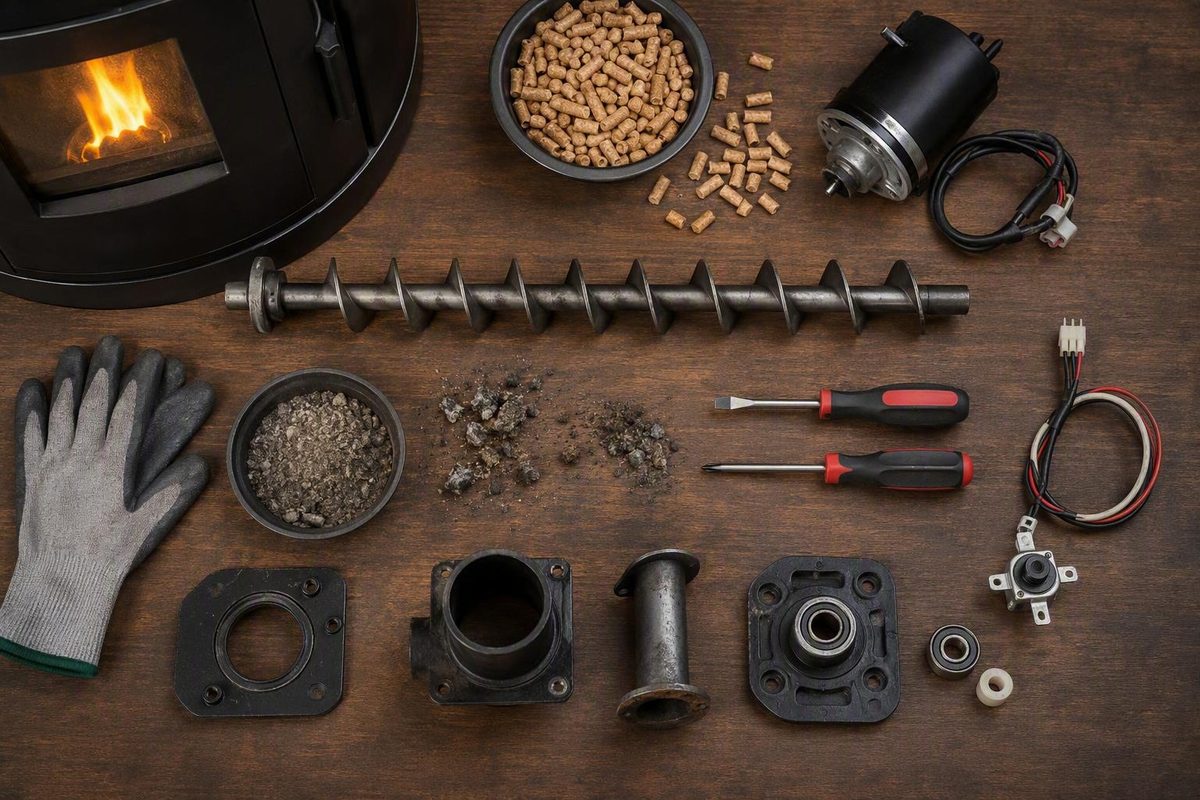
The auger screw is the helical metal shaft that moves fuel from a pellet stove’s hopper toward the drop chute or burn pot. It is also called an auger, feed screw or auger shaft. The feed motor is a separate part that turns it, usually through a coupler, pin or similar connection.
That distinction matters when pellets stop dropping. A stationary auger does not prove that the screw itself is damaged—or even jammed. Improper airflow, a recent maintenance error and an auger jam are all possible causes of a no-feed condition, according to the manufacturer’s Forge & Flame troubleshooting guidance.
Check the feed system in the right order
Start with the exact model’s owner or service manual, not a generic replacement video. Then work from simple operating conditions toward mechanical disassembly:
- Let the stove complete its shutdown. Do not interrupt a normal cool-down just to inspect the feed system. Once it is fully cool, unplug it before opening panels or putting a hand or tool near the auger.
- Confirm fuel and controls. Check that the hopper contains usable pellets, the heat setting calls for operation and any displayed fault code has been recorded.
- Check the hopper lid. On models with a lid switch, an open lid or failed switch can prevent feeding.
- Check airflow-related items permitted by the manual. A blocked vacuum-switch hose, dirty exhaust path, open door or poor seal can keep the feed circuit from operating. PelPro’s service sequence, for example, has the exhaust blower establish negative pressure, the vacuum switch close and only then the feed motor run (PelPro service manual).
- Observe; do not bypass. Listen for the motor and watch for pellet movement only from a safe position. Never jumper a lid, vacuum or overheat switch to make the auger run.
This sequence prevents an unnecessary auger or motor purchase. It also avoids treating a combustion-air or safety-circuit fault as a simple mechanical jam. For a broader no-feed decision tree, see common pellet-stove problems and safe checks.
When a jam is plausible
A jam becomes more likely when the feed motor tries to turn, hums, moves the shaft intermittently or repeatedly stalls. Pellet fragments and dust can compact in the feed path; a foreign object can also obstruct the screw. However, sounds alone are not a final diagnosis: a loose coupler or failing gearbox can produce similar symptoms.
Use only the access procedure in the stove’s manual. On the covered PelPro models, the manufacturer’s jam procedure says to shut down and unplug the stove, empty and vacuum the hopper, remove the auger plate, clear obstructions and vacuum pellet debris. It then says the cleaned auger should move only a quarter to half turn before reassembly and priming (PelPro service manual). That is a model-specific procedure, not permission to pull the shaft from every stove.
Do not force the auger with a drill, apply lubricant unless the manufacturer specifies it, or run the exposed mechanism. Stop and arrange service if removal requires disturbing wiring you cannot identify, the shaft is bent, metal is grinding, the feed tube is damaged, or the manual assigns the work to a technician. Energized voltage testing is also a service task unless you are trained and the manufacturer supplies the procedure; PelPro warns that its live tests expose 115-volt power and present a shock or electrocution risk (PelPro service manual).
Match the replacement to the exact stove
“Pellet stove auger screw” is not a universal part description. Before ordering, record:
- manufacturer, complete model number and serial number;
- part number from the parts diagram or current manufacturer lookup;
- auger length, shaft diameter and flight diameter;
- flight direction and pitch;
- upper and lower bearing or bushing arrangement;
- motor-end connection: hole and pin, flat, key, set-screw coupler or other fitting;
- any revision or serial-number break in the parts listing.
Do not assume a shaft fits because a listing names the brand or because its motor voltage matches. Even closely related models can use a different shaft, coupling or feed arrangement. A current PP130-C manual, for example, identifies the feed motor as a component inside the stove and says unapproved parts or components must not be installed (PP130-C owner’s manual).
If only the coupling pin or motor has failed, replacing the entire auger may add cost without fixing the actual fault. Conversely, fitting a new motor to a seized or bent screw can overload the replacement. Confirm that the auger turns as the model’s service instructions specify and that the feed tube, supports and coupling are sound before deciding which component to buy.
After reassembly, restore panels and guards, add only the amount of fuel the manual recommends for testing, prime exactly as directed and watch the first startup. Shut the stove down if feeding remains irregular or any grinding returns. If the stove feeds but will not ignite, move to the ignition and airflow checks in safe pellet-stove troubleshooting rather than continuing to replace feed parts.