
Which Quadra-Fire Pellet Insert Fits Your Fireplace—and Your Budget?
Compare Trekker, Classic Bay 1200i and Santa Fe pellet inserts by documented output, efficiency, hopper size, price, fireplace fit and maintenance.
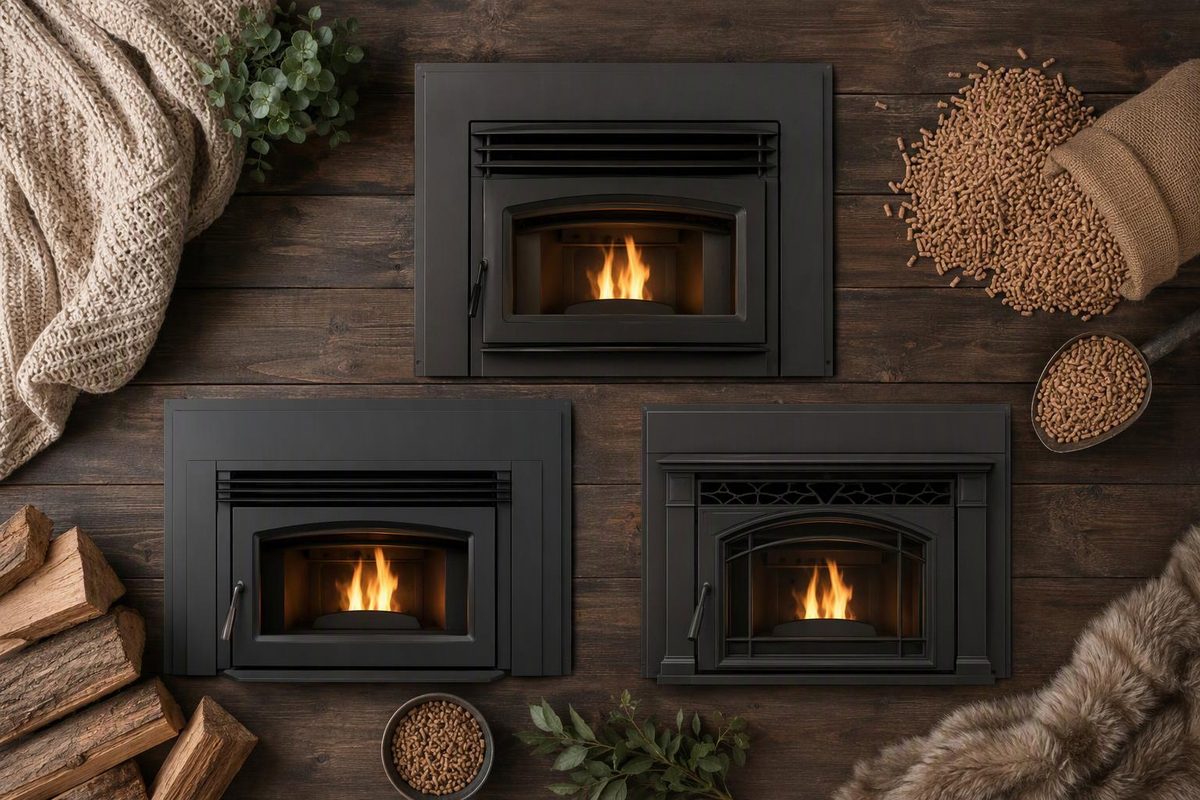
For a new Quadra-Fire pellet stove insert, start with Trekker, Classic Bay 1200i and Santa Fe. Trekker offers the highest published HHV efficiency and maximum manual-listed output of these three; Classic Bay has the largest nominal hopper; Santa Fe has the lowest starting price and lowest listed output range. The right choice still depends on fireplace fit, the heat you need in that part of the house, and local service.
Specifications and U.S. starting prices checked October 29, 2026. These are manufacturer-published ratings, not Pellet Finder performance tests.
Compare insert specifications—not freestanding stove listings
Quadra-Fire uses some model names for both stoves and inserts. Match the rating plate and full model designation before comparing specifications or ordering parts.
| Insert and manual | Manual-listed EPA output, BTU/hr | Tested HHV efficiency | Nominal hopper |
|---|---|---|---|
| Santa Fe I-C | 5,800–22,400 | 66.1% | 45 lb |
| Classic Bay 1200i-C | 10,200–33,900 | 63.6% | 75 lb |
| Trekker TREKKERI-MBK | 12,700–39,400 | 77.9% | 52 lb |
The output figures are calculated ratings, not three directly measured heat-output ranges on an identical basis. Santa Fe’s manual describes its range as based on EPA default efficiency and test burn rates; Classic Bay and Trekker describe theirs as calculated using HHV efficiency and test burn rates. Use them as a starting point for sizing, not a precise prediction of heat delivered in your home.
The manuals also distinguish fuel input from heat output. For example, Trekker’s product page prominently displays 51,000 BTU/hr, but also identifies that figure as maximum input; its manual lists maximum EPA output of 39,400 BTU/hr. Do not size the heating job using the larger input number. The manufacturer describes square-foot coverage as a general guide dependent on climate, home efficiency, heater location and air movement—not a whole-house heating guarantee. (Trekker product specifications)
Practical shortlist:
- Santa Fe: investigate first for a smaller heating load, checking whether its low-fire operation suits the room as well as whether peak output is sufficient.
- Classic Bay: consider when hopper capacity and the bay-window appearance matter more than maximum efficiency.
- Trekker: consider when higher output and fuel efficiency justify a higher purchase price. Its published features include a seven-day programmable thermostat and cast-iron firepot. (Trekker features)
Starting prices are not installed prices
Forge & Flame lists estimated starting prices of $4,068 for Santa Fe, $4,538 for Classic Bay, and $5,558 for Trekker. All exclude delivery, installation, venting, finishing materials, accessories and taxes; availability varies by retailer.
Ask for an itemized project quote covering:
- Insert, surround/trim, thermostat and required accessories.
- Chimney inspection, approved vent or liner, connections and termination.
- Hearth protection, support and any fireplace alterations.
- Electrical work, permits, labor, delivery and tax.
- Annual service pricing and charges for pulling the insert out when necessary.
Our pellet insert fit and installation guide explains the checks to make before accepting that quote.
What might Trekker’s efficiency save?
Use the same efficiency basis: Trekker’s advertised 83.2% is LHV, while its manual gives 77.9% HHV. Classic Bay’s corresponding HHV figure is 63.6%. Mixing LHV and HHV overstates the comparison.
Here is a fuel-only illustration, not a consumption forecast:
- Assume Classic Bay burns 3 tons per season.
- Assume delivered pellets cost $350 per ton—an example price, not a local market quote.
- Hold pellet heat content and useful heat delivered equal.
- Apply the published HHV efficiencies:
3 × 0.636 ÷ 0.779 ≈ 2.45 tonsfor Trekker.
That produces approximately $1,050 versus $857 in seasonal fuel cost, a difference of about $193. Trekker’s listed starting-price premium is $1,020, so efficiency alone does not imply a quick payback. Actual cycling, fuel, maintenance and electricity use can change the result. Keep those costs separate using a full winter heating budget.
Fireplace opening dimensions can change the choice
Do not mistake appliance width or surround size for the required fireplace opening. Santa Fe’s product page lists a 21½-inch appliance width, but its installation manual requires a 29⅜-inch front opening, 23¼-inch opening height, 24⅛-inch rear width, and 13-inch depth. (Santa Fe installation manual, section 3)
Trekker requires a 32¼-inch front opening, 24⅜-inch height, and 24⅛-inch rear width. Its minimum depth varies with the panel set: 16⅝ inches with steel panels or 16¼ inches with cast panels. These opening dimensions do not replace mantel, sidewall or floor-protection checks. (Trekker installation manual, section 3)
Classic Bay has an adjustable hopper that accommodates different opening heights. Lowering it by 2½ inches reduces its listed capacity from 75 lb to 60 lb. Have the installer document the chosen configuration rather than assume the nominal capacity applies unchanged. Its manual also specifies thermal floor protection for relevant installations; decorative tile over combustible flooring is not automatically sufficient. (Classic Bay installation manual, sections 3 and 6)
For an existing masonry or factory-built fireplace, require a written venting plan and approval of any alterations. These manuals require a full-height liner in some configurations, including certain older or non-HT-listed factory-built chimney installations; they also show other venting arrangements. The exact manual, chimney condition and local authority govern the route. See our chimney liner guide.
Budget time for cleaning—and plan for power loss
These are electrically powered heaters, not passive wood-burning inserts. Decide whether your backup system should support safe shutdown or continued heating. Quadra-Fire’s battery-backup guidance distinguishes those jobs; do not assume a small computer UPS will keep the insert heating through an outage. Confirm current compatibility and runtime with the dealer. (Manufacturer backup guidance)
Cleaning access matters just as much as hopper size. For example, Classic Bay’s detailed care instructions call for firepot cleaning daily or more often as needed, ash-drawer cleaning weekly or every five bags, and deeper cleaning of the hopper and heat-exchanger areas at stated intervals. The manual recommends annual service by a qualified technician. Let shutdown and cooling finish before following the relevant cleaning procedure. (Classic Bay owner’s manual, section 3)
Before buying, ask the dealer to demonstrate routine cleaning access and explain which service tasks require removal from the fireplace. Our pellet-stove cleaning guide covers why visible ash is only part of the job.
Buying used: identify the generation first
For older Castile and Mt. Vernon AE/E2 inserts, the manufacturer’s manual library places legacy manuals among inactive products and separates multiple generations of other models.
Get a readable rating-plate photo, serial number, matching installation and owner’s manuals, and maintenance history. Ask a servicing dealer to confirm parts availability for that exact unit, then arrange an inspection and operating demonstration. A low used price is worthwhile only after removal, transport, repairs and a compliant new installation are included.