
Choose the Right Pellet Heater for Your Fireplace and Home
Compare fireplace fit, venting, heat-loss-informed output, total installed cost, electrical dependence, maintenance and local service before choosing.
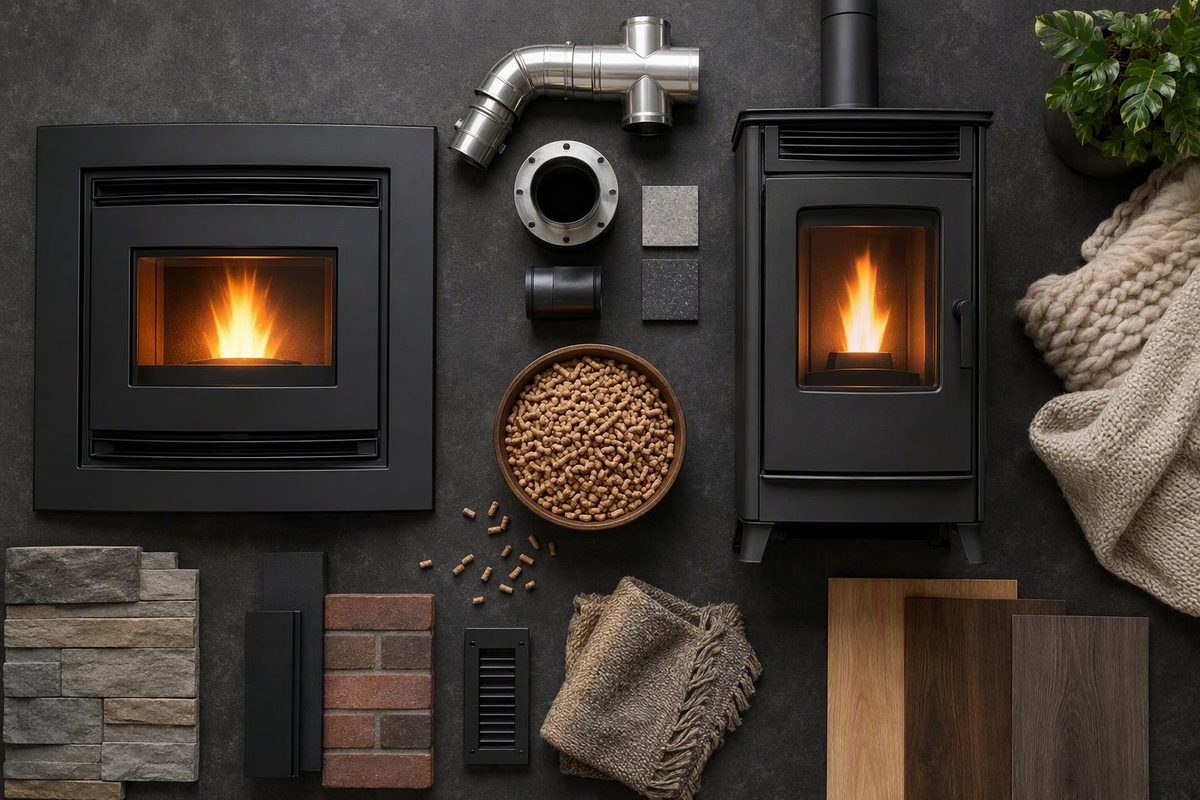
A “pellet fireplace stove” usually means one of two products: a freestanding pellet stove installed on suitable floor protection, or a pellet insert specifically listed for installation in a compatible existing fireplace or enclosure. Choose the format first. Then compare heat-loss-informed output, current certification records, installation requirements, total project cost, electrical dependence, maintenance, and local service—not just advertised square footage.
First decide: pellet stove or fireplace insert?
Both formats use the same basic operating system. Pellets sit in a hopper, an electrically powered auger moves them into a burn pot, and electronic controls manage fuel delivery and fans. A thermostat commonly raises, lowers, or pauses the feed rate to maintain the selected room temperature.
The physical installation is the important difference:
- Freestanding pellet stove: A complete appliance placed in a room on suitable floor protection, with its own approved venting route.
- Pellet fireplace insert: An appliance designed and listed to fit within an approved fireplace or manufacturer-specified enclosure, usually with a surround that finishes the opening.
An insert is not a freestanding stove pushed into a fireplace. The fireplace type, opening dimensions, chimney condition, liner or vent connection, electrical access, clearances, floor protection, and appliance listing must all match the insert’s current manual.
Most pellet appliances require electricity to operate their auger, controls, combustion fan, and room blower. Explicitly designed non-electric pellet appliances exist, but they are exceptions. A conventional electric pellet appliance ordinarily cannot continue normal operation during an outage; one documented insert manual states directly that the heater will not operate without power (Travis Industries AGP pellet insert manual).
Compared with a conventional open fireplace, a pellet insert is intended to deliver controlled room heat. An open fireplace can send much of its heat up the chimney. Pellet appliances are not pollution-free, but pellet inserts and stoves use controlled fuel delivery and combustion rather than an open fireplace’s largely uncontrolled burn.
Use this stove-versus-insert decision table
Start with the building, not the appliance catalog.
| Decision point | Pellet fireplace insert | Freestanding pellet stove |
|---|---|---|
| Existing usable fireplace | Worth investigating for a qualifying masonry or eligible factory-built fireplace | Not required |
| Available floor space | Uses the fireplace opening but needs room for its surround and service removal | Requires dedicated floor area and specified clearance around the appliance |
| Visual integration | Retains a built-in fireplace appearance | Becomes a visible room appliance |
| Chimney or liner work | Often requires fireplace preparation and a listed liner or model-specific connection | May avoid an existing chimney but needs a new approved vent route |
| Venting path | Usually connects through the existing chimney system | Often offers more routing flexibility, subject to the manual and local rules |
| Hearth protection | Existing hearth may help, but adequacy must be verified | Requires the floor protection specified for the model |
| Electrical access | Needs a suitable, accessible supply near the fireplace | Outlet placement may be easier to plan |
| Service access | Must remain accessible or removable for cleaning and repairs | Often easier to reach, although side and rear access still matter |
| Likely complexity | Fireplace survey, fit verification, preparation, liner, trim, and removal planning | Site selection, floor protection, vent penetration, and clearance planning |
If you have an existing masonry fireplace or an eligible factory-built fireplace, investigate an insert—but only after a site survey and review of the exact current manual. Insert approvals are model-specific. For example, the Accentra 52i manual identifies masonry fireplaces, certain factory-built wood-burning fireplaces, and a specified manufacturer enclosure as acceptable locations; those permissions cannot be transferred to another model (Harman Accentra 52i installation manual).
Without a suitable fireplace—or when room placement and vent-routing flexibility matter more—a freestanding stove is usually the more relevant category. It still needs an approved vent design, floor protection, electrical supply, combustible clearances, and room for service.
Before requesting quotations, record:
- Fireplace opening width, height, and depth
- Hearth depth and projection into the room
- Chimney height, construction, condition, and current liner
- Distance to combustible mantel, trim, flooring, walls, and furniture
- Location and type of available electrical outlet
- Access for bringing in and installing the appliance
- Space needed to open panels, clean passages, and replace motors or controls
- A practical route for removing an insert later without damaging the hearth or surround
There is no universal minimum fireplace opening or clearance for every insert. Exact dimensions, clearances, liner arrangements, vent designs, and floor-protection values must come from the complete current manual and the authority having jurisdiction.
Size for heat loss, not the largest square-foot claim
Advertised heating area is a rough screening number, not a promise. A stove providing occasional living-room heat has a different job from one expected to carry most of the winter load.
Compare the tested output range in BTU per hour where one is available. Do not substitute the highest input figure, maximum fuel-burn claim, or “up to” output.
Consider two homes with the same floor area:
- A mild-climate, insulated, relatively airtight home with an open plan may need moderate output and benefit from a low minimum firing rate.
- A cold-climate, leaky home with high ceilings and closed bedrooms may require more output, yet still distribute heat poorly beyond the appliance room.
A generic BTU-per-square-foot shortcut cannot resolve that difference accurately. If pellet heat will carry a substantial share of the load, obtain a home heat-loss calculation or an assessment from a qualified heating professional.
Distribution matters as much as capacity. A powerful insert can make the fireplace room hot while distant bedrooms remain cool. Doorways, stairwells, ceiling fans, and the home’s existing heating system all affect comfort. Retain other heat where necessary rather than assuming one room heater will distribute heat evenly throughout the building.
Also examine the low end of the output range. A high maximum output is not automatically better for a mild climate, a small heating zone, or a room that cannot move heat effectively to the rest of the house.
Compare tested specifications model by model
Normalize every candidate into the same worksheet. Do not compare a tested output on one model with a marketing maximum on another, or an HHV efficiency on one with an LHV efficiency on another.
| Specification | What to record | Why it matters |
|---|---|---|
| Format | Insert or freestanding | Determines the installation path |
| Tested output | Minimum–maximum BTU/hr and test basis | Shows the documented operating range |
| Efficiency | HHV percentage and test basis | Supports consistent comparison |
| Emissions | Particulate grams per hour | Helps verify performance records |
| Fuel and feed | Every approved fuel and grade | Affects operation, warranty, and venting |
| Fuel storage | Hopper capacity | Indicates capacity, not guaranteed runtime |
| Electrical | Startup and running amps or watts | Needed for circuit and backup-power planning |
| Installation | Venting, dimensions, weight, and locations | Determines site compatibility |
| Controls | Thermostat and included or optional controls | Affects operation |
| Documentation | Exact model, series, revision, and date | Prevents mixing specifications across versions |
Higher heating value and lower heating value efficiencies use different accounting conventions. LHV figures are generally numerically higher, so an LHV percentage should not be treated as equivalent to an HHV percentage. Use HHV when normalizing models if it is available.
The following inserts illustrate model variation. They are not recommendations, rankings, or evidence of comparative reliability.
| Field | Quadra-Fire CB1200I-C | True North TN40 | Harman Accentra 52i |
|---|---|---|---|
| Appliance type | Pellet insert | Pellet insert | Pellet insert |
| Output | EPA output: 10,200–33,900 BTU/hr | EPA-tested output: 6,000–25,600 BTU/hr | Manual-stated output: 8,000–52,000 BTU/hr |
| HHV efficiency | 63.6% | 73% | Not normalized here |
| Particulate emissions | 0.8 g/hr | 0.69 g/hr | Not listed in the available specifications |
| Hopper | 75 lb | Confirm in current manual | 64.5 lb |
| Electrical demand | 4.1 A startup; 1.1 A running | 4.3 A peak; 2.5 A normal | 120 VAC supply; verify detailed demand |
| Approved fuel | Premium wood pellets only | Premium wood pellets only | Wood pellets or shelled corn |
| Venting | Specified pellet-vent options; follow complete manual | Full liner required in Canada; U.S. options differ | Corn requires venting specifically suitable for corn |
| Weight | 193 lb | Confirm in current manual | 475 lb shipping weight |
| Controls | Thermostat connection documented | Manual control or optional wall thermostat | Check exact current configuration |
| Dimensions | Check current manual and fireplace tables | Check current manual and fireplace tables | Check current manual and fireplace tables |
| Manual revision/date | Confirm current version before purchase | Confirm current version before purchase | Confirm current version before purchase |
The Quadra-Fire values apply specifically to the CB1200I-C, which its manual identifies as a wood-pellet-only insert (Quadra-Fire CB1200I-C installation manual).
The True North values apply to the TN40 under the manual’s stated test and premium-pellet conditions. Its optional wall thermostat is not included with the appliance (True North TN40 installation and operating manual).
The Accentra example illustrates output and fuel variation. Its manual permits wood pellets or shelled corn and calls for venting suitable for corn when corn is burned. That does not mean another Harman product—or pellet appliances generally—approves corn (Harman Accentra 52i installation manual).
Before buying, search the exact manufacturer and model in the EPA Certified Wood Heater Database. A brand name, retailer category, or old manual alone does not establish a model’s current certification record.
Certification, approved fuel, installation locations, mobile-home approval, venting, and performance values are model-specific. Even similarly named stove and insert versions may differ.
Plan the installation before choosing the appliance
Treat installation as part of product selection. A model that looks attractive on paper may be wrong for the chimney, hearth, room pressure, electrical supply, or service path.
Use this installation-readiness checklist:
- [ ] Obtain the complete current manual for the exact model and series.
- [ ] Confirm the appliance listing and approved installation location.
- [ ] Ask the local authority about permits, inspection, and applicable code.
- [ ] Verify all clearances to walls, mantel, trim, furniture, and other combustibles.
- [ ] Confirm the required hearth or floor protection.
- [ ] Specify the approved vent, chimney liner, adapters, termination, and cleanouts.
- [ ] Seal vent joints as required by the appliance and vent instructions.
- [ ] Evaluate combustion-air supply and determine whether outside air is required.
- [ ] Confirm the circuit, outlet location, grounding, and accessibility.
- [ ] Install and maintain smoke and carbon-monoxide alarms as required.
- [ ] Leave access for cleaning, inspection, and component replacement.
- [ ] Document how an insert will be removed for service.
These are not interchangeable design instructions. For example, the CB1200I-C manual requires installation to applicable codes, specified combustible clearances, venting instructions, and floor-protection requirements, and recommends qualified factory-trained or NFI-certified personnel (Quadra-Fire CB1200I-C installation manual).
A listed appliance must be installed according to its manual as well as applicable local requirements. Rules vary by jurisdiction. Portland, Oregon, for example, requires a mechanical permit and inspection for installation of a pellet stove or another solid-fuel appliance; that is a Portland requirement, not a nationwide rule.
Outside combustion air is model- and site-specific. It may be mandatory in a mobile home, a small room, a particularly tight building, or under a particular manual or jurisdiction, but it is not universal. Negative pressure also matters: the TN40 manual warns against operation in a negatively pressurized room and notes that outside air may reduce, but not necessarily eliminate, extreme pressure problems (True North TN40 installation and operating manual).
Mobile-home approval cannot be inferred from the product category. Documented requirements may include outside combustion air, listed venting, attachment or grounding provisions, preservation of structural integrity, and a prohibition on installation in a sleeping room. The AGP manual, for example, requires outside air, attachment to the floor, and no bedroom installation for mobile-home use (Travis Industries AGP pellet insert manual).
Contact the home insurer before work begins. Ask whether notification, permits, inspection records, photographs, or evidence of professional installation are required. Keep the final permit, inspection approval, invoice, model and serial number, and installer documentation together.
Calculate the whole project, not just the stove price
The shelf price is only one line in the budget. Complete this worksheet after a site survey:
| Project item | Quoted cost | Quote date |
|---|---|---|
| Appliance | ||
| Surround, trim, legs, finish, or controls | ||
| Pellet vent or chimney liner and fittings | ||
| Fireplace cleaning, repair, or preparation | ||
| Hearth extension or floor protection | ||
| Electrical work | ||
| Outside-air kit and installation | ||
| Installation labor | ||
| Permits and inspection | ||
| Delivery and removal equipment | ||
| Taxes and shipping | ||
| Compatible backup power | ||
| Initial pellet supply | ||
| First professional service | ||
| Total installed project |
For dated context rather than a universal market range, a limited retailer catalog checked on September 11, 2026, displayed starting MSRPs from $2,479 to $6,069 across selected Harman and Quadra-Fire pellet stoves and inserts. “Starting MSRP” may exclude configuration options, installation, venting, shipping, taxes, and site work (retailer pellet stove and insert catalog).
For another dated reference point, Consumer Reports’ guide updated February 21, 2025, described appliance prices from just under $1,000 to more than $5,000 before installation (Consumer Reports pellet stove buying guide).
Two appliances with similar purchase prices can produce very different installed totals. An insert may need fireplace cleaning or repair, a chimney liner, adapters, a surround, and a safe removal arrangement. A freestanding stove may need a hearth pad, wall or roof penetration, a longer vent route, and additional room protection.
Add recurring annual budget fields for:
- Pellets and delivery
- Electricity
- Professional inspection and service
- Brushes, gaskets, and cleaning supplies
- Replacement wear parts such as igniters, blowers, switches, or motors
- Backup-power maintenance or battery replacement
Record the date of every appliance, fuel, and labor price. Local supply, delivery distance, fuel quality, weather, and building heat loss make undated national estimates poor budgeting tools.
Check federal, state, utility, and local incentives against current official rules and the exact model record. Do not assume that older material describing a federal biomass credit applies to equipment placed in service in 2026.
Be honest about daily ownership
Pellet heat replaces log loading with a different routine. You still have to carry and store fuel, fill the hopper, inspect or scrape the burn pot, remove ash, clean the glass and heat-exchange areas, and service exhaust passages and venting according to the model manual.
There is no responsible universal cleaning calendar. Consumer Reports says many models need daily or near-daily burn-pot attention, while individual manuals set their own inspection and vent-cleaning intervals. Pellets are also commonly sold in 40-pound bags, creating regular lifting and dry-storage work throughout the heating season (Consumer Reports pellet stove buying guide).
Hopper capacity does not guarantee burn time. A larger hopper may extend the interval between refills, but thermostat demand, feed rate, outdoor temperature, pellet size, density, and quality all affect consumption. Compare hopper size as a capacity specification, not as a promise of a particular number of operating hours.
Noise deserves an in-person check. The auger motor, pellets dropping into the burn pot, combustion fan, and room-air blower can all be audible. If possible, listen to the exact model at low, medium, and high settings in a quiet showroom.
Most conventional pellet appliances stop normal operation when power fails. Do not size backup power from running watts alone because startup demand may be higher.
Store pellets in a dry, accessible location. Also consider whether everyone expected to operate the stove can safely move bags and lift fuel into the hopper.
Burn only the fuel approved for the exact appliance. Some inserts are approved for premium wood pellets only. The Accentra 52i manual permits shelled corn as well as pellets but adds corn-specific venting considerations. That exception is not permission to burn corn, cherry pits, mixed biomass, or improvised fuel in another model.
A pellet appliance is a better fit for a household willing to:
- Clean it regularly rather than waiting for performance to deteriorate
- Move and store fuel in dry conditions
- Tolerate fan, auger, and pellet-drop noise
- Plan for electrical outages
- Keep access open for service
- Buy a model supported by local technicians and obtainable parts
Build a shortlist in five checks
Use this workflow before requesting final quotations.
- Choose the format. Decide whether the site supports a listed fireplace insert or calls for a freestanding stove.
- Document the installation site. Measure the fireplace or proposed stove area, inspect the chimney or vent path, identify combustibles and electrical access, and plan for service.
- Set a heat-loss-informed output range. Decide whether the appliance will provide supplemental or primary heat, then account for climate, building shell, room layout, and heat distribution.
- Normalize the specifications. Compare tested output, HHV efficiency, emissions, approved fuel, hopper capacity, electrical demand, controls, dimensions, weight, venting, and manual revision.
- Request complete installed quotes. Require an itemized scope covering the appliance, every required component, permits, site modifications, labor, delivery, and options.
Get the exact model and series number before accepting any statement about certification, efficiency, emissions, fuel approval, venting, mobile-home use, or backup-power compatibility. Download the current manual, search the EPA database, and ask the installer to identify every required component in writing.
Ask each dealer or installer:
- Who performs warranty diagnosis and repair?
- Which igniters, blowers, sensors, control boards, gaskets, and motors are stocked locally?
- How is the appliance opened or removed for service?
- How long has the local technician worked on this exact product family?
- Who handles permit applications and inspection corrections?
- What work is excluded from the quote?
- What happens if chimney damage or inadequate hearth protection is discovered?
Choose an insert when a compatible fireplace and chimney make it the sensible installation. Choose a freestanding stove when placement and venting flexibility matter more. Postpone either purchase if dry fuel storage, routine maintenance, outage resilience, heat distribution, or long-term service access remains unresolved.