
Is Pellet Heat a Practical Fit for Your Home?
The fit depends on heat distribution, venting, outage backup, dry storage and upkeep; compare full ownership costs before choosing a system.
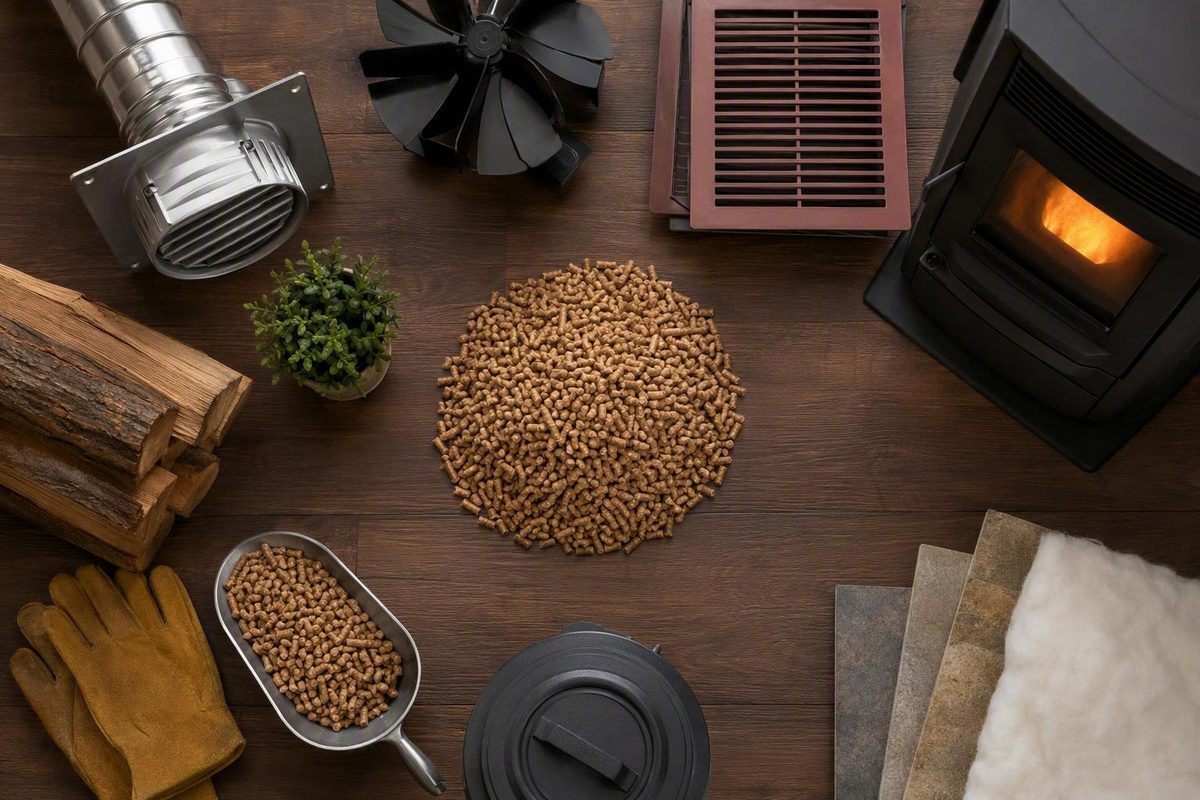
Heating with wood pellets can be practical when your home has a credible heat-distribution plan, an approved vent route, dependable electricity or an outage strategy, dry fuel storage, and someone willing to load fuel and clean the appliance. A room stove generally heats a room or zone; for central ducted or hydronic heat, consider a pellet furnace or boiler. Base the decision on a heat-loss calculation and complete ownership costs—not advertised square-foot coverage or pellet price alone.
Most of this guide concerns conventional powered pellet room stoves because the available operating and safety documentation is strongest for that category.
The short answer: when pellet heat makes sense
Pellet heat sits between a manually tended wood stove and a conventional automatic heating system. A hopper and controls automate fuel delivery, but ownership still involves buying and storing fuel, moving it into the appliance, removing ash, cleaning combustion and exhaust passages, and arranging service.
A pellet room stove is the likely fit when you want to heat an open living area or create a warm zone around the appliance. A pellet furnace heats air for central distribution, while a pellet boiler heats water for radiators, baseboards, radiant floors, or another compatible hydronic system. Central pellet equipment may work with an existing distribution system, but compatibility must be confirmed.
Do not assume that a pellet room heater can safely serve as the home’s only heating system. Several manufacturers classify particular room heaters as supplemental equipment and advise retaining another heat source. For example, the Drolet ECO-65 manual describes that model as a supplementary heat source. Primary-heat suitability depends on the home’s design heat loss, climate, layout, appliance design, installation, distribution system, and outage plan.
| Option | Heat distribution | Fuel, storage, and upkeep | Outage exposure |
|---|---|---|---|
| Pellet room stove | Direct heat to a room or zone; best where air can circulate | Bag loading, accessible dry storage, ash removal, and regular cleaning | Conventional powered models normally stop; backup heat may be necessary |
| Pellet furnace or boiler | Central ducted air or heated water | Typically needs dedicated mechanical and storage space; service and ash removal remain | Controls, feed equipment, pumps, or blowers may depend on power |
| No-pellet alternative | Select a system suited to the home’s full load and layout | Avoids pellet storage and handling; other maintenance still applies | Depends on the selected equipment and fuel |
A practical “yes” therefore requires more than room for a stove. You need a workable way to move heat to the intended rooms, install the exact model correctly, keep fuel dry, protect the home during outages or equipment failures, and obtain local parts and service.
How a pellet heating system works
In a typical powered pellet room heater, pellets sit in a hopper. An electric auger meters them into a burn pot or grate, a combustion fan supplies air, and electronic controls vary the feed rate. Hot combustion gases pass across a heat exchanger, while a room-air fan moves much of the resulting heat into the living space. Exhaust leaves through a listed pellet-vent system.
Controls may respond to a thermostat, room sensor, feed-rate setting, or another model-specific input. Some appliances ignite automatically, but control layouts and safety switches vary. Automatic feeding reduces the repeated tending associated with cordwood; it does not eliminate hopper loading, burn-pot cleaning, ash disposal, internal cleaning, vent inspection, or service.
Distribution is the major dividing line:
- Room stoves and inserts release heat directly into a room or nearby zone.
- Pellet furnaces heat air for ducted distribution.
- Pellet boilers heat water for a central hydronic system.
Do not transfer instructions between these categories—or even between similar-looking stoves.
Choose the system by heat loss and distribution—not square feet alone
Start with a professional room-by-room or whole-building heat-loss calculation.
An advertised square-foot figure cannot capture those variables. The Englander 25-CBPAH manual, for example, says actual heating capacity varies with climate, building construction, insulation, and other factors even though it advertises coverage “up to” a stated area. Treat coverage figures as broad references, not promises.
Next, map the heat path. A room stove generally performs better in an open plan where heated air can circulate. Closed bedrooms, long hallways, separate wings, and multiple stories make direct room heating less predictable. A divided home may need central distribution, supplemental heat, or a different system.
Central equipment requires its own design work. Pellet-boiler efficiency can fall during partial-load operation, and buffer storage may reduce short firing cycles in some systems. These are system-design considerations rather than reasons to choose a generic boiler size or tank volume; the proper arrangement depends on the building load, boiler, controls, and distribution system.
Ask each installer to answer these questions in writing:
- What is the calculated design heat loss, and what indoor and outdoor temperatures were used?
- How will heat reach closed bedrooms, bathrooms, upper floors, and remote zones?
- What happens during mild weather when the building load is low?
- If a boiler is proposed, is buffer storage included, and what problem is it intended to solve?
- How much heating capacity remains if the pellet system is unavailable?
- Does the manufacturer describe the exact appliance as supplemental or primary equipment?
- Which output and efficiency figures are being used, and under what test conditions?
- Who provides warranty service, routine service, and replacement parts locally?
Installation and certification checks before buying
For a new U.S. purchase, search the exact manufacturer and model in the EPA Certified Wood Heater Database. Confirm that the entry describes the correct heater and fuel type, then review the available efficiency, emissions, carbon-monoxide, and 2020 Step 2 fields. A similar model name or older version is not sufficient.
EPA certification addresses compliance with applicable emissions requirements. It does not establish operating cost, comfort, seasonal efficiency, suitability for a particular floor plan, or safety under every installation. EPA has also identified deficiencies in some certification tests and may require retesting or revoke a certificate, so the current database record is more useful than an old brochure or dealer screenshot. The EPA compliance-monitoring program describes that review and enforcement process.
Before paying a deposit, have a qualified installer confirm:
- an approved vent route for the exact appliance and configuration;
- listed pellet vent with correctly assembled, sealed joints;
- required clearances from combustible materials;
- suitable noncombustible floor protection;
- a grounded electrical supply that meets the model’s requirements;
- combustion-air provisions where required;
- permits and inspection requirements;
- any mobile- or manufactured-home restrictions;
- any notification or approval required by the insurer; and
- access for cleaning, vent inspection, and component replacement.
These details are model- and jurisdiction-specific. For example, one Englander manual requires approved Type L or PL pellet vent, mandatory outside combustion air, specified clearances, and consultation with local officials about permits and inspections. The appliance label, current manufacturer manual, vent instructions, and local authority—not a generic online diagram—determine what applies to a particular installation. See the Englander installation and operation manual.
Install and maintain smoke alarms and carbon-monoxide alarms according to the current appliance manual and local requirements. Confirm placement with the installer because appropriate locations depend on the building, appliance, and applicable rules.
Plan for electricity use and winter outages
Conventional powered pellet stoves use electricity for components such as the auger, igniter, combustion blower, room-air blower, and controls. They normally stop operating in the usual way when power fails. This is one reason several manufacturers advise keeping an alternative heat source available.
Build the outage plan before installation:
- Learn the exact model’s shutdown and power-failure behavior.
- Keep the viewing door, hopper, and ash-pan door closed as directed.
- Watch for smoke spillage and follow the manual if it occurs.
- Maintain working smoke and carbon-monoxide alarms.
- Keep backup heat capable of protecting occupants and plumbing during the expected outage.
- Store the manual where it remains accessible without internet service.
The ComfortBilt HP42 documentation, for example, says the stove shuts down during an outage, instructs users to keep the main and ash-pan doors closed, and calls for smoke and carbon-monoxide alarms. Those directions are model-specific, so owners should follow the current manual for their own appliance. See the ComfortBilt HP42 owner’s manual.
Do not choose a generic UPS, inverter, battery, or generator based only on a wattage label. Verify the required waveform and voltage, startup and continuous loads, grounding, surge protection, connection method, expected runtime, ventilation, and warranty conditions with the manufacturer’s current documentation or a qualified technician.
Electrical demand varies even among room stoves. The Harman P43 manual lists 4.2 amps at startup and 2.8 amps while running. The Osburn Hybrid-45 MF manual lists 3.5 amps during ignition and 2.5 amps continuously. These are examples of model variation, not universal backup-power sizing figures.
Fuel, storage, and realistic refill planning
Start with the appliance label and current manual. “Pellet stove” does not mean “burn anything pellet-shaped.” Some appliances permit only a specified grade of wood pellet; particular multifuel models may allow corn or another named biomass. Use only fuels expressly approved for the exact appliance. Some manufacturer manuals warn that unapproved fuel can create unsafe operation and may void that model’s warranty or safety listing.
When comparing pellets approved for your appliance, look for:
- intact, dry packaging;
- low stated ash content;
- few fines or loose sawdust in the bag;
- consistent dimensions within the appliance specification;
- stated heat content; and
- the quality standard required by the manual.
Pellet quality generally matters more than a hardwood or softwood label. Compression reduces some of the density differences found in raw firewood, while ash, moisture, fines, dimensions, composition, and manufacturing consistency directly affect feeding and cleaning. A retailer’s technical overview of hardwood and softwood pellet characteristics likewise emphasizes quality and ash content over the species label, although actual results remain appliance- and product-specific.
Storage must stay dry. Moisture can cause pellets to swell, break down, and become unsuitable for reliable feeding or combustion.
Plan for both space and lifting. One ton is fifty 40-pound bags, according to a Menards pellet listing. That makes storage a handling decision as well as a space decision. Consider delivery access, pallet placement, stairs, snow, distance to the appliance, and who will lift each bag.
Estimate refill timing with:
Usable hopper capacity in pounds ÷ burn rate in pounds per hour = approximate runtime
For example, the Hybrid-45 MF documentation lists a hopper capacity of up to 60 pounds and a maximum feed rate of 5.5 pounds per hour. At that rate:
60 ÷ 5.5 = 10.9 hours, or roughly 11 hours
The capacity and feed-rate inputs come from the Osburn Hybrid-45 MF manual. Actual runtime changes with thermostat demand, feed settings, pellet dimensions, fuel quality, and how much of the nominal hopper capacity is usable. Use the exact model’s documented range rather than a vague “days per fill” claim.
The maintenance and safety workload
There is no honest universal cleaning schedule. Frequency depends on the appliance, fuel ash content, operating rate, installation, and what inspection reveals. The ComfortBilt HP42 manual calls for burn-pot cleaning whenever its hopper is filled, while other manuals specify periodic in-season work and annual inspection or service. A trigger-based calendar is more useful than pretending every stove follows the same interval.
| Trigger | Work to plan |
|---|---|
| While operating | Observe the flame and burn area; verify that required doors and ash pans remain closed and latched |
| At the manual’s stated trigger or when ash accumulates | Clean the burn pot or grate and remove ash |
| Periodically during the season | Clean accessible internal passages and heat-exchange surfaces as directed; inspect seals |
| At the manual’s vent interval | Inspect and clean the exhaust system for ash, soot, or deposits |
| Before each season or annually where specified | Arrange qualified inspection or service; inspect feed, electrical, sealing, and vent components |
| After changing approved pellet products | Watch feeding, flame quality, ash accumulation, and any adjustments permitted by the manual |
A lazy orange flame with black tips, unusual soot, or an overfilled firepot is identified as a poor-combustion warning in documented PelPro equipment. Shut the appliance down using its prescribed procedure and follow the model’s troubleshooting instructions. Do not defeat safety switches, alter manufacturer-set minimum-feed settings, or improvise repairs.
Before maintenance, let the appliance cool and disconnect electrical power as directed. Turning the control panel off may not de-energize every component. Keep required doors, hopper lids, and ash pans closed and latched during operation, and maintain an airtight, properly assembled exhaust system.
For ash disposal, use a tightly covered metal container placed on the ground or another noncombustible surface, away from the building and combustible material, until final disposal is safe. These operating, shutdown, and ash-handling precautions are described in the PelPro owner’s manual, but the current manual for the installed model remains controlling.
Higher-ash or inconsistent fuel can fill the burn pot faster and increase ash accumulation, glass sooting, and vent or blower fouling. Changing fuel may therefore change the cleaning workload even when both products are permitted by the appliance manual.
Build the full ownership-cost worksheet
The available evidence does not establish that pellets are always cheaper than oil, propane, natural gas, electricity, cordwood, or a heat pump. Comparative economics depend on current local fuel and electricity prices, climate, building load, installation cost, financing, equipment performance, maintenance, and backup-heat use.
Use the following worksheet to collect dated local figures rather than relying on generalized ranges:
| Cost item | Your figure | Basis and date |
|---|---|---|
| Appliance and controls | Written model-specific quote | |
| Installation labor | Contractor and defined scope | |
| Venting or chimney work | Materials and configuration | |
| Permits and inspection | Local authority | |
| Electrical work | Circuit or other required work | |
| Fuel storage | Pallet area, bin, enclosure, or site work | |
| Pellets and delivery | Current local delivered price | |
| Electricity | Estimated kWh and utility rate | |
| Cleaning supplies and owner time | Household assumption | |
| Professional service | Current local quote | |
| Repairs and parts allowance | Warranty and service assumptions | |
| Backup heat | Equipment and expected energy use | |
| Financing or equipment-cost treatment | Interest, term, or annualized cost |
The basic annual fuel calculation is:
Annual pellet cost = bags used × local delivered price per bag
Then add annual electricity, professional service, repairs, backup heat, and whatever financing or equipment-cost treatment you choose. Date every quote. Without current local inputs and comparable performance data, this worksheet can structure a decision but cannot prove that pellet heat will save money.
Compare useful delivered heat, not fuel sticker prices alone. A cost-per-useful-BTU calculation is meaningful only when the efficiency measures are genuinely comparable. Certification status, advertised maximum output, and square-foot coverage also answer different questions.
Before buying, confirm every item:
- [ ] A professional heat-loss calculation supports the proposed capacity.
- [ ] The distribution plan reaches every room you expect to heat.
- [ ] The exact model has a compliant vent route.
- [ ] The electrical supply is suitable.
- [ ] Backup heat covers realistic winter outages and failures.
- [ ] Pellet storage will stay dry.
- [ ] The household can manage repeated bag handling or the proposed bulk-delivery system.
- [ ] The cleaning and service workload is acceptable.
- [ ] Local pellet supply is dependable.
- [ ] Qualified service and replacement parts are available.
- [ ] The exact model’s current EPA record has been checked where applicable.
- [ ] The cost comparison uses current, dated local figures.
If a critical item remains unresolved—especially heat loss, distribution, venting, outage protection, storage, or service access—pause the purchase. Heating with wood pellets is a conditional fit, not an automatic upgrade.
Are pellet stoves EPA certified?
Some pellet stoves are EPA-certified, but certification is determined by the exact model and whether it is covered by the applicable federal residential wood-heater requirements. For a new U.S. purchase, search the EPA Certified Wood Heater Database, confirm the model and fuel type, and review its current record. Certification addresses applicable emissions compliance; it does not prove low operating cost, comfort, safe installation, seasonal efficiency, or pollution-free operation.
Do wood pellets need to be stored indoors?
Not necessarily, but they must remain dry. A dry garage, shed, or protected storage room may work if it prevents leaks, ground moisture, and condensation and complies with the fuel and appliance instructions. Do not assume a retail bag will protect pellets indefinitely in a damp location; moisture can make them swell and crumble.
Can I burn corn or other biomass in a wood-pellet stove?
Only if the exact appliance label and current manual expressly permit that fuel and explain how it may be used. Some appliances allow only wood pellets, while particular multifuel models permit specified corn mixtures or named biomass fuels. Never infer permission from another model, even one made by the same manufacturer.
Are hardwood pellets better than softwood pellets?
Not inherently. For compressed heating pellets, consistent manufacturing, low ash, low moisture, limited fines, suitable dimensions, stated heat content, and compliance with the appliance manual are usually more useful criteria than the hardwood-or-softwood label. Any trial product must first meet the appliance’s fuel requirements, and a short burn does not override the label or manual.