
A pellet stove can back up heat—but not every job your oil boiler does
A room pellet stove may cover one heating zone. Replacing whole-house oil backup usually requires a pellet boiler, power plan and heat-loss check.
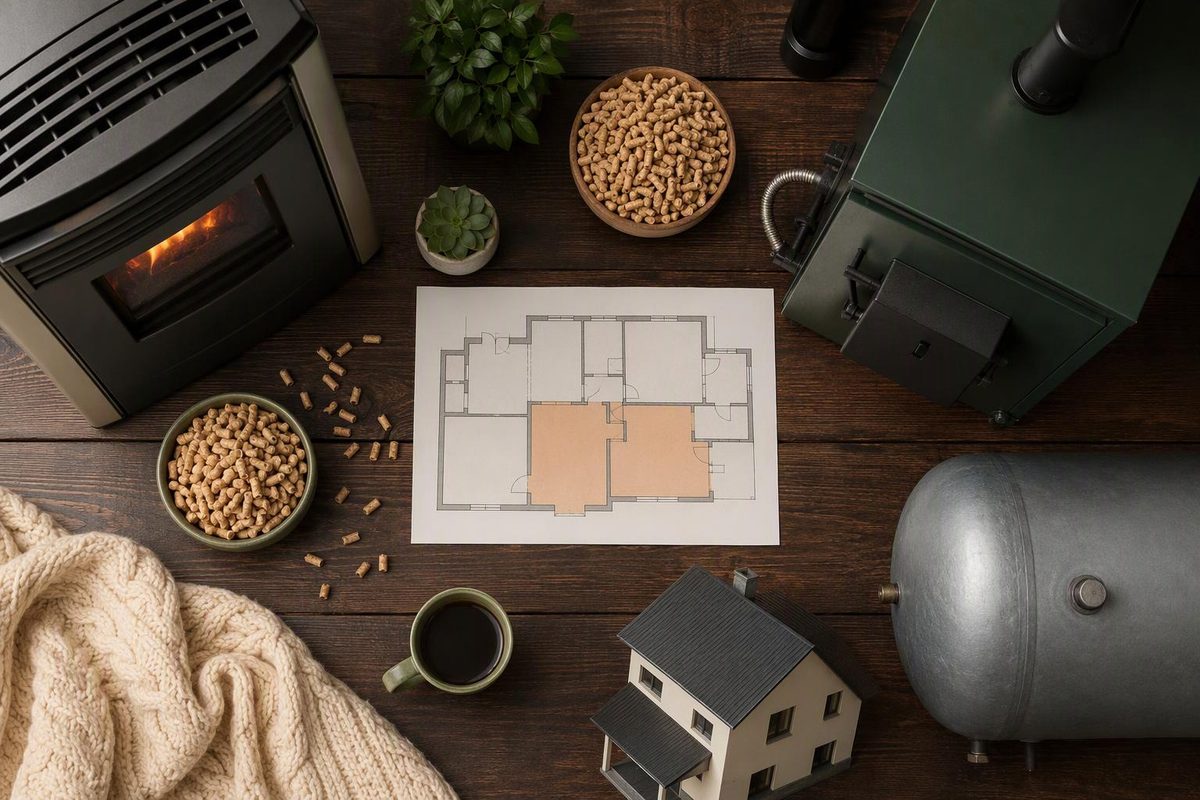
A pellet room stove can replace an oil boiler as limited backup heat, but it usually cannot replace the boiler’s whole-house distribution, pipe-freeze protection and domestic hot water. For a functional one-for-one replacement, consider a properly sized pellet boiler—not merely a larger room stove.
That distinction matters especially when heat pumps are now the primary system and oil runs only on the coldest days or during a failure.
First decide what “backup” must cover
An oil boiler may perform several jobs:
- heat every room through hydronic baseboards or radiators;
- protect plumbing in basements, bathrooms and exterior walls;
- make domestic hot water, directly or through an indirect tank;
- operate automatically while the house is empty; and
- provide heat during a primary-system fault.
A freestanding pellet stove delivers warm air mainly near its installation. The German Pellet Institute’s September 2026 comparison describes a pellet boiler as whole-house central heat that can also make hot water, while a room stove generally heats its room and serves as supplemental or shoulder-season heat. Installation rules differ by country, but the equipment distinction applies in the United States too (DEPI).
A current U.S. stove manual makes the point more concretely: Harman classifies its Absolute63 as a pellet-fueled room heater for “supplementary” residential use, despite an EPA-tested output range of 10,200–46,400 Btu/h (Harman owner’s manual). Output capacity does not create ductwork or move heat reliably through closed doors and into remote plumbing spaces.
| Option | What it can reasonably replace | What remains unresolved |
|---|---|---|
| Pellet room stove or insert | Backup heat for an open living area; possibly most space heat in a compact, open home | Remote rooms, plumbing zones, domestic hot water and unattended coverage |
| Ducted pellet furnace | Central warm-air heat where a compatible duct system exists | Hot water, fuel storage, electrical backup and installation compatibility |
| Pellet boiler | Hydronic baseboards, radiators or radiant zones; potentially indirect hot water | Electrical backup, bulk storage, service access and a larger installation project |
For example, a Maine Energy Systems residential pellet boiler is designed to heat water for central or indirect heating systems and building hot-water supply (PES 12–56 manual). Whether a particular installation supplies domestic hot water depends on its design.
Pellets do not automatically solve an outage
If the backup is intended for a heat-pump breakdown while utility power remains on, a pellet stove can provide useful redundancy. The heat pump and stove do not share every mechanical component or failure mode.
If the backup is intended for a grid outage, most pellet appliances require electricity for controls, fuel feed and blowers. The cited Harman stove is rated at 3.5 amps during startup and 2.5 amps while running. Its manual says a UPS provides safe shutdown rather than continued heating; it describes an approved inverter/charger connected to a 12-volt deep-cycle battery as providing up to eight hours. Actual runtime depends on the battery, appliance load and operating conditions.
Central pellet equipment also depends on power. The Maine Energy Systems manual says its boiler stops when power is interrupted and starts automatically after power returns. A generator or manufacturer-compatible battery system therefore has to support the complete installation—boiler or stove, circulators, zone controls, pellet-feed equipment and any other essential household loads—not just the appliance’s average wattage.
An oil boiler may also need electricity for its burner, controls and circulators. Compare the complete electrical loads and restart behavior of the actual oil and pellet systems; do not assume either will heat through an outage without planned backup power.
Work from the exact appliance manual before buying a battery or generator. Our pellet-stove battery backup guide explains why ignition output and usable watt-hours must be sized separately.
Test heat distribution before removing oil
Do not infer whole-house coverage from an advertised Btu rating or from one warm room. Use this sequence:
- Get a room-by-room heat-loss calculation. Compare the design load with the appliance’s tested output range, not merely its maximum input rating.
- Map vulnerable spaces. Include bathrooms, bedrooms behind closed doors, basement plumbing, crawlspaces and pipes routed through exterior walls.
- Plan domestic hot water separately. If the oil boiler heats water, identify the replacement and include its fuel and electrical demand.
- Operate the pellet system through genuinely cold weather before decommissioning oil. Monitor temperatures in remote rooms and pipe-risk areas while preserving a way to restore safe heat during the trial.
- Test the outage plan. Confirm transfer equipment, startup behavior, runtime and safe shutdown according to the appliance and backup-power manuals.
- Get written answers from the insurer and local authority. Ask about the proposed solid-fuel installation, permits, inspection, unattended-heat requirements and the approved process for disconnecting or removing the oil tank and boiler.
A September 2026 New Hampshire article reported commenters suggesting pellet or wood stoves to a homeowner considering removal of unused oil equipment. But that homeowner’s two-winter trial involved heat pumps—not proof that a room pellet stove could protect the particular house (The Cool Down). Treat such stories as questions to investigate, not system design.
Compare fuel on useful heat, not sticker price
For a rough fuel-only comparison, use:
- Oil cost per useful MMBtu = price per gallon ÷ (0.1385 MMBtu per gallon × boiler efficiency)
- Pellet cost per useful MMBtu = delivered price per ton ÷ (pellet Btu per pound × 2,000 ÷ 1,000,000 × appliance efficiency)
EIA lists heating oil at 138,500 Btu per gallon and notes that fuel characteristics vary (EIA). Use heating values and efficiencies stated on the same basis—preferably higher heating value, or HHV, for both appliances.
As an illustration, pellets rated at 8,600 Btu/lb in a 75%-efficient appliance deliver about 12.9 useful MMBtu per ton. An 85%-efficient oil boiler delivers about 0.118 useful MMBtu per gallon, so one pellet ton would replace roughly 110 gallons of oil under those assumptions. This is an energy equivalence, not a promise that a room stove will deliver that heat to the same rooms as a boiler.
Use your pellet label and each appliance’s tested efficiency. Then add electricity, annual service, cleaning, repairs, delivery, storage and any costs retained with the oil system. The 2026 pellet-versus-oil break-even method and oil-displacement worksheet show the full calculation.
The practical decision
A pellet room stove is a credible replacement when “backup” means keeping an occupied central zone comfortable during a heat-pump fault, the layout distributes heat adequately, another system covers hot water and vulnerable plumbing, and approved backup electricity supports the intended outage.
Keep the oil boiler—or replace it with another central system—when backup heat must reach closed rooms automatically, protect distributed plumbing while nobody is home, make hot water or operate through a long outage. A pellet boiler can take over central-heating duties, but that is a designed boiler conversion with storage, hydronics and power planning, not a room-stove substitution.
For either appliance type, use the current EPA Certified Wood Heater Database to check the exact model’s emissions-certification record. Certification does not establish suitability for the house, so have the installation and oil-system retirement reviewed under local code.