
Automated Heat or Off-Grid Simplicity? Choosing the Stove That Fits Your Home
After 12 winters, one pellet-stove owner reported scraping the burn pot every few days, removing ash every week or two and doing a full teardown annually.
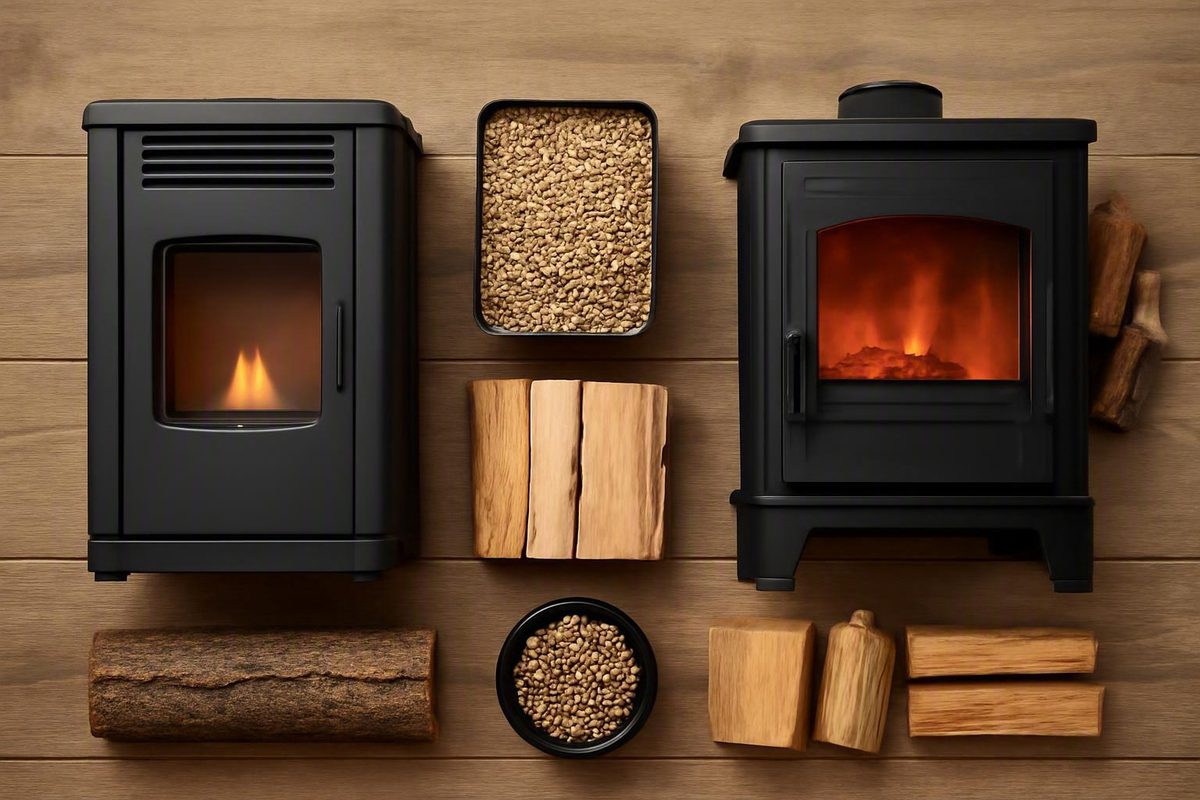
Comparing pellet stoves vs. wood stoves is less about finding a universal winner than deciding which set of compromises fits your home.
A pellet stove generally favors convenience: automatic fuel feeding, push-button operation, steadier output, and thermostat-style temperature control. A wood stove favors resilience and simplicity: heat without grid power, fewer powered components, a traditional log fire, and potentially favorable economics when seasoned firewood is inexpensive.
Neither category is automatically cheaper, cleaner, more efficient, or easier to maintain. Local fuel prices, installation conditions, power reliability, heating demand, storage, and the value of your labor can reverse the usual recommendation.
The short answer: pellet convenience versus wood resilience
Choose a pellet stove when you want controlled space heat with fewer loading events and less direct fire management—and you have dependable electricity, a reliable pellet supply, protected storage, and the willingness to clean the appliance frequently.
Choose a wood stove when outage performance, mechanical simplicity, traditional ambience, quiet operation, or access to inexpensive seasoned firewood matters more than automatic temperature control.
| Decision factor | Pellet stove | Wood stove |
|---|---|---|
| Fuel | Compressed pellets, usually bagged | Split and seasoned firewood |
| Heat control | Commonly electronic and thermostat-based | Primarily controlled by fuel load and airflow |
| Electricity | Most conventional models require it | Usually not required for combustion |
| Fire tending | Automatic feeding reduces tending | Manual starting, loading, and airflow adjustment |
| Routine cleaning | Frequent burn-pot, ash, glass, and passage cleaning | Ash removal plus firebox and chimney care |
| Components | Auger, igniter, blowers, sensors, switches, and controls are common | Generally fewer powered components |
| Outage performance | Usually stops unless suitable backup power is available | Generally continues heating; an optional blower will stop |
| Fuel storage | Compact, but pellets must be protected from moisture | Larger, ventilated stacking area; seasoning may be required |
| Noise | Blower and auger can be audible | Generally less mechanical noise without an optional blower |
| Ambience | Real flame, but usually a smaller pellet-fed fire | Visible logs, embers, and crackling |
| Likely best fit | Convenience-first, reliable-grid, zoned-heating household | Outage-prone, off-grid, ambience-first, or low-cost-firewood household |
These are category-level tendencies, not guarantees. A particular pellet stove may be quieter, easier to clean, or less automated than expected. Wood-stove designs also differ substantially in combustion system, usable output, burn behavior, and maintenance.
The installation can be just as decisive as the appliance. A serviceable existing chimney might make a wood stove attractive. In another house, an approved pellet-vent route could make pellet installation simpler. Neither possibility should be assumed until the proposed appliance, placement, venting, clearances, and local requirements have been evaluated.
Your heating objective matters too. A stove may work very well as supplemental or zoned heat in a frequently occupied room without heating distant bedrooms evenly. Primary heating places greater demands on fuel supply, outage planning, output modulation, maintenance, and room-to-room heat movement.
Before leaning toward either category, answer five questions:
- Is the stove intended as primary, emergency, supplemental, or zoned heat?
- How dependable are local electricity and fuel supplies?
- What venting or chimney work does the house require?
- How much fuel can be stored safely and protected from moisture?
- How much loading, cleaning, and maintenance will the household actually perform?
How pellet and wood stoves produce and control heat
A wood stove is fundamentally a manually fueled combustion appliance. You place firewood in the firebox, establish the fire, and manage heat by changing the fuel load and combustion airflow. Once a load is burning properly, it may require little intervention for a period, but output naturally changes as the wood ignites, burns down, and becomes embers.
Wood quality is part of the control system. Log size, species, moisture, firebox loading, draft, and airflow settings all influence how quickly the load burns and how much useful heat it produces. The user therefore plays a direct role in achieving comfortable combustion.
A conventional pellet stove adds powered fuel delivery and electronic control. Pellets are poured into a hopper, from which an electric auger meters them into a burn pot. Conventional designs commonly use an igniter, blowers, temperature controls, and safety switches or sensors. Instead of loading each individual fire, the owner fills the hopper and selects an output or temperature setting.
That automation is the principal lifestyle difference. Pellet heat can rise and fall in response to a control setting, while wood heat follows the fire you build. A pellet stove still needs attention, but the work shifts from tending logs toward filling, cleaning, monitoring, and servicing a machine.
Do not assume that every pellet stove has the same controls. Basic models may offer only an onboard control panel and several output settings. Programmable schedules, handheld remotes, external thermostats, Wi-Fi, and app control are model-specific. Confirm what is included, what requires an accessory, and how the selected stove restarts after a power interruption.
A larger hopper can extend the time between refills. Some pellet appliances may run for more than 24 hours from one hopper, but runtime depends on hopper capacity, feed rate, output setting, weather, fuel quality, and the building’s heat loss—not hopper size alone.Consumer Reports explains pellet-stove runtime, controls, and buying considerations Treat any runtime statement as conditional rather than a promise that one fill will always last overnight or all day.
The same caution applies to maximum BTU figures and advertised square-foot coverage. A large number on a product page does not establish that the stove can comfortably heat your home. Climate, insulation, air leakage, ceiling height, floor plan, stove placement, and heat movement between rooms all affect the result.
Use a design heat-load assessment to define what the home needs under expected winter conditions. Then compare each stove’s usable operating range, not merely its maximum rating. An oversized stove may overheat the room where it is installed even while distant rooms remain cool.
Daily ownership: loading, controls, noise, ash, and fire ambience
The practical question is not whether either stove involves work. Both do. The question is which type of work you prefer.
With a wood stove, ownership may include:
- Buying, cutting, splitting, transporting, or receiving firewood
- Stacking it where air can circulate while protecting it from precipitation
- Carrying logs indoors
- Building or relighting fires
- Adjusting airflow as a load catches and burns down
- Reloading at suitable intervals
- Removing and safely managing ash
- Inspecting and cleaning the connector pipe and chimney
If you process your own firewood, the fuel-supply work can begin months before heating season. Even purchased wood must fit the stove and be suitably seasoned.
Pellet-stove work is organized differently:
- Receiving and moving bags
- Protecting fuel from water and excessive humidity
- Lifting and pouring fuel into the hopper
- Scraping deposits from the burn pot
- Removing ash
- Cleaning glass, heat-exchange surfaces, and internal passages
- Checking that fuel feeds properly
- Deep-cleaning or servicing the stove and exhaust path
- Replacing worn components when necessary
Automation reduces fire tending; it does not make a pellet stove maintenance-free. A dirty burn pot or restricted passage can interfere with ignition, combustion, heat transfer, and dependable operation.
In one long-term ownership example, Pellet Finder author Walt Jensen reports scraping his stove’s burn pot every few days, removing ash every week or two, and completing a full teardown annually after twelve winters of use.Read Jensen’s twelve-winter pellet-stove account That is one owner’s reported routine, not a universal schedule. The correct interval depends on the appliance, fuel, operating rate, ash production, installation, and manufacturer instructions.
This helps explain why maintenance rankings conflict. Some comparisons count fire tending as maintenance and conclude that wood is more demanding. Others focus on cleaning frequency and powered components and conclude that pellets require more upkeep. A useful comparison separates the work:
| Work category | Pellet stove | Wood stove |
|---|---|---|
| Fire tending | Usually lower because feeding is automatic | Higher because loading and airflow are manual |
| Routine owner cleaning | Often frequent and detail-oriented | Ash removal plus periodic firebox cleaning |
| Vent or chimney care | Exhaust-path inspection and cleaning | Chimney inspection and creosote management |
| Component service | More powered and electronic parts to inspect or replace | Generally fewer powered parts |
More components do not prove that every pellet stove will fail more often or cost more to repair. They do mean that the ownership plan should account for parts availability and qualified service.
Comfort also differs. A pellet stove commonly produces steadier output and can reduce temperature swings in its immediate zone. That can be valuable when someone works from home, keeps a predictable schedule, or wants the stove to supplement central heating without repeatedly tending a fire.
A wood stove provides a different experience: visible logs, changing flames, glowing embers, and crackling. Its output is less automatic, but many owners consider the fire itself part of the value.
Noise deserves more attention than it usually receives. Sound may change with output and become more noticeable at night or during quiet activities. If the appliance will sit near a sofa, television, office, or bedroom, hear candidate models operating at both low and high output before buying.
A wood stove generally creates less mechanical noise unless it uses a circulation blower. Without that blower, heat is delivered primarily through radiation and natural convection, accompanied by the normal sounds of combustion.
Power outages and long-term reliability
For an outage-prone household, electrical dependence should be a threshold decision—not a minor line in a feature table.
Most conventional pellet stoves need electricity for fuel feeding, ignition, controls, combustion, and heat distribution. Without suitable backup power, they generally stop operating. A conventional wood stove can ordinarily continue producing heat through natural draft and radiant or convective transfer, although an optional electric circulation blower will stop.Regency compares wood- and pellet-stove outage operation
Consider four practical outage cases:
1. An unprotected pellet stove
When power fails, the feed system, controls, and blowers stop. Follow the appliance manual’s outage and shutdown instructions rather than opening, rewiring, or otherwise improvising with the stove.
2. A battery-backed pellet stove
A manufacturer-compatible battery or backup system may allow continued operation or an orderly shutdown. Capability and runtime vary by appliance and backup product, so confirm compatibility for the exact stove rather than assuming that any household battery will work.
3. A generator-backed pellet stove
Treat the generator and connection equipment as part of the heating plan, not as an unspecified future accessory.
4. A naturally drafting wood stove
A correctly installed conventional wood stove can continue producing heat without household electricity. Heat distribution may become less even if a circulation blower stops, and closed floor plans can leave distant rooms cooler. The household must also have dry fuel and someone able to tend the fire.
Battery backups and generators are identified as possible outage options for pellet appliances, but their suitability is model-specific.Forge & Flame discusses pellet-stove electricity dependence and backup options Use only arrangements accepted by the appliance manufacturer, backup-equipment supplier, and any qualified installer or electrician involved.
Long-term reliability involves more than whether a stove works during one outage. Pellet stoves commonly add an auger, igniter, blowers, sensors, switches, and control electronics. Those parts enable automation but also require inspection, service, and eventual replacement in some appliances.
Wood stoves generally contain fewer powered parts. They are not maintenance-free: door gaskets, glass, baffles, firebrick, controls, catalytic components where fitted, and the chimney system still require inspection and may eventually need attention.
Jensen’s owner account also reports an ongoing need to budget for pellet-stove replacement parts. That illustrates one owner’s experience, not a failure-rate or component-life forecast for every model.
Before buying, ask:
- Which parts commonly require service on this model?
- Are parts stocked locally?
- Which routine components may the owner replace without affecting the warranty?
- How quickly can a technician respond during winter?
- How long has the manufacturer supported electronics for earlier models?
- What does the warranty cover for parts, labor, and travel?
- Is another heat source available if service is delayed?
In remote, outage-prone, or off-grid locations, a conventional wood stove usually has the resilience advantage. A pellet stove can still work, but backup electricity or alternate heat must be treated as part of the system.
Fuel cost, storage, and handling
There is no universal fuel-cost winner.
Pellet economics depend on the delivered price per ton or bag, electricity use, seasonal consumption, pellet quality, delivery charges, and availability. Firewood economics depend on delivered price per cord, whether the quantity is honestly measured, moisture content, species, transportation, seasoning, and the value of the owner’s labor and equipment.
Heating demand matters just as much. Identical stoves can consume different amounts of fuel in homes with different climates, insulation, air leakage, operating schedules, and temperature settings. Do not transfer a national estimate or another owner’s burn rate directly into your budget.
Pellets commonly come in 40-pound bags and must be protected from liquid water and excessive humidity. Moisture exposure can make pellets swell or disintegrate and interfere with reliable feeding. Three tons equals 150 standard 40-pound bags, which illustrates the physical handling involved rather than predicting how much any household will burn.Pellet Heat discusses pellet packaging and moisture-sensitive storage
Before choosing pellets, picture the entire route: delivery point, stairs, door width, storage platform, distance to the stove, and hopper height. Someone must repeatedly move and pour the fuel, not merely find floor space for it.
Firewood requires more stacking space and ventilation. A full cord occupies approximately 4 feet by 4 feet by 8 feet when stacked, although the stack’s shape may vary.Fire Pit Surplus describes cord dimensions and fuel-storage considerations Heating value per cord varies with species, moisture, and stacking. Wood should be protected from precipitation while remaining ventilated, and freshly cut wood may require substantial seasoning before use.
“Free wood” can transform the cash-cost comparison, but it is rarely costless in a broader sense. Self-harvested fuel may involve:
- Land access, permissions, or permits
- Chainsaws, splitters, trailers, and protective equipment
- Equipment fuel and maintenance
- Cutting, splitting, loading, unloading, and stacking labor
- Transportation
- Drying time
- Storage losses or unusable pieces
Assign a value to those inputs if you are comparing total ownership cost rather than cash purchases alone.
Use this local fuel-supply checklist before ordering a stove:
- Obtain delivered pellet prices by bag, pallet, and ton.
- Obtain delivered firewood prices for a clearly defined quantity.
- Ask when the firewood was split and how its moisture has been assessed.
- Confirm whether prices include delivery, stacking, deposits, or bag handling.
- Ask suppliers about availability during peak winter demand.
- Inspect pellet storage for leaks, condensation, and floor moisture.
- Measure available ventilated space for firewood.
- Determine whether household members can repeatedly lift the selected package or log size.
- Identify a second fuel supplier.
- Check the appliance warranty and manual for acceptable fuel specifications.
A local annual worksheet is more useful than a broad average:
Pellet annual fuel cost
Local delivered price per ton × estimated tons per season
Add:
Estimated stove electricity + delivery and handling charges
Firewood annual fuel cost
Local delivered price per cord × estimated cords per season
Add:
Delivery + processing equipment + permits + assigned labor and storage cost
Obtain seasonal-use estimates from a heat-load assessment, local experience in similar homes, and documentation for the specific appliance under realistic conditions. Run low-, expected-, and high-demand cases rather than relying on one optimistic number.
Purchase, installation, maintenance, and repair costs
The appliance price is only the first line of the comparison. Calculate total ownership cost over the period you expect to keep the system.
Include:
- Stove and required accessories
- Freight or delivery
- Hearth protection
- Chimney, liner, connector pipe, or pellet vent
- Wall or roof penetrations
- Outside-air components where required for the installation
- Electrical work for a conventional pellet stove
- Permits and inspection fees
- Installation labor
- Commissioning and owner instruction
- Annual fuel
- Pellet-stove electricity
- Cleaning tools and routine supplies
- Professional inspection and service
- Chimney sweeping or vent cleaning
- Backup power
- Repair allowances and replacement parts
Published figures cannot decide an individual project because they combine different regions, dates, appliance types, labor markets, and installation assumptions. As one dated benchmark, Consumer Reports’ 2025 pellet-stove guide described appliance prices ranging from just under $1,000 to more than $5,000, excluding installation. That broad range is useful for initial screening, not as a substitute for a local quote.
An existing masonry chimney can reduce the apparent scope of a wood-stove project, but only if it is suitable for the selected appliance. It may require inspection, repair, a compatible liner, or other changes. Conversely, some pellet installations can use an approved vent route through an exterior wall or roof and avoid a traditional masonry chimney.
Neither arrangement is automatically simple or less expensive. The selected model, vent route, building construction, required hearth work, service access, and local approval process can change the quote.
Separate maintenance into four cost buckets:
- Routine owner cleaning: ash removal, glass cleaning, burn-pot scraping, and internal cleaning.
- Professional service: inspection, operational checks, gasket assessment, and appliance-specific maintenance.
- Chimney or vent work: sweeping, exhaust-path cleaning, liner inspection, and repairs.
- Long-term components: blowers, augers, igniters, sensors, switches, control boards, gaskets, firebrick, baffles, and catalytic components where fitted.
This structure resolves much of the “which needs more maintenance?” debate. Pellet stoves can require more frequent detail cleaning and have more powered parts to maintain. Wood stoves require more manual fire work and chimney management. Which burden costs more depends on the appliance, local service prices, and what the owner does personally.
Use this formula for either a five- or ten-year comparison:
Installed cost
+ cumulative fuel
+ cumulative electricity
+ cleaning supplies
+ professional inspections and service
+ chimney or vent work
+ backup-power purchase and upkeep
+ repair and component-replacement allowance
− verified incentives
Do not subtract a tax credit, rebate, or other incentive until the relevant government agency confirms that the current program applies to the specific appliance, project date, taxpayer, installation expense, and jurisdiction. Keep the required certification and invoices.
Jensen reports that his pellet stove still costs less than the propane system it replaced after he accounts for fuel, replacement parts, and maintenance time. That result belongs to his circumstances. Without details about the home, climate, appliance, fuel prices, and operating schedule, it cannot establish that pellets will beat propane—or wood—in another household.
Run the worksheet using at least three scenarios:
- Best case: moderate winter, favorable fuel price, limited repairs
- Expected case: typical local winter and realistic service costs
- Stress case: colder winter, higher fuel price, and a significant repair
The stress case is especially important when the stove will serve as primary heat.
Efficiency, heat output, smoke, and environmental tradeoffs
Neither fuel category has an automatic efficiency victory.
Reported efficiency ranges for modern pellet and wood stoves can overlap. Selected catalytic wood stoves may compare favorably with selected pellet models, while other pellet models may outperform particular wood stoves. The meaningful comparison is between certified appliances evaluated under the same method.
Check whether ratings use a higher heating value (HHV) or lower heating value (LHV) basis.
Actual performance depends on:
- Certified appliance performance
- Fuel moisture and quality
- Operating rate
- Maintenance condition
- Chimney or vent performance
- Outdoor temperature
- Insulation and air leakage
- Floor plan and ceiling height
- Stove placement
- Air movement between rooms
Use the home’s design heat load and the stove’s intended role—primary, supplemental, or zoned heat—to choose capacity. Maximum output and generalized square-foot claims are screening information, not a substitute for sizing.
Oversizing can be uncomfortable. A stove placed in one room may overheat that room before warmth reaches distant spaces. A pellet unit with a broad controllable output range may work well for zoned heating, but the floor plan still controls distribution. A powerful wood stove does not guarantee whole-house comfort if doors, stairs, and walls impede natural convection.
Commercial comparisons commonly characterize pellet stoves as producing less particulate smoke than traditional wood stoves, but such category-level descriptions do not establish the performance of a particular model. Fuel, installation, operation, and maintenance also affect emissions. Review current certified efficiency and particulate-emissions information for each candidate appliance rather than relying on marketing labels.
Neither appliance is emission-free. Consumer Reports notes that pellet stoves can burn more cleanly than fireplaces or traditional wood stoves while still releasing more point-of-use air pollutants than gas furnaces or electric heating. Local air-quality restrictions may also affect when solid-fuel appliances can be used.
Combustion emissions are only one part of environmental impact. A broader comparison can include:
- Forest and wood-residue sourcing
- Firewood harvesting and regeneration practices
- Pellet processing and drying
- Transportation distance
- Bag manufacturing and disposal
- Pellet-stove electricity
- Appliance and component production
- Fuel losses from moisture or poor storage
Do not assume either pellets or cordwood is carbon neutral, inherently sustainable, or universally greener. Ask where the available fuel comes from, how it is processed, how far it travels, and how efficiently the selected appliance uses it.
For each candidate model, request:
- Certified overall efficiency
- The measurement basis, including HHV or LHV
- Certified particulate-emissions information
- Minimum and maximum usable output
- Approved fuel specifications
- Maintenance requirements at the expected operating rate
Compare those figures alongside the home’s heat load and intended operating pattern.
Installation, safety, and the final decision checklist
Both stove types are combustion appliances. Safe operation depends on the complete system: appliance, hearth, vent or chimney, fuel, alarms, installation, operation, and maintenance.
Manufacturer and retailer guidance consistently makes safe use conditional on proper installation, required clearances and floor protection, approved fuel, and maintenance according to the appliance instructions.ComfortBilt summarizes fuel, vent, and maintenance considerations for pellet and wood stoves
Shared precautions include:
- Use only venting or chimney components approved for the appliance and installation.
- Maintain the clearances specified in the installation instructions.
- Provide the specified hearth and floor protection.
- Burn only fuel approved for the appliance.
- Handle ash as directed by the manufacturer.
- Complete the required cleaning and inspection.
- Maintain working smoke and carbon-monoxide alarms.
- Follow the installation and operating manuals.
- Complete any permits or inspections required by the applicable local authority.
Carbon-monoxide detection and manufacturer-specified maintenance are important around both stove types, while the appliances and venting must be treated as complete systems rather than interchangeable parts.Northern Tool’s comparison addresses carbon-monoxide detection and model-specific maintenance
A wood installation may require evaluation of an existing chimney, a compatible liner, repairs, or a new listed chimney system. Pellet appliances may use shorter approved venting arrangements in some homes, but the exact route is appliance- and site-specific. Do not assume that any pellet stove can use a simple wall vent or that an existing wood chimney can accept a new appliance without modification.
Before purchase, obtain a professional evaluation covering:
- Design heat load
- Primary, supplemental, or zoned-heating objective
- Stove placement and service access
- Room-to-room heat movement
- Chimney or vent route
- Hearth construction
- Combustible clearances
- Outside-air provisions where applicable
- Electrical supply for a conventional pellet stove
- Permit and inspection responsibilities
- Applicable air-quality restrictions
- Insurer documentation
- Fuel storage and handling
Consumer Reports describes freestanding pellet stoves as requiring an exhaust route and fire-resistant hearth protection, while pellet inserts may require a chimney liner; actual requirements depend on the appliance and installation.Consumer Reports outlines pellet-stove installation considerations
Ask every contractor to itemize the same scope. The quote should identify:
- Exact certified model
- Usable output range
- Chimney or vent brand, size, and route
- Liner requirements
- Hearth work
- Clearance solutions
- Outside-air components
- Electrical work
- Permit and inspection responsibility
- Labor and delivery
- Startup, testing, and commissioning
- Owner training
- Warranty service arrangements
- Recommended maintenance
- Exclusions and possible change-order conditions
Then match the decision to the household:
Convenience-first, reliable-grid household: Pellet usually has the advantage because of automatic feeding and temperature control.
Outage-prone or off-grid household: Wood usually has the advantage because conventional operation does not depend on electricity.
Household with inexpensive seasoned firewood: Wood may offer stronger fuel economics, especially when storage and labor are already available.
Thermostat-oriented zoned heating: Pellet may fit well when the goal is controlled heat in one occupied area alongside a central system.
Ambience- and quiet-focused household: Wood usually provides the more traditional fire and avoids routine auger and blower noise.
Household with physical handling constraints: Neither category should be assumed easy. Compare lifting 40-pound pellet bags with carrying irregular logs, and account for the full route from delivery to stove.
Low-maintenance expectation: Reconsider both. Pellet ownership trades fire tending for frequent cleaning and powered-component service; wood ownership requires manual fuel work, ash handling, and chimney care.
Before signing a contract, answer these threshold questions:
- Is reliable electricity available?
- If not, is compatible backup power or another heat source planned?
- Is the selected fuel dependable during peak winter demand?
- Is there enough protected storage?
- Can household members safely move and load the fuel?
- Will the owner follow the required cleaning schedule?
- Are local technicians and replacement parts available?
- Can the stove’s heat move through the intended area?
- Has the proposed installation been accepted by the relevant local authority and insurer?
- Have current air-quality restrictions and incentives been independently verified?
Compare at least two certified models and obtain multiple itemized installation quotes. Do not choose solely by fuel category, maximum output, advertised square footage, or appliance price.
The conditional verdict is straightforward: a pellet stove is usually the stronger fit when controlled, automated space heat matters most and electricity, pellets, protected storage, regular cleaning, and technical support are dependable. A wood stove is usually the stronger fit when outages are common, inexpensive seasoned wood is available, mechanical simplicity and traditional ambience matter, and the household accepts manual fire tending and chimney care.
Before buying either one, calculate local total cost, obtain a heat-load assessment, compare installation quotes, confirm fuel and service availability, review certified model data, and verify current code, insurance, air-quality, and incentive requirements.
Frequently asked questions
Can a pellet stove run during a power outage?
Most conventional pellet stoves cannot operate normally without electricity because their auger, igniter, controls, and blowers are powered. A compatible battery system or generator may keep a stove operating or permit an orderly shutdown, but suitability depends on the specific appliance.
Use only backup arrangements accepted by the stove manufacturer and backup-equipment supplier. Do not assume that a generic household battery or generator will operate every stove.
Which is cheaper to run: a pellet stove or a wood stove?
Neither is universally cheaper. Compare local delivered pellet prices, firewood prices, seasonal heat demand, appliance performance, electricity, delivery, cleaning, service, and repair costs.
Wood can gain a major advantage when inexpensive seasoned fuel is available, but harvesting, processing, transportation, equipment, labor, seasoning, and storage still have value. Pellets may be economically attractive where bagged fuel is competitively priced and the stove displaces a more expensive heating source.
Which stove requires more maintenance?
It depends on what you count. Pellet stoves generally require frequent burn-pot and internal cleaning and contain more powered components to service. Wood stoves require manual fire management, ash removal, chimney inspection and cleaning, and creosote management.
Separate fire tending, routine owner cleaning, professional service, chimney or vent work, and component replacement. That produces a more useful answer than assigning either category a single “high” or “low” maintenance label.
Are pellet stoves cleaner and more efficient than wood stoves?
Pellet stoves are commonly characterized as producing steadier combustion and less particulate smoke than traditional wood stoves, but model-level efficiency can overlap. Results vary with the appliance, fuel, installation, maintenance, and operation.
Compare certified efficiency using the same HHV or LHV basis and review current particulate-emissions information for the exact models. Neither stove is emission-free, and neither fuel should be assumed inherently sustainable or carbon neutral.
Can either stove heat an entire house?
Potentially, but not in every house. Success depends on design heat load, climate, insulation, air leakage, stove output, placement, floor plan, and room-to-room airflow.
Either type may heat an open central area effectively while leaving closed or distant rooms cool. Size the system from a heat-load assessment and decide whether the stove is intended for primary, supplemental, or zoned heat. Do not rely on maximum output or advertised square-foot coverage alone.