
Is a Non-Electric Pellet Stove the Right Backup or Off-Grid Heater?
It is worth considering when grid-free heat matters and the property supports the required chimney, clearances, combustion air, cleaning and manual operation.
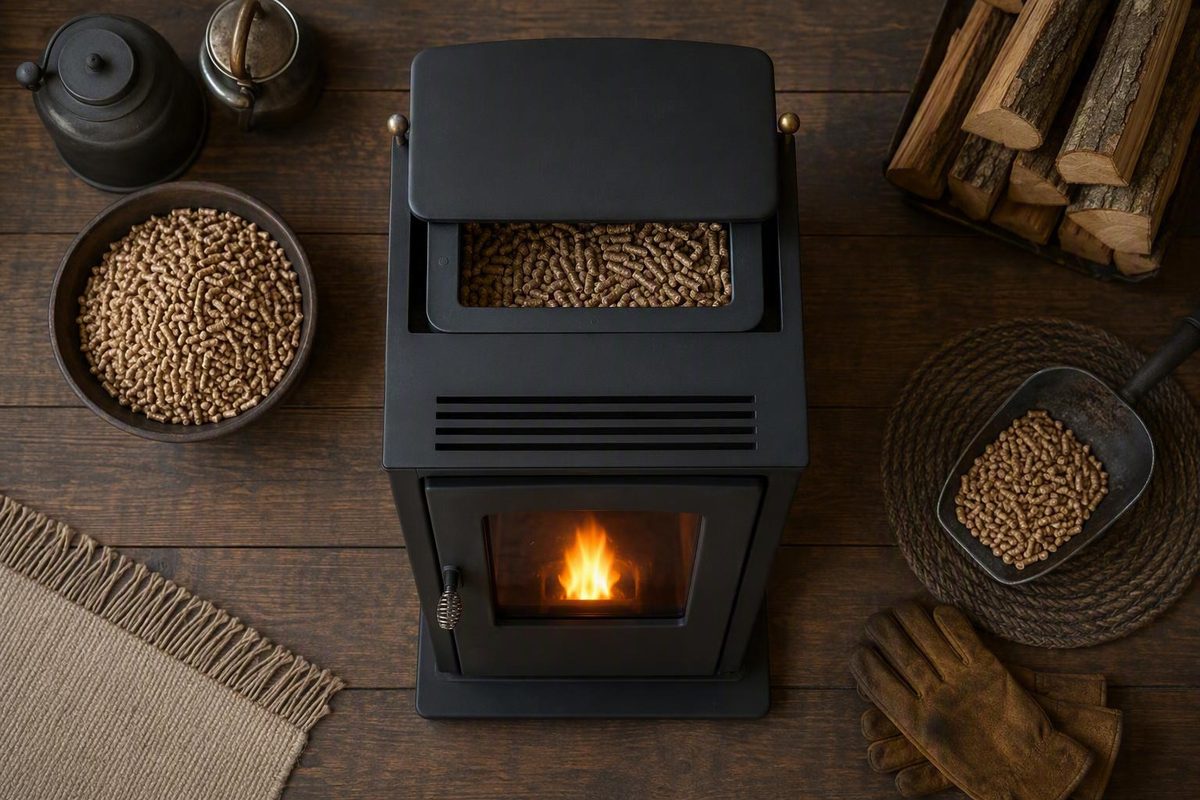
A gravity feed pellet stove can produce pellet heat without a wall outlet. Instead of using an electric auger to deliver fuel and powered blowers to manage combustion and room air, it relies on pellet weight, a controlled feed point, and natural chimney draft.
That makes the category worth investigating for an off-grid cabin, an outage-prone home, or a property where electrical independence matters. The tradeoff is less automation: ignition and adjustment are generally manual, heat moves mainly by radiation and natural convection, chimney design has a direct effect on combustion, and cleaning and inspection remain essential.
The fastest decision test is:
- Setting: Is the exact appliance approved for a home, cabin, tent, patio, or another specific use?
- Chimney: Can the property support the model’s required vertical vent configuration?
- Heating load: Does documented output match a building heat-loss assessment?
- Operation: Are you comfortable with manual lighting, adjustment, monitoring, and cleaning?
- Support: Are replacement burn components, warranty service, and qualified installation available?
Start there—not with an advertised maximum BTU figure, square-foot rating, or “up to” hopper runtime.
What a gravity feed pellet stove is—and what it is not
“Gravity feed” describes how pellets travel from the hopper toward the burn area. Their weight moves them downward through a chute or restricted opening instead of an electric motor turning an auger.
Near the fire, a firepot, basket, retention plate, or similar structure supports the burning fuel and admits combustion air. Pellets form a limited blockage at the feed point. As the burning pellets shrink and become ash, space opens and more fuel descends.
The exact metering method varies. One stove may use a feed collar or sliding opening. Another may change the distance between the hopper chute and firepot, reposition a plate, or depend more heavily on adjustable air inlets. Controls and procedures should therefore never be transferred from one model to another without confirmation in the exact appliance manual.
A conventional electric pellet stove commonly uses electricity for:
- A motor-driven pellet auger
- Automatic ignition
- Electronic controls and safety switches
- A combustion or exhaust blower
- A room-air blower
- Thermostat-based control
A non-electric model omits some or all of that powered equipment. Gravity-fed stoves remain a comparatively uncommon alternative, however; an ordinary pellet stove does not become non-electric merely because its hopper sits above the burn pot. A 2025 technology overview identifies WiseWay, Independent Stove GAP 2020, and Flame Innovation Mini Me as documented U.S. gravity-fed examples, while also emphasizing that buyers should research this niche category carefully in the Alliance for Green Heat overview.
Appliance category matters as much as feed mechanism. Residential room heaters, patio heaters, portable emergency stoves, tent heaters, camp cookers, and homemade burners can all use gravity to move pellets.
For a house or full-time residential cabin, consider only an appliance explicitly documented for residential room heating in the proposed installation. Descriptions such as “off-grid,” “portable,” “emergency,” or “indoor/outdoor” do not by themselves establish residential approval.
How gravity feed and natural draft make non-electric operation possible
The basic operating cycle is:
- Pellets are loaded into a hopper.
- Their weight moves them toward a restricted outlet or chute.
- A retention structure supports the burning fuel and provides an airflow path.
- Burning pellets lose volume and become ash.
- Additional pellets descend into the available space.
- Hot exhaust rises through the vent, helping draw combustion air into the firebox.
Timber describes this temporary pellet blockage as a “log jam” effect: fuel enters as the pellets already in the firebox burn down. Its products use a sealed firebox and vertical pipe to create the natural draft that draws air through openings beneath the firepot in the manufacturer’s explanation of its outdoor heaters.
Why the chimney is part of the combustion system
In a natural-draft stove, the chimney does more than remove exhaust. As hot gases rise through the vertical vent, the resulting pressure difference draws replacement combustion air through the stove’s intended inlets. The firebox, air controls, burn structure, connector, and chimney must operate as one system.
A predominantly straight vertical vent generally supports more predictable draft than a route with several elbows or long horizontal sections. That does not mean every installation must be perfectly straight; it means the route must follow the exact model documentation and approved vent-system requirements.
The GW1949 shows how specific those instructions can be. Its manual says a straight vertical chimney provides the best performance, permits 3-inch venting for an 8- to 12-foot chimney, recommends 4-inch venting above 15 feet, discourages elbows and horizontal runs, and prohibits a manual flue damper. Those instructions belong to that model and are not universal dimensions for gravity-fed stoves in the GW1949 installation and operation manual.
Outdoor products follow their own documentation. Timber recommends six to seven feet of vertical pipe for its tent heaters and says additional rise may be needed when an elbow reduces draft. It favors a 45-degree elbow over a 90-degree elbow. That illustrates how vent resistance can affect a natural-draft fire, but it is product-specific tent-heater guidance—not a residential chimney rule on Timber’s tent-heater page.
Variables that can change the burn
Natural-draft operation can be affected by:
- Chimney height, diameter, temperature, and location
- Elbows and horizontal connector length
- Available combustion air
- Air leakage in the stove or vent
- Outdoor temperature and wind
- Pellet dimensions, density, and ash behavior
- Fuel quality and storage condition
- Altitude
- Ash accumulation in the firepot, internal passages, or vent
Riley, for example, says its portable pellet stoves do not work above 8,000 feet because of reduced oxygen. That is a seller-stated restriction for those products, not a category-wide rule on Riley Stove Company’s pellet-stove page.
Before buying, give the manufacturer and installer the proposed elevation, chimney route, prevailing weather exposure, and combustion-air arrangement.
Gravity-fed versus electric pellet stoves: the practical tradeoffs
Neither category is inherently better. Each solves a different problem.
| Decision factor | Gravity-fed, non-electric stove | Conventional electric pellet stove |
|---|---|---|
| Fuel delivery | Pellet weight plus a mechanical feed restriction or adjustment | Motor-driven auger |
| Combustion air | Natural chimney draft | Commonly assisted by a powered combustion blower |
| Ignition | Usually manual and model-specific | Often automatic |
| Heat movement | Mainly radiation and passive convection | Often assisted by a room-air blower |
| Temperature control | Manual feed and/or air adjustment | Often electronic and thermostat-based |
| Outage operation | Stove itself may require no electricity | Requires manufacturer-compatible backup power if grid power fails |
| Operating sound | No auger or powered blower noise when those components are absent | May include auger, motor, and fan noise |
| Main sensitivities | Draft, vent geometry, weather, pellet flow, ash, and operator adjustment | Power, motors, controls, sensors, ash, and fuel quality |
Simplicity is a tradeoff, not a reliability guarantee
Removing an auger motor, igniter, electronic board, and blower eliminates components that can fail. It does not prove that every gravity-fed stove is more reliable, durable, or lower-maintenance.
Its performance also depends more directly on chimney draft and operator adjustment.
Less powered equipment may reduce operating noise, but the supplied evidence contains no controlled, category-wide noise comparison. Draft sounds, falling pellets, and metal expansion can still be audible.
Automation and temperature control
Many electric pellet stoves can ignite automatically, meter fuel electronically, regulate combustion, and respond to a thermostat. A gravity-fed stove commonly requires the operator to light the fire and balance fuel flow with combustion air.
That distinction can be especially important during mild weather. A powered stove may reduce output or cycle in response to room temperature. A manually controlled natural-draft stove may need more observation and may provide less exact temperature regulation.
Flame Innovation describes its Mini Me as using manual damper control and says an operator may need several burns to learn the stove, while conventional electric models provide auger-fed, thermostat-oriented automation. Because this is manufacturer content, it should be treated as a product description rather than an independent comparison in the company’s cabin-heating article.
Heat distribution
Combustion output and whole-building comfort are separate questions. A stove may produce strong heat nearby while leaving closed bedrooms or distant rooms cold.
A gravity-fed design generally relies on radiation, natural convection, and the building’s internal air paths. A heat-powered fan or open doorway should not be assumed to provide the same distribution as a designed forced-air system.
Outages are not a strict either-or choice
A genuinely non-electric stove can operate without grid power when it has suitable draft, combustion air, approved fuel, and proper maintenance. That is its clearest advantage.
An electric pellet stove is not necessarily unusable during every outage. Some models can operate with manufacturer-compatible battery backup. Any backup arrangement should be selected according to the stove manufacturer’s instructions rather than assumed to work because it can power another household appliance.
Investigate gravity feed when independence from electricity outweighs automatic ignition, close temperature control, and powered heat circulation. Investigate an electric stove with approved backup power when normal-day automation and heat distribution matter more.
Heat output and runtime: how to read the numbers
Maximum BTU and square-foot claims are screening information, not complete sizing data. Actual suitability depends on:
- Local winter design conditions and wind exposure
- Insulation and air leakage
- Window and door performance
- Ceiling height
- Building shape and floor area
- Open versus divided rooms
- Stove location
- Heat movement between spaces
- Whether the stove is supplemental, backup, or proposed primary heat
Two buildings with the same floor area can have very different heating loads. An open, insulated cabin may also distribute stove heat more effectively than a larger or highly divided house.
A worked GW1949 example
The GW1949 manual provides a useful model-specific calculation. Under stated test conditions, it reports heat output from 7,481 to 19,475 Btu per hour and particulate emissions of 1.9 grams per hour. It lists a 60-pound hopper, an estimated minimum burn rate of 2 pounds per hour, and an estimated 30-hour runtime at the lowest setting.
The arithmetic is:
60 pounds ÷ 2 pounds per hour = approximately 30 hours
The same manual warns that pellet size can change feed rate and burn time, with fuel-feed variation of as much as 20%. It also identifies the stove as supplemental rather than primary heat.
Those figures describe one appliance under documented conditions. They are not a category standard or a guarantee for a particular installation.
When the sales page and manual disagree
The GW1949 sales page illustrates why specifications should be classified by source. It advertises up to 40,000 BTU and coverage of up to 2,000 square feet. It also gives a maximum runtime of up to 30 hours in one place and up to 36 hours elsewhere.
Those are manufacturer marketing claims, not proof of performance in a particular building. The manual-supported estimate of 30 hours follows directly from the listed hopper capacity and minimum burn rate. The sales page and manual also report different dimensions and weights, so a buyer should establish which documentation matches the exact unit being offered on the US Stove GW1949 product page.
Portable and homemade designs produce different observations. Riley advertises about eight hours from a 40-pound bag for its portable products. A DIY builder also reported more than eight hours at minimum feed in one rocket-stove arrangement. Neither figure should be converted into a general runtime expectation for residential gravity-fed stoves in the builder’s gravity-fed burner account.
A better sizing process
Use this sequence instead of selecting by advertised coverage:
- Obtain a heat-loss assessment. Establish the building’s required output under local winter design conditions.
- Identify the needed operating range. Consider ordinary winter weather as well as colder periods.
- Review the floor plan. Mark closed rooms, stairways, high ceilings, and likely cold zones.
- Define the stove’s role. Decide whether it will provide supplemental heat, outage backup, or proposed primary heat.
- Use exact-model documentation. Compare approved fuel, documented output, vent requirements, and operating limitations.
- Classify every specification. Mark it as manual-listed, officially verified, manufacturer-claimed, owner-reported, or unknown.
- Evaluate distribution. Determine whether passive heat movement can serve occupied spaces without overheating the stove room.
If the appliance manual identifies a stove as supplemental heat, do not reinterpret a larger sales-page square-foot claim as approval to use it as the home’s sole heating system.
Installation and safety requirements do not disappear with the power cord
Non-electric does not mean vent-free, installation-free, or suitable for unattended operation. A gravity-fed stove remains a solid-fuel appliance with hot surfaces, exhaust gases, ash, and a continuing fuel supply.
Before purchase, verify for the exact model and revision:
- Intended installation setting
- Installation and operation manual
- Applicable EPA information
- Claimed safety listing and the model covered by it
- Local building and fire-code acceptance
- Permit and inspection requirements
- Approved vent components and configuration
- Combustion-air requirements
- Wall and ceiling clearances
- Hearth protection
- Alarm requirements and placement
- Installer availability
Marketing words such as “certified,” “listed,” “safe,” or “off-grid” are not substitutes for exact-model documentation and acceptance by the authority responsible for the proposed installation.
Model-specific requirements: the GW1949 example
The GW1949 manual lists clearances of 8 inches to the left sidewall, 2 inches to the back wall, and 36 inches to the ceiling. It states a minimum U.S. hearth size of 31 by 48 inches with at least Type 1 ember protection.
The same manual prohibits installation in a sleeping room and connection to a chimney flue serving another appliance. It describes conditional U.S. mobile-home installation subject to outside combustion air, fastening, grounding, and approved venting. It references 2015 EPA particulate standards, UL 1482-11, ULC S627-00, and UM 84-HUD, but those manual statements should not be projected onto another model or treated as confirmation of present database status.
The manual also directs owners to inspect the chimney and connector annually or after each ton of pellets and recommends professional inspection before each heating season. All of these requirements are specific to the documented GW1949 and remain subject to applicable vent instructions and local rules in the GW1949 manual.
Combustion air, alarms, and hot surfaces
Determine combustion-air and alarm requirements from the exact appliance documentation, alarm instructions, installer, and local authority.
Stove bodies, doors, connectors, and nearby components can become dangerously hot. Maintain documented clearances, keep combustibles and pellet bags away from the appliance, and use any required guards. US Stove warns that the GW1949’s front and sides become extremely hot; its small on-page review sample also includes reports of burn-component deterioration and replacement-parts difficulties, although those reports cannot establish a failure rate on the manufacturer’s product and review page.
Riley separately warns that its portable products become very hot and must not be left unattended. That warning applies to those products, not automatically to every residential stove, but it underscores why “non-electric” should never be interpreted as “safe to ignore.”
Tent heaters belong in a separate installation pathway. Timber recommends placing a carbon-monoxide detector inside tents used with its products. Its pipe-height, tent-size, and alarm guidance does not establish residential approval for a house or cabin bedroom.
Have a qualified professional familiar with solid-fuel and natural-draft appliances install or inspect the system as required by the manual and local rules. If smoke enters the room, draft becomes abnormal, or fuel feed behaves unexpectedly, use the exact model’s shutdown or emergency procedure. Do not improvise with an unapproved damper, liquid, or hot-component disassembly.
What daily operation and maintenance really involve
Gravity feed reduces electrical automation; it does not eliminate operating work.
Ignition is model-specific
The GW1949 sales information describes preheating the burn chamber and flue with a propane torch before starting pellet flow. Timber describes fire gel or charcoal-lighting fluid for its outdoor heaters in Timber’s operating explanation.
These procedures are not interchangeable. Use only the ignition method authorized by the manual for the exact appliance. Never transfer a lighting-fluid procedure from a patio or tent product to a residential stove unless that residential stove’s documentation expressly permits it.
At a high level, operation commonly involves:
- Inspecting the stove, hopper, burn area, connector, and visible vent.
- Confirming that required air inlets are unobstructed.
- Establishing draft as directed by the manual.
- Using the authorized ignition method.
- Beginning pellet flow in the prescribed sequence.
- Adjusting air, draft, or feed only through permitted controls.
- Watching for stable combustion and consistent fuel movement.
- Monitoring the appliance as required.
- Following the documented shutdown procedure.
Depending on the model, output may be adjusted through fresh-air inlets, feed openings, dampers, a collar, or plate position. Learning how feed, air, draft, and flame interact can take practice.
Routine cleaning
Recurring work can include:
- Removing ash from designated collection areas
- Cleaning the firepot, basket, or retention plate
- Clearing combustion-air openings
- Removing fly ash from internal passages
- Checking the hopper chute and feed path for bridging or debris
- Inspecting door and access-panel gaskets
- Looking for warping, cracking, corrosion, or burn-through
- Cleaning and inspecting the connector and chimney
- Confirming that the vent termination remains unobstructed
Frequency depends on the model, fuel, heat setting, chimney, ash production, and operating hours.
One reviewer on the GW1949 product page reported removing fly ash every six to eight hours in that installation. That is an individual owner report, not a manufacturer schedule. The GW1949’s documented chimney and connector interval is summarized in the installation section above; owners of other models should follow their own manuals.
Wear parts and support
A stove can have no electric motors and still contain wear components. Burn baskets, firepots, chambers, baffles, gaskets, air-control parts, and connector components operate in high-temperature conditions.
A small sample of GW1949 reviews includes reports of burn-basket or primary-chamber deterioration after one or two heating seasons and difficulty obtaining certain replacements. These reports identify questions worth investigating; they do not measure failure rates.
Before buying, request:
- Current part numbers and prices for high-temperature components
- Gasket and burn-component availability
- Typical heating-season lead times
- Written warranty terms and exclusions
- Dealer responsibility for diagnosis and labor
- Local service availability
- Freight charges for large replacement parts
- A support plan if the model is discontinued
Mechanical simplicity has limited value if a proprietary burn component is unavailable.
Which use cases fit—and which appliance category belongs there
Begin with the setting, then select the appliance category. Do not begin with an attractive stove and look afterward for somewhere to install it.
Home or full-time residential cabin
Use only a residential room heater documented for the proposed application. Confirm:
- Exact-model approvals and local acceptance
- A viable chimney route
- Required clearances and hearth protection
- Combustion-air provisions
- Professional installation or inspection
- Required smoke and carbon-monoxide protection
- Heat-loss-based sizing
- A realistic heat-distribution plan
- Dry fuel storage
- Cleaning and service access
Outage resilience is the strongest reason to investigate a gravity-fed residential stove. Safe operation during an outage still depends on draft, combustion air, a clean vent, approved fuel, maintained safety equipment, and the supervision required by the appliance documentation.
Off-grid property
Removing the utility connection does not remove installation, venting, inspection, maintenance, or replacement-parts requirements. Remote properties may need more support planning because winter service and freight can be difficult.
A manually lit solid-fuel heater should not be treated as automatic freeze protection for an unoccupied building unless the exact appliance documentation and installation plan support that use.
Outage backup
A gravity-fed stove can be a practical backup where outages are frequent or prolonged and pellet storage is manageable. Install and test the complete system before winter rather than treating the first outage as commissioning day.
Compare it with an electric pellet stove and manufacturer-compatible backup power. Brief outages may favor preserving thermostatic control and blower-assisted heat movement. Longer outages may increase the value of eliminating the stove’s electrical demand.
Workshop or garage
Workshops and garages are special occupancies. Vehicles, fuel, solvents, dust, and other combustible materials may create risks not present in a living room.
Use a stove only when the exact documentation permits the setting and the local authority accepts the installation. A video or DIY report showing a burner in a garage does not establish garage approval, residential listing, adequate clearances, or safe exhaust design.
Patio, tent, or camp shelter
Select a product explicitly intended for that environment. Outdoor and tent manufacturers may specify pipe height, shelter dimensions, floor protection, ventilation, and alarm use. Those instructions do not convert the appliance into a residential room heater.
Riley products in the supplied documentation are portable or emergency-oriented. The Timber products discussed here cover outdoor, patio, and tent applications. They should be evaluated in those categories rather than included in a residential model ranking.
Named residential examples
A July 2025 market overview documented WiseWay GW1949, Independent Stove GAP 2020, and Flame Innovation Mini Me as gravity-fed U.S. examples. Treat those names as research leads, not a verified current shortlist.
Before purchase, confirm production status, exact revision, inventory, official credentials, warranty, dealer support, and parts availability. Product status can change, and an older article or dealer listing may describe a discontinued or revised appliance.
Experimental DIY project
A homemade gravity-fed burner can illustrate how pellets descend as burning fuel loses volume. It does not establish acceptable chimney design, hopper back-burn protection, emissions performance, structural durability, clearances, or indoor approval.
DIY material is educational evidence of the feed mechanism—not a tested or recommended substitute for an approved room heater.
A pre-purchase checklist for choosing a gravity-fed model
Use a written checklist for the exact unit and revision being offered.
1. Confirm the intended setting
Ask whether the appliance is documented for:
- A residential room
- A manufactured or mobile home
- A full-time cabin
- A workshop or garage
- An outdoor patio
- A tent
- A camp or emergency shelter
Do not accept broad advertising terms as a substitute for a precise approved application.
2. Obtain the exact manual
Get the installation and operation manual before paying a deposit. Confirm that the model number, revision, dimensions, weight, vent size, and pictured components match the physical product.
Resolve conflicts between the manual, sales page, dealer quotation, and unit in writing.
3. Verify approvals independently
Check current EPA information and any claimed UL, ULC, CSA, or other listing through the appropriate official record or listing organization. Confirm that the record covers the exact model and revision.
An older manual can document what the manufacturer stated when it was issued; it does not by itself prove current production status or current listing records.
4. Review the installation before ordering
Ask a qualified installer and the local authority to evaluate:
- Chimney height and diameter
- Interior versus exterior routing
- Elbows and horizontal sections
- Termination location
- Outside-air requirements
- Hearth construction
- Wall and ceiling clearances
- Floor support
- Mobile-home conditions, if applicable
- Permits and inspection
- Alarm requirements
A difficult chimney route can materially change the project cost or make a preferred model unsuitable.
5. Size from heat loss
Obtain a building heat-loss assessment and review the floor plan. Identify which rooms must remain warm under design-cold conditions and how heat will reach them.
Do not equate “up to 2,000 square feet” with the ability to heat every building of that size.
6. Normalize performance data
Record:
- Hopper capacity
- Documented minimum and maximum burn rates
- Runtime calculated at each supported burn rate
- Approved pellet grade and dimensions
- Test-condition output range
- Measured emissions, if available
- Verified efficiency, if available
- Conditions behind square-foot and runtime claims
“Burns all night” is not a comparable specification unless hopper capacity, burn rate, setting, fuel, and test conditions are known.
7. Understand operation before ownership
Request manual-based procedures for:
- Cold startup
- Draft establishment
- Ignition
- Starting pellet flow
- Output adjustment
- Hopper refilling
- Normal shutdown
- Smoke spillage
- Weak or reversed draft
- Pellet bridging
- Irregular feed
- Suspected hopper problems
- Emergency shutdown
Pause the purchase if the seller cannot provide clear documentation.
8. Confirm parts and service
Verify:
- Warranty coverage
- Dealer and manufacturer responsibilities
- Burn-basket, chamber, baffle, and gasket availability
- Parts prices and winter lead times
- Local service access
- Freight charges
- Required proprietary tools or adapters
9. Calculate total installed cost
Include:
- Stove price
- Freight and delivery access
- Connector and chimney components
- Roof or wall work
- Hearth construction
- Outside-air components
- Permits and inspection
- Professional labor
- Required alarms and guards
- Initial spare wear parts
- Fuel storage
- Future chimney cleaning and service
The least expensive stove can become the costlier installation if it requires major chimney work or carries high freight and parts costs.
10. Compare the alternative system
If outage operation is the main objective, compare the complete gravity-fed installation with an electric pellet stove and manufacturer-compatible backup power. Consider backup runtime, battery replacement, fuel storage where relevant, maintenance, noise, thermostatic control, and powered heat distribution.
The available evidence is not sufficiently comparable or current to support a responsible “best gravity feed pellet stove” ranking across efficiency, durability, availability, installed cost, and support.
Frequently asked questions
Can a gravity feed pellet stove run during a power outage?
Yes, a genuinely non-electric model can operate without grid power because gravity moves the pellets and natural chimney draft supports combustion.
It still requires the exact model’s approved venting, adequate combustion air, approved fuel, proper maintenance, safety equipment, and documented operating procedures. Do not assume that every pellet stove is non-electric; conventional models commonly need power for the auger, igniter, controls, and blowers.
Does a gravity-fed pellet stove need a chimney?
Yes. A natural-draft gravity-fed stove needs an approved vent system with the vertical rise and configuration required by its manual. The chimney helps create the draft that draws combustion air through the stove and carries exhaust outdoors.
Height, diameter, connector arrangement, termination, clearances, and outside-air provisions are model- and site-specific. Elbows and horizontal runs can reduce draft, so the proposed route should be reviewed before purchase.
How long will a gravity feed pellet stove burn on one hopper?
There is no universal runtime. The basic estimate is:
Usable hopper pounds ÷ pounds burned per hour = estimated runtime
A 60-pound hopper at 2 pounds per hour gives an estimated 30 hours. Higher output shortens runtime.
Treat unexplained “up to” figures cautiously. A meaningful runtime claim identifies hopper capacity, burn rate, heat setting, fuel, and test conditions.
Can I build a DIY gravity-fed pellet burner for indoor heating?
A homemade burner can demonstrate the gravity-feed principle, but it should not be treated as a tested indoor heater. A DIY project may lack evaluated clearances, approved chimney design, emissions testing, durable high-temperature construction, and hopper back-burn protection.
One documented builder described continuously supervised garage use and expressly said not to install the burner in an apartment in the project notes. That account is not evidence of residential approval.
For indoor heating, use an appliance documented for the precise setting and have the proposed installation reviewed by the appropriate local authority and a qualified professional.
Can a gravity-fed pellet stove be used as a home’s primary heat source?
Only when the exact model is documented for that role, its output matches a building heat-loss assessment, and the installation can distribute heat throughout the required area.
Some gravity-fed room heaters are explicitly supplemental. The GW1949 manual, for example, says that model is not intended as a primary heat source. Passive heat movement can also be a significant limitation in a divided floor plan.
Conclusion
A gravity-fed pellet stove deserves consideration when heating without grid electricity is a genuine priority and the property can support the required chimney, clearances, combustion air, safety equipment, fuel handling, cleaning, and manual operation.
Do not select one from a headline runtime, maximum BTU figure, or square-foot claim. Choose the correct appliance category first, verify the exact model and revision, obtain the manual, check official credentials and local acceptance, assess building heat loss and passive heat distribution, review the vent route, confirm parts support, and compare the total installation with an electric pellet stove using compatible backup power.