
What to Know Before Heating a Patio With Wood Pellets
Seller-stated runtimes span 90 minutes to three hours per fill. Ownership also means dry fuel storage, refilling, ash removal and moisture protection.
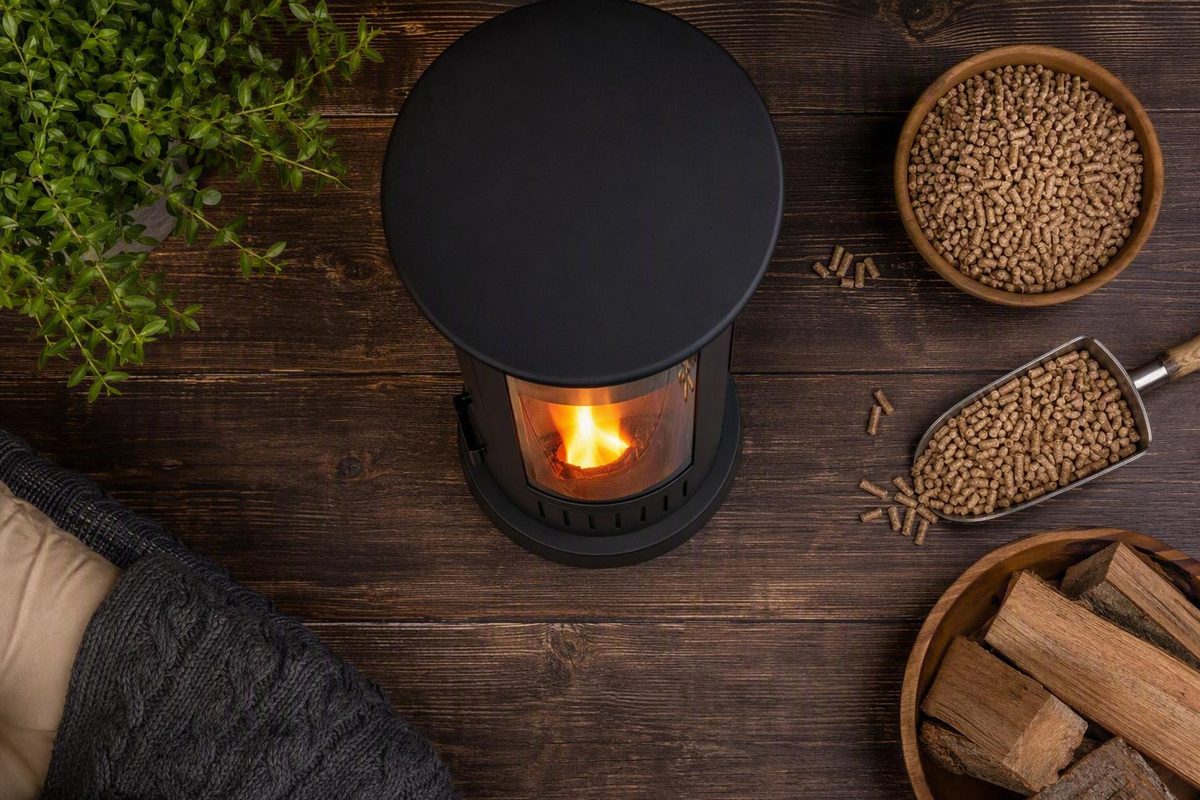
A pellet outdoor heater burns compressed wood pellets to produce outdoor heat, often while displaying the flame through glass. Documented gravity-fed models can work without a propane cylinder or electrical connection, but that benefit is model-specific rather than universal.
Compared with propane or electric patio heat, pellets create a different ownership routine. Fuel must remain dry, the hopper needs periodic refilling, ash must be removed, and the appliance needs protection from moisture. Products sold under the same broad label also vary significantly: full-height patio heaters and compact heater–fire-pit hybrids should not be treated as equivalent.
This guide is therefore a survey of seller-listed specifications and ownership considerations, not an independent performance or safety test. Product pages do not establish useful heat delivered to occupants, standardized comfort areas, universal clearances, or suitability beneath a covered patio. Prices and other time-sensitive details below were captured from the supplied pages in August 2026; verify them before ordering.
What a pellet outdoor heater is—and what it is not
A pellet outdoor heater is an outdoor appliance that burns compressed wood pellets to create heat. Many designs place the flame behind glass or in an elevated combustion chamber, making the appliance both a heat source and a visual feature.
There are two broad product classes in this comparison:
- Full-height patio heaters are designed to distribute heat around standing or seated occupants. Listings may disclose output, hopper capacity, runtime, dimensions, controls, and claimed heating reach.
- Compact heater–fire-pit hybrids emphasize portability, flame viewing, or fire-pit use. Unless output, fuel capacity, runtime, and placement requirements are documented, they cannot be assumed to heat a seating area as effectively as a full-height model.
Some full-height models use gravity feed and natural draft. Pellets descend from a hopper toward the combustion area, while a vertical stove-pipe arrangement supports airflow. Timber describes its heaters as gravity-fed and non-electric in its patio-heater comparison. Solo Stove likewise describes the Tower as gravity-fed and non-electric, with two operating feed positions and a closed position rather than a powered auger or digital thermostat, according to the Tower product page.
Before buying, verify whether the exact appliance has an electric igniter, fan, auger, controller, or other powered component.
An outdoor pellet heater is also different from a conventional indoor pellet stove. Indoor models may use powered fuel delivery, blowers, electronic controls, and thermostats to regulate room temperature. For more context on those ownership differences, see this pellet-stove pros-and-cons guide. An outdoor gravity-fed heater may offer only broad mechanical feed adjustment, with the fire, draft, weather, and fuel condition affecting output.
Sellers position pellet models as alternatives to propane, natural gas, and electric patio heaters. That is a useful shopping framework, but the available comparisons do not establish standardized, independently tested differences in useful heat, operating cost, smoke, or comfort.
The main variables to compare are:
- Product class and intended use
- Footprint, height, and assembled weight
- Seller-listed heat rating
- Claimed heating radius or width
- Hopper capacity and runtime
- Feed or heat controls
- Wheels, handles, and stability equipment
- Ash access and cleaning method
- Required accessories
- Compatible pellet specification
- Refueling and shutdown rules
- Weather protection and maintenance
- Clearances, permitted surfaces, and local solid-fuel rules
- Warranty exclusions, return costs, and replacement-part support
A lower base price may exclude wheels, a weighted base, a cover, or an upgraded firepot. Likewise, the highest advertised output does not establish the best comfort or easiest ownership.
How to interpret BTUs, heating radius, hopper size, and runtime
Three concepts frequently blur together in patio-heater listings:
- Heating radius: The seller’s claimed distance from the appliance.
- Comfort zone: The area in which occupants actually feel sufficiently warm.
These are not interchangeable. The available listings do not clarify whether their advertised ratings represent fuel-energy input or useful heat delivered to occupants.
A claimed radius is not a measured comfort guarantee. Perceived warmth may change with:
- Wind speed and direction
- Ambient temperature
- Open versus partially sheltered placement
- Seat distance and orientation
- Height of the heat source
- Feed setting
- Pellet condition and moisture
- Clothing and personal preference
Geometry creates another source of confusion. A 10-foot radius describes a circle with a 20-foot diameter. Solo Stove uses both “10-foot radius” and “10-foot-wide” wording, which could imply substantially different coverage. Buyers should seek clarification before designing a seating plan around the larger interpretation.
Hopper capacity and runtime can be used to calculate rough implied consumption, but not measured fuel use.
Big Timber lists a 20-pound hopper and a two-hour runtime:
20 pounds ÷ 2 hours = approximately 10 pounds per hour
The Big Timber product page supplies both inputs. The result is arithmetic, not a burn test, and does not establish consumption under every draft condition, pellet type, or control position.
Solo Tower lists capacity of up to 25 pounds and operation for up to three hours:
25 pounds ÷ 3 hours = approximately 8.3 pounds per hour
Both inputs are maximum or “up to” figures. They do not show that every full hopper lasts three hours at every feed setting.
Throughout a comparison, specifications should be classified as:
- Seller-listed: Transcribed from a manufacturer or retailer
- Calculated: Derived from seller-listed figures
- Independently measured: Produced by a disclosed third-party test
- Unknown: Not supplied or too ambiguous to use
For the products considered here, the principal performance figures are seller-listed or calculated. The supplied evidence does not include independently measured comfort areas, setting-specific consumption rates, or useful-heat delivery figures.
Pellet outdoor heater comparison: four current product groups
The table normalizes the available information rather than treating missing specifications as evidence of equivalent performance. Prices, promotions, inventory, shipping offers, review counts, returns, and warranty terms are time-sensitive and were captured in August 2026.
| Product | Category | Listed price | Seller-listed heat rating | Claimed reach | Hopper and runtime | Implied pellet use | Dimensions and weight | Controls and mobility | Ash handling | Warranty or return language | Important unknowns |
|---|---|---|---|---|---|---|---|---|---|---|---|
| Big Timber | Full-height patio heater | $1,169.10 sale price | 90,000 BTU | Maximum 12-ft radius | 20 lb; 2 hours | About 10 lb/hr, calculated | 18 × 22 × 84 in; manufacturer says 70 lb, retailer says 82 lb | Damper dial and pellet shutoff key; optional casters | Detailed removable-pan system not identified | Complete terms not supplied | Input versus useful output; setting-specific use; clearances; certification; ash volume; exact materials (manufacturer listing) |
| Solo Stove Tower | Full-height patio heater | $799.99 | At least 72,000 BTU | Listed as 10-ft radius and elsewhere as 10 ft wide | Up to 25 lb; up to 3 hours | About 8.3 lb/hr using both maximum figures | 80.5 in high; 23.3 in deep; 19.8-in base; 104 lb | Open, Half, Closed; integrated wheels and two handles | Shaker, grate, removable ash pan | Thirty-day returns for eligible contiguous-U.S. orders; conditional limited lifetime warranty | Setting-specific use; radius-versus-width meaning; useful output; clearances; ash volume (Tower listing) |
| Patiofyre Metro and Bistro Jetlamp | Full-height, infrared-positioned patio heater | Metro $1,099; Bistro $1,649 | Not supplied | Up to 12 ft | Capacity not supplied; 90 minutes per fill | Cannot calculate | Not supplied | Not sufficiently described | Not sufficiently described | Lifetime warranty advertised; complete exclusions not supplied | Capacity, output, dimensions, weight, consumption, controls, cleaning, certification (Patiofyre site) |
| Onlyfire pellet models | Compact heater–fire-pit hybrids | $130.99 and $179.99 | Not supplied | Not supplied | Not supplied | Cannot calculate | One model identified as 43 in tall; other details absent | Portability appears in product naming, but details are absent | Not supplied | Collection advertises a 30-day money-back guarantee | Output, capacity, runtime, reach, clearances, certification, controls, ash access, intended heating performance (Onlyfire collection) |
Big Timber’s manufacturer listing gives a 70-pound weight, while a retailer lists 82 pounds. The retailer repeats the 90,000-BTU rating, 20-pound hopper, two-hour runtime, 12-foot maximum radius, and 18-by-22-by-84-inch dimensions, but the weight conflict should be resolved before planning transport or assembly. Its product specifications also contain ambiguous construction language concerning stainless steel and the firepot (retailer listing).
The manufacturer page lists three viewing windows. It also displays a five-star score based on 45 customer ratings while referring separately to 48 reviews. That discrepancy does not show which count is current, and seller-hosted ratings do not establish safety, durability, or heating performance. The page describes the heater broadly as stainless steel while separately offering a stainless-steel firepot upgrade, so buyers concerned about corrosion should request a component-level materials list.
Solo Tower is the most completely documented option here for included mobility and routine ash handling. It has wheels, two handles, an ash shaker, a grate, and a removable ash pan. Its controls provide two burn positions plus shutoff. The manufacturer says its wheels and handles are for repositioning before ignition.
Solo states a 30-day return period for eligible orders shipped in the contiguous United States, subject to exclusions. Its limited lifetime warranty is conditional, and the stated remedy gives the company discretion over replacement of a product it deems defective. Neither term establishes coverage for every failure, wear component, shipping charge, or use case.
Patiofyre lists the Metro Jetlamp at $1,099 and the Bistro at $1,649, advertises heat reaching up to 12 feet, and promotes a lifetime warranty. Its supplied pages do not give hopper capacity or enough operating data to normalize consumption. The company’s infrared-style positioning may interest buyers seeking a different form factor, but it is not a substitute for disclosed output, clearance, consumption, and test data.
Onlyfire lists compact products at $130.99 and $179.99. One is identified as a 43-inch glass-tube model. Because the collection does not disclose output, capacity, runtime, reach, or detailed safety information, these products cannot be compared directly with the full-height models.
There is no evidence-supported universal winner. More defensible shortlists are:
- Solo Tower: For buyers prioritizing integrated wheels, handles, and a defined ash-removal system
- Big Timber: For the highest seller-listed rating among the detailed examples and three-sided flame viewing, subject to listing conflicts and absent independent testing
- Patiofyre Jetlamp: For buyers interested in its infrared-style positioning or configurations who can obtain the missing technical and warranty documents
- Onlyfire compact products: For buyers specifically seeking a hybrid format and willing to investigate substantial performance and safety unknowns
Hospitality buyers must also consider approved commercial use, staff workload, refueling frequency, pedestrian flow, local regulations, spare parts, and warranty treatment.
What everyday operation and refueling may involve
The supplied evidence does not include complete operating manuals for all featured models, so it cannot support one universal lighting, refueling, shutdown, or cleaning procedure.
At a high level, ownership requires the user to answer these model-specific questions before operation:
- Which pellet specification does the appliance permit?
- What ignition method and starting materials does its manual require?
- How are draft and feed established and adjusted?
- Must the appliance remain attended?
- Does the manual permit refilling during operation?
- What shutdown procedure and cooling period apply?
- Where is cold ash accessed, and how should it be removed?
Big Timber lists a damper dial and a key that starts or stops pellet flow. Its seller says the hopper can be refilled while operating, but that claim applies only to this model and should be confirmed in the current manual. It cannot be transferred to Solo, Patiofyre, Onlyfire, or another heater.
Solo Tower uses Open, Half, and Closed positions. Open and Half are its two operating feed rates; Closed stops pellet flow.
Seller-stated refueling intervals are approximately:
- Big Timber: Two hours from a listed 20-pound hopper
- Solo Tower: Up to three hours at its maximum listed capacity
- Patiofyre Jetlamp: A claimed 90 minutes per fill
Patiofyre’s 90-minute runtime and softwood-pellet recommendation are specific to the Jetlamp. Its pellet-versus-propane guidance does not state hopper capacity, so hourly use cannot be calculated. Its fuel recommendation should not become general advice for other heaters.
Pellets are compressed solid fuel and are commonly sold in 40-pound bags. No universal shelf life can be established independently of packaging, humidity, storage conditions, and appliance requirements.
Ash handling may be a significant day-to-day difference. Solo describes a shaker, grate, and removable pan. Equivalent details are not consistently disclosed for the other models, so buyers should not assume equal access or cleaning time.
Before ordering, ask the seller to provide written answers to these questions, preferably by pointing to the relevant manual section:
- How long does cold startup normally take?
- What are the measured high- and low-setting consumption rates?
- How much ash remains after one hopper?
- How often must the combustion area be cleared?
- How long does routine cleaning take?
- How long can pellets or embers remain active after shutoff?
- Is hot refilling permitted, and what exact procedure applies?
- Can unused pellets remain in the hopper between sessions?
- Which pellet dimensions, composition, and grades are permitted?
- Are the firepot, grate, glass, gaskets, feed components, and ash pan replaceable?
- Are replacement parts available, and what do they cost?
For a restaurant, hotel, or event space, convert those answers into labor. Multiple heaters multiply loading, supervision, shutdown, and ash work.
Purchase price, accessories, and a defensible fuel-cost estimate
A realistic ownership budget should separate:
- Base heater price
- Configured purchase price
- Tax, freight, assembly, and return exposure
- Recurring pellet expense
- Approved ignition and cleaning supplies
- Weather protection
- Wear parts and repairs
Big Timber illustrates the difference between base and configured pricing. In August 2026, its listed sale price was $1,169.10, and the product page offered these upgrades:
- Stainless-steel firepot: $99
- 12-pound hopper extension: $60
- Set of four casters: $60
- Weighted plate adding 30 pounds: $99
Adding all four gives:
$1,169.10 + $99 + $60 + $60 + $99 = $1,487.10
That calculated total excludes tax and shipping and assumes the buyer wants every option. The Elite safety-cage configuration was listed at $1,708.20. Neither a cage nor a weighted plate is, by itself, proof against burns, impacts, wind movement, or tipping; their intended functions and supporting tests would need separate documentation.
Fuel cost can be estimated without adopting a seller’s propane comparison:
Pellet price per pound × pounds consumed per hour = estimated hourly fuel cost
For a 40-pound bag priced at B dollars:
B ÷ 40 = pellet price per pound
Using the calculated rates above:
- Big Timber rough hourly cost:
(B ÷ 40) × 10 - Solo Tower rough hourly cost:
(B ÷ 40) × 8.3
The same arithmetic implies roughly four hours from a 40-pound bag for Big Timber and about 4.8 hours for Solo Tower. These are not measured results. Big Timber’s figure assumes 20 pounds always provides two hours; Solo’s combines maximum listed capacity with maximum claimed runtime.
Calculate several use patterns rather than one optimistic annual estimate:
| Usage pattern | Weekly operating hours | Cost calculation |
|---|---|---|
| Occasional household use | 2 | Hourly pellet cost × 2 |
| Regular household entertaining | 6 | Hourly pellet cost × 6 |
| Hospitality or event use | Service hours per heater × number of heaters | Hourly pellet cost × total heater-hours |
Seller claims that pellets cost one-quarter or one-half as much as propane are unsuitable as budget assumptions. The marketing comparisons do not disclose dated local fuel prices, matched heater models, common test conditions, or useful-heat normalization. A lower hourly fuel cost may also disappear if more heaters are required to produce comparable comfort.
Add these possible expenses to the worksheet:
- Fitted cover
- Approved ignition supplies
- Assembly labor
- Freight and delivery surcharges
- Return shipping or restocking charges
- Casters, handles, or moving equipment
- Specified stability equipment
- Guard or table configuration
- Replacement firepot, grate, pan, glass, or gaskets
- Manufacturer-approved corrosion treatment
- Warranty shipping and labor
- Off-season storage
- Local availability of compatible pellets
Compare configured prices consistently. Integrated wheels on one model should not be compared with the bare price of another if optional casters are necessary for the intended site.
Pellets versus propane and electric patio heat
Pellet, propane, electric, and natural-gas heaters solve different practical problems. None is automatically best for every patio.
| Decision factor | Pellet | Propane | Electric | Natural gas |
|---|---|---|---|---|
| Grid electricity | Some documented gravity-fed models need none; verify the exact model | Usually not required for basic portable units | Required | Depends on appliance controls |
| Fuel handling | Store dry bags and load hopper | Exchange or refill cylinder | No fuel stored at heater | Continuous connection where available |
| On-site combustion | Yes | Yes | No | Yes |
| Visible flame | Common on featured models | Available on some models | Typically no real flame | Available on some models |
| Ash | Yes | No solid-fuel ash | None | No solid-fuel ash |
| Routine work | Fuel loading and ash removal | Cylinder and connection management | Mainly surface cleaning | Appliance-specific |
| Mobility | Depends on weight, wheels, and cool-down rules | Portable models move with cylinder | Limited by cord, outlet, or mounting | Usually location-bound |
| Control style | May use mechanical feed positions | Valve controls are common | Switches, power levels, or thermostats vary | Appliance-specific |
| Fuel availability | Depends on compatible pellets | Cylinder exchange is common in many areas | Depends on suitable electrical service | Requires a gas connection |
The documented Big Timber and Solo Tower can operate without grid electricity and provide a visible wood flame. That may suit buyers without a convenient receptacle or those who want flame ambience without handling propane cylinders.
The tradeoff is solid-fuel work: keeping bags dry, lifting and pouring fuel, monitoring hopper level, dealing with ash, and controlling moisture exposure. Propane users instead manage cylinder weight, exchanges or refills, valve connections, and empty-tank timing. Electric users require appropriate power access but do not handle combustion fuel or ash at the heater.
Fuel-container size alone does not provide a fair runtime comparison. Heater input and control setting matter. Hopper extensions can lengthen a pellet session but may change cost, capacity, height, or weight.
Natural-gas heaters avoid cylinder and pellet refills but are tied to a gas connection and installation requirements. Portable propane, pellet, and plug-in electric heaters have different constraints involving fuel weight, appliance weight, cord reach, permitted surfaces, and movement while hot.
Electric heat has no combustion or ash at the point of use, but that does not establish that its full generation and supply chain is emissions-free. Likewise, pellets being compressed wood does not prove that they are categorically renewable, carbon-neutral, cleaner, or greener.
A practical fit matrix is:
- Shortlist pellet if a visible wood flame and model-documented non-electric operation matter, compatible pellets are available, dry storage is practical, and ash work is acceptable.
- Shortlist propane if familiar controls, cylinder logistics, and potentially longer fuel-handling intervals matter more than solid-fuel ambience.
- Shortlist electric if suitable power is available and avoiding on-site combustion and ash is the priority.
- Consider natural gas where a permanent location, gas connection, and required installation are practical.
Compare current local fuel prices only after defining the comfort outcome. Headline ratings cannot show where heat lands, how wind changes comfort, or how many units a venue needs.
Safety and placement questions to resolve before buying
The supplied evidence does not establish universal clearances, permitted floor surfaces, overhead requirements, wind limits, recognized safety certifications, or covered-patio suitability. Because complete model manuals and certification records were not supplied, this section identifies questions to resolve rather than prescribing a universal setup.
Obtain the current manual for the exact model and confirm:
- Minimum side, rear, and overhead clearances
- Whether combustible decking is permitted
- Whether protection beneath the heater is required
- Required distance from walls, doors, windows, and furniture
- Rules concerning awnings, umbrellas, pergolas, and low roofs
- Wind limits and shutdown guidance
- Stability or anchoring requirements
- Restrictions for enclosed or partially enclosed spaces
- Required separation from pedestrian routes
- Supervision provisions involving children and pets
Do not infer covered-patio approval from a photograph. Only model-specific documentation and applicable local rules can resolve placement.
Mobility also requires model-specific direction. Solo states that the Tower’s wheels and handles are intended for repositioning before it is lit. “Portable” does not establish that any heater can be rolled or carried while burning or hot.
Safety cages and weighted bases are design features, not proof of contact safety, wind stability, or resistance to every impact. Ask what each accessory is designed to do and whether a recognized test supports that function.
Before purchase, check the requirements that apply to the proposed location, including:
- Solid-fuel appliance rules
- Seasonal burn bans
- Air-quality restrictions
- Fire and building codes
- Homeowners’ association rules
- Rental or multifamily restrictions
- Restaurant, hotel, and event requirements
- Commercial occupancy and egress rules
- Insurer or landlord conditions
Commercial buyers should request any recognized listing or certification record, approved-use statement, surface requirements, clearances, wind guidance, and guarding requirements. Marketing a heater to restaurants or events does not establish regulatory approval for a particular venue.
Refueling, shutdown, and ash disposal must follow the exact appliance manual. Flamesa’s product-specific maintenance guidance says fully cooled ash should be placed in a metal bucket or another noncombustible container, but that vendor guidance is not a substitute for another manufacturer’s instructions.
Do not accept unsupported assurances that a heater is completely smokeless, cannot tip, is safe under any cover, or is safe at a clearance copied from another product.
If a seller cannot provide a current manual, complete warranty, and relevant certification or listing information before purchase, treat those absences as material limitations.
Maintenance, weather protection, and the final buying checklist
The available maintenance evidence is vendor-authored rather than an independent durability study. Flamesa advises users of its products to let the heater cool completely, remove cold ash, wipe away moisture, and cover the unit only when both heater and cover are dry. It identifies standing moisture on steel—particularly where ash remains—as a corrosion concern.
That guidance supports a set of questions for the actual heater manufacturer:
- What shutdown and cooling procedure applies?
- When and how should cold ash be removed?
- Which areas require inspection for trapped moisture?
- Must the heater be completely dry before covering?
- Which fitted cover is approved?
- What off-season storage conditions are required?
Flamesa also advises emptying pellets before inactivity longer than one week. That is model-specific guidance, not a universal deadline. Another manufacturer may require earlier removal, permit a different interval, or specify a particular hopper-cleaning process.
Sheltered, dry off-season storage reduces exposure where the heater manufacturer permits it. Follow the applicable instructions concerning removal of glass, chimney sections, reflectors, hopper parts, or accessories before transport or storage.
Light surface corrosion may be repairable using manufacturer-approved surface preparation and high-temperature coating. Do not apply coating to flame-contact surfaces, glass, or hopper interiors unless expressly permitted.
Structural corrosion is different from a cosmetic spot. Damaged seams, thinning or perforated metal, unstable bases, compromised load-bearing components, cracked glass, and degraded combustion parts need qualified assessment or replacement. Paint should not conceal structural damage.
Before paying, use this checklist.
Product and performance
- [ ] Is it a full-height patio heater or a compact heater–fire-pit hybrid?
- [ ] Is the advertised heat figure identified as fuel input or useful output?
- [ ] Is claimed reach a radius, diameter, or width?
- [ ] Is there an independent performance test?
- [ ] What are hopper capacity and runtime at each setting?
- [ ] Are measured consumption rates available?
- [ ] Which pellet type and dimensions are required?
Operation and cleaning
- [ ] Is the current manual available before purchase?
- [ ] What feed or heat settings are available?
- [ ] How is the heater ignited and shut down?
- [ ] Does the manual permit refilling while operating?
- [ ] What cooling period applies before cleaning or movement?
- [ ] How is ash accessed and removed?
- [ ] Which approved tools and ignition supplies are required?
- [ ] Are cleaning intervals documented?
Placement and mobility
- [ ] What are the documented side, rear, and overhead clearances?
- [ ] Which surfaces are approved?
- [ ] Is covered-patio use expressly permitted?
- [ ] Is wind guidance documented?
- [ ] What does the heater weigh assembled and fueled?
- [ ] Are wheels and handles included or optional?
- [ ] When may the heater be moved?
- [ ] Is a weighted base, guard, anchor, or other equipment required?
Weather and durability
- [ ] Is a fitted cover available?
- [ ] Which components are stainless steel, coated steel, glass, or wear parts?
- [ ] What storage procedure applies?
- [ ] Must unused pellets be removed between sessions?
- [ ] What corrosion is excluded from warranty coverage?
- [ ] Which maintenance products are approved?
Service and total cost
- [ ] What is the configured price with necessary accessories?
- [ ] What are the freight, assembly, tax, and return costs?
- [ ] Are firepots, grates, glass, pans, gaskets, and feed parts available?
- [ ] What do likely wear parts cost?
- [ ] Does the warranty cover commercial use?
- [ ] Who pays warranty freight and labor?
- [ ] Is compatible pellet fuel reliably available locally?
- [ ] Are the complete warranty and return policies available in writing?
Full-height models are the stronger starting point for buyers seeking documented patio-heating specifications. Compact hybrids may suit those prioritizing flame ambience or a smaller footprint, but only if they accept significant performance unknowns.
Hospitality buyers should proceed only after confirming commercial approval, clearances, staff workload, local solid-fuel rules, guest-flow protection, parts support, and warranty treatment. Multiple units multiply refilling and ash work as well as purchase cost.
The decision test is straightforward: buy only if the household or venue can safely place a solid-fuel appliance, store compatible pellets dry, tolerate refilling and ash work, and verify consequential claims in the exact model’s current documentation.
Listed products, prices, and specifications are shortlist inputs—not substitutes for manuals, complete warranty terms, local regulations, certification records, or independent testing.
Does a pellet outdoor heater need electricity?
Not always. Big Timber and Solo Stove Tower are described by their manufacturers as gravity-fed models that operate without electricity.
That feature is not universal. Check the exact model’s manual and electrical specifications.
How long does a hopper of pellets last in an outdoor heater?
Seller-stated examples range from 90 minutes to three hours per fill: Big Timber lists two hours from 20 pounds, Solo Tower lists up to three hours from up to 25 pounds, and Patiofyre claims 90 minutes for the Jetlamp.
Those are seller claims, not standardized test results. Setting, pellet condition, draft, and load definition may affect runtime.
Can you add pellets while an outdoor heater is burning?
Only if the exact model’s current manual permits it. Timber says Big Timber can be refilled during operation, but that model-specific claim should be verified before use.
Do not apply it to Solo Tower, Patiofyre Jetlamp, Onlyfire products, or another appliance.
Is a pellet outdoor heater cheaper to run than propane?
It may be in a particular location and use case, but the available seller comparisons do not prove a general cost advantage.
Calculate pellet cost by multiplying local price per pound by expected pounds used per hour. Compare that with local propane cost and realistic runtime, then account for how many heaters are needed to provide similar comfort.
Can a pellet outdoor heater stay outside all year?
Do not assume so. Weather resistance does not establish that indefinite exposure is permitted.
Follow the exact manufacturer’s covering and storage directions. Vendor maintenance guidance emphasizes cooling, cold-ash removal, moisture control, dry covering, and sheltered off-season storage, but another model’s instructions may differ.