
What to Check Before Buying or Repairing a 25-PDVC
Verify model numbers, avoid the 25-PDV manual mix-up, check parts fitment, troubleshoot feed failures, and weigh repair against replacement.
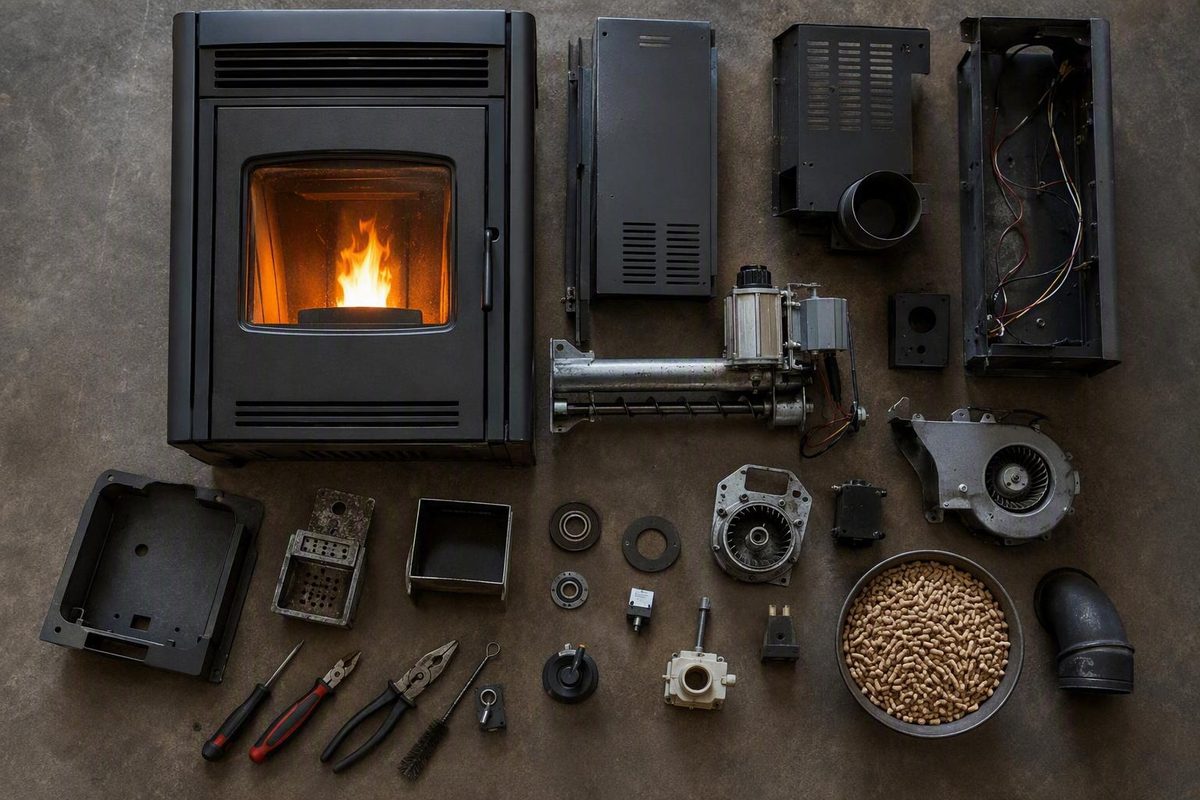
The Englander 25-PDVC can still be a practical stove to own or repair because sellers continue to list many common service parts. However, dealer material describes it as discontinued, and commercial sources conflict over some related badge numbers. Before buying the stove, following a manual, or ordering a control board, establish the complete model designation, manufacturing information, serial number, and installed component number.
The short answer: an older stove with parts support, but verify everything
StoveSource, an Englander dealer, describes the 25-PDVC as discontinued. That is useful commercial guidance, but it is not the same as a manufacturer discontinuation notice. The available evidence does not include such a notice from Englander.
The encouraging part is continued parts availability. A commercial 25-PDVC model-family catalog lists components across most major systems, including igniters, auger motors and bearings, feed parts, combustion and convection blowers, vacuum switches, gaskets, glass, sensors, firebox wear parts, baffles, and digital control boards.
That catalog breadth indicates that many repairs remain commercially possible. It does not prove that every component is available for every production year or that a part grouped under a broad model family will fit a particular stove. Differences in connectors, mounting, controls, sensors, switches, or programming remain compatibility possibilities unless the seller or manufacturer confirms otherwise.
The 25-PDVC is best approached as a basic, budget-oriented pellet stove rather than a current premium appliance. A parts retailer’s service account describes straightforward controls and a low-frills design, but the available evidence does not establish comparative reliability, verified efficiency, universal heating coverage, or present-day certification status.
The practical rule is: identify first, diagnose second, order third. A missing or unreadable data plate makes both parts ordering and safe use of model-specific instructions much harder.
25-PDVC model-number crosswalk: where the labels agree and conflict
Englander, Summer’s Heat, and Timber Ridge badge numbers frequently appear together in commercial material. They are useful search leads, but the sources do not support treating every number as universally interchangeable across all years and revisions.
| Model number | What the sources claim | What the owner should do |
|---|---|---|
| 25-PDVC | The Englander designation discussed here | Record the complete designation, serial number, and manufacturing information |
| 55-SHP10 | Commercial sources consistently associate this Summer’s Heat model with the 25-PDVC | Use it as a search lead, then confirm the exact part and production range |
| 55-TRP10 | A parts catalog and service article associate this Timber Ridge number with the 25-PDVC | Do not assume compatibility without written fitment confirmation |
| 55-TRP22 | Another dealer identifies this as the Timber Ridge counterpart | Treat the conflicting number as unresolved and rely on the appliance label |
| 25-PDV | A similar-looking but different Englander designation | Do not use its manual or specifications for a 25-PDVC without confirmation |
The strongest agreement is around 25-PDVC and 55-SHP10. For Timber Ridge, the evidence conflicts. A retailer’s service article uses 55-TRP10, while a dealer-authored badge-model crosswalk names 55-TRP22. Those badge numbers may help locate candidate parts, but they do not establish universal compatibility for controls, wiring, switches, or service instructions.
Do not confuse 25-PDVC with 25-PDV. The available manufacturer installation and operation manual expressly covers the 25-PDV, 55-SHP22, and 55-TRP22—not the 25-PDVC.
Without exact-model confirmation, do not transfer that manual’s clearances, floor protection, outside-air requirements, venting limits, settings, error-code definitions, wiring details, or maintenance procedures to a 25-PDVC. The designation difference may indicate a different configuration and is sufficient reason to seek confirmation before relying on the document.
Before ordering a component or accepting a related badge number:
- Photograph the entire appliance data plate clearly.
- Transcribe every visible field, including the full model, serial number, and manufacturing information.
- Record and photograph the number on the component already installed.
- Send the stove and component details to the seller and request written fitment confirmation.
What day-to-day ownership reportedly involves
A commercial service account reports that the 25-PDVC has automatic electric ignition, digital controls, dual-auger pellet feeding, and a 40-pound hopper. It also says the heat level and room-air blower can be adjusted separately. These are retailer-reported features rather than specifications verified here against a model-specific manufacturer manual.
Thermostat operation is more limited than some buyers may expect. According to the same retailer’s 25-PDVC ownership discussion, a connected thermostat moves the stove between the selected heat setting and a low maintenance burn instead of switching the appliance completely off and back on. That can provide steady heat, but it is not equivalent to a furnace that stops firing after satisfying the thermostat.
The service account also reports several practical compromises:
- There is no ash pan.
- The stove must be shut down for cleaning.
- Blower and auger operation can be noticeable.
- Moving components may eventually require replacement.
- Routine cleaning requires a scraper, brush, and vacuum even if ordinary access does not require extensive disassembly.
These are commercially reported service observations, not results from a controlled comparison with other stoves.
The broader workload of pellet heat also matters. Augers, blowers, igniters, and electronic controls depend on electricity. Pellets require dry storage, bags must be handled and lifted into the hopper, ash and fuel residue need recurring cleaning, and outages require a backup-heat or backup-power plan. Motors, switches, and igniters can also become repair items over time.
Those demands are not unique defects of the 25-PDVC. They are part of deciding whether pellet heat suits the household, particularly when dry storage is limited, bag handling is difficult, or power outages are frequent.
Commercial estimates for burn time or square-foot coverage should not be treated as promises. Actual results depend on heat setting, pellet quality, climate, insulation, layout, stove placement, maintenance, and the building’s heat loss.
Replacement parts: what is listed and how to avoid a compatibility mistake
Commercial catalogs list replacement parts for most principal 25-PDVC systems:
- Ignition: igniters and related mounting items
- Fuel feed: auger motors, bearings, gaskets, and feed-system assemblies
- Combustion air: exhaust or combustion blowers and associated gaskets
- Room-air circulation: convection blowers
- Safety and sensing: vacuum switches and heat sensors
- Seals and glass: door glass, glass gasket, hopper gasket, and blower gaskets
- Firebox wear parts: wear plates and impingement baffles
- Electronic controls: digital control boards
Some items are offered in both OEM and aftermarket versions. That choice can affect construction, warranty, price, and seller support, but neither label resolves fitment by itself. A retailer’s model-family listing is still a commercial compatibility claim rather than manufacturer documentation for a particular serial number.
The PU-CB04 control board illustrates the risk. One replacement-parts retailer lists the PU-CB04 for auto-ignite models from 2004 through 2019. That broad range does not establish that the board fits every 25-PDVC configuration within those years or that no connector, switch, programming, wiring, or revision distinction applies.
Use this four-step ordering process:
- Verify the appliance label. Capture the complete model, serial number, and manufacturing information.
- Match the installed component. Compare its part number, label, connectors, mounting points, and physical layout.
- Confirm the production range. Give the seller both the stove details and the existing component number, then request written confirmation for that exact configuration.
- Read the return policy. Determine whether an electrical part remains returnable after its packaging is opened or after it has been connected or installed.
Do not buy an expensive control board merely because its photograph looks right or a related badge number appears in the listing title. On an older stove, the number on the existing component may be as important as the model shown on the front badge.
If it lights but will not keep feeding pellets
No. Ignition followed by a dying fire does not prove that the control board has failed.
In one unresolved owner anecdote, a 25-PDVC/55-SHP10 ignited normally, but the upper auger’s feed cycle then shortened and the fire went out from insufficient fuel. The owner later reported an E2 display and suspected the PU-CB04 board, but the forum account did not establish a final diagnosis.
The report also does not supply a manufacturer-confirmed E2 definition for every 25-PDVC revision, an approved reset sequence, diagnostic-mode instructions, test-point values, or an authorized control-board test. A feed symptom and an error display are observations; neither identifies the failed component by itself.
A cautious symptom flow is more useful than guessing:
- Stop and cool the stove according to instructions for the exact model. If those instructions cannot be identified, do not improvise a service procedure.
- Confirm routine cleaning. Once the appliance is safely shut down, check accessible burn areas and burn-pot air openings for ash or residue.
- Look for an obvious fuel-feed issue. Note bridging pellets, visible blockage, unusual motor sounds, or abnormal auger movement without reaching near moving parts.
- Limit inspection to safely accessible items. Follow the exact-model shutdown and electrical-isolation instructions before examining visible vacuum tubing, connectors, or wiring for obvious damage.
- Escalate an unresolved fault. Airflow, vent obstruction, vacuum sensing, switches, auger motors, wiring, fuel feed, maintenance condition, and electronic controls may all require evaluation. The available evidence does not rank these possibilities or identify a culprit.
Do not move, probe, ground, or meter an energized control board based on the forum anecdote. Repositioning the connected board appeared to change that owner’s symptom, but the result was unexplained and is not an established diagnostic procedure.
Because the supplied manufacturer manual covers the distinct 25-PDV family, it cannot establish a 25-PDVC shutdown sequence. It does, however, illustrate the manufacturer’s treatment of smoke as a serious condition: for its listed models, it says to stop operation, ventilate, avoid restarting, and contact technical support when smoke enters without a power failure. Use that only as a general warning, not as substitute instructions for the 25-PDVC. Do not continue operating a stove that leaks smoke; obtain exact-model guidance and qualified service.
Qualified service is also appropriate for energized electrical testing, repeated shutdowns, combustion or venting concerns, or an installation whose compliance is uncertain.
Used-stove inspection checklist
A low purchase price can disappear quickly if the stove needs a control board, blowers, seals, vent corrections, and hearth work. Check the following before committing:
- Establish the stove’s identity. Require a legible data plate showing the complete model and manufacturing information. Avoid buying a stove whose identity cannot be established.
- Record component numbers. Photograph the existing control-board label and accessible labels on motors, blowers, the igniter, sensors, or switches.
- Ask for service records. Request invoices or notes for auger motors, blowers, igniters, vacuum switches, controls, and wiring repairs.
- Inspect for corrosion and damage. Examine the body, hopper, burn area, seams, door, glass, hinges, latches, and accessible internal surfaces.
- Assess the seals. Door and glass gaskets should be intact and properly seated, without obvious gaps or crumbling material.
- Observe operation if a safe demonstration is possible. Watch ignition, pellet feeding, auger movement, blower operation, controls, flame behavior, and shutdown.
- Check for leakage evidence. Soot trails, staining, smoke odor, or visible smoke outside the intended exhaust path require investigation.
- Verify exact parts availability. Check likely wear components against the stove’s complete identity and existing part numbers rather than relying on a general family catalog.
- Evaluate the intended installation separately. Have the hearth protection, clearances, venting, outside-air provisions, electrical supply, and local permit requirements checked for the exact stove.
A demonstration burn proves only that the stove operates at that moment. It does not establish long-term reliability, suitability for the home, installation compliance, or the remaining life of its electrical and mechanical components.
Ask for a clear data-plate photograph before traveling to inspect a used stove. That simple request can expose a PDV/PDVC mix-up before money changes hands.
Repair or replace: a decision table for an aging 25-PDVC
The decision is not simply a replacement-part price versus a new-stove price. Compare the total cost of returning the existing stove to safe, dependable service with the complete installed cost and practical benefits of another appliance.
| Repair may make sense | Replacement deserves a quote |
|---|---|
| Exact stove, revision, and failed-part identity are confirmed | Model identity or production revision remains uncertain |
| The existing installation is judged acceptable | Installation compliance is doubtful |
| The stove body, firebox, glass, and seals are otherwise sound | Corrosion, physical damage, or smoke leakage is present |
| The failed component is available with verified fitment | Parts fitment cannot be verified |
| The fault is limited and professionally diagnosable | Several major components need work |
| The written repair estimate is comfortably below the complete replacement case | Repair cost approaches the installed cost and benefits of another appliance |
Compare total installed costs, not bare appliance prices. A replacement may require changes to the hearth, venting, outside-air route, electrical supply, clearances, or permits. Conversely, an aging stove with a sound body and one clearly diagnosed, obtainable component may still be a reasonable repair candidate.
There is no universal dollar cutoff, and a newer Englander stove should not be assumed to be a drop-in replacement. The practical rule is to diagnose the fault first, verify the exact part second, and then compare written repair and replacement estimates before spending money.
For any 25-PDVC decision, follow three steps: identify the exact appliance and revision; confirm parts and instructions against that configuration; and obtain qualified help when the work involves electricity, combustion, venting, or smoke. The 25-PDVC may remain repairable, but a badge-model match or retailer listing is not enough evidence to order an expensive component—or to follow a different stove’s manual.