
A Small Pellet Heater Needs More Than a Small Footprint
Compare two compact pellet stoves by minimum heat output, installed space, hopper capacity and running costs before choosing one for a small home.
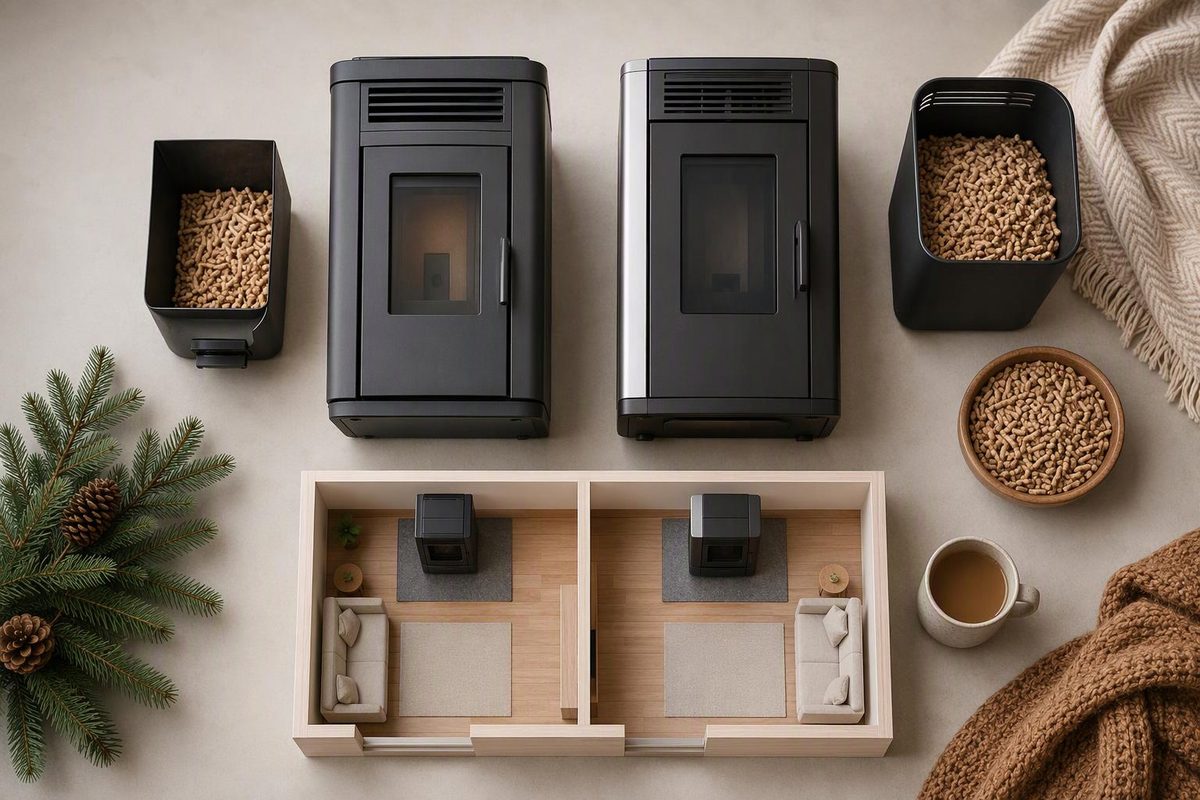
For a small room or well-insulated home, minimum heat output can matter more than cabinet size. A narrow pellet stove may fit neatly against a wall yet deliver more heat than the room needs—even on low.
Choose an indoor, vented pellet room heater by three things: the space’s heating demand, the stove’s lowest documented output, and the complete installation footprint. Then compare refilling, cleaning and operating costs. This guide concerns residential room stoves, not pellet boilers or outdoor patio heaters.
Two compact stoves worth comparing
These are documented examples, not tested recommendations or a ranking. Specifications were checked October 10, 2026; match the rating plate and supplied manual before buying.
| Decision factor | Castle Serenity, model 41278 | PelPro PP60, PP60-B version |
|---|---|---|
| Cabinet size, width × height × depth | 18.25 × 34 × 23.75 inches | Approximately 22 × 33 × 22 inches |
| Documented tested heat-output range, rounded | 12,800–26,500 BTU/hour | 6,800–26,000 BTU/hour |
| Hopper capacity | 40 pounds | Approximately 60 pounds |
| Temperature control | Thermostat mode drops to low; Eco setting permits shutdown and restart | Comfort settings 1–10 automatically shut down and restart; LO runs continuously |
Sources: Castle’s product specifications, 41278 test report, Table 6 and linked manual, revision 4; PelPro’s product dimensions and PP60-B manual, revision S.
The important distinction: the narrower Castle has the higher documented minimum output. The PelPro deserves a closer look where low heating demand is the concern; the Castle deserves a closer look where cabinet width is the constraint. Neither wins until the installation and heating demand are checked.
These are test ranges, not guarantees of output in your home. Do not compare a brochure’s maximum fuel input with another stove’s delivered heat output. The PP60-B manual separates 33,200 BTU/hour maximum input from 26,000 BTU/hour tested maximum output.
One document check matters here: Castle lists model 41278 on its product page, but the linked revision-4 manual’s specifications table says 41728. Ask Castle to confirm the applicable manual for the unit’s model and serial number before installation.
Size it for mild days as well as cold nights
Ask an installer to estimate heat loss for the area you actually want to heat—not simply the home’s total floor area. Insulation, windows, climate, layout and stove placement affect suitability; PelPro expressly describes its square-foot coverage as a general guide dependent on those conditions. Manufacturer sizing notes
Consider a hypothetical room needing 5,000 BTU/hour during mild weather. Both examples above have documented minimum outputs above that demand. Continuous low burning could supply excess heat; automatic shutdown and restart may therefore be important.
Check what “thermostat” means on the exact model. Castle’s temperature mode without Eco continues burning at low after reaching its target, while the Eco setting allows shutdown and reignition. Its manual specifically identifies Eco as useful for small or well-insulated spaces, but warns that more frequent ignition reduces igniter life compared with operation without Eco. Castle operating guidance
Before choosing, ask for a demonstration of low operation and a full startup. Listen from your expected seating position, rather than judging noise from a video.
Measure the installation, not just the stove
Mark out the proposed location with tape, including:
- Required wall and corner clearances.
- Floor protection extending beyond the appliance as specified.
- Vent pipe, elbows and cleanout access.
- Space to open the door, lift the hopper lid and remove service panels.
- A practical route for carrying fuel without placing bags against the stove.
A small cabinet does not remove venting requirements. Castle’s linked manual requires at least three feet of vertical pellet vent; PelPro recommends at least five feet. Each has its own termination rules, and both prohibit sleeping-room installation. These are fixed heating appliances, not portable bedroom space heaters. Castle installation manual · PelPro installation manual
Get the vent route, permit requirements and floor protection settled before ordering. Our pellet-stove installation guide covers those decisions in more detail.
Small hopper, shorter refill interval
Estimate runtime as usable hopper pounds ÷ average pellet consumption in pounds/hour.
At an assumed continuous consumption of 2 pounds/hour, a nominal 40-pound hopper provides 20 hours and a 60-pound hopper 30 hours. These are arithmetic examples—not measured runtimes—and assume the full nominal capacity is usable. Cleaning may interrupt operation before the hopper empties.
For a fuel-budget example, assume:
- 2 pounds/hour for 12 burning hours/day.
- 180 operating days.
- Delivered pellets costing $350 per U.S. short ton.
That is 4,320 pounds, or 2.16 tons, costing $756 for pellets. The price and consumption are planning assumptions, not a current local quote or a seasonal forecast.
Electricity is additional. Castle’s linked manual lists 77 watts during operation and 402 watts during ignition. At 77 watts for 12 hours/day over 180 days, electricity would cost about $33 at $0.20/kWh, excluding ignition, shutdown and standby consumption. Castle electrical specifications
Price the ownership work before committing
Request an installed quote that separates the stove, venting, floor protection, outside-air connection where required, labor, permits and taxes. Add fuel delivery, electricity, annual service and a separate repair allowance to your running budget.
Compact does not mean maintenance-free. Castle calls for daily firepot cleaning and weekly interior cleaning. PelPro’s maintenance table calls for daily-or-as-needed firepot attention, with additional ash, hopper, blower and vent work. Use the normal shutdown controls, let the stove cool fully and the blowers stop, then disconnect power before cleaning or servicing. Never unplug a burning stove to shut it down. Castle maintenance and shutdown guidance · PelPro maintenance and shutdown guidance
Finally, identify who will service the stove and how you will heat during outages or maintenance. Castle explicitly warns against using its stove as the home’s only heat source because both interrupt heat. Castle backup-heat warning A small pellet heater belongs on your shortlist only when its low-output behavior, complete footprint and ownership workload fit—not merely its advertised square-foot coverage.