
Size a Pellet Stove for Cold Days—and Mild Ones
Choose a pellet stove by the heat loss of the space it will serve, its low-to-high output range, and your home's layout—not square footage alone.
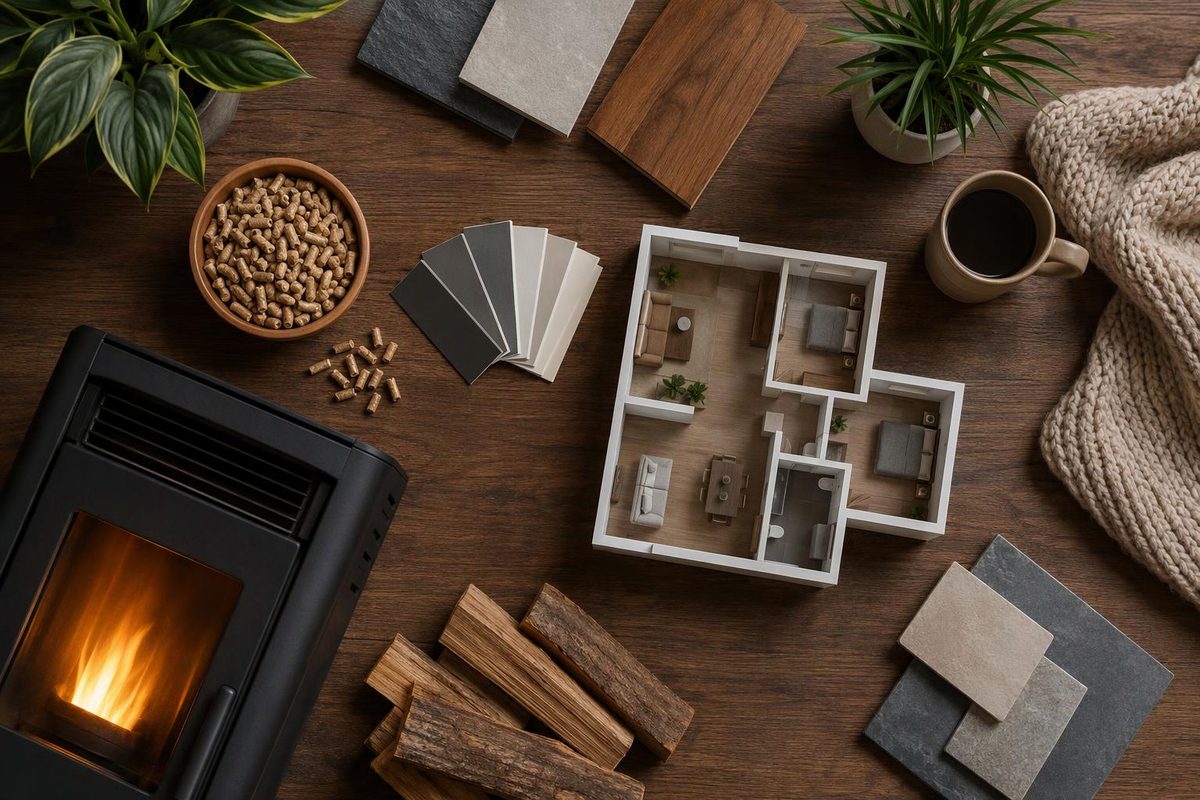
Choose a pellet stove whose usable heat-output range fits the space you intend to heat—not simply one whose advertised square-foot coverage exceeds your home’s size. Maximum output matters on cold days; minimum output and thermostat behavior matter when you need only a little heat.
The right recommendation starts with three things: the stove’s job, a heat-loss calculation, and a realistic way for its heat to reach the intended rooms.
Decide what the stove must cover
Write down which rooms you expect the stove to heat and what your existing system will still handle.
| Intended job | Sizing priority |
|---|---|
| Warm the living area while central heat serves bedrooms | Match the served area’s load; pay particular attention to low output |
| Supply most winter heat, with another system covering the coldest periods | Define the load the stove should cover and when backup heat will take over |
| Serve as the only winter heat source | Verify cold-weather capacity, heat delivery to every necessary room, suitability for that role and an outage plan |
A room stove’s capacity is not the same as whole-house heat distribution. ULMA’s pellet-stove selection guidance explains that air-stove heat spreads more evenly through open spaces, while walls and doors affect delivery to separate rooms.
For a divided or multistory home, don’t assume a larger stove will solve distant cold bedrooms. Ask the installer to assess the proposed location, stairs, doorways and rooms normally kept closed. If the distribution plan is weak, change the location or heating plan before increasing capacity.
Get the heating load, not a square-foot multiplier
A heating load is the rate of heat the building loses under stated conditions, expressed in BTU per hour. To maintain temperature, the heating equipment must replace that loss.
Ask a qualified HVAC contractor or energy professional for a residential heat-loss calculation, preferably with room-by-room results. ACCA’s Manual J is an ANSI-recognized residential load-calculation standard; its procedures address outdoor design conditions, windows, walls, infiltration and ventilation, among other factors.
Have the calculation reflect:
- Your location’s winter design temperature and desired indoor temperature.
- Actual insulation, windows, exterior surfaces and air leakage.
- Room dimensions, including ceiling height—not just floor area.
- Any insulation or air-sealing improvements planned before installation.
Request the load for the area the stove will serve, alongside the whole-house result. Don’t substitute the existing furnace’s nameplate rating for the building’s calculated heat loss.
Two homes with the same floor area can have different heating requirements. Treat an “up to 2,000 square feet” claim as a screening description, not proof that the stove fits your house. Ask what climate, insulation and layout assumptions support it.
Compare output with output
A brochure’s largest BTU number may describe fuel energy going into the stove rather than heat delivered to the home.
For example, page 4 of the September 2025 Harman Absolute43-C owner’s manual lists:
- BTU input: 14,100–44,200 per hour.
- EPA BTU output: 10,600–34,800 per hour.
The manual describes the output figures as based on EPA default efficiency and the low and high test burn rates. These are documented ratings, not a guarantee of identical performance in every installation—but they show why a 44,200-input figure should not be treated as 44,200 delivered BTU/h.
For each candidate, record the exact model’s low and high output, the rating method, and the document revision. Don’t multiply an already stated output rating by efficiency again. If a seller supplies only input, ask for documented output before comparing it with your heating load.
Check the low end as carefully as the high end
“Buy bigger—you can turn it down” leaves out an important limit: how far down?
Consider this hypothetical comparison, not specifications for actual products. Assume the served area needs 28,000 BTU/h at winter design conditions and about 7,000 BTU/h on a milder day. Also assume each stove can modulate continuously across its stated range.
| Hypothetical stove output range | What it suggests |
|---|---|
| 6,000–32,000 BTU/h | Covers both stated loads within its range |
| 12,000–50,000 BTU/h | Covers the cold-day load, but mild-day demand falls below its low continuous output |
| 5,000–22,000 BTU/h | Fits mild demand, but needs another heat source at design conditions |
The middle option has more maximum capacity, but it would need to cycle off or otherwise manage excess heat on the mild day. That may be acceptable with suitable controls; it is not automatically a better fit.
For a real stove, don’t assume a low EPA-test output establishes its lowest continuous operating output. Ask the manufacturer or dealer to confirm the usable range and explain how the exact model responds when demand falls below its minimum: does it shut down and relight, or continue at low burn? Also verify thermostat or room-sensor placement.
Never alter factory minimum-burn settings to make an oversized stove fit; the Harman manual explicitly prohibits changing its manufacturer-set minimum.
Before accepting a size recommendation
Have the dealer put these items beside the proposed model:
- The rooms it is expected to serve and their calculated cold-weather load.
- Documented low and high heat output—not just advertised input or coverage.
- Expected mild-weather operation and the role of backup heat.
- The stove location and plan for heating remote rooms.
- The complete installation footprint, including clearances and service access.
Physical size is a separate check. Use the exact manual to verify the hearth-pad requirements and vent route and sizing. A large hopper can reduce refill frequency; it does not establish that the stove’s heat output suits the house.
A useful recommendation should explain both how the stove meets cold-day demand and how it avoids delivering too much heat on ordinary days. If the answer is only a square-foot figure, ask for the missing load and output comparison before committing.