
Size Your Pellet Stove Hearth Pad From the Manual, Not a Chart
Ember vs thermal protection, sizing the footprint from your stove manual, what a pad label must show, and why one 40-inch pad does not fit every stove.
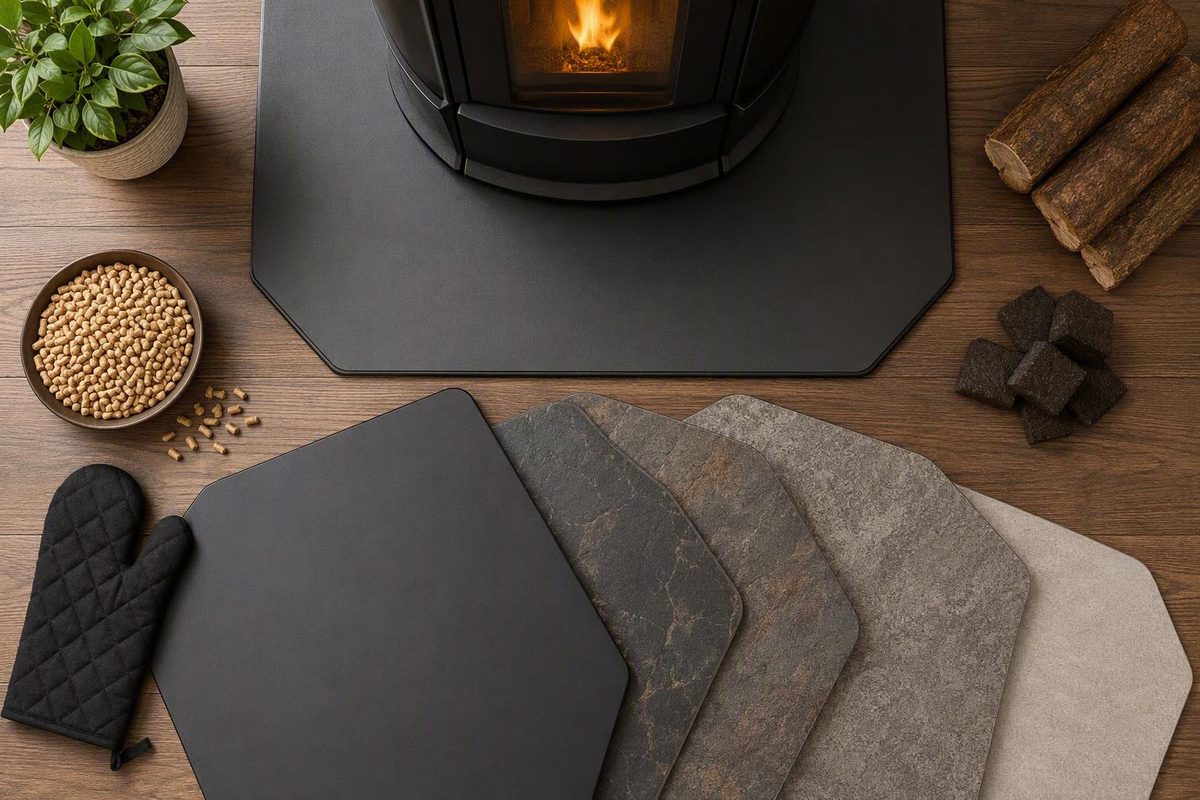
The hearth pad your pellet stove needs is whatever the installation manual for your exact model specifies: ember-only or thermal protection, a minimum R-value if one is stated, and a footprint built from the stove’s width and depth plus the projections the manual requires on each side. There is no universal size, thickness or R-value. Work the manual’s numbers into a finished minimum footprint, buy a pad whose label and technical sheet document that size and rating, and have a qualified installer check the whole layout before you order. Code, permit and inspection questions go to your local authority, not the retailer.
Enter your stove’s dimensions and the manual’s projections; the minimum pad size updates as you type.
Minimum Hearth Pad Size From Your Stove Manual
Inches. Width = stove width + left + right projection. Depth = stove depth + front + rear projection. Defaults are the article's fictional example.
Width 24 + 2 + 2 = 28. Depth 26 + 6 + 2 = 34.
Round up to a commercial size, then plot the stove position against wall clearances and the vent route.
Enter a pad you are considering to check whether it covers this footprint.
Side and rear projections
Compare a pad you are considering
Source: the projections come from your stove's installation manual, measured from the reference points it names. This computes footprint only; it does not check R-value, wall clearance, listing or substrate.
Why the Stove Manual, Not a Size Chart, Sets the Pad
Even models from the same manufacturer carry different floor-protection and clearance requirements, so a generic chart cannot tell you what to buy. The process is four steps:
| Step | What to do | What to record |
|---|---|---|
| 1. Identify the stove | Read the rating label; confirm make, model and variant | Make, model, serial number |
| 2. Find the manual | Get the installation manual for that exact model and its floor-protection section | Manual revision and publication number |
| 3. Translate it | Note protection type, measurement points, required projections, minimum R-value if stated | Type, dimensions, R-value |
| 4. Confirm it | Have a qualified installer assess the layout; ask the local authority about permits and inspection | Findings and approval steps |
Rank your sources in this order: the installation manual and rating label first, then the pad’s own label and technical documentation, then the locally adopted code and permit rules, and only then retailer guidance, which is a lead to verify rather than an answer.
That order follows the listing framework in the model codes. The 2021 International Mechanical Code, Section 904.1 requires pellet fuel-burning appliances to be listed and labeled to ASTM E1509 and installed according to the terms of their listing. The 2018 International Residential Code contains a general 18-inch floor-protection provision, but it also carves out exceptions for listed room heaters, including UL 1618-listed floor protectors used with the materials and dimensions the appliance manufacturer specifies. That 18-inch figure is not a universal pellet-stove rule.
Both are historical model-code editions. Neither tells you which edition or amendments your town, county, state or province enforces today. The installer interprets the appliance documents; the local authority decides code, permits, inspection and acceptance.
Stop before ordering if the manual is missing, the rating label is unreadable, you cannot pin down the exact variant, or the manual, label, retailer table and pad documentation disagree. For a used or discontinued stove, use the rating label to locate the archived manufacturer manual. If doubt remains, get written clarification from the stove or pad manufacturer.
Ember Protection and Thermal Protection Are Different Ratings
A hearth pad is a noncombustible surface under and, where required, in front of the appliance. Depending on the manual, it provides ember protection only or ember plus thermal protection. Manufacturers use shorthand for this: Type 1 is ember protection, Type 2 is ember plus thermal protection. American Panel describes Type 1 and Type 2 in those terms while telling buyers to check the stove’s requirements. The category labels are useful, but they do not override the manual, and a vendor’s proposed universal R-value threshold is not a code rule for every stove or jurisdiction.
The terms matter because they are separate properties:
- Noncombustibility means the material does not ignite or burn under the applicable test. It says nothing about insulation.
- Ember protection is a continuous surface that keeps sparks, ash and embers off vulnerable flooring.
- Thermal protection is an assembly that limits heat transfer into the floor.
- R-value is resistance to heat flow; higher is more resistant.
- Listing information is the standard, testing laboratory, model or file number and stated installation conditions.
When the manual states a minimum R-value, the documented complete assembly must meet or exceed it. Tile, slate, stone, steel and glass can all be noncombustible without delivering the required thermal resistance. For a commercial pad, rely on the documented rating for the whole product in the exact configuration. For a site-built assembly, the rating comes from the exact materials, thicknesses, units and construction details, never from how thick it looks.
The reverse also holds: not every pellet stove needs an insulated Type 2 pad. Some listed appliances call only for a defined noncombustible surface. Follow the manual either way.
How to Calculate the Minimum Pad Footprint
Once the manual gives the required projections, the minimum pad width is the stove width plus the left projection plus the right projection, and the minimum pad depth is the stove depth plus the front projection plus the rear projection.
Record these from the manual before you shop: exact make and model, stove width and depth, left, right, front and rear projections, the manual’s measurement reference points, the protection type, and the minimum R-value if one is stated.
A Worked Example: 24 by 26 Inches Becomes 28 by 34
Suppose a fictional stove is 24 inches wide by 26 inches deep and the manual requires 2 inches on the left, 2 inches on the right, 6 inches in front and 2 inches behind. Width is 24 + 2 + 2 = 28 inches. Depth is 26 + 6 + 2 = 34 inches. The pad must be at least 28 by 34 inches.
This shows the arithmetic only; it is not a recommendation for any named stove. Measure from the reference points the manual names. Measuring from the wrong edge can produce a pad that looks big enough but does not match the listed installation.
Rounding up to the next commercial size is fine, but plot the larger pad in the room first. The stove position it produces still has to satisfy combustible clearances, the vent route, door swing, walking space and service access.
Four Things to Verify on a Commercial Pad Before Ordering
A listing that says “pellet stove hearth pad” proves nothing on its own. Each check is independent:
| Check | Evidence to request | What it does not prove |
|---|---|---|
| Noncombustible surface | Material description, label, technical sheet | Required R-value |
| Assembly R-value | Rating for the complete pad in the exact configuration | Footprint or listing |
| UL 1618 information, where applicable | Laboratory identity, listing or file number, label or certificate | Compatibility with every stove |
| Dimensional compatibility | Finished dimensions checked against the exact manual | Wall clearance or substrate suitability |
UL 1618 appears in the model-code provisions for certain listed floor protectors and hearth extensions. A seller’s statement that a product “meets UL standards” is not verifiable listing information. If the documentation is missing, ask for the laboratory, the listing or file number, the model designation and the installation limitations.
Then compare the physical label and technical sheet against the manual: finished width, depth, shape and thickness; the complete-assembly R-value; ember-only or thermal; required substrate and installation method; restrictions on seams, trim, fasteners or modular sections; and permitted appliance types. A high R-value solves one part of the problem and none of the others.
Distinguish a full hearth pad built to carry a freestanding stove from a shallow fireplace hearth-extension panel. StoveSource’s retailer guide separates full pads from tempered-glass extension panels that it says are not intended to support freestanding stoves. Confirm intended use in the pad manufacturer’s documentation, not from appearance.
Keep the pad’s physical label, technical sheet, listing documents, receipt, appliance manual, permit paperwork, inspection record and any written clarifications. Those outlast a product page that changes after you buy.
Why ComfortBilt’s 40-Inch Corner Pad Does Not Fit Every ComfortBilt Stove
ComfortBilt’s corner pad shows why “40-inch pellet stove pad” is not a complete specification. This is an illustration, not a product recommendation, and the details below were checked on September 19, 2026; confirm them again before ordering.
The ComfortBilt product page describes the pad as 40 by 40 inches, 1 1/8 inches thick, Type 1, with an R-value of 0.84. ComfortBilt identifies it for HP50S and HP21 installations. For the HP22 and HP22N, the company says the stated minimum wall clearances are met only when the pad sits 3 inches from the rear walls. It does not recommend the pad for the HP61 because the pad is too small to satisfy that stove’s clearances.
A retailer guide checked the same day claimed the 40-inch corner pad fits all ComfortBilt stoves. That contradicts the manufacturer’s model-specific warning. The manufacturer’s current documentation wins, and any unresolved conflict should be cleared up in writing before purchase.
The product page itself raises questions: the Type 1 and R-value information is formatted unclearly, it claims laboratory testing without showing a laboratory name, listing number, certificate or test report, and the title calls the color “Midnight Black” while the specifications say “Mill Black.” None of these alone settles whether the pad is acceptable. Together they justify confirming the exact item and its documentation before ordering.
The lesson: physical fit, thermal rating, wall clearance and listing documentation are four separate checks. Passing one establishes none of the others.
The Pad Is Only One Part of the Layout
An adequate pad can still sit in an unacceptable layout. Clearances to combustible walls, trim, furniture and curtains are separate requirements from floor protection, and the appliance manuals warn that specified clearances must be maintained. The IRC also treats cleaning, servicing, blower or motor replacement, vent access and eventual appliance replacement as placement considerations.
For a corner installation, draw the room and stove to scale and plot both the required pad edges and the stove-to-wall clearances. A corner-cut pad can fit the room while leaving one side of the stove too close to a wall.
Leave room to clean the stove, remove ash, service the vent, open panels and replace parts. Settle the vent route before fixing the pad location; a convenient pad position is worthless if the complete vent installation cannot follow the appliance and vent-system instructions.
The floor also has to carry the finished installation: stove, full hopper, hearth assembly, vent components and any pedestal or platform. As one model-specific data point, the Quadra-Fire Trekker installation manual reports a maximum loaded appliance weight of 473 pounds before the hearth assembly is added. That figure applies only to the Trekker models the manual names. Use the weight for your stove and have the floor evaluated if the combined load is in doubt.
When a DIY Hearth Pad Becomes a Documentation Problem
A site-built pad is possible, but the completed assembly must satisfy the exact appliance requirements and the local approval process. A handsome tile surface or a thick platform of “noncombustible” layers does not prove thermal performance.
Any thermal calculation needs current, traceable data for every exact product, each layer’s thickness, the units and thickness basis behind each thermal value, the final assembled configuration and any construction details the product data or appliance instructions require you to account for.
A Hearth.com thread about a proposed Quadra-Fire Santa Fe hearth shows the difficulty. Participants debated layered assemblies of plywood, mineral-fiber board, cement board, mortar and tile, with open questions about thermal values and unit conversion. It is a useful example of DIY complexity, not an approved recipe, and the installation described had not passed inspection when the owner posted the result.
Before buying materials, write a layer schedule: each exact product, its thickness, its thermal value, the data-sheet source and the installation method. Have the installer review it against the appliance instructions, then ask the local authority whether the documentation and assembly will be accepted under the permit and inspection process.
A documented commercial pad simplifies this because its dimensions and complete-assembly rating usually sit on one technical sheet. That does not make every commercial pad compliant; model fit, substrate, installation limits, listing information and local acceptance still need checking.
Do not build if the manual is unavailable, the model cannot be confirmed, the specifications conflict, a material value lacks current manufacturer documentation, the units or thickness basis are unclear, or the authority has not accepted the documentation where prior approval is required.
What to Settle With the Installer and Inspector
Bring the following to the installer for technical planning and to the local authority for code, permits and acceptance.
Appliance and manual: exact manufacturer, model and variant, serial number, manual title and revision, a readable rating label that agrees with the manual, and the floor-protection section identified.
Hearth-pad requirement: stove width and depth, all four projections, the manual’s measurement reference points, protection type, minimum R-value if stated, and the calculated minimum finished pad size.
Pad and substrate: actual pad dimensions from its label, complete-assembly R-value, UL 1618 listing information where applicable with laboratory and file number recorded, installation limitations reviewed, the existing substrate identified, and the pad approved for that substrate. Ask how the complete floor assembly will be evaluated if the room has tile, stone, concrete, laminate, vinyl, carpet or a floating floor; the visible finish is not the answer.
Complete layout: combustible clearances plotted, corner geometry drawn, vent route and penetrations finalized, cleaning access preserved, doors and panels able to open fully, room for blower or motor replacement and eventual removal, loaded stove weight confirmed with hearth and vent weight added, and the floor evaluated for the total.
Local approval: which code edition the jurisdiction has adopted and whether it has amended the relevant provisions, whether a permit and inspection are required, who will verify a claimed UL 1618 listing, whether the available documentation is sufficient, and who is responsible for final measurements before installation. Keep every written clarification with the project records.
The Harman Pathfinder installation manual requires compliance with applicable local, regional, state and national requirements and recommends qualified personnel for installation and service; the Trekker manual gives the same direction for its models. Choose the pad only after the exact manual has been translated into a protection type, a minimum rating and a finished footprint, and verify the pad’s documentation and the rest of the installation before ordering or building anything.