
Which “King” Stove Do You Mean? A Practical Model Guide
Distinguish the KP5522-W, KP130 and KP60, then check exact-model specs, thermostat limits, manuals, parts, certification and recalls.
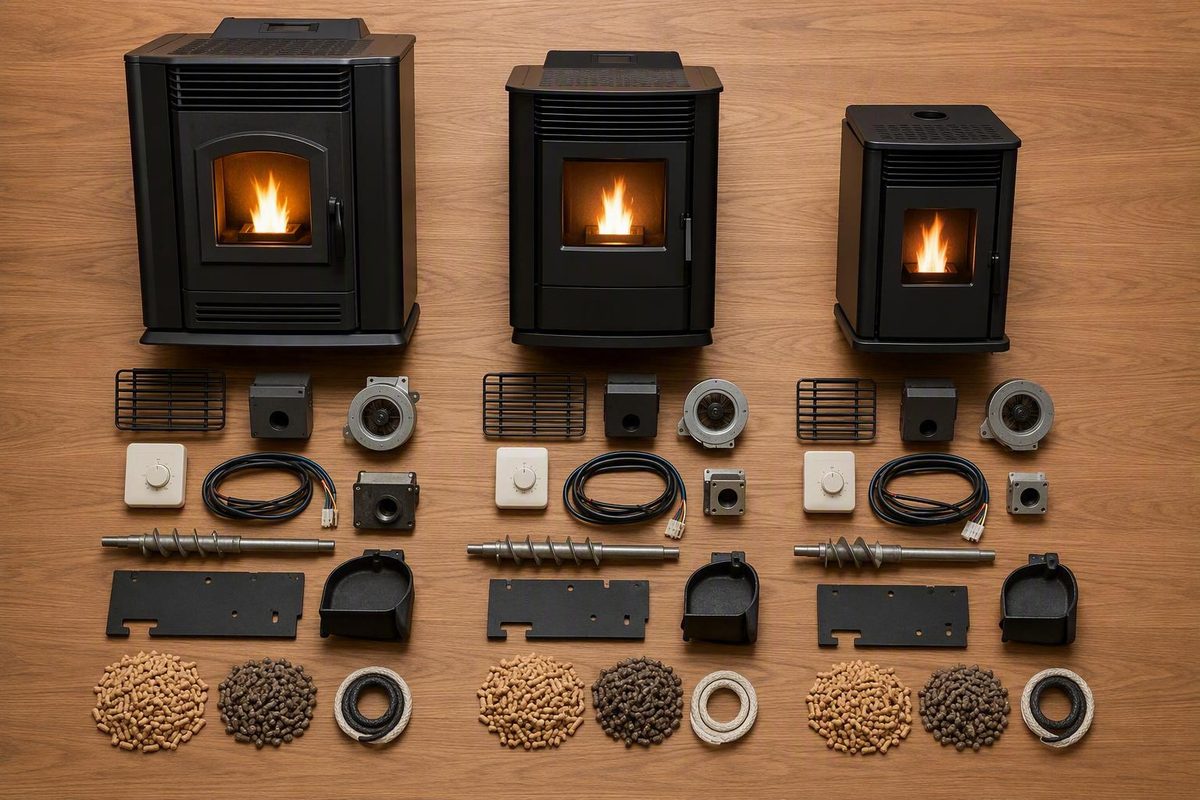
“Pellet stove king” can refer to a US Stove King pellet stove—such as the KP5522-W, KP130 or KP60—a regional retailer named Stove King, or an unrelated Blaze King appliance. Before relying on specifications, ordering parts or checking certification, identify the manufacturer and complete model number from the appliance’s permanent data plate.
Start here: identify which “King” you mean
| If you found… | What it is | What to verify |
|---|---|---|
| US Stove King KP5522-W, KP130 or KP60 | King-branded pellet-stove models associated with US Stove | Complete model, serial number, manual and certification label |
| Stove King | A Connecticut and Massachusetts appliance retailer, installer and service provider—not a stove model | The appliance manufacturer and model shown on sales or service paperwork |
| Blaze King | A different appliance manufacturer | Fuel type and model: King Catalytic heaters burn wood, while the historical PAL-4000 was a pellet appliance |
US Stove uses King branding on pellet models including the KP5522-W and the older KP130 and KP60. Stove King, by contrast, describes itself as a heating-appliance retailer, installer and service provider serving Connecticut and Massachusetts. Its name on a receipt or service sticker does not identify the stove manufacturer.
Blaze King creates another possible mix-up. Historical records identify its King Catalytic KEJ-1101 and King Catalytic Insert KEI-1300 as wood heaters, not pellet stoves. The Blaze King pellet appliance documented in the same records was the PAL-4000, which was already listed as out of production.
Before researching any “King” stove, photograph the permanent data plate and certification label. Record:
- Manufacturer
- Complete model number, including suffixes
- Serial number
- Production date or other production information
- Fuel type
- Certification or listing information
- Original part numbers, where available
Do not transfer operating instructions, clearances, wiring guidance or part numbers from one King-branded appliance to another.
King KP5522-W specifications: claims versus confirmed details
The KP5522-W is the current US Stove King model covered by the available manufacturer listing. The figures below are manufacturer claims, not independent household results.
Product page and displayed price checked September 19, 2026.
| Item | Manufacturer listing | Limitation |
|---|---|---|
| Hopper capacity | 170 pounds | Does not establish the actual refill interval |
| Heat output | Up to 33,000 BTU | Test conditions are not supplied |
| Runtime | Up to 80 hours on lowest setting | Depends on feed rate and operating conditions |
| Heating coverage | Up to 3,000 square feet | Product-page URL refers to 2,200 square feet |
| Dimensions | 27 × 32 × 41 inches | Installation clearances must be checked separately |
| Weight | 264 pounds | Excludes venting, hearth protection and fuel |
| Displayed stove price | $1,799.99 | Changeable snapshot; freight and installation can add cost |
The specifications, displayed price and coverage discrepancy appear on the US Stove KP5522-W product page. Its body says “up to 3,000 sq. ft.,” while the URL refers to 2,200 square feet. The page does not provide the test conditions behind either coverage figure, the output claim or the maximum-runtime claim.
The runtime claim supports a limited calculation:
170 pounds ÷ 80 hours = approximately 2.1 pounds per hour.
That is the low-setting burn rate implied by using the entire stated hopper capacity over the advertised maximum runtime. It is not an observed seasonal average and does not show how the stove will perform during ignition, higher-output operation or changing heat demand.
Square-foot coverage is particularly easy to overread. An open, insulated house in a moderate climate does not impose the same heating load as a drafty home with closed rooms, tall ceilings or severe winter temperatures. Have the home’s heating demand evaluated rather than choosing solely by the largest coverage number on a product page.
The displayed $1,799.99 is a stove-price snapshot, not a delivered or installed total. As checked on September 19, 2026, the manufacturer said the unit ships by LTL freight and that shipping costs may change after the delivery address is confirmed.
Wi-Fi and thermostat control: the important limitation
According to US Stove, the W suffix denotes Wi-Fi control through the US Stove app; the version without the W uses an infrared remote. The available product information does not establish app scheduling, alerts, diagnostics or long-term connection reliability, so buyers should not assume those functions are included.
More importantly, the KP5522-W does not provide conventional thermostat-controlled shutdown. The manufacturer says its control board accepts a compatible wired wall thermostat but not wireless or smart thermostats. When the thermostat is satisfied, the stove drops to heat setting 1 rather than shutting off.
That High/Low behavior changes the ownership experience. The stove continues producing heat after the room reaches the thermostat setpoint, potentially adding more room heat than a buyer expecting automatic On/Off control anticipates. The exact result will depend on the room, weather, heat loss and stove setting.
Control decision
Potentially suitable: You are comfortable with continuous low-fire operation after the thermostat is satisfied.
Investigate another control strategy or appliance: True thermostat shutdown is essential for your room, schedule or comfort expectations.
Adding a third-party smart thermostat should not be assumed to change the control board’s underlying High/Low behavior.
Daily ownership: fuel, cleaning, power and installation
US Stove specifies wood pellets only for the KP5522-W and excludes corn, coffee pellets and other fuels. It recommends PFI-certified premium hardwood pellets for this model. Do not automatically transfer that recommendation to an older King stove; use the manual written for the exact appliance.
The manufacturer recommends emptying and cleaning the burn pot before ignition and inspecting it daily during continuous operation. Pellet quality, draft and operating setting can affect how quickly deposits form, but a large hopper does not remove the need for regular inspection.
US Stove recommends a 1,000-watt pure-sine-wave backup or inverter generator, although that recommendation is not a measurement of the stove’s ignition or steady-state electrical draw. This recommendation appears in the manufacturer’s KP5522-W documentation cited above.
US Stove says the stove may vent through a ceiling when installed according to the owner’s manual. That does not replace the model-specific vent layout, clearances, termination rules or applicable local requirements. For a mobile-home installation, the manufacturer requires a fresh-air kit and identifies the 69FAK kit. It also warns that the stove’s front and sides can become hot enough to cause burns.
Pre-purchase cost worksheet
- Stove: $__
- Freight or delivery: $__
- Pellet vent and fittings: $__
- Hearth protection: $__
- Outside-air components: $__
- Permits and inspections: $__
- Professional installation labor: $__
- Electrical work, if required: $__
- Backup power: $__
- Initial pellet supply: $__
- Cleaning tools and ash handling: $__
- Estimated total: $__
Leave room for site-specific work.
Older King models: manuals, parts and repair checks
Owners of a KP130, KP60 or related older US Stove appliance can still find documentation. The US Stove older-manual index includes links for the KP130 and KP60, along with a 5500 Series manual and manuals for the 5501S, 5502M and 5520.
An archived manual is useful, but its presence does not prove that the stove remains in production, complies with current requirements or retains factory parts support. A manual for a visually similar model is not a substitute for the document matching the complete model number and production variation.
A commercial retailer’s KP130 replacement-parts collection includes:
- Door and blower gaskets
- Igniters
- Distribution and exhaust blowers
- Auger shafts and motors
- Burn-pot components
- Door glass
- Pressure-switch hoses
That retailer page is not a universal fitment guide. Its prices, discounts, inventory, shipping offers and warranty terms can change. Before ordering, match the stove’s complete model, serial number, production variation and original part number. Placement in a “KP130” collection does not establish compatibility with every KP130 produced.
If an auger does not turn, manufacturer-listed possibilities include a broken auger pin, a fuel jam, a misaligned hopper switch or a vacuum problem related to dirt, leaks or improper venting. These are diagnostic starting points—not instructions to bypass safety switches or open powered machinery. Follow the exact manual’s shutdown and service procedures or use a qualified technician.
For an older or discontinued stove, parts availability can matter as much as the purchase price. Before buying, confirm the availability of critical electrical and mechanical components, including the control board, sensors, igniter, blowers and auger parts.
Verify certification, safety and support before buying
Use this model-first process for a new or used King stove:
- Identify the manufacturer, complete model and serial number. Photograph the data plate rather than relying on a seller’s description.
- Obtain the exact owner’s manual. Match every suffix and identifiable production variation.
- Inspect the permanent certification label. Confirm that it belongs to the appliance and remains legible.
- Search EPA records by exact model. Do not infer certification from the King name or another model in the same series.
- Search current Consumer Product Safety Commission recall records. Use the exact manufacturer and model, then determine whether any listed remedy applies to the stove’s serial number.
- Confirm parts and service support. Ask about igniters, blowers, sensors, control boards, auger components, glass and gaskets.
- Obtain an installation inspection. Verify that the proposed location, hearth, venting, outside air and electrical supply can meet the manual and local requirements.
The EPA Certified Wood Heater Database can be searched by manufacturer or model and includes fields for heater type, efficiency, emissions, carbon monoxide, fuel and compliance with the 2020 Step 2 limits. This article did not verify current database results for the KP5522-W, KP130 or KP60, so no current EPA certification status is claimed for those models. Conduct a fresh exact-model search and compare the result with the appliance’s permanent label.
Historical lists are not a substitute for that current check. A March 2014 record listed the Blaze King PAL-4000 as an out-of-production pellet appliance with emissions of 2.5 grams per hour and heat output from 12,200 to 33,700 Btu per hour. Its displayed 78% efficiency was the EPA category default for pellet heaters, not a model-specific measured result. The same historical EPA heater list identified Blaze King’s King Catalytic models as wood heaters rather than pellet appliances.
For a used stove, inspect or have a professional evaluate:
- Corrosion and evidence of water exposure
- Vent condition and suitability for reuse
- Service and cleaning history
- Auger and blower operation
- Ignition and shutdown behavior
- Glass, door seals and other gaskets
- Availability of model-correct replacement parts
- Whether the proposed installation can meet the manual and local rules
Pellet-burning appliances have been subject to recalls in the broader market, as documented in this historical recall review. That history is a reason to search current official records; it is not evidence that a particular King-branded stove was recalled.
The practical recommendation is model-first, not brand-first: confirm the manufacturer and complete model number, retrieve the correct manual, check the exact appliance in current EPA and recall records, and verify parts and service support. For a prospective KP5522-W buyer, the decisive questions are whether continuous low-fire thermostat operation is acceptable, whether a proper heating-load assessment supports the intended application, and whether freight, installation, cleaning, fuel handling and backup power fit the household.