
Read the Pellet Fuel Label Before Buying a Ton
Understand PFI pellet fuel grades, ash and moisture limits, heating-value claims and delivered-price math before committing to a winter supply.
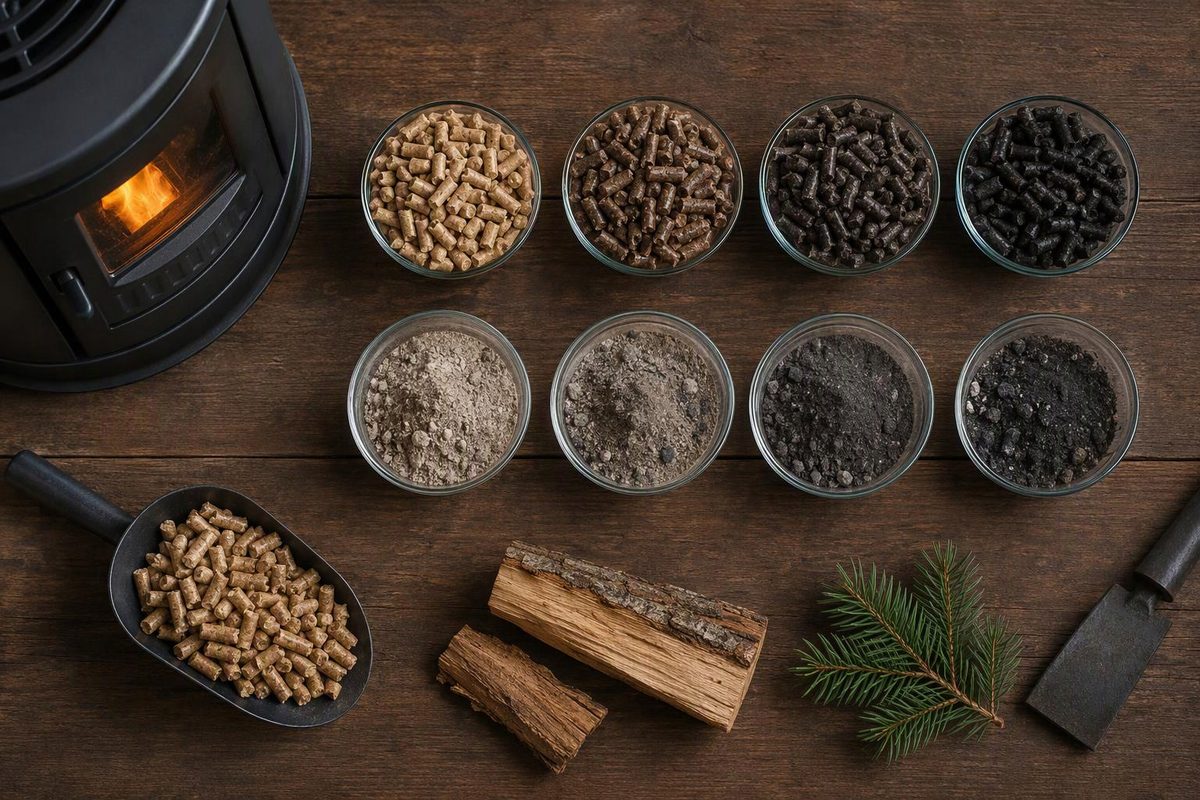
For a U.S. pellet-stove owner, “premium” is useful only when you know which standard it refers to—and whether the fuel meets your stove’s requirements. A verified quality mark tells you more than a large “high heat” claim on the front of a bag.
Wood heating pellets are made from sawdust and other wood by-products. But being a wood pellet does not, by itself, establish appliance compatibility. For example, the September 2025 Harman Absolute43-C owner’s manual specifies premium-grade wood pellets, recommends PFI-certified fuel and prohibits fuel containing additives. Start with your own model’s manual, not another stove’s requirements.
Look for the quality mark, not just the word
The Pellet Fuels Institute’s PFI Graded Fuel Quality Mark identifies fuel from production facilities qualified under its third-party inspection and laboratory-testing program. A bag’s “premium” wording alone does not establish participation in that program. PFI explains how to identify qualified fuel.
PFI’s guide to the Quality Mark shows three useful details:
- Fuel grade and mill registration number: identify the grade and production facility.
- Auditing-agency logo: identifies the independent oversight organization.
- Manufacturer’s guaranteed analysis: includes additional guarantees, such as minimum higher heating value.
The mark is evidence of a quality-control program, not a promise that every stove will need the same amount of cleaning or deliver the same heat. Conversely, a missing mark does not by itself establish poor quality or incompatibility; it means the bag lacks this particular evidence of program participation.
What the grades actually limit
These selected limits come from PFI’s published July 9, 2015 specification; they are not a complete list of grade requirements. PFI’s specification also covers dimensions, durability, bulk density and chloride content.
| Fuel property | PFI Premium | PFI Standard | PFI Utility |
|---|---|---|---|
| Maximum inorganic ash | 1.0% | 2.0% | 6.0% |
| Maximum moisture | 8.0% | 10.0% | 10.0% |
| Maximum fines at the mill gate | 0.50% | 1.0% | 1.0% |
These are ceilings, not the measured composition of every bag. Two Premium fuels can meet the same grade while having different ash content and heating values. Nor does this table make Standard or Utility fuel acceptable in a stove that requires Premium.
Ash matters mainly to the residue you must manage. As a simple mass calculation, 1% of a 2,000-pound U.S. short ton is 20 pounds; 0.5% is 10 pounds. That illustrates why a lower verified ash figure can be valuable, but it does not predict your cleaning interval. Harman’s manual notes that higher ash requires more frequent maintenance and that mineral content affects hard, glass-like deposits called clinkers. See its fuel specifications.
PFI defines fines as fuel material passing through a 1/8-inch screen under its specified sampling and testing procedure. Importantly, its limit applies at the mill gate, not after every delivery and handling step. Inspect the bags you receive as well as their printed specifications. See the definition and Table 1, note 5.
“Premium” does not guarantee a particular BTU number
PFI’s specification sets no grade-specific heating-value threshold. Instead, quality-marked product must carry a manufacturer’s minimum higher heating value guarantee. Premium is therefore not a universal BTU rating. The specification explains this distinction in Table 1, note 3.
Compare heat claims on the same basis:
- BTU per pound, not differently sized bags.
- Higher heating value with higher heating value.
- As-received fuel with as-received fuel—not a dry-basis figure.
- Guaranteed minimums with guaranteed minimums, rather than an advertised average against a minimum.
Fuel energy is also not the same as heat delivered into the room; appliance efficiency remains part of the calculation.
Decide whether the price premium buys anything
For 40-pound bags, 50 bags equal one U.S. short ton. Check the actual bag count and weight rather than assuming every pallet contains a ton.
Illustrative prices—not October 2026 market quotes:
- $7 per 40-pound bag equals $350 per ton before additional charges.
- $7.50 per bag equals $375 per ton before additional charges.
The second fuel costs about 7.1% more. Using those pre-delivery prices and the same appliance efficiency, it would need about 7.1% more energy per pound to match the first fuel’s cost per unit of useful heat. Lower ash or better feeding may still justify paying more, but those are separate benefits—not automatic fuel savings. Recalculate with complete delivered prices before deciding.
Before ordering, confirm dry storage and buy a small quantity of an unfamiliar approved fuel. Keep notes on feeding, deposits and cleaning under reasonably similar operating conditions. The Absolute43-C manual warns that damp pellets can revert to sawdust and feed poorly; it recommends keeping them in their original sealed bags until use. Its storage guidance also keeps fuel outside stove clearances.
For the broader purchase checklist, see how to choose pellets for your stove.