
Pine Pellet Fuel: Buy by Quality and Delivered Cost, Not Species
Pine pellets can be good stove fuel. Check appliance approval, fuel-grade labels, ash, heat-value claims and delivered cost before buying a winter supply.
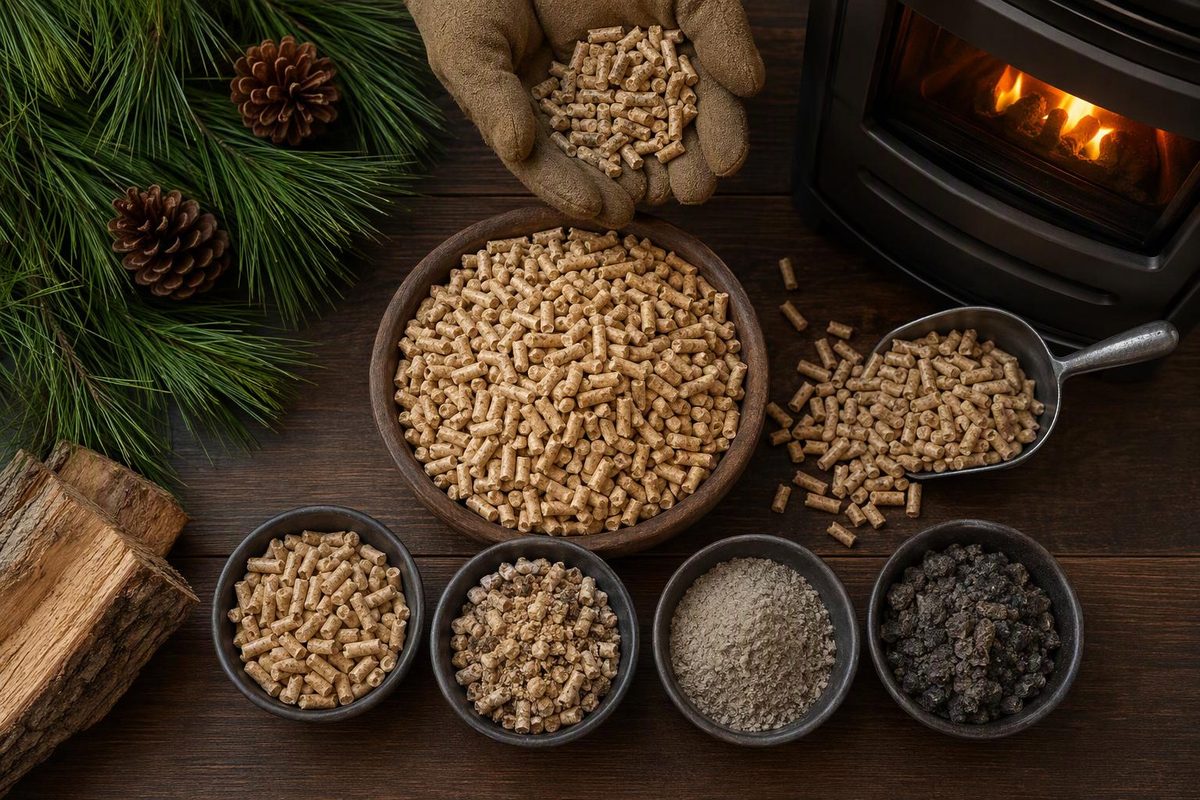
Pine heating pellets can be a sensible choice for a pellet stove. Don’t reject them because pine is a softwood—but don’t pay extra for the species name alone. The useful comparison is approved fuel, documented quality, delivered cost and how the pellets perform in your particular stove.
Also check what you are buying: pine heating fuel is not automatically interchangeable with a bag labeled only for horse bedding or cat litter.
Is pine suitable for your pellet stove?
Start with your exact model’s fuel requirements. As one documented example, the September 2025 Harman Absolute43-C owner’s manual specifies wood pellet fuel, recommends PFI-certified fuel and explicitly lists softwoods such as pine and fir among lower-ash source materials. Pine is not inherently excluded from pellet-stove use.
That is an example, not approval for every appliance. Check your manual’s requirements for fuel type, grade, dimensions, additives and certification before ordering. The Harman manual, for instance, prohibits fuel containing additives. If you have a pellet boiler rather than a room stove, use the boiler’s own fuel specification.
For bedding or litter pellets, don’t treat “100% pine” or “no additives” as proof of heating-fuel suitability. Ask the producer whether the exact product is intended for combustion and obtain its fuel specifications. Then check those against the appliance manual. If you cannot establish compatibility, choose documented heating pellets instead.
What the pine label does—and doesn’t—tell you
Pine can be a low-ash feedstock, but the finished pellet matters more than the tree name. The Harman manual’s fuel specifications note that source material affects ash, that bark and mineral content matter, and that pellet quality can vary between manufacturers and even bags. They also explain that minerals and sand can form hard, glass-like deposits called clinkers. Higher ash means more frequent maintenance.
For U.S. bagged fuel, look for the PFI Quality Mark, not just a prominent “premium” claim. The Pellet Fuels Institute’s standards program subjects qualified producers to regular third-party inspection and laboratory testing.
PFI’s Quality Mark guide lists these Premium-grade limits:
| Property | Premium-grade limit | Why check it? |
|---|---|---|
| Ash, as received | No more than 1% | Compare documented ash figures when cleaning burden matters |
| Moisture | No more than 8% | Dry fuel is important for proper combustion |
| Fines | No more than 0.50% | Check the specification and inspect bags for excessive loose dust |
Those are grade limits, not the measured results for every bag. The mark also provides space for a manufacturer’s guaranteed minimum higher heating value, as received, and additives information. Our pellet fuel label guide explains the distinction between a grade and a product’s claimed performance.
How much extra is pine worth?
A higher heat-value claim can justify a higher price—but only when both fuels’ figures use the same basis. Don’t compare a dry-basis number with an as-received number, or higher heating value with lower heating value.
Here is an illustrative comparison, not a current price quote or product test. Assume U.S. short tons of 2,000 pounds, comparable as-received higher heating values, and the same 75% stove efficiency on a higher-heating-value basis for both fuels:
| Fuel | Delivered price | Heat value | Useful heat per ton | Fuel cost per useful million Btu |
|---|---|---|---|---|
| Alternative pellet | $350/ton | 8,000 Btu/lb | 12 million Btu | $29.17 |
| Pine pellet | $380/ton | 8,500 Btu/lb | 12.75 million Btu | $29.80 |
The pine fuel contains 6.25% more energy per pound, but costs about 8.6% more. On fuel cost alone, it loses narrowly. Its break-even delivered price would be about $372 per ton: $350 × 8,500 ÷ 8,000.
Lower ash or better feeding could still make it preferable, but don’t assign those benefits without evidence. Use actual local quotes, including delivery, and your available product specifications.
Test before committing to a winter supply
Buy a few bags of an approved pine heating pellet before ordering a pallet or several tons. Start with a stove cleaned according to its manual, and record bag consumption, room comfort, ignition, feeding and burn-pot deposits under reasonably similar weather and settings. This is a compatibility check, not a laboratory efficiency test.
Keep the manual’s cleaning schedule during the trial; low-ash marketing is not permission to skip vent maintenance. Protect the supply from moisture, too: Harman warns that damp pellets can revert to sawdust and stop flowing properly through the feed system. See our pellet fuel storage guide before a large delivery.