
The Cheaper Fuel Depends on Your Local Quotes—Here’s How to Calculate It
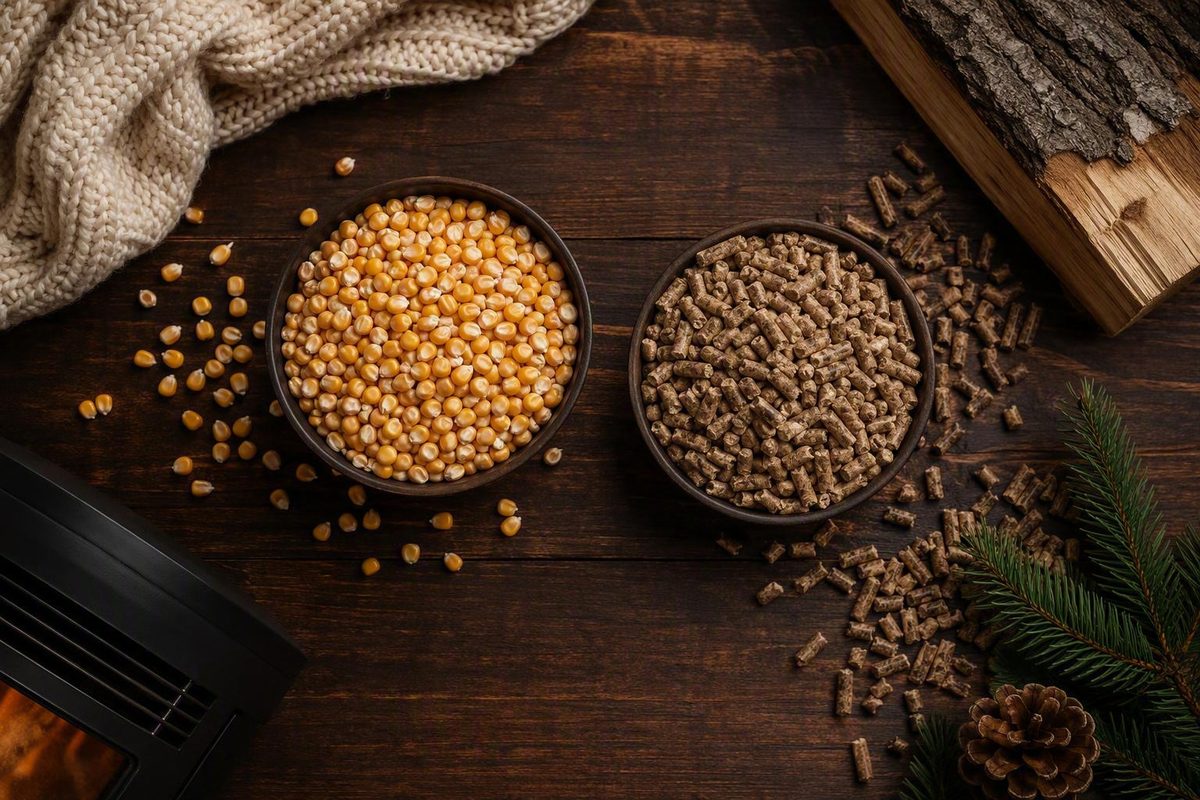
There is not enough current retail-price evidence to declare corn or wood pellets cheaper nationwide for winter 2026–2027. For your home, compare local delivered prices, documented fuel quality and heat content, and your appliance’s efficiency with each permitted fuel. Then add electricity, storage, cleaning, maintenance, and other seasonal costs.
Short answer: corn may be cheaper locally, but the current evidence does not prove it
The meaningful comparison is delivered stove-ready corn versus delivered heating pellets in your ZIP code. Commodity corn prices describe an agricultural market; they do not show what cleaned, dried, handled, packaged, and delivered heating corn will cost. Likewise, a pellet price advertised for pickup is not comparable with a corn quote that includes delivery.
Ask both suppliers for quotes on the same day and, where possible, for the same total weight. Record:
- Fuel quantity and packaging
- Pickup or delivered price
- Delivery charge
- Taxes and other mandatory fees
- Minimum-order requirements
- Winter or fuel surcharges
- Quote expiration date
If one quote is for bags and the other is for bulk fuel, convert both to pounds before comparing them. Do not compare a bushel of corn directly with a bag or ton of pellets without determining how many pounds each quoted unit represents.
What the record corn harvest does—and does not—tell us
The corn supply backdrop makes local shopping worthwhile. The National Corn Growers Association described the 2025 U.S. crop as a record 17.02 billion bushels and estimated that farmers received $4.15 per bushel. That was below the cited five-year average of $5.10 and the 10- and 20-year averages of $4.31 and $4.32, respectively, according to a July 2026 report on the NCGA figures.
Those figures provide favorable supply context, not a winter retail-price forecast. The $4.15 figure is an estimated price paid to farmers—not a residential quote for stove-ready heating corn.
The harvest report also provides no corresponding wood-pellet price. It therefore cannot establish a national corn-versus-pellet winner or support a household savings estimate. Treat the harvest as a reason to request local corn quotes, not as an input for your heating-cost calculation.
Use this delivered-heat worksheet instead of comparing tons or bags
A ton of corn does not necessarily provide the same usable room heat as a ton of pellets. Normalize each quote by calculating its cost per million BTU of delivered heat.
Complete this worksheet using supplier specifications and documentation for your exact appliance and each permitted fuel:
| Input | Stove-ready corn | Wood pellets |
|---|---|---|
| Date checked | ______ | ______ |
| Supplier | ______ | ______ |
| Quoted quantity | ______ | ______ |
| Fuel price | $______ | $______ |
| Delivery and mandatory charges | $______ | $______ |
| Total delivered price | $______ | $______ |
| Pounds per quoted unit | ______ lb | ______ lb |
| Documented BTU per pound | ______ | ______ |
| Appliance efficiency for this fuel | ______% | ______% |
A consumer corn-stove guide reports 6,800–8,500 BTU per pound for shelled corn and warns that corn prices can fluctuate seasonally. Treat the heat-content figures as a broad reported range, not a guarantee for a supplier’s product (see the guide’s corn-fuel discussion).
Do not insert an assumed pellet heat-content figure or presume that an appliance has the same efficiency with both fuels. Obtain the pellet specification from the supplier and the applicable efficiency information from the documentation for your exact appliance. Make sure the figures being compared use consistent definitions and measurement bases.
Calculate each option as follows.
1. Total BTU per quoted unit
Pounds per unit × BTU per pound = Total BTU per unit
2. Delivered BTU per quoted unit
Total BTU per unit × appliance efficiency as a decimal = Delivered BTU
For example, enter an efficiency of 75% as 0.75. Use only a documented figure applicable to the appliance and fuel being evaluated.
3. Cost per million delivered BTU
Total delivered price ÷ delivered BTU × 1,000,000 = Cost per million delivered BTU
The lower result identifies the cheaper fuel-only option under the assumptions entered. Keep the quote date, supplier specification, and appliance source with the calculation so you can revise it when prices or available products change.
Calculate the corn break-even price from your pellet quote
The break-even price is the maximum delivered corn price that would equal the delivered-heat cost of your pellet quote. First normalize both fuels to a comparable unit, such as the same total weight.
Use this formula:
Break-even delivered corn price = Delivered pellet price × (Corn delivered BTU per comparable unit ÷ Pellet delivered BTU per comparable unit)
For each fuel:
Delivered BTU = Unit weight × documented BTU per pound × appliance efficiency as a decimal
Use this blank template:
- Delivered pellet price: $P
- Comparable unit weight: W pounds
- Pellet heat content: PB BTU per pound
- Pellet efficiency: PE
- Corn heat content: CB BTU per pound
- Corn efficiency: CE
Then calculate:
Pellet delivered BTU = W × PB × PE
Corn delivered BTU = W × CB × CE
Break-even corn price = P × [(W × CB × CE) ÷ (W × PB × PE)]
If your actual delivered corn quote is below the break-even result, corn is cheaper on fuel-only delivered heat. If the quote is above it, pellets are cheaper under the entered assumptions.
If you cannot obtain a narrower supplier specification, run separate corn scenarios at 6,800 and 8,500 BTU per pound, the endpoints of the reported range (consumer corn-stove guide). Do not average the two values and present the midpoint as a known specification.
The result is only as reliable as the delivered quotes, fuel specifications, unit conversions, and fuel-specific efficiency figures entered.
Add the costs that a fuel-only comparison misses
The option with the lowest cost per million delivered BTU can still have the higher full-winter cost. Start with the fuel-only delivered total, then add only expenses that were not already included in that figure:
- [ ] Additional deliveries or seasonal surcharges
- [ ] Bags, bins, pallets, covers, or other storage supplies
- [ ] Any cost assigned to required dry storage space
- [ ] Stove electricity
- [ ] Routine cleaning supplies or paid cleaning
- [ ] Replacement parts
- [ ] Scheduled and unscheduled maintenance
- [ ] Ash containers and handling
- [ ] Time spent moving fuel and maintaining the appliance
Do not add the initial delivery charge twice. If it was included in the worksheet’s total delivered price, add only later deliveries or charges not covered by the original quote.
Pellet Finder’s account of long-term pellet-stove ownership treats fuel, replacement parts, maintenance time, electricity dependence, dry storage, and regular cleaning as genuine ownership considerations. These costs and practical demands should be evaluated alongside the fuel price rather than treated as afterthoughts.
Keep expected consumption household-specific.
For purchases planned in several loads, ask how long the quote remains valid and whether the same product is likely to be available later in winter. Do not multiply one unusually low spot quote across the entire season unless the supplier will honor that price and quantity.
Check the stove and fuel before buying
Do not assume your existing pellet stove permits corn merely because both fuels are granular. Before ordering, read the current manufacturer documentation for your exact model and identify the fuels it expressly permits. If corn is not listed, do not treat general information about corn or multifuel stoves as authorization.
Ask the corn supplier:
- Is this product intended and prepared for stove use?
- What moisture or other quality specification applies?
- Has it been cleaned or screened?
- Is it sold in bulk or packages?
- What storage conditions does it require?
- Is the same product likely to remain available later in winter?
Confirm that you have enough dry storage, can lift or move the expected quantity, and can arrange dependable deliveries. Where the appliance documentation says electricity is required, account for grid reliability and determine what backup arrangements are appropriate for that model.
Resolve operating and fuel-compatibility questions through the current manual or manufacturer. Do not transfer assumptions from a different stove, model, or fuel blend.
A five-minute buying decision
-
Get same-day local quotes. Request delivered prices for stove-ready corn and heating pellets in your area.
-
Record what each quote includes. Note quantity, packaging, taxes, delivery, minimum orders, surcharges, and expiration date. Convert both quotes to a common weight.
-
Collect documented performance inputs. Obtain heat content for each fuel and the appliance-efficiency figure applicable to every permitted fuel being considered.
-
Run both calculations. Compare cost per million delivered BTU, then calculate the break-even delivered corn price. Use low- and high-heat corn scenarios if no narrower supplier specification is available.
-
Build the seasonal total. Carry forward the delivered fuel cost and add electricity, storage, cleaning, parts, maintenance, ash handling, and only those delivery charges not already included.
-
Confirm compatibility and supply. Order only after verifying that the exact appliance permits the fuel and that the supplier can support your winter plan.
Save the result in a dated format:
- Location: ______
- Quotes checked on: ______
- Corn quote and quantity: ______
- Pellet quote and quantity: ______
- Fuel specifications assumed: ______
- Efficiency inputs and source: ______
- Fuel-only winner: ______
- Estimated all-in seasonal winner: ______
The record harvest makes corn worth pricing, not an automatic winner. The cheaper choice is the fuel that wins your local, dated delivered-heat calculation after the practical costs of operating the stove are included.