
Secure Your Winter Fuel Without Trying to Guess the Market
Use the complete local price, fuel test, dry storage and uncertainty to choose a full order, test bags, a baseline supply or a delayed purchase.
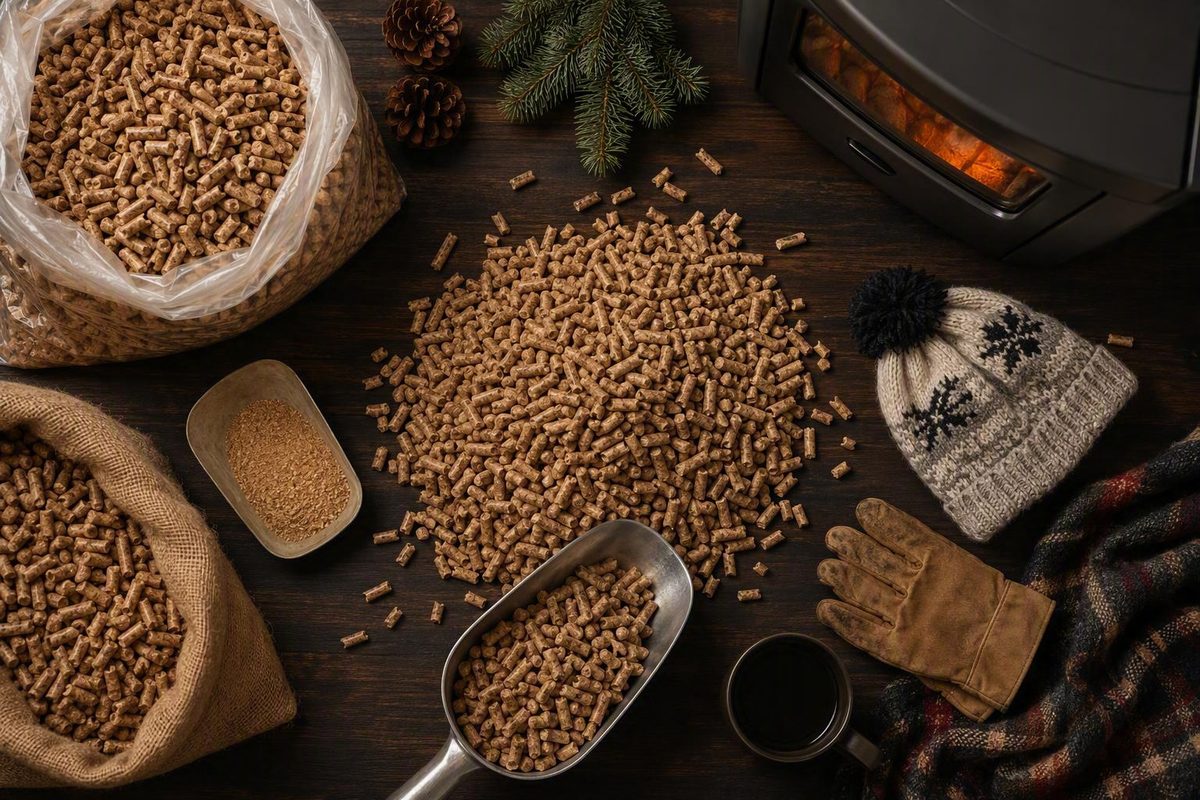
Buy pellets now if you have tested the fuel in your stove, have dry storage, and consider the complete local price acceptable. If the brand is unfamiliar, buy several test bags first. If cash, storage, or price uncertainty is significant, secure only a baseline supply and purchase the rest later. Wait and monitor when the current quote is uncompetitive, the terms are unclear, or your storage is not ready.
The short answer: buy for certainty, not a promised discount
There is no reliable universal rule identifying the cheapest month to buy pellets. Available market information also does not establish whether residential pellet prices will be higher or lower in winter 2026–2027.
Buying early primarily purchases certainty:
- A known fuel that works in your stove
- Better access to your preferred brand or grade
- More choice among delivery dates
- Less risk of searching for fuel during a cold spell
Those benefits can justify an order even when the price is not the lowest of the year. They do not turn an early purchase into guaranteed savings.
Use one of four paths:
- Buy now: The pellets are proven, the all-in quote is acceptable, the quantity fits your expected use, and storage is dry.
- Test first: The brand or product is unfamiliar, even if the posted price looks attractive.
- Split the purchase: Buy enough proven fuel to cover a baseline portion of winter, then compare updated offers before buying the balance.
- Wait and monitor: The quote is poor, the dealer’s terms are vague, or you cannot yet protect the fuel from moisture.
Keep local availability in perspective. A dealer can run out of one product without there being a regional or nationwide pellet shortage. What matters to your household is whether suitable fuel is available from a practical supplier, at an acceptable total cost, when you need it.
Compare the all-in cost, not the advertised ton price
A posted price per ton is only the beginning. Delivery tiers, payment discounts, membership charges, deposits, taxes, pallet fees, and pickup costs can change which offer is actually cheaper.
Use this calculation:
Effective cost per ton = (gross fuel subtotal before discounts + delivery + pickup expenses + taxes and fees − discounts) ÷ tons received
If the supplier has already given you a discounted fuel subtotal, use that amount and do not subtract the same discount again.
Record every quote in the same format:
| Quote field | Supplier A | Supplier B | What to verify |
|---|---|---|---|
| Product and grade | Exact brand, product line, and grade | ||
| Bags per pallet | Do not assume every pallet equals one ton | ||
| Base price | Per bag, pallet, or ton | ||
| Number of tons | Actual quantity received | ||
| Quantity discount | Minimum order and eligible products | ||
| Payment discount | Cash, check, or other conditions | ||
| Delivery charge | Flat fee or distance-based charge | ||
| Membership or pallet fees | Include refundable pallet deposits | ||
| Applicable tax | Confirm local tax treatment | ||
| Other supplier charges | Handling, access, scheduling, or similar fees | ||
| Pickup travel cost | Fuel, tolls, trailer rental, and time | ||
| Deposit | Amount due now and whether refundable | ||
| Delivery date | Firm date, range, or customer scheduling | ||
| Effective cost per ton | Calculate after all adjustments |
As checked September 20, 2026, Squier Lumber & Hardware listed Spring 2026 New England Wood Pellets at $399 per one-ton pallet, with 50 bags weighing 40 pounds each. The posted quantity price was $389 per ton for four or more tons, with another $5 per ton off for cash or check. Four tons paid by cash or check would therefore cost $384 per ton, or $1,536 total, before delivery or other unlisted charges on the Squier pellet pricing page.
Energy Co-op of Vermont posted prices effective April 1, 2026, and still displayed them when checked September 20, 2026: $425 per ton for pickup, $445 delivered when ordering at least three pallets, and $465 delivered for two or fewer. At those posted rates, three delivered tons would total $1,335, while two delivered tons would total $930. The same page described early-buy and budget-payment options for members on the co-op’s wood-pellet page.
Do not compare a $425 pickup price directly with a $445 delivered price and conclude that pickup saves $20. Pickup may require a suitable vehicle or trailer, travel, loading arrangements, unloading labor, and fuel. Delivery may carry minimum quantities, access restrictions, or additional charges. Compare the cost of getting the same quantity into usable storage at your home.
Why the calendar alone cannot tell you when to buy
The claim that pellets are always cheaper in spring or summer fails even within one retailer’s price history. Squier reported that its Spring 2026 price was $30 higher than its Winter 2025 price and $60 higher than its Spring 2025 price on the same product listing.
That does not mean winter is normally cheaper. It means the calendar is not enough. One retailer’s history for one product cannot predict another supplier, another region, or winter 2026–2027.
Unverified, user-generated reports also conflict. Some pellet owners describe spring prebuys, summer price breaks, reduced delivery charges, or broader brand selection. Others report high spring prices, no preseason promotion, steady prices through winter, or occasional post-season clearance offers. These anecdotes can suggest questions to ask local dealers, but they do not establish a national pricing rule; experiences vary throughout the Hearth.com discussion about when to buy pellets.
Several variables can matter as much as the month:
- Supplier and location
- Pellet brand and grade
- Order quantity
- Pickup versus delivery
- Inventory remaining after the previous winter
- Transportation costs
- Heating-season severity
- Dealer promotions and payment terms
A better method is to track dated quotes from the same two or three local suppliers. Record the exact product, inventory status, order size, delivery terms, and final cost per ton. Over time, that gives you a local purchasing history instead of a collection of unrelated anecdotes.
Put a value on supply and delivery certainty
Waiting creates risks even if the posted price never rises. Your preferred pellet may sell out, a convenient delivery week may fill up, or the remaining inventory may be limited to products you have not tested.
As checked September 20, 2026, Energy Co-op of Vermont listed Maine wood pellets as sold out for the 2026 season on its pellet sales page. That is a supplier- and product-specific example. It does not demonstrate a Vermont, New England, or national shortage, and the status may change independently of other products.
Think of early buying as an insurance choice. The potential return is not necessarily a discount; it is known fuel, an orderly delivery, and less exposure to cold-weather scrambling. Decide what that certainty is worth to your household rather than accepting an unsupported prediction about future prices.
A split purchase offers a middle path. Secure enough proven fuel for a baseline portion of winter while retaining cash and storage capacity for a later order. You can then compare updated quotes and adjust for actual consumption without committing the entire seasonal budget to an uncertain product or price.
Prepayment requires particular care when the pellets will remain at the dealership. Get written terms identifying:
- The exact product and reserved quantity
- How long the dealer will hold it
- The pickup or delivery deadline
- Who schedules transportation
- Refund and cancellation conditions
- What happens if the dealer cannot supply the promised fuel
An invoice saying only “pellet deposit” is less useful than a document connecting your payment to a specified product, quantity, and fulfillment deadline.
Confirm quantity, storage, and pellet performance first
One ton is 50 bags weighing 40 pounds each, so a four-ton order means 200 bags to store, move, and load into the stove over time, as confirmed by the pallet quantity on Squier’s cited product page. A bulk discount is not valuable if part of the order has nowhere suitable to go.
Start with your household’s consumption during comparable winters. Then adjust qualitatively for:
- Pellets already on hand
- Whether the stove will provide primary or supplemental heat
- Expected occupancy and thermostat habits
- Changes to insulation, air sealing, or heated space
- Other heating systems you expect to use
- Whether the coming season is likely to resemble the winters in your records
Do not treat a generic seasonal tonnage range—or another household’s experience—as a personalized requirement.
Test unfamiliar pellets before buying multiple tons. Burn several bags under your normal stove settings and keep a simple log:
| Test item | What to record |
|---|---|
| Room heat | Whether the normal setting maintains the expected temperature |
| Bag consumption | Approximate hours or days per bag under comparable conditions |
| Ash volume | Amount produced and how quickly the ash pan fills |
| Visible fines | Dust or broken material in the bags and hopper |
| Clinker formation | Frequency and severity of hard deposits |
| Cleaning frequency | How often the burn pot, glass, or stove needs attention |
This is not a laboratory comparison, but it can reveal whether a pellet is a poor match for your stove and operating routine. A lower-priced ton may be poor value if you burn noticeably more fuel, receive less useful room heat, or spend substantially more time cleaning.
Finally, confirm dry, weather-protected storage before committing. If you cannot keep the bags dry and inspect the storage area throughout the season, postpone the full order or buy a smaller quantity.
What national biomass data—and oil headlines—cannot predict
National biomass figures provide industry context, but they are not equivalent to delivered bagged-pellet prices. The U.S. Energy Information Administration reported domestic densified-biomass sales averaging $239.75 per ton in April 2026. That figure combined retail and wholesale transactions across covered densified-biomass products, according to the EIA’s April 2026 report.
For June 2026, EIA reported an average of $261.19 per ton for domestic densified-biomass sales. EIA distinguishes premium or standard wood pellets from utility pellets, while its headline domestic average includes multiple products and transaction channels. The agency’s June 2026 biomass data should not be read as the price a homeowner would pay for a delivered pallet.
The difference between April and June does not establish a consumer pellet-price trend, much less a winter forecast. National production, inventory, sales, and export totals also do not directly measure the availability of residential bagged pellets at a particular dealer.
Heating-oil reports provide household-heating context, not pellet-price direction. An August 21, 2026 report described Vermont households and fuel businesses responding cautiously to heating-oil instability, including strong interest in contracts after a delayed offering. The VTDigger report reported no pellet prices and cannot show whether pellets will rise or fall.
Connecticut heating oil averaged $5.61 per gallon on September 15, 2026, compared with $3.19 one year earlier, according to NBC Connecticut. That change may affect household interest in alternative heating, but it does not prove that pellet prices will move in the same direction.
Use this purchase trigger instead of guessing the market bottom
Place the order when all of these core checks pass:
- [ ] The exact pellet has passed a test burn in your stove.
- [ ] You have compared its effective delivered cost with at least two other local offers.
- [ ] The quantity reflects your household’s burn history and remaining inventory.
- [ ] You have enough dry, protected storage.
- [ ] The product, payment, reservation, pickup, and delivery terms are in writing.
- [ ] You can afford the commitment without depending on an unverified future saving.
If every check passes and the current price is acceptable to your household, buying is reasonable. Waiting solely because a lower price might appear risks losing a proven product or workable delivery date without any assurance of savings.
Choose a test or split purchase when pellet performance, required quantity, storage, or price remains uncertain. Continue monitoring when the quote is uncompetitive, the dealer cannot explain the terms clearly, or the fuel cannot yet be stored dry.
For every offer, record the quote date, inventory status, and promised delivery date. All three can change independently. The practical goal is not to identify the lowest pellet price anyone will offer all year; it is to secure suitable fuel, in a manageable quantity, at a total cost and level of certainty your household can accept.