
Double Wall Vent Pipe: Pellet Vent Is Not Wood-Stove Pipe
Double-wall construction doesn’t prove pellet-stove compatibility. Check vent type, diameter, clearances and matching parts before buying.
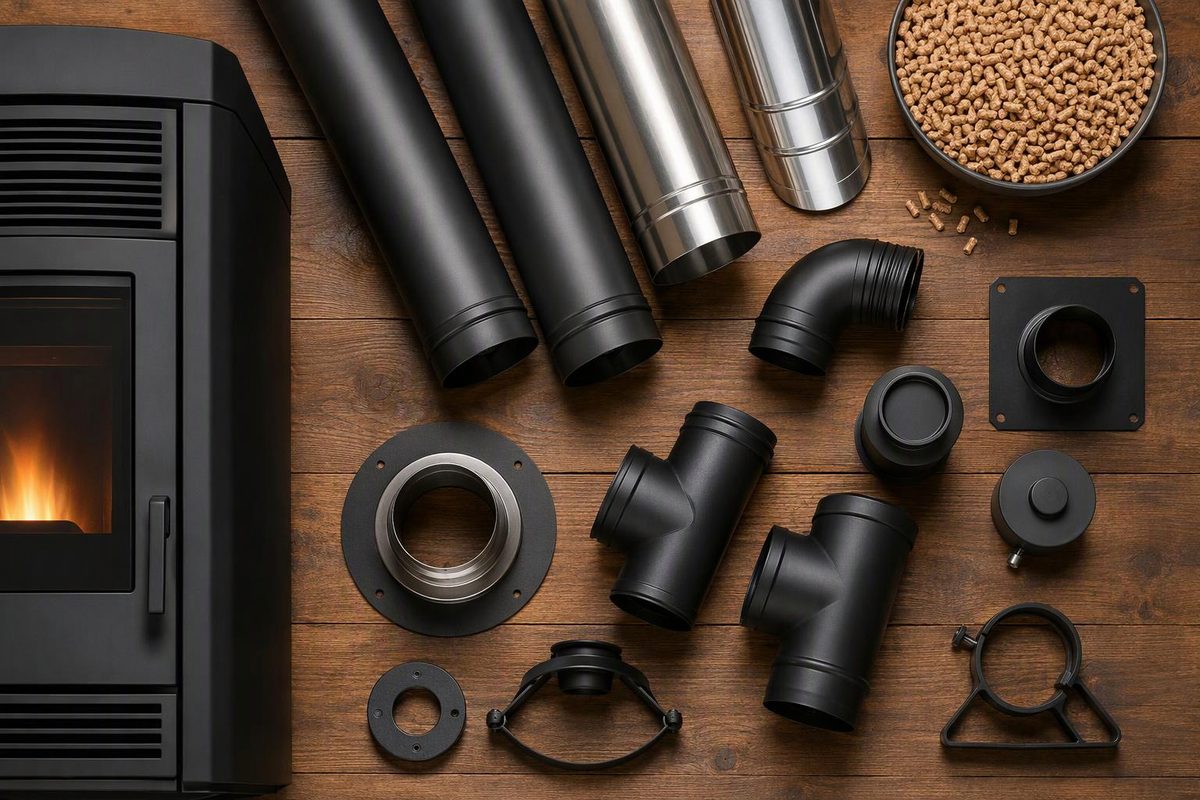
For a pellet stove, buy the vent system approved in the stove’s manual—not simply a pipe advertised as “double wall.” That phrase describes construction, not which appliance the pipe can serve. Pellet vent, wood-stove connector pipe and Type B gas vent can all have two walls, but they are not interchangeable.
For example, the Harman Absolute43-C’s September 2025 owner’s manual specifies a 3- or 4-inch Type L or PL venting system. That is a model-specific requirement, not permission to use any double-wall pipe of those diameters. Check your own stove’s rating plate and installation manual before ordering. (Harman manual)
Three products that are easy to confuse
| Product | Intended use | What a pellet-stove buyer should know |
|---|---|---|
| Double-wall pellet vent | Exhaust from approved pellet appliances | A candidate only when its listing and instructions meet the stove’s requirements. |
| Double-wall stove connector, such as DuraVent DVL | Interior connection from a wood stove to a manufactured chimney | Not the same product as pellet vent, and not a through-wall or through-ceiling chimney. |
| Type B gas vent | Approved gas appliances | Not a substitute for pellet vent, even if the diameter matches. |
DuraVent’s PelletVent Pro illustrates the first category: it has a corrosion-resistant stainless-steel inner wall, a galvalume outer wall and sealed connections. It is offered in 3- and 4-inch diameters and listed to UL 641. Its two-wall design is air-insulated; “double wall” does not necessarily mean insulation is packed between the walls. (PelletVent Pro specifications)
By contrast, DuraVent describes DVL as an interior wood-stove connector. Its instructions explicitly prohibit enclosing it or passing it through walls, ceilings, attics or closets. A second wall does not make connector pipe suitable for those locations. (DVL installation instructions)
Type B vent is designed for specified natural-gas and propane appliances and uses an aluminum inner wall. DuraVent’s pellet-vent instructions expressly say not to connect aluminum-lined Type B gas vent to pellet appliances. (Type B specifications, pellet-vent instructions)
Clearance belongs to the exact system
There is no universal “double-wall clearance.” PelletVent Pro specifies 1 inch to combustibles in the United States and Canada. DVL specifies 6 inches to walls and 8 inches to ceilings. Those numbers apply to those named products—not every pipe that looks similar. (PelletVent Pro, DVL)
Check both the appliance and vent instructions. The stove’s distance from a wall, the vent’s clearance to framing and the outdoor cap’s distance from openings are separate requirements.
Do not pack the required clearance space with ordinary insulation. PelletVent Pro permits a narrowly defined noncombustible-insulation exception in wall thimbles or support boxes, subject to stated material requirements and acceptance by the local authority; it specifically excludes fiberglass. That exception is not permission to wrap the vent generally. (PelletVent Pro installation instructions)
Before buying pipe or replacing a section
Use this order of checks:
- Identify the stove and approved vent type. Match the exact model to its installation manual.
- Confirm the route and diameter. Check permitted configurations, horizontal-run limits, vertical-rise requirements and offsets. A 3-inch stove outlet does not automatically mean the entire installation can use 3-inch vent; PelletVent Pro provides a 3-to-4-inch increaser adapter where 4-inch vent is required.
- Identify the existing vent brand and product series. Do not assume matching diameters or the same brand name prove compatibility. Use documented compatible parts and transitions, not improvised connections.
- Check the connection instructions. Gaskets, locking joints and sealant requirements differ. PelletVent Pro generally needs no additional sealant at its pipe joints, but its manual identifies connections that do require sealant.
- Price the complete route. Include the appliance adapter, penetration components, supports, suitable cap and cleaning access—not just straight pipe. (Planning guidance, connection instructions)
For a new installation, use our pellet stove vent-kit checklist to review the parts list. If the route is still undecided, start with pellet stove exhaust pipe by vent route.
The useful purchasing question is not “Is it double wall?” It is “Is this exact vent system approved for my stove and proposed route?” Have the local building department or fire officials confirm permit and inspection requirements before work begins.