
Check Dampness, Flood Risk and Access Before Storing Pellets Downstairs
A basement pellet-storage checklist covering humidity, seepage, concrete-floor contact, flood risk, ventilation and carrying bags to the stove.
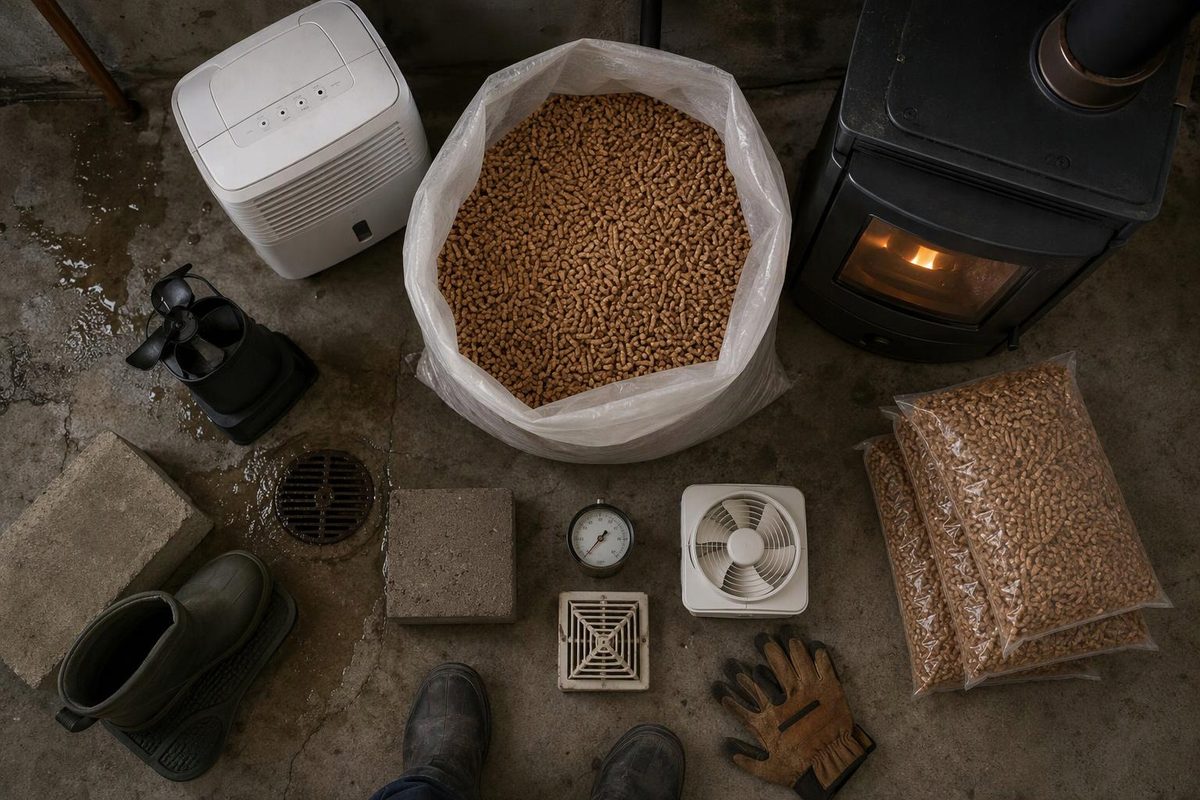
A basement can keep bagged wood pellets out of the weather, but it is a good storage choice only if it stays dry, has an appropriate ventilation plan and makes fuel handling manageable. A dry corner on delivery day is not enough: check what happens during heavy rain, spring thaw and humid summer weather before committing a winter’s supply.
This guide is for homeowners storing bags for a pellet stove—not for converting a basement room into a bulk pellet bunker.
Check the basement through its wettest conditions
Start with the proposed storage area, not just the room’s general appearance. Look for:
- Damp patches or water stains at the wall–floor joint.
- Puddles, seepage or a history of sewer backup or flooding.
- Condensation on cold pipes, walls or the floor.
- Musty odors, visible mold or deteriorating cardboard already stored there.
- Leaking plumbing, laundry hoses or equipment above the stack.
The University of Minnesota Extension’s basement-moisture guide identifies groundwater, indoor moisture and humid outdoor air condensing on cool surfaces as distinct sources. That distinction matters: a dehumidifier can reduce airborne moisture, but it does not repair a leak or drainage problem.
Put a humidity meter near the intended stack and check it over time, including after rain and during summer if bags will remain there. EPA recommends indoor relative humidity below 60%, ideally 30–50%, for moisture and mold control. That is a building-moisture guideline, not a guaranteed pellet-storage threshold. A satisfactory meter reading does not cancel out a wet floor or dripping pipe.
Do not assume opening basement windows will dry the room. Minnesota Extension warns that warm, humid summer air can condense on cold basement surfaces. Address the moisture source and use dehumidification when needed rather than relying on an open window.
Separate floor contact from flood protection
WoodPellets.com recommends indoor storage free from flooding, mold and excessive humidity, and suggests reusing the delivery pallet in a dry area. For a basement, use a sound pallet or another stable, load-rated raised platform rather than putting bags directly on the concrete.
Elevation helps separate the bags from the floor. It does not make a flood-prone basement suitable. If past water levels could reach the lowest bags, choose another location until the water problem is resolved. Do not count on bag plastic to make a wet storage area acceptable.
Place the stack away from known seepage points and leave enough room to inspect the surrounding floor and walls. Keep access to the sump, drains, shutoff valves and equipment clear. A stack that hides a developing leak makes a small problem harder to catch.
Keep unopened pellets in their original bags. Harman’s September 2025 Absolute43-C owner’s manual directs owners to leave fuel sealed until use and warns that damp pellets can turn back into sawdust that will not flow properly through the feed system. Set aside swollen or disintegrating fuel rather than feeding it into the hopper.
Test the carrying route before ordering a ton
Basement space is useful only if you can get the fuel in—and retrieve it comfortably throughout winter.
A U.S. short ton means 50 bags when each bag weighs 40 pounds. If the stove is upstairs and you move one bag per trip, that is 50 loaded trips back up, as well as moving the delivery downstairs.
Before placing a large order:
- Carry one full bag along the actual route, if you can do so safely, and assess the stairs, turns and lifting involved.
- Ask whether delivery ends outside or includes moving bags into storage.
- Keep stairs, doors and exit routes unobstructed.
- Stack so bags are reachable without climbing or pulling from an unstable pile.
- Verify the support capacity of shelving or a raised floor; do not assume that a platform can carry a seasonal supply because it has room for it.
If carrying full bags is impractical, a smaller basement reserve or a dry location on the stove’s level may be the better trade-off. If heating equipment shares the basement, preserve its required combustible clearances and service access.
Treat ventilation as a separate check
A dehumidifier controls moisture; it does not establish that the storage area has adequate ventilation. New York’s Department of Health warns that stored pellets can produce carbon monoxide and recommends a separate outbuilding ventilated outdoors to minimize exposure. Its recommendation favors outdoor storage; a dry basement alone does not satisfy that advice.
Before storing a seasonal quantity in an enclosed basement, ask a qualified professional to assess ventilation and CO-monitoring needs. Maintain home CO alarms according to their instructions and local requirements; dryness alone is not an air-quality assessment.
Bulk boiler storage needs a purpose-designed system. The UK Health and Safety Executive’s bulk-storage alert warns against entering pellet stores or putting your head into bulk hoppers because CO accumulation and oxygen depletion can be lethal.
For broader bag protection and routine handling, see our pellet fuel storage guide. If your basement fails the water or access checks, buy a smaller quantity or use another suitable location—not a larger stack with more plastic around it.