
Hardwood Wood Pellets Are Not Automatically Better
Choose hardwood wood pellets by verified grade, ash, moisture, heat output and stove performance—not the hardwood label alone.
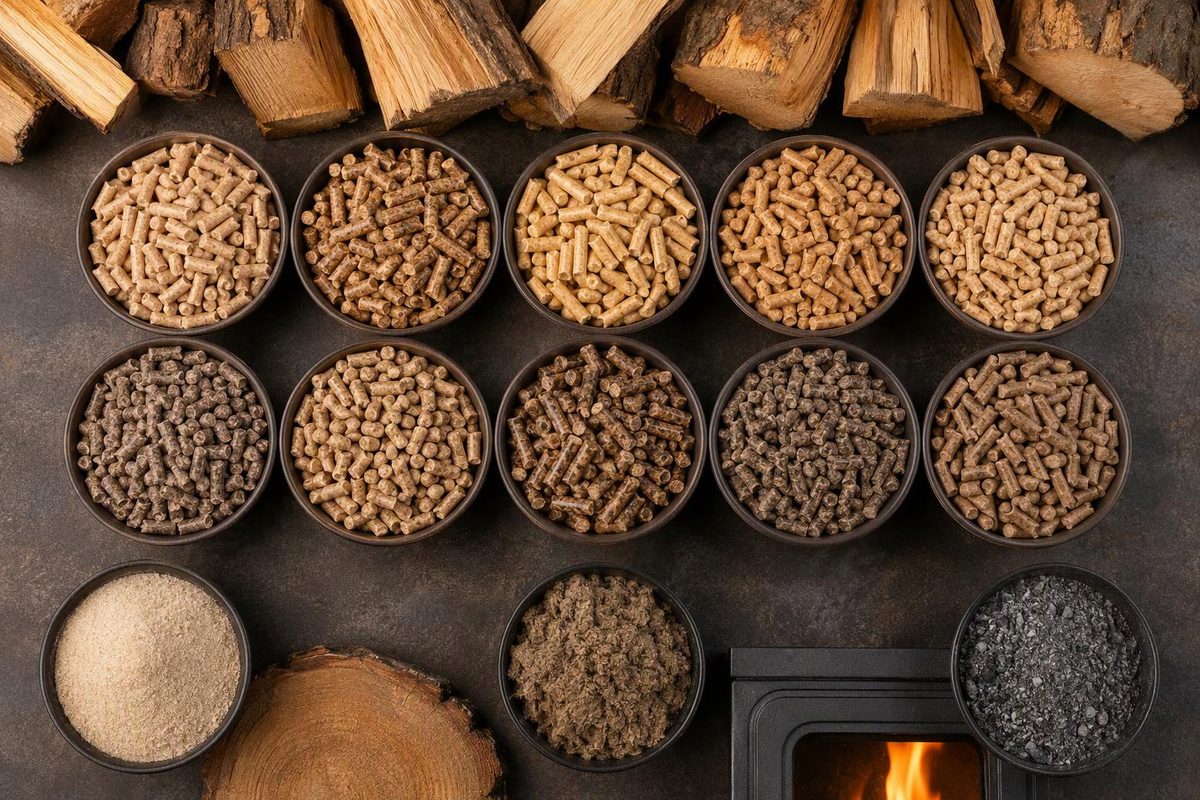
Hardwood wood pellets can be excellent heating fuel, but “hardwood” is not a quality grade. Unlike cordwood, pellets have been ground, dried and compressed to a fairly uniform density. A hardwood pellet is therefore not automatically hotter, cleaner or longer-burning than a softwood pellet.
The better buying rule is to follow the appliance manual, look for fuel graded under a recognized program, compare ash, moisture and heating-value figures on the bag, and test a few bags before ordering a ton.
Hardwood pellets versus hardwood firewood
Dense hardwood logs generally contain more energy per volume than softwood logs, which is why hardwood has a strong reputation as firewood. That distinction becomes less useful after wood is processed into pellets and sold by weight.
The New Hampshire Department of Energy explains that pellets have roughly similar density regardless of the original wood. Softwood pellets can sometimes provide more heat per bag because their resins have higher heating values. The agency identifies ash production and clean burning as more useful performance considerations than the hardwood-or-softwood label (New Hampshire Department of Energy).
Vermont’s pellet buying guide reaches a similar conclusion: high-quality pellets may be hardwood, softwood or a blend. It says softwood pellets generally have higher heat output and lower ash while recommending that owners determine what performs best in their appliance (Vermont Department of Forests, Parks & Recreation).
That does not make hardwood pellets a poor choice. It means species alone cannot settle the choice.
What matters more than the hardwood label
1. The stove manual
Start with the fuel section of the manual for your exact model. It may specify wood-only pellets, a grade, dimensions or other restrictions. For pellet heaters covered by the federal rule, operators may burn only pellets specified in the owner’s manual and graded through an EPA-approved third-party organization. PFI, ENplus and CANplus are among the organizations named in the rule. The same rule requires covered heaters to be operated consistently with their manuals and says the manual must warn that inconsistent operation voids the warranty (40 CFR §60.532(e) and (g)).
Do not assume that a bag marked “100% hardwood” satisfies those instructions. For a broader label checklist, see how to choose pellets for a pellet stove.
2. A verified grade and quality mark
The Pellet Fuels Institute says its program subjects qualified production facilities to regular third-party inspection and laboratory testing. Bags from qualified producers can be identified by the PFI Quality Mark—not merely by similar-looking quality claims elsewhere on the package (PFI Standards Program).
The published PFI specification covers ash, moisture, fines, durability, bulk density, dimensions, chloride and heating value. Hardwood content is not the deciding quality measure (PFI Standard Specification).
A hardwood claim describes the stated feedstock. A recognized quality mark says more about whether the finished fuel has been assessed under a defined program.
3. Ash and moisture
Lower ash generally means a slower-filling ash pan and less frequent cleaning. Vermont’s guide suggests no more than 1% ash. Mathematically, 1% of a 40-pound bag is 0.4 pound, or 6.4 ounces, so small percentage differences become noticeable over a ton. The guide also recommends less than 8% moisture for premium pellets and notes that excess moisture can delay ignition.
Treat those figures as screening criteria, not a promise that every stove will behave identically. Bark, leaves, dirt and other mineral-bearing material can increase ash regardless of whether the wood is called hardwood. One Harman manual, for example, associates high-mineral hardwood, bark and leaves with higher ash. It also warns that pellet quality can vary by manufacturer and even by bag (Harman XXV owner’s manual).
4. Heat output on the same basis
Compare BTU figures only when they use the same basis. A “moisture-free” heating value looks higher than an “as-received” value because it excludes the water actually present in the bag. Vermont’s guide considers about 8,000–8,400 BTU per pound a strong as-received range.
Even then, the highest advertised BTU figure may not produce the lowest heating cost. Use:
Fuel cost per useful MMBtu = delivered price per ton ÷ [(BTU/lb × 2,000 ÷ 1,000,000) × appliance efficiency]
At $350 per ton, 8,200 BTU/lb and 75% overall efficiency, the result is about $28.46 per useful MMBtu. Include delivery in the pellet price. Use overall efficiency for your appliance rather than an unspecified combustion-efficiency claim; EPA distinguishes overall efficiency as the share of fuel heat transferred to the heated space (EPA’s archived efficiency explainer).
Test hardwood pellets before buying a ton
Buy several bags from the same lot when possible, then keep stove settings and cleaning condition consistent. Record:
- pounds burned over a comparable period;
- room temperature and thermostat demand;
- ash after a known amount of fuel;
- clinker and burn-pot buildup;
- ignition reliability and unburned pellets;
- fines in the bottom of each bag;
- glass darkening and changes in cleaning frequency.
This is a household comparison, not a laboratory test. Outdoor temperature and heat demand can distort results, but the exercise is still more informative than choosing by species alone. The Harman manual likewise recommends trying different brands before making a multi-ton purchase.
Once you find a compatible lot at a competitive delivered price, decide whether to buy pellets now or wait. Keep bags sealed until use and store them in a dry place; damp pellets can break down into sawdust and feed poorly.
Buying judgment
Choose hardwood wood pellets when they meet your manual’s requirements, carry the appropriate verified grade, publish competitive ash, moisture and heat figures, and run well in your stove. Do not pay a large hardwood premium based on the species name alone.
A graded softwood pellet or blend with lower ash, comparable delivered cost and better performance in your appliance can be the better fuel. Conversely, a consistent, low-ash hardwood pellet that feeds and burns cleanly is a sound purchase. The finished pellet and its performance matter more than the hardwood label.