
Build a Cleaning Setup That Actually Fits Your Stove
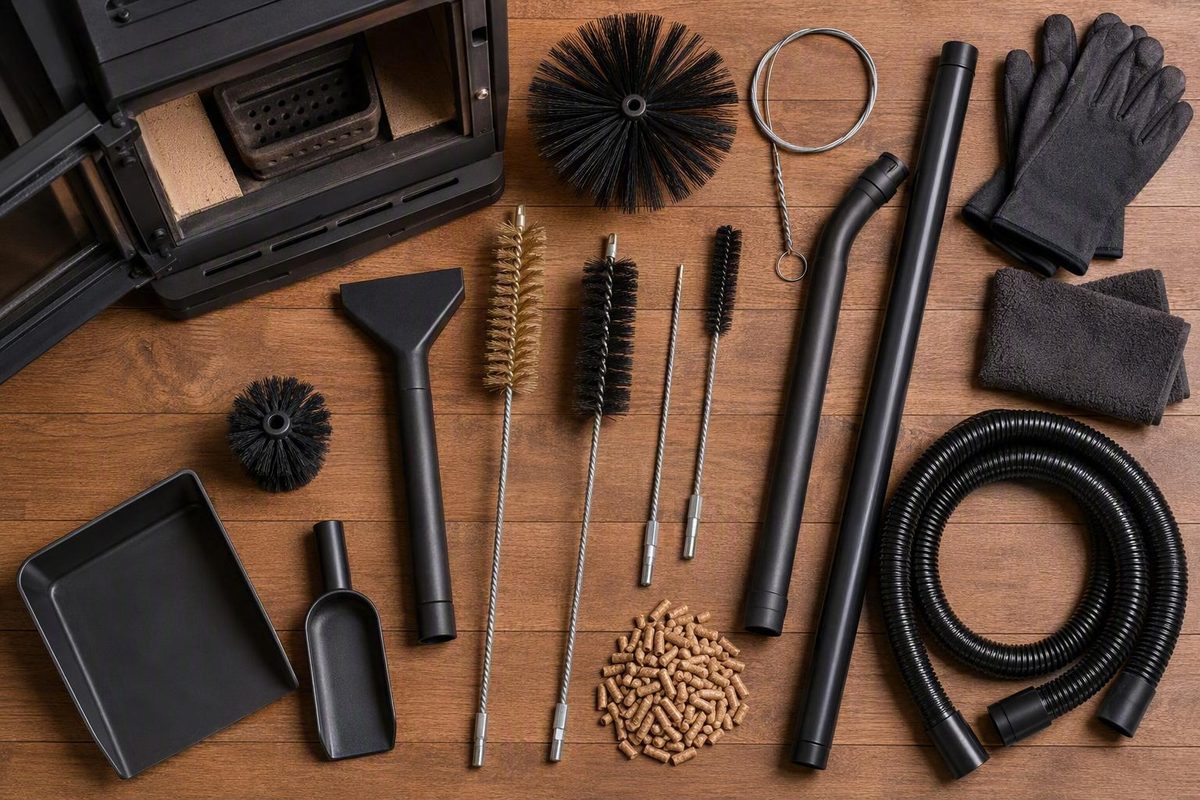
Products sold as a pellet stove cleaning kit differ substantially in scope. One package may cover the burn pot, firebox, narrow passages, vent, and glass. Another may contain only a vent brush and rods. A third may be a set of attachments for an ash vacuum that you must already own.
The right choice is therefore not the bundle with the most pieces or the highest marketplace rating. It is a task-specific set of tools matched to:
- Your exact stove model and owner manual
- Vent diameter, layout, and accessible cleaning length
- Brush material, rod connection, and coupling type
- Ash-vacuum model, inlet, and hose size
- Internal access points and clearances
- The maintenance the manufacturer permits an owner to perform
Start by defining the jobs you intend to do. Then verify every dimension, connection, required add-on, and model-specific restriction before comparing prices.
Last reviewed August 25, 2026. Product contents and prices below are snapshots from the cited listings and may change. Recheck them before ordering.
Start by identifying which kind of kit you are buying
A product name alone does not tell you what a kit can clean.
- Broad stove-maintenance kit: Combines tools for several areas, potentially including the burn pot, firebox, narrow passages, vent, and viewing glass.
- Flue-focused brush-and-rod system: Primarily cleans pellet venting. It may include one or two stove tools, but brush diameter and rod reach remain its defining specifications.
- Ash-vacuum attachment kit: Adds narrow hoses, brushes, crevice tools, or adapters to a compatible ash vacuum. It does not necessarily include the vacuum.
- Standalone tool or build-your-own component: A scraper, bottle brush, vent brush, rod, adapter, or cleaner purchased separately for a specific task.
A complete setup may need to address five distinct areas: the burn pot, firebox and ash pan, narrow internal spaces, viewing glass, and venting. No single retail package necessarily covers all five.
Use this quick decision matrix before reading product specifications:
| If you mainly need to… | Start with this format | Likely separate equipment | Primary reason to reject it |
|---|---|---|---|
| Handle several routine stove and vent tasks | Broad maintenance kit | Usually an ash-rated vacuum; possibly additional rods | Wrong vent size, insufficient reach, or tools not approved for the stove |
| Clean an accessible pellet vent | Flue-focused brush-and-rod system | Possibly a drill, extensions, and an ash vacuum | Wrong brush material or size, incompatible route, or inadequate rod reach |
| Reach ash in small interior spaces | Ash-vacuum attachment kit | A specifically compatible ash vacuum | Unconfirmed hose or inlet fit |
| Fill one exact gap in an existing setup | Individual component | Whatever equipment drives or connects to it | Incompatible thread, coupling, material, or dimensions |
The Drolet AC02712 illustrates the broad-kit format. Its listed contents include a long steel-blade scraper, stainless-steel brush, tapered nylon brush for spaces from 1 to 2.25 inches, a 3-inch chimney brush with flexible rods, and 500 mL of glass cleaner. The listing states a vent-cleaning reach of up to 10 feet. That gives it broader task coverage than a vent-only product, but does not establish compatibility with a particular stove or vent route. See the Drolet AC02712 contents and dimensions.
The SootEater RPS204B is better understood as a flue-focused rotary system with supplementary firebox tools. Its listed contents are 3-inch and 4-inch propeller brushes, three three-foot flexible rods, a long-handle stove brush with scraper, and an operator manual. It is powered by a cordless drill, which the manufacturer says is not included. It therefore does not replace an ash vacuum or glass-cleaning supplies. Review the manufacturer’s RPS204B specifications.
The PowerSmith PAAC302 represents the attachment category. The retailer lists a crevice tool, brush nozzle, pellet-stove hose, adapter, and storage bag, and names the PAVC101 ash vacuum as compatible. The listing does not establish cross-brand compatibility or state that an ash vacuum is included. Review the retailer-listed PAAC302 contents and compatibility.
Do not infer completeness from a photograph, marketplace category, result count, or phrases such as “deep cleaning kit.” A photograph may show equipment sold separately, and a search category may mix complete bundles with brushes, rods, and adapters. Read the written contents list, identify required equipment, and treat anything not listed as unconfirmed until the seller or manufacturer answers.
What a practical pellet-stove cleaning setup should contain
Each stove area presents a different cleaning problem. Hard cooled deposits call for a suitable scraper. Loose ash requires controlled pickup. Delicate seals call for soft bristles. Venting requires a correctly sized brush and enough compatible rods to cover the approved cleaning path.
| Stove area | Suitable tool | Specification to verify | Purchase priority | Commonly included in retail kits? |
|---|---|---|---|---|
| Burn pot | Model-appropriate scraper or a flathead tool expressly permitted by the manual | Blade shape, access angle, material, and manufacturer instructions | Routine essential | Often in broad kits; uncommon in attachment kits |
| Burn-pot air holes | Manufacturer-approved narrow tool | Tool diameter, permitted depth, and proximity to the ignitor | Model-dependent essential | Sometimes |
| Firebox and ash pan | Ash-rated vacuum plus suitable brush or crevice attachment | Ash-use approval, required filters, hose fit, and access clearance | Routine essential | Attachments may be included; vacuum often separate |
| Ignitor area and narrow passages | Small bottle brush, tapered brush, crevice tool, or narrow hose | Tool diameter, insertion depth, clog clearance, and nearby wiring | Model-dependent | Sometimes |
| Door gasket and delicate surfaces | Soft brush, such as a small paintbrush | Bristle softness and whether the gasket may be disturbed | Routine or model-dependent | Rarely |
| Accessible fan or blower surfaces | Soft brush, only where the manual permits access | Disassembly limits, wiring, blade clearance, and dust control | Service-dependent | Rarely |
| Pellet vent | Correctly sized pellet-vent brush and compatible flexible rods | Inside diameter, brush material, accessible route, bends, reach, and rod connection | Vent-maintenance essential | Common in flue kits; sometimes in broad kits |
| Viewing glass | Soft, non-scratching cloth and manufacturer-approved cleaner | Glass treatment, cleaner restrictions, and cool-surface procedure | Routine essential | Cleaner sometimes included; cloth often separate |
| Hopper or permitted feed area | Manual-approved vacuum nozzle or brush | Shutdown procedure, auger access, and safe disassembly limits | Seasonal and model-dependent | Uncommon |
For a cooled burn pot, choose a scraper shaped for the deposits and available working angle. A large generic scraper may not fit under a lip or around an ignitor opening. If air holes need clearing, follow the manual’s instructions on tool diameter, material, and insertion depth. Do not assume that a drill bit, wire, screwdriver, or other improvised implement is acceptable merely because it fits.
Loose residue in the firebox and ash pan generally calls for an ash-rated vacuum and an attachment that fits the available openings. The brush loosens residue and the vacuum collects it. Confirm ash-use approval and required filters with the vacuum manufacturer instead of assuming that any household or wet/dry vacuum is suitable.
Ignitor areas, heat-exchanger passages, and narrow channels may benefit from bottle brushes, tapered detail brushes, crevice tools, or small hoses. The attachment must be narrow enough to enter without contacting unverified components, but wide enough to avoid constant pellet-fragment clogs. Stop if you cannot identify what lies beyond an opening or how deeply the manufacturer permits the tool to travel.
Use soft bristles around gaskets and other delicate surfaces. Whether a gasket, fan, blower, or hidden chamber may be cleaned by the owner depends on the exact appliance instructions. A tool intended for cooled burn-pot deposits should not automatically be used on a seal or light component.
For the vent, match the brush to the documented inside diameter and any brush-material restrictions. Add enough mutually compatible rods to cover the entire owner-accessible section from the chosen entry point. A manufacturer’s description of a rod as flexible does not establish that it can safely negotiate every elbow, tee, offset, liner, or obstruction.
Clean viewing glass only when the stove and glass are cool. Use a non-scratching cloth and a cleaner approved for the appliance. A bottle labeled for “stove glass” is not, by itself, proof that its ingredients are suitable for every manufacturer’s glass or surface treatment.
For many owners, the essential routine set is modest:
- Model-appropriate burn-pot scraper
- Ash-rated vacuum
- Soft brush
- Crevice tool or narrow detail attachment
- Approved glass-cleaning supplies
Vent cleaning adds a correctly sized brush and sufficient compatible rods. Optional or model-dependent additions include:
- Flashlight or inspection light
- Gloves
- Dust protection appropriate to the user
- Storage bag
- Replacement brush heads
- Extension rods
- Small bottle brushes
- Spare adapters
- Gasket material required by a documented service procedure
An attachment kit and an ash vacuum are separate purchases unless the written contents list expressly includes both. Verify the package contents rather than relying on a lifestyle photograph.
Measure compatibility before comparing brands or prices
Compatibility has three layers:
- The tool must fit the stove area or vent.
- Its connection must fit the equipment driving, holding, or collecting through it.
- It must reach the intended cleaning path without exceeding owner-approved access.
A brush of the correct nominal diameter can still be unusable if its rods are too short, the coupling is incompatible, the route contains an obstruction, or the manufacturer prohibits that brush material.
Use this master pre-purchase worksheet:
| Item to record | Your specification |
|---|---|
| Stove manufacturer | |
| Exact stove model and relevant serial range | |
| Owner-manual cleaning instructions | |
| Routine owner-serviceable access points | |
| Components reserved for qualified service | |
| Approved or prohibited tools and brush materials | |
| Glass-cleaner restrictions | |
| Vent inside diameter | |
| Accessible vent length from the chosen entry point | |
| Vertical and horizontal sections | |
| Number and type of elbows or offsets | |
| Cleanout tee location | |
| Probes, sensors, dampers, liners, or other obstructions | |
| Required brush diameter and material | |
| Rod coupling, connection, or thread | |
| Total usable rod reach required | |
| Extension availability and any stated limit | |
| Replacement brush-head availability | |
| Vacuum manufacturer and model | |
| Vacuum inlet and hose dimensions | |
| Named attachment compatibility | |
| Required adapter | |
| Narrowest internal clearance to be cleaned | |
| Required attachment diameter and insertion depth | |
| Separately required vacuum, drill, cleaner, cloth, or gasket |
Both 3-inch and 4-inch vent brushes are represented in the pellet-stove market, but neither size should be inferred from the appliance category alone. Confirm the installed vent through installation records, component markings, appliance documentation, or a reliable inside-diameter measurement at a safe access point. Then check whether the stove or vent manufacturer restricts brush materials.
Calculate rod reach along the complete section you intend and are permitted to clean—not the straight-line distance from the stove to the exterior wall. Include vertical rises, horizontal runs, and accessible offsets. Do not include sealed or inaccessible branches merely to make the calculated reach correspond to the entire installation.
For comparison, the SootEater package supplies three three-foot rods for nine feet of listed reach and identifies a separate six-foot extension. The Drolet listing states reach of up to 10 feet. Those figures describe supplied or stated reach, not suitability for a particular installation.
Connections matter as much as length. The Drolet 3-inch chimney brush is listed with a 1/4-inch-20 thread. The SootEater uses screw-connect rods, while another system may use a different or proprietary coupling. Similar-looking brushes and rods should not be assumed to connect securely.
Vacuum attachments require the same discipline. PowerSmith’s listing names the PAVC101 ash vacuum. That does not establish compatibility with another PowerSmith vacuum or a different brand. An adapter in the package also does not prove that it fits every hose or inlet.
If a listing leaves gaps, ask the seller or manufacturer:
- What are the exact brush diameter and bristle material?
- Which vent materials may the brush clean?
- What is the usable rod length after sections are coupled?
- What coupling or thread standard does the system use?
- Can extensions be added, and is there a stated maximum?
- Are replacement rods, couplings, and brush heads available?
- What is the hose’s inside diameter?
- Which vacuum inlet and hose sizes fit the adapter?
- Which vacuum models are expressly supported?
- What are the attachments made from?
- Are temperature limitations stated?
- How deeply may the narrow tool be inserted?
- May it be used near ignitors, wiring, sensors, and gaskets?
- What procedure applies if a brush or rod cannot be withdrawn?
- Are instructions and replacement-part numbers available before purchase?
If the seller cannot answer a fit question that determines whether the product can be used, reject the uncertain product rather than testing the connection inside the stove or vent.
Compare representative kits by verified specifications—not rankings
The following products illustrate different formats. They are not direct substitutes, and this is not a ranking.
Price note: Prices shown were listed in the reviewed source material on August 25, 2026. They may change and do not establish quality, value, availability, or cleaning performance.
| Product | Category | Vent sizes | Included reach | Firebox or stove tools | Vacuum or drill required | Named compatibility | Extensions or replacements | Important missing specifications | Source-listed price |
|---|---|---|---|---|---|---|---|---|---|
| Drolet AC02712 | Broad maintenance kit | 3 in. | Up to 10 ft. | Stainless-steel brush; long steel-blade scraper; tapered nylon brush for 1–2.25 in. spaces; 500 mL glass cleaner | Vacuum not listed among included contents; no drill requirement stated | 3-in. brush with 1/4-in.-20 thread | Not specified in the supplied listing | Exact rod count, vacuum provisions, and model-specific stove approval | $99.99 |
| SootEater RPS204B | Drill-powered flue system with firebox tools | 3 and 4 in. | 9 ft. | Long-handle brush with scraper; operator manual | Cordless drill required and not included; vacuum not listed | Includes 3-in. and 4-in. brushes; installation compatibility must be confirmed | PRD308 6-ft. extension and PBS212 replacement brush set listed separately | Installation-specific drill procedure, bend suitability, and source-listed price | Not reported |
| PowerSmith PAAC302 | Ash-vacuum attachment kit | None | Not applicable | Crevice tool, brush nozzle, pellet-stove hose, adapter, and storage bag | Compatible ash vacuum required; vacuum not listed among the five pieces | PowerSmith PAVC101 | Not specified | Attachment dimensions, materials, temperature limits, and cross-brand fit | Not established |
| Shop-Vac 9191500 | Ash-vacuum accessory kit | None | Not applicable | Described as including tools for hard-to-reach cold ash and debris; individual tools are not enumerated in the supplied text | Shop-Vac Ash Vacuum required; vacuum not stated to be included | Shop-Vac Ash Vacuum | Not specified | Full contents, dimensions, materials, exact vacuum models, and temperature limits | $27.68 |
The Drolet package has the broadest listed task coverage among these four examples. It addresses scraping, brushing, narrow spaces, a 3-inch vent, and glass. Its listed price does not prove better quality, compatibility, or results.
The SootEater package covers two brush diameters and includes nine feet of rods plus a firebox brush and scraper. Its defining requirement is a separately supplied cordless drill. The separately listed extension adds six feet, and the replacement set supplies new brush heads. Before selecting it, confirm that rotary cleaning is permitted and that the verified route is suitable for the system.
PowerSmith’s PAAC302 is not a vent kit and is not itself an ash vacuum. Limit assumed compatibility to the named PAVC101 unless the manufacturer confirms another model, inlet, or hose arrangement.
Shop-Vac’s 9191500 is likewise an accessory package rather than a complete stove-and-vent cleaning system. Its listing identifies cold ash and hard-to-reach debris as the intended application, but does not enumerate or dimension every attachment in the supplied description.
Customer ratings and sponsored marketplace placement should not drive this comparison. They can show buyer sentiment or product visibility, but they do not establish controlled cleaning performance, durability, safety, or compatibility with your installation.
When a build-your-own kit makes more sense
Assembling tools separately often makes sense when you:
- Already own a manufacturer-approved ash vacuum
- Need an unusual rod length
- Need a scraper shaped for a particular burn pot
- Have different requirements for the firebox and vent
- Want to avoid duplicates
- Need a particular coupling or thread
- Cannot find one bundle that covers every intended task
Retail assortments show how a task-specific set can be assembled. Pellethead lists burn-pot scrapers, bottle brushes in 1/4-inch, 3/8-inch, and 1/2-inch sizes, 3-inch and 4-inch flue brushes, and three-foot threaded rods. The category listing does not establish that every item fits every stove or that all rods and brushes share a connection. See the individual tools and listed sizes.
An illustrative price scope from that listing, checked August 25, 2026, was:
- OEM scraper: $10.95
- Bottle brush: $7.95 each
- 3-inch flue brush: $8.99
- 4-inch flue brush: $9.99
- One three-foot threaded rod: $9.99
- Three-rod pack totaling nine feet: $21
These figures are not a cheapest-kit calculation. They may change and do not establish thread compatibility, brush-material suitability, shipping cost, stove approval, or the final price of a usable system.
A bundle reduces selection work when every component matches your installation. It becomes poor value when it includes the wrong vent diameter, inadequate reach, incompatible fittings, or tools you already own. Conversely, several inexpensive individual pieces are not a bargain if you later discover that you need another rod system, adapter, or approved brush.
Calculate total system cost rather than comparing package prices alone. Include:
- Ash-rated vacuum
- Cordless drill, if required
- Extension rods
- Hose or inlet adapters
- Replacement brush heads
- Approved glass cleaner and cloth
- Scraper or specialty detail brush
- Shipping
- Consumable gaskets required by a documented procedure
- Qualified service for work outside owner-approved access
Owners have discussed making narrow vacuum attachments from hose and a reducer, but the same discussion reports kinking, reduced suction, pellet-fragment clogs, and concern about contacting wiring. These are individual experiences rather than manufacturer instructions. Read the owner discussion of narrow-hose benefits and limitations.
Do not treat a homemade attachment as suitable merely because it connects. Verify material suitability, attachment security, resistance to kinking, clearance for pellet fragments, and whether it could contact hidden wiring or other components.
The decision rule is straightforward: buy a bundle only after every necessary task and connection is accounted for. Otherwise, assemble a model-specific set from confirmed compatible components.
Use the kit safely: cold ash, correct vacuum, and model-specific limits
Before cleaning:
- Let the stove and ash cool completely.
- Switch the stove off.
- Unplug it where the exact owner manual directs.
- Read the cleaning section for the model and serial range.
- Use protection appropriate for ash and dust exposure.
- Keep tools away from wiring, sensors, ignitors, and delicate seals.
- Confirm that access covers are owner-serviceable before removing them.
- Prepare a metal ash container positioned away from combustible materials.
Do not vacuum warm or hot ash. Shop-Vac expressly describes its pellet-stove accessory kit for cold ash, and the manufacturer does not support extending that description to warm material. See Shop-Vac’s cold-ash limitation.
Do not assume that an ordinary household vacuum is suitable for fine pellet ash. Maintenance guidance from stove service providers recommends purpose-built or ash-rated equipment rather than a household vacuum. The supplied evidence does not establish one universal filtration specification, so confirm ash-use approval, required filters, operating limits, and disposal instructions with the vacuum manufacturer.
Match the tool’s diameter, material, and aggressiveness to the component:
- Use a permitted scraper for hard, cooled burn-pot deposits.
- Use a soft brush on delicate, owner-accessible surfaces.
- Use an approved narrow brush or nozzle only in identified passages.
- Use the documented brush diameter and material for the vent.
- Use a non-scratching cloth and approved cleaner on cool glass.
These tools are not interchangeable. The fact that a tool physically enters an opening does not establish that its material, shape, or insertion depth is acceptable.
Flexible rods require controlled use. Do not force them around an unknown obstruction or push a brush beyond a point you cannot verify. Forge & Flame’s maintenance guidance specifically warns that pushing a flue brush too far could damage an exhaust-sensing probe, illustrating why the vent path and component locations must be understood before cleaning. See the probe warning and cooling precautions.
Place removed ash in a metal container away from combustible materials until it is completely cool. Follow the stove manual and applicable local disposal requirements.
Stop and arrange qualified service when you are uncertain about:
- Removing access covers or panels
- Disturbing or replacing gaskets
- Working near hidden wiring, sensors, or ignitors
- Reaching blowers or fan housings
- Cleaning a complex or inaccessible vent route
- Passing rods through an unknown elbow or offset
- Retrieving a rod or brush that cannot be withdrawn normally
- Reassembling sealed combustion components
- Confirming that the stove and vent are ready to operate
Cleaning is necessary maintenance, but claims that a particular retail kit will improve efficiency, extend service life, or prevent fires should not be treated as independently proven outcomes.
Match the kit to routine, every-ton, and annual work
There is no universal pellet-stove cleaning calendar. A useful planning framework divides maintenance into four non-universal bands:
- Frequent burn-pot attention
- Weekly or regular interior cleanup
- Deeper work after a specified quantity of fuel
- Seasonal or annual service
The exact owner manual remains the controlling source for intervals, approved tools, access, and exceptions.
Frequent burn-pot attention
Depending on the model, fuel, and operating pattern, routine work may include:
- Scraping cooled deposits and clinkers from the burn pot
- Checking that combustion-air holes are open
- Removing unburned pellets where instructed
- Confirming that the burn pot is correctly seated
- Watching for changes in ash accumulation or flame appearance
Published schedules differ. ComfortBilt-affiliated guidance calls for burn-pot attention at each hopper refill for the covered equipment, while other maintenance guides describe weekly routines. These are not interchangeable prescriptions. Use them to identify what to check in your own manual, not to select the least demanding interval.
Weekly or regular interior cleanup
Typical owner tasks may include:
- Emptying the ash pan before it reaches the manual’s limit
- Brushing loose residue from owner-accessible firebox surfaces
- Vacuuming completely cooled loose ash with approved equipment
- Cleaning cool viewing glass
- Operating built-in heat-exchanger cleaning rods where directed
- Inspecting accessible seals without disturbing them
A service-provider maintenance guide lists brushing interior ash, cleaning glass, vacuuming loose ash, scraping the burn pot, and operating fitted heat-exchanger cleaning rods among common weekly tasks. It also notes that deeper intervals vary by manufacturer and fuel use. Review the weekly task list and interval caveats.
A retail cleaning kit may cover the scraper, brushes, and attachments needed for these jobs, but it will not necessarily include the ash vacuum, approved glass supplies, or stove-specific replacement parts.
Deeper cleaning after a quantity of pellets
Where the model instructions permit owner access, deeper work may extend to:
- Internal ash passages
- Ash traps
- Owner-serviceable chamber covers
- Vent pipe
- Cleanout tees
- Elbows
- Horizontal vent sections
ComfortBilt’s support schedule uses approximately every ton of pellets as a marker for several deeper internal and venting tasks and notes that fuel quality may change the required frequency. That schedule may be specific to the covered designs and should not override another manufacturer’s manual. See the task-by-task ComfortBilt schedule.
Access-cover removal may disturb a gasket or require replacement material. If the manual does not clearly identify a cover as owner-serviceable and explain the reassembly procedure, leave it closed and arrange service.
This is also where vent-kit limitations become important. A brush-and-rod package may have enough nominal length but still be unsuitable because of an elbow, probe, coupling, brush-material restriction, or inaccessible termination.
Seasonal or annual work
At the end of the heating season, model instructions may permit removal of unused pellets and fines from the hopper and accessible feed area. Do not reach into an auger system or remove guarded components without explicit shutdown and access instructions.
Annual service can extend beyond the scope of an ordinary retail kit to include:
- Combustion and convection blowers
- Fan blades and housings
- Sensors and pressure-related components
- Baffles and hidden ash chambers
- Door and ash-pan seals
- Gaskets
- Wiring inspection
- Complete venting
- Operational checks after reassembly
These tasks may require replacement seals, diagnostic knowledge, and access that is not intended for routine owner maintenance.
Reported schedules vary substantially. Sources describe weekly work, attention at every hopper refill for some burn pots, deeper cleaning after approximately one ton, service after two tons, or seasonal work.
As a personal ownership example rather than a prescription, the author of Pellet Finder’s account of 12 winters reports scraping the burn pot every few days, removing ash every week or two, and performing a yearly teardown. The account is not tied to a named stove model and should not replace manufacturer instructions. Read the attributed 12-winter ownership account.
A final pre-purchase checklist for choosing your setup
Complete this checklist before ordering. If an answer is already recorded in the compatibility worksheet, verify it rather than estimating again.
Stove and manual
- [ ] I recorded the exact manufacturer, model, and relevant serial range.
- [ ] I found the correct owner manual.
- [ ] I identified routine owner-cleaning tasks.
- [ ] I identified components reserved for service personnel.
- [ ] I noted approved and prohibited brush materials, cleaners, and tools.
- [ ] I checked whether opening an access point requires a replacement gasket.
Product scope
- [ ] I classified the product as a broad maintenance kit, flue kit, vacuum attachment kit, or individual tool.
- [ ] I verified the written contents list.
- [ ] I did not assume that everything shown in a photograph is included.
- [ ] I matched each included item to a task I actually need to perform.
- [ ] I identified missing equipment and duplicate tools I already own.
Vent fit and reach
- [ ] I confirmed the vent’s inside diameter.
- [ ] I measured the complete accessible cleaning route.
- [ ] I recorded each vertical rise, horizontal section, elbow, offset, and tee.
- [ ] I identified the intended entry point and cleanout access.
- [ ] I checked for probes, sensors, dampers, liners, or other obstructions.
- [ ] I confirmed the included usable rod length.
- [ ] I confirmed the rod coupling or thread.
- [ ] I checked whether compatible extensions are available.
- [ ] I checked whether replacement brush heads are available.
- [ ] I verified that the brush material is permitted.
Vacuum and attachment fit
- [ ] I confirmed that the vacuum manufacturer approves ash pickup.
- [ ] I recorded the exact vacuum model.
- [ ] I verified the inlet and hose dimensions.
- [ ] I confirmed named compatibility instead of relying on appearance.
- [ ] I identified any required adapter.
- [ ] I checked the narrow hose or nozzle dimensions.
- [ ] I considered whether pellet fragments can pass without frequent clogs.
- [ ] I checked listed materials and operating limitations.
- [ ] I will use the equipment only with completely cooled ash.
Required add-ons and total cost
- [ ] I confirmed whether an ash vacuum is listed as included.
- [ ] I confirmed whether a cordless drill is required and whether it is included.
- [ ] I confirmed whether a hose adapter is included.
- [ ] I confirmed whether glass cleaner and a suitable cloth are included.
- [ ] I priced compatible extension rods and replacement brushes.
- [ ] I included shipping and model-required consumables.
- [ ] I included professional service for work outside owner-approved access.
- [ ] I compared total system cost rather than the advertised package price alone.
Missing information
- [ ] I asked the seller or manufacturer about omitted dimensions.
- [ ] I asked about brush, rod, hose, and attachment materials.
- [ ] I asked about connection standards and temperature limitations.
- [ ] I asked for replacement-part numbers.
- [ ] I obtained instructions before ordering.
- [ ] I rejected products I could not confidently match to the stove, vent, vacuum, access points, and intended tasks.
Finally, choose the format that corresponds to your use:
- Basic weekly cleanup: Model-appropriate scraper, soft brush, approved ash vacuum, crevice tool, and glass supplies.
- Tight-space detailing: Correctly sized bottle or tapered brushes and a compatible narrow vacuum attachment.
- Manual vent cleaning: Approved vent brush plus enough matching rods for the complete accessible route.
- Drill-powered vent cleaning: A manufacturer-permitted rotary system, compatible drill, correct brush, and verified route.
- Long vent runs: Extendable rod system with confirmed couplings and enough measured reach.
- Broad seasonal maintenance: Stove tools, ash collection, glass supplies, vent equipment, and any model-required consumables, with uncertain disassembly left to a qualified technician.
Choose by fit and task, not bundle size or marketing language. Identify the maintenance you will perform, follow the manual, measure the vent and connections, calculate reach, account for separately required equipment, and hire a technician when the work involves hidden components, uncertain disassembly, or a complex route.
Frequently asked questions about pellet stove cleaning kits
Do I need a 3-inch or 4-inch pellet-stove vent brush?
Use the size that matches the documented inside diameter of the installed vent and the stove or vent manufacturer’s instructions. Both 3-inch and 4-inch brushes are represented in pellet-stove maintenance products, but neither is universally correct. A service-provider guide likewise advises matching the brush head to the installed vent rather than choosing by appliance category alone. See the vent-brush sizing guidance.
Confirm the diameter through installation documentation, component markings, or a reliable measurement at a safe access point. Also verify any restrictions on brush material.
Can I use a regular household vacuum to clean pellet ash?
Do not assume so. Fine pellet ash calls for equipment whose manufacturer expressly approves ash pickup and whose required filters and operating conditions you can verify. A household vacuum should not be treated as suitable merely because it can collect visible dust. Service-provider guidance recommends an ash-designed vacuum rather than a regular household unit. Review the ash-vacuum guidance.
Regardless of vacuum type, let the stove and ash cool completely and follow both the appliance and vacuum instructions.
Does a pellet stove cleaning kit include the ash vacuum or cordless drill?
Only if the written contents list explicitly says so. Some products are attachment packages designed for a named ash vacuum, while rotary vent systems may require a separately supplied cordless drill. Treat every vacuum, drill, adapter, extension, filter, cleaner, or replacement brush not listed among the contents as an unconfirmed or separate purchase.
How much cleaning-rod reach do I need for my pellet vent?
Measure the complete owner-accessible section from the chosen entry point along its actual route. Include vertical rises and horizontal runs rather than using the straight-line distance to the wall or termination.
Then check the usable coupled length, not merely the nominal length of each loose rod. Extra reach does not prove that the system can safely pass every bend, tee, liner, sensor, or obstruction. Verify the route and the distance.
When should pellet-stove cleaning be left to a professional?
Arrange qualified service when the work requires uncertain access-cover removal, gasket replacement, blower or fan disassembly, work around hidden wiring or sensors, retrieval of a lodged tool, or cleaning a vent route you cannot inspect or verify.
Professional help is also appropriate when the manual does not clearly authorize owner access or you cannot confirm correct reassembly. Manufacturer maintenance guidance distinguishes routine owner cleaning from deeper work involving flues, seals, internal residue, and electrical or mechanical components. See the manufacturer’s distinction between routine and technical maintenance.