
Match Your Pellet Bin to Refills, Not Seasonal Storage
Choose a pellet storage bin by usable capacity, lifting weight, moisture protection and stove clearances. Keep small refill bins separate from bulk systems.
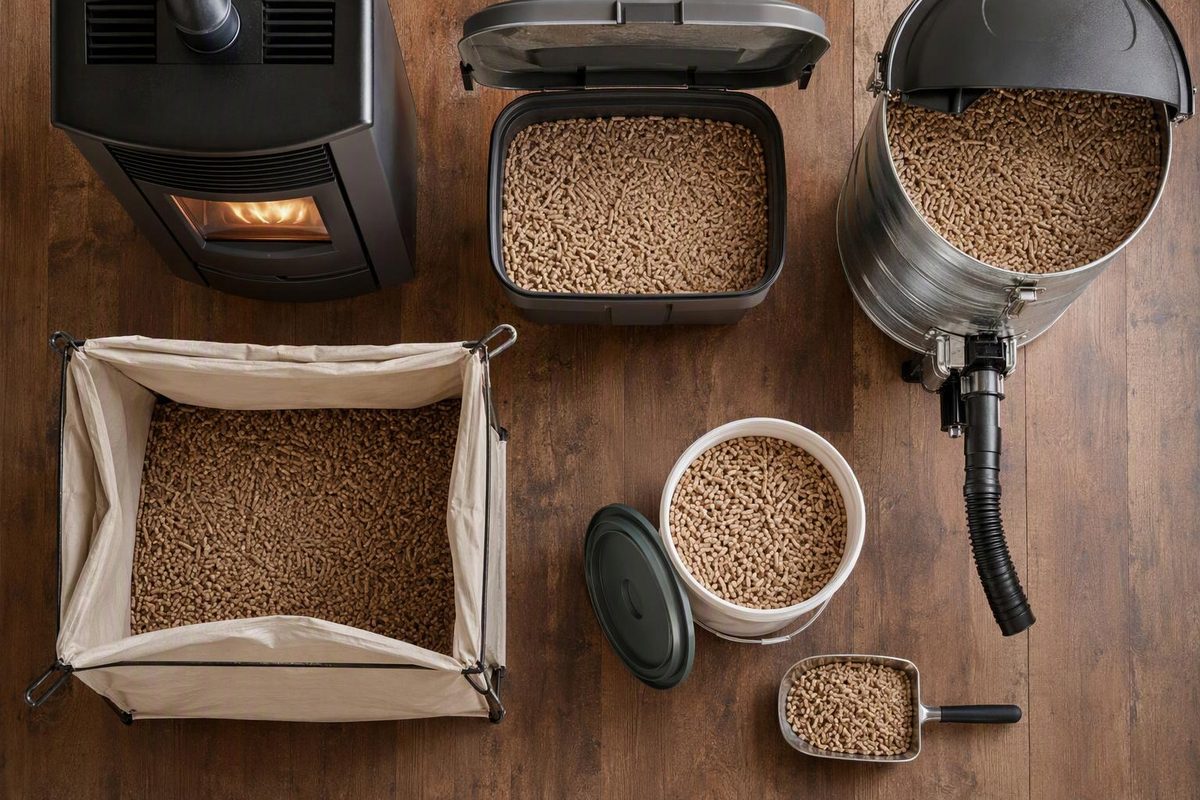
For bagged heating pellets, a pellet storage bin is usually a refill convenience—not a replacement for seasonal bag storage. Choose one if it makes scooping, carrying or containing an opened bag easier. For one 40-pound bag, a 10-gallon container is a reasonable size to investigate, but verify its usable capacity and load rating. Otherwise, keeping unopened bags dry and protected may be simpler.
A small refill container and a bulk pellet boiler silo are different purchases. The latter needs a designed delivery, ventilation and fuel-feed system, not just a bigger lid.
Enter the pellet weight you want to store; check the estimated fuel volume before allowing extra room for the lid and scoop.
Pellet Volume Estimate
Allow extra usable room for the lid and scoop. This is not a container load rating.
Source: bagged-pellet research; assumes ~40 lb per cubic foot. Actual density and usable bin capacity vary.
Choose Storage for the Way You Handle Fuel
| Your Task | Starting Point | Main Buying Check |
|---|---|---|
| Contain an opened bag | Small, dry, lidded container | Usable capacity and lifting weight |
| Keep several refills accessible | Stationary bin with a scoop | Filling height, load rating and lid access |
| Store a winter’s bagged supply | Original bags on protected pallets | Dry location, floor capacity and access |
| Receive loose bulk deliveries | Purpose-built storage | Installer and supplier approval |
You do not need to empty every bag into a bin. The Harman Absolute43-C owner’s manual, for example, says to leave pellets in their original sealed bags until ready to use to prevent moisture exposure.
For the larger delivery-space calculation, see how much space pellet stove fuel storage needs.
Size the Bin by Pellet Weight
A bin marketed for pellets may not hold your whole heating-fuel bag. Check its stated pellet capacity in pounds, rather than assuming a gallon rating or photograph proves the fit.
If only volume is listed, use this starting estimate: required volume in cubic feet = pellet weight in pounds ÷ assumed bulk density in pounds per cubic foot.
Using approximately 40 pounds per cubic foot, the density reported for pellets in a bagged-pellet research study, gives:
| Fuel Weight | Estimated Volume | U.S. Gallons |
|---|---|---|
| 40 lb | 1 cubic foot | 7.5 |
| 80 lb | 2 cubic feet | 15 |
| 120 lb | 3 cubic feet | 22.4 |
These estimates describe the pellets alone, before headroom. They are not guaranteed container capacities. Pellet density varies, and tapered walls, lid space and a scoop reduce usable room. A nominal 10-gallon container is therefore worth checking for one 40-pound bag, not an assured fit.
Size the bin around handling, too. Two bags mean 80 pounds of fuel plus the container. If you intend to lift and pour it, a smaller container may serve you better than one that holds several days’ supply.
For a stationary refill bin, check that you can reach the bottom with a scoop without leaning deeply inside. Wheels help only where the loaded bin can travel safely; check their load ratings and the route’s thresholds and stairs.
Choose a Dry, Accessible Refill Container
An everyday refill bin needs a securely closing lid, a smooth interior you can inspect and empty, and an opening wide enough to pour into without scattering pellets. Handles or wheels must be rated for the intended load. Leave enough space above the bin to open the lid and refill it.
Keep it in a cool, dry location, away from leaks and floor puddles. A lid does not make an ordinary indoor tote suitable for outdoor weather. For bagged outdoor storage, WoodPellets.com recommends elevated pallets, an intact protective shroud and a secured tarp with airflow at the base.
Inspect fuel before transferring it. Damp pellets can revert to sawdust and fail to flow properly through the feed system, as the Harman manual explains. A new bin cannot restore swollen, crumbling fuel.
Keep the bag label or record the brand and batch before decanting. That preserves useful information if you later need to identify a troublesome batch.
Keep Stored Pellets Outside Stove Clearances
A metal bin does not make the pellets inside noncombustible. Keep stored fuel outside your stove’s specified installation clearances and out of the space needed for cleaning and ash removal. Those requirements are explicit in the Absolute43-C manual; consult your own model’s documents rather than borrowing its distances.
Keep the fuel bin separate from the ash container. The same manual specifies a steel, noncombustible container with a tight-fitting lid, placed outside, for removed ashes. A decorative pellet bin is not automatically an appropriate ash container.
Bulk Storage Requires Ventilation and Controlled Access
Wood pellets can release carbon monoxide without burning. The UK Health and Safety Executive’s storage safety alert addresses toxic atmospheres and oxygen depletion in enclosed pellet stores. It warns against entering a store or putting your head into a bulk hopper, and calls for competent installation and controlled entry procedures.
Bagged fuel is not exempt from off-gassing. Research on fresh bagged pellets found CO emissions and recommends active ventilation and CO monitoring for spaces storing large quantities. Its sealed-drum experiments and warehouse measurements do not establish a universal safe household quantity.
For a boiler silo, have the installer address ventilation, monitoring, structural loading, delivery connections and maintenance access before ordering storage. If you plan to keep a large seasonal supply in an enclosed room—even in bags—have a qualified professional assess ventilation and CO monitoring rather than assuming the packaging eliminates the risk.