
Measure the winter’s pellet supply—not just the stove
Calculate bags, pallet space and seasonal fuel cost, then check moisture protection, floor loading and the route from delivery to your pellet stove.
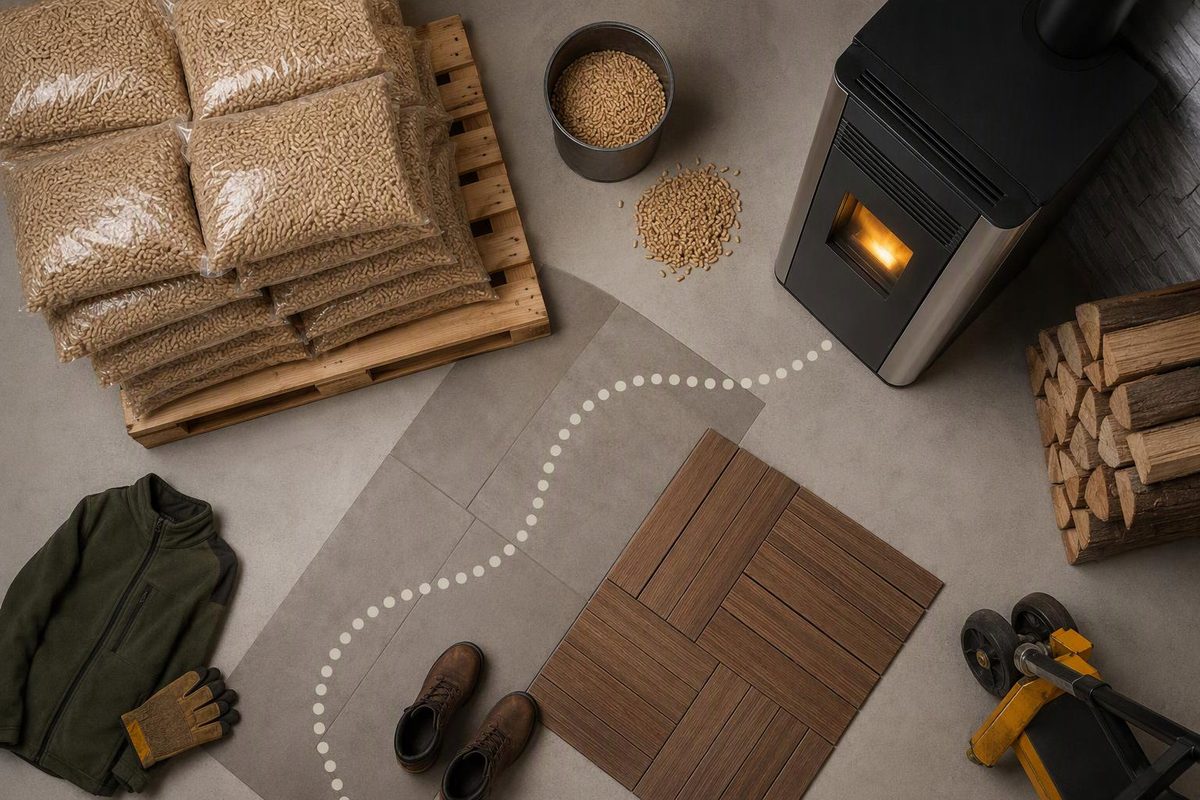
A U.S. short ton of pellets equals 50 bags when each bag weighs 40 pounds. For a full-ton pallet, a useful starting allowance is a footprint of 40 × 48 inches—about 13.3 square feet—plus access space. Confirm your supplier’s load dimensions before ordering; ATLAS lists that footprint for its 50-bag pallet. That is compact storage, but it puts 2,000 pounds of fuel in one spot.
Before buying a season’s supply for your pellet stove, check three things: how many bags you expect to burn, where they will stay dry, and how you will get them from delivery to the hopper.
Turn daily use into a storage target
For 40-pound bags, calculate:
Seasonal tons = average bags per day × heating days ÷ 50
These are planning scenarios, not consumption forecasts:
| Average use over 150 heating days | Bags needed | U.S. short tons | Fuel cost at an assumed $350/ton |
|---|---|---|---|
| Half a bag daily | 75 | 1.5 | $525 |
| One bag daily | 150 | 3 | $1,050 |
| One and a half bags daily | 225 | 4.5 | $1,575 |
The $350 figure is an illustrative assumption, not an October 2026 market quote. Substitute your local delivered price. These totals cover fuel only, excluding stove electricity, maintenance and installation.
If you already own a stove, use last winter’s bag count and note whether its heating role will change. For a first season, treat the calculation as a purchasing scenario and track actual use. A few cold days are not a reliable season-long average.
Also confirm the seller’s unit: a metric tonne is not the same as a 2,000-pound U.S. short ton, and not every pallet contains 50 bags.
Measure the packaged fuel, not loose-pellet volume
As checked on October 3, 2026, ATLAS Pellet Energy lists its LOGIK-Ê full-ton pallet as 50 forty-pound bags, measuring 40 × 48 × 44 inches. WoodPellets.com’s June 2016 storage guide describes its skids as 48 × 40 inches and about four feet tall. Those examples support a starting footprint, but ask your supplier for the dimensions of the actual load.
Using that footprint:
- One full-ton pallet: about 13.3 square feet of pallet space.
- Three tons on three separate pallets: about 40 square feet.
- Three pallets side by side: a nominal 10 × 4-foot block, before gaps or access space.
Do not mistake that block for the complete storage area. Leave room to remove bags, inspect the wrapping, open nearby doors and reach equipment. Check ceiling height, shelves and pipes too.
Hand-stacking can adapt the supply to an awkward space. WoodPellets.com gives an approximate bag size of 27 × 18 × 5 inches, while ATLAS lists 18 × 26 × 4 inches for its product. Bags flex, so measure several of the ones you intend to buy rather than designing a tight stack from a generic dimension.
Check weight, moisture and stove clearance
Weight: One ton over a 40 × 48-inch footprint averages about 150 pounds per square foot of fuel weight, excluding the pallet. That arithmetic is not a structural approval; the load also reaches the floor through the pallet’s supports. Do not assume a wood-framed floor, loft or shelving can carry it. If capacity is uncertain, have it assessed before delivery. Avoid solving a space problem with an unverified tall stack or by stacking loaded pallets.
Moisture: Keep bags in a dry location, off a potentially wet floor, and inspect for leaks or tears. Harman’s August 2026 Pathfinder owner’s manual says to leave pellets in their original sealed bags until use. It also warns that damp pellets can turn back into sawdust and fail to flow properly through the feed system. Pathfinder owner’s manual, fuel storage and moisture
Clearance: Do not use the space beside the stove simply because bags fit there. Follow your model’s fuel-storage rules and required combustible clearances, while preserving loading, ash-removal and maintenance access. The Pathfinder manual expressly prohibits fuel storage within its clearance areas or where it interferes with cleaning. Pathfinder owner’s manual
Outdoor storage needs more protection, not just unopened bags. WoodPellets.com advises inspecting and repairing the outer shroud, avoiding sprinkler spray and adding a securely fastened tarp that sheds water. A dry indoor location is the simpler option when available. Outdoor storage precautions
A purpose-built bulk pellet store for a boiler is a different system. Do not turn a sealed room into a loose-pellet bunker: the UK Health and Safety Executive warns that enclosed bulk stores can accumulate carbon monoxide and become oxygen-depleted. Its guidance calls for competent installation and ventilation, and warns against entering a store or putting your head into a hopper without specialist confined-space procedures. HSE bulk-storage safety alert
Choose an order size you can actually handle
Before ordering, ask the supplier where delivery ends, what access its equipment needs, and whether it can place pallets in your proposed storage location. Walk the remaining route carrying a representative bag if you can do so safely. Stairs, narrow doors and repeated lifting may matter more than the total square footage.
If three tons fit only by blocking access or relying on questionable outdoor protection, price smaller scheduled deliveries instead. Compare the all-in seasonal cost, including delivery charges and minimum orders, rather than the advertised ton price alone. Test an unfamiliar fuel before committing to a multi-ton purchase; Harman’s Pathfinder manual recommends trying brands first. Manufacturer fuel-purchasing guidance
Storage is one part of the ownership decision. Pair this space check with the pellet heater stove suitability checklist and a separate annual maintenance budget.