
Quadra-Fire E2 Not Dropping Pellets: What to Check
Troubleshoot a Mt. Vernon E2 no-feed problem using its LED signals, hopper switch, priming sequence, firepot floor and airflow checks.
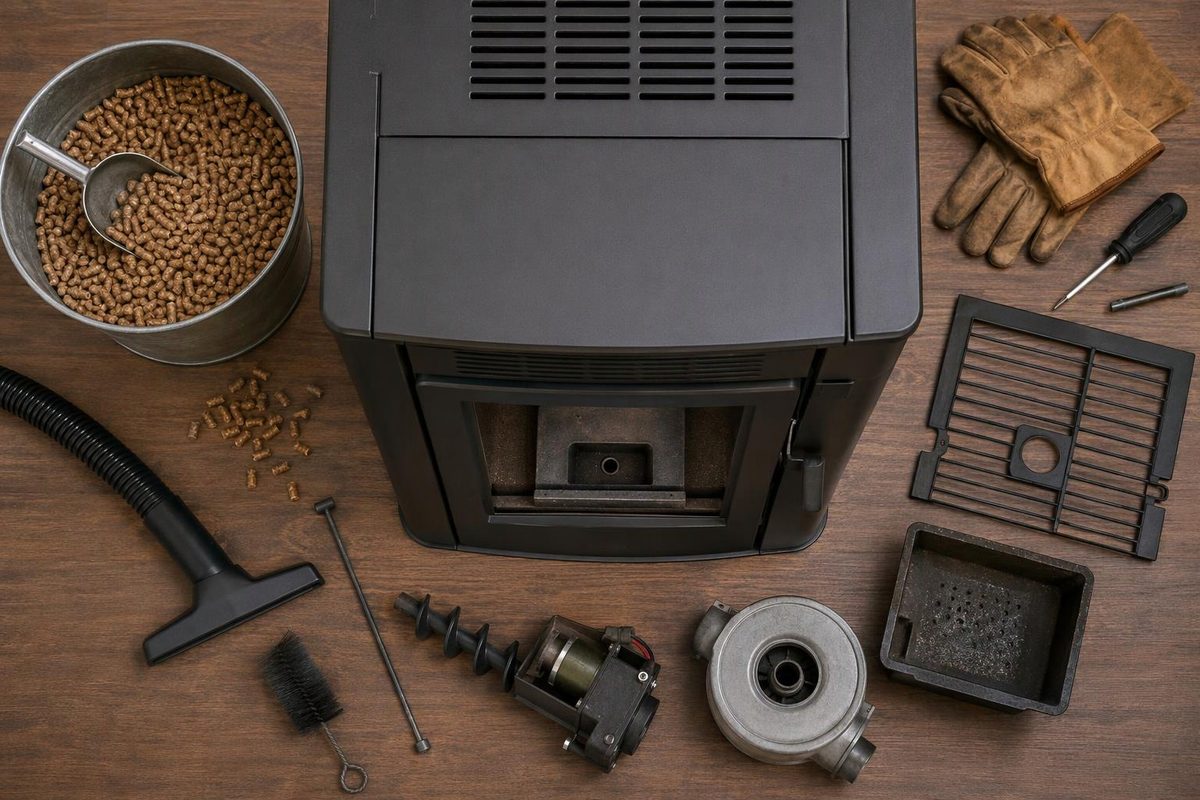
A Mt. Vernon E2 that is not dropping pellets does not automatically need a new auger motor. Its feed system depends on the hopper lid being closed, adequate firebox vacuum and closed safety circuits. An empty feed tube may need priming; a stove in shutdown deliberately stops feeding even while its fans run. Quadra-Fire’s E2 owner’s manual describes these separate conditions.
This guide follows the dial-controlled Mt. Vernon E2 stove manual, revision 7080-132N, and the E2 insert manual, revision 7082-132L. Match the model on your appliance label to its manual before using the controls below.
1. Read the light before resetting anything
Record the LED color and count flashes between pauses. On these E2 models:
| Signal | Meaning—and the useful next check |
|---|---|
| Green flash every two seconds | Standby. Check that the thermostat is requesting heat and the stove dial is not OFF. |
| Continuously blinking green | Startup/ignition or shutdown. The light alone does not prove the auger should be feeding. |
| Continuously blinking amber | Shutdown. Feeding stops while the blowers finish cooling the appliance. |
| Steady green during priming | The control is in its continuous-feed priming mode, for up to two minutes. Observe whether pellets actually arrive. |
| One red flash | “Empty Hopper” alarm. A full hopper does not rule out this alarm: a jam or interrupted feed circuit can also cause it. |
| Four red flashes | Missed ignition. If the firepot is empty, investigate fuel delivery; if pellets arrived but did not light, investigate ignition and cleaning instead. |
These meanings come from the manual’s LED chart and alarm troubleshooting table, pages 12 and 27. Two red flashes indicate an exhaust-probe fault, six an exhaust-blower/encoder fault, and eight exhaust over-temperature—not a simple instruction to add pellets. E2 LED and alarm guidance
Do not keep turning the dial OFF and back on to hurry startup. The E2 completes a shutdown sequence before restarting after that interruption. Its quick-start guide allows as long as ten minutes to establish a fire. During normal ignition, the feed motor first runs continuously for about a minute, then cycles on and off; a brief pause alone is not a no-feed fault. E2 startup and shutdown instructions
2. Check the lid, heat request and firepot floor
Start with the external checks:
- Make sure there are pellets in the hopper and close the hopper lid fully. The E2 will not feed with it open.
- Set the thermostat above room temperature—the quick-start guide specifies at least one degree—and select a heat setting other than OFF.
- Keep the firebox door closed and latched during operation.
Before cleaning or inspecting inside, turn the dial OFF, let the appliance cool completely and wait for the exhaust blower to stop. Then unplug it. Unplugging a hot stove can cause smoke spillage. E2 operating and shutdown instructions
With the stove cold, clean the firepot and confirm its movable floor is fully closed after using the ash-dump lever. Look for pellets in the ash pan as well as the firepot. The manual identifies weakened floor springs as a cause of fuel falling into the ash pan and ignition problems. If the floor will not close properly, have the dealer inspect it rather than repeatedly attempting ignition. Firepot-floor inspection, page 19
3. Prime only after initial setup or an empty hopper
If the stove ran out of pellets, refilling the hopper does not immediately refill the feed tube. Both cited E2 manuals give this quick-start priming sequence:
- With the appliance cold and unplugged, clear the firebox/firepot, close the firepot floor, add pellets and close the lid and door.
- Put the dial at OFF and plug in the appliance.
- Let the exhaust blower complete its approximately 45-second run and stop.
- Quickly move the dial OFF → HI → OFF → HI.
- The LED should turn solid green. Wait two minutes, watching through the closed door for pellets dropping, then select the desired heat setting. The control automatically enters startup after priming; do not leave it unattended during this check.
If the light never becomes solid green, the quick-start guide says to return the dial to OFF, unplug, reconnect and repeat. Follow the shutdown-and-cooling procedure above before disconnecting power. This retry is for an unrecognized priming command—not a reason to keep priming when pellets are already arriving. Priming during normal operation can overfill the firepot. If pellets accumulate without igniting, turn the dial OFF and let the stove shut down and cool before clearing the firepot or attempting another start. E2 quick-start and priming guidance, pages 7 and 12
4. If it still does not feed, check cleaning before buying parts
After a complete shutdown, cooling and unplugging, inspect the fuel and perform the owner maintenance in your manual. Damp pellets can clog the feed system; accumulated sawdust and fines can reduce delivery. The E2 manual calls for emptying and vacuuming the hopper and feed tube during hopper cleaning.
Do not stop at the burn pot. Clean the heat exchanger, behind the baffle, the drop tube and the exhaust path. The stove manual specifically emphasizes both exhaust exits at the back of the firebox floor. Restricted exhaust or heat-exchanger passages can prevent the vacuum safety switch from enabling the feed motor. E2 cleaning and vacuum-switch guidance
If pellets still do not drop, arrange service. Quadra-Fire reserves its troubleshooting table for qualified technicians. Ask for checks of the vacuum hose and port, hopper switch, safety snap discs, feed-motor connection and feed assembly for a jam. Do not bypass switches or repeatedly reset an unexplained safety trip. E2 service troubleshooting, pages 24–28
Give the technician the model and serial number, LED pattern, whether the hopper ran empty, whether priming produced solid green, and whether pellets reached the firepot or ash pan. Those observations are more useful than ordering an auger motor based only on an empty firepot.