
Is This Compact P-Series Stove the Right Fit for Your Home?
Reconcile exact-unit documents, size the stove against home heat loss, price the full installation, and confirm warranty and local service.
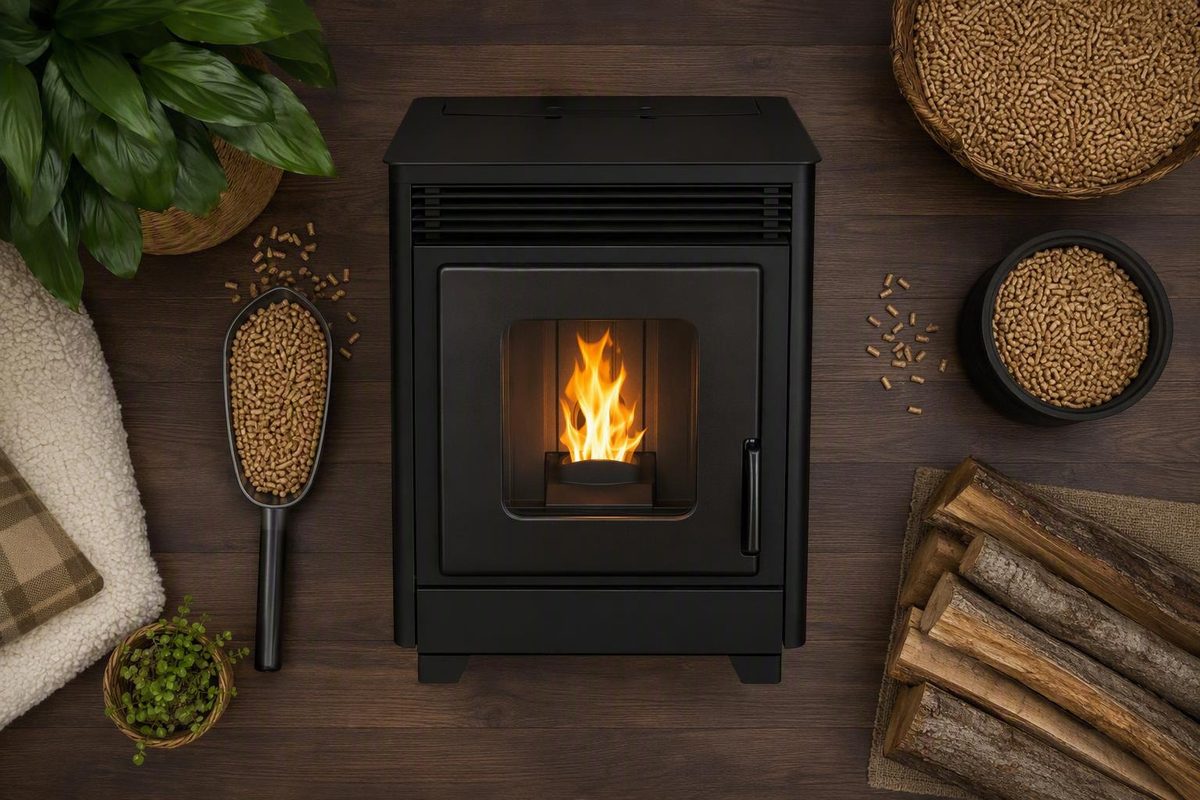
The Harman P43 pellet stove looks straightforward on a showroom floor: a compact cabinet, automatic ignition, thermostat control, and an advertised heating range broad enough to interest many homeowners. The buying decision is more complicated.
Third-party listings disagree about its BTU range, hopper capacity, heating coverage, efficiency, and emissions. The commonly displayed stove price does not represent a complete installation. Most importantly, a square-foot rating cannot establish whether the P43 will keep a particular home comfortable during severe winter weather.
The available evidence is also limited: the specifications examined for this guide come from retailers and dealer-support pages rather than verified, current Harman documentation for a specific serial range. The P43 should therefore be treated as a promising compact candidate—not a purchase to make from one specification badge.
Before ordering, reconcile the documentation for the exact unit, size it against the home’s heat loss, price the entire installation, and confirm the maintenance, electrical, venting, warranty, and local-service arrangements.
Harman P43 at a glance: what retailers consistently advertise
Retailers consistently present the P43 as a compact, freestanding stove in Harman’s P-Series. Some use P43, while others use P43-C. The available evidence does not establish the official meaning of the “-C” or whether it reflects certification, a production revision, a documentation convention, or another distinction.
Both names appear in connection with the repeated listing identifier 1-90-04400-1, but retailers do not consistently clarify whether they are presenting that value as a manufacturer model number, a retailer SKU, or both. The shared identifier also does not prove that every specification, accessory, and replacement part applies to all production runs.
The following planning figures appear together in a detailed Wood Heat P43 retailer listing:
| Item | What the retailer reports | Buying implication |
|---|---|---|
| Product type | Compact freestanding P-Series pellet stove | Suitable for initial comparison with other freestanding models |
| Listing identifier | 1-90-04400-1 | Record this with the serial number when requesting documents or parts |
| Cabinet width | Approximately 22 in. | Does not include required clearances or hearth area |
| Cabinet height | Approximately 33.5 in. | A hopper extension would increase overall height |
| Cabinet depth | Approximately 28-5/16 in. | Venting and service access increase the practical footprint |
| Listed unit weight | 213 lb. | Safe handling and floor suitability remain site-specific questions |
| Listed hopper capacity | 50 lb. | Another retailer guide reports 43 lb. |
| Listed flue outlet | 3-in. rear flue | Outlet size alone is insufficient to design the vent system |
| Controls | Automatic ignition and thermostat control | Operation depends on electricity and correct setup |
| Heat distribution | Standard blower | Expect operating sound and a need for room-air circulation |
Commonly advertised equipment includes:
- automatic ignition;
- thermostat-based control;
- a distribution blower;
- a large ash pan;
- an air-wash arrangement at the glass;
- flame-reactive mirrored glass; and
- an accordion-style heat exchanger.
Retailers also repeat claims that the controls regulate room temperature within one degree and that the air wash produces cleaner glass. These are marketing claims, not independent findings that every installation will achieve that stability or glass condition. Fuel, venting, placement, cleaning, heat loss, and room airflow can all influence actual operation.
Advertised options vary by seller. They include decorative trim or tile and inlay choices, a ceramic log, a hearth pad or heat shield, and a hopper extension. Do not assume that an option displayed on a sales page is compatible with every P43 or P43-C revision. Obtain the accessory part number and written confirmation that it applies to the model and serial number being purchased.
Evidence note: All technical data in this section comes from third-party retailer listings. Verify dimensions, weight, clearances, venting, electrical requirements, accessories, and replacement parts against the current owner, installation, and service documents for the exact stove and serial range.
Why the published P43 specifications do not all agree
The online specifications are inconsistent enough that copying one sales page into a comparison spreadsheet can create a false sense of precision. Several retailers may also be repeating the same underlying marketing feed, so agreement among listings does not necessarily represent independent verification.
The supplied evidence contains the following conflicts:
| Source or listing | BTU figure | Advertised coverage | Hopper | Efficiency | Emissions |
|---|---|---|---|---|---|
| Forge & Flame P43 | 23,900–45,200 BTU/hr, described as input | 800–2,400 sq. ft. | 50 lb. | 82.7% LHV; 76.7% HHV | 1.82 g/hr |
| Warming Trends P43 | 17,200–43,500 BTU/hr, described as heat output | Up to 2,400 sq. ft. | 50 lb. | Not stated | Not stated |
| Wood Heat P43 | Up to 43,500 BTU/hr, described as maximum input | Up to 2,400 sq. ft. | 50 lb. | 84% LHV; 77% HHV | 0.95 g/hr |
| Fireside P43-C | 17,200–43,500 BTU/hr, described as input | 800–2,400 sq. ft. | 50 lb. | 84% LHV; 77% HHV | 0.95 g/hr |
| Earth Sense retailer guide | Not stated | Up to 1,500 sq. ft. | 43 lb. | Not stated | Not stated |
The two broad BTU datasets are therefore 23,900–45,200 BTU/hr and 17,200–43,500 BTU/hr. The supplied evidence does not resolve whether the difference reflects fuel input versus delivered heat output, certification data, a product revision, or a listing error. The terminology itself is inconsistent: one retailer describes the lower range as output, while another calls the same range input.
The hopper discrepancy is smaller but still relevant. Most detailed listings report 50 pounds, while the Earth Sense guide reports 43 pounds and pairs that figure with coverage of up to 1,500 square feet. Averaging those figures would produce a number supported by no source. The correct response is to identify the documentation governing the actual unit.
Efficiency figures must retain their labels. Compare LHV with LHV and HHV with HHV; do not rank two stoves by comparing one convention with the other.
The emissions figures also conflict materially. One dataset reports 0.95 grams per hour, while another reports 1.82 grams per hour. The retailer pages do not establish that either dataset applies to every stove sold under the P43 name, and a sales-page certification icon is not a substitute for the applicable certification record.
Before relying on a quote, ask the seller to document:
- Exact designation: P43, P43-C, or another label.
- Listing or model identifier: including how the seller classifies 1-90-04400-1.
- Serial applicability: the serial range covered by the supplied documents.
- Manual revision: the document number and revision date.
- Certification record: the record applying to the quoted unit.
- BTU basis: whether a figure represents fuel input or delivered heat output.
- Efficiency convention: HHV or LHV.
- Included configuration: standard hopper, thermostat, trim, and other equipment.
- Accessory compatibility: the part numbers approved for that unit.
- Document source: whether each specification comes from a current manufacturer document or a retailer database.
This level of verification may feel excessive for a mature stove line, but it is necessary when competing sellers use different definitions and datasets.
Can the P43 heat your home? Size it by heat loss, not square footage
The most common advertised selection range is 800–2,400 square feet, although the supplied retailer guide also reports coverage of up to 1,500 square feet. These are screening ranges, not promises of comfort.
A square-foot figure does not reveal how quickly a building loses heat on a cold, windy night. Nor does it establish whether heat from a freestanding room appliance will reach bedrooms, bathrooms, or a second floor.
A credible sizing discussion should account for:
- local winter design temperature;
- insulation levels and air leakage;
- ceiling height and total heated volume;
- window quantity, size, condition, and exposure;
- the amount of exterior wall and roof area;
- open versus divided floor plans;
- stairways and other paths for warm-air movement;
- the proposed stove location;
- which rooms must remain at the target temperature;
- whether interior doors normally remain open or closed; and
- whether the P43 will supplement another system or carry the primary load.
Consider two homes with the same floor area.
Scenario A: compact, insulated, and open. The home is in a moderate climate, has reasonable insulation and air sealing, standard-height ceilings, and an open main level. The stove can be placed centrally, and the household accepts that distant bedrooms may remain cooler. In this setting, heat can move relatively freely, and the P43 may be a plausible candidate—subject to a heat-loss assessment and confirmation of the applicable output data.
Scenario B: older, draftier, and divided. The home has significant air leakage, more exterior exposure, older windows, tall ceilings, closed rooms, and severe winter cold. The only feasible stove location is at one end of the first floor. Even with the same floor area, both the required output and the distribution challenge may be much greater. An “up to” rating says little about bedroom temperatures or recovery after the house has cooled.
That does not automatically mean the correct answer is a larger stove. Selecting a larger appliance solely from square footage raises separate questions about low-output operation, comfort near the stove, control behavior, and pellet use. The evidence does not support a universal rule that a larger model will necessarily cycle, consume more fuel, or perform worse.
A P43-versus-P68 discussion offers useful anecdotal context but not a sizing rule. A self-described owner preferred the larger P68 for recovery and reserve capacity after using both stoves in the same older home. Other posters argued that heat loss, insulation, air sealing, and layout should govern selection, and they reported mixed experiences with larger stoves. The forum discussion contains no controlled heat-load calculation, standardized temperature record, or measured fuel-consumption comparison.
Before requesting a final quote:
- obtain or review a whole-home or room-by-room heat-loss estimate;
- identify the rooms that must remain at the target temperature;
- decide whether the existing central system will remain available;
- define whether the stove will be supplemental, primary, or emergency heat;
- discuss expected operation at local design-weather conditions;
- review how warm air will reach distant or closed rooms; and
- ask what reserve remains if calculated demand approaches the stove’s verified maximum output.
If a recommendation rests almost entirely on square footage, ask the seller to identify the assumptions behind it.
Price and total installed cost: look beyond the $4,449 listing
Market snapshot, reviewed August 22, 2026: multiple supplied retailer pages displayed a new P43 or P43-C at approximately $4,449. Depending on the seller, that number was presented as a starting price, MSRP, or listed product price. It is evidence of advertised stove pricing at the time of review—not a universal current price or an installed budget.
One retailer is explicit that its $4,449 starting price excludes delivery, installation, venting, finishing materials, accessories, and applicable taxes. It also warns that pricing and availability can change, according to the Forge & Flame product page. Other sellers may have similar exclusions without presenting them as clearly.
Use a worksheet that puts every dealer proposal on the same scope:
| Budget item | Your quote |
|---|---|
| Stove and standard factory equipment | $_____ |
| Vent pipe, adapters, supports, termination, and sealing materials | $_____ |
| Outside-air components, if required | $_____ |
| Hearth pad or site-built floor protection | $_____ |
| Installation labor | $_____ |
| Delivery, freight, and placement | $_____ |
| Receptacle or other electrical work | $_____ |
| Permit and inspection fees | $_____ |
| Thermostat or control accessories | $_____ |
| Hopper extension, trim, log, or other options | $_____ |
| Removal and disposal of existing equipment | $_____ |
| Taxes | $_____ |
| Complete installed total | $_____ |
Also record exclusions that can become expensive later: wall repair, painting, chimney work, roof work, floor reinforcement, technician travel, initial fuel, commissioning, owner orientation, and post-install inspection.
The supplied market evidence also included a store-display P43 advertised at $3,799, compared with the common $4,449 new-unit listing—an apparent difference of $650 before installation and other costs. The listing described it as a store-display demo with free shipping in the contiguous United States and a 45-day retailer warranty. Those terms were observed on the Pellethead display-demo listing and should be rechecked because price, inventory, shipping, and warranty terms can change.
The demo is not necessarily better or worse value. Ask about:
- cosmetic wear;
- whether it was ever fired;
- operating hours, if known;
- missing packaging, manuals, or accessories;
- return or transit damage;
- inspection before dispatch;
- shipping responsibility if it arrives damaged;
- return rights;
- replacement-part availability; and
- exactly who provides warranty coverage.
A 45-day retailer warranty should not be treated as equivalent to a manufacturer warranty unless the written terms expressly establish that equivalence.
Installed cost is particularly sensitive to:
- location-dependent product availability;
- the dealer’s delivery and service radius;
- freight and difficult placement;
- wall venting versus use of an existing chimney;
- total vent length, routing, rise, and required components;
- hearth construction;
- outside-air provisions;
- local permit practices;
- labor rates; and
- decorative or capacity accessories.
Compare written proposals, not product-page prices. Each proposal should use the same vent route, hearth scope, accessories, permit assumptions, delivery terms, warranty treatment, and commissioning work.
Installation planning: footprint, venting, power, and service access
Retailer-listed planning dimensions are approximately 22 inches wide, 33.5 inches high, and 28-5/16 inches deep, with a listed unit weight of 213 pounds. Detailed listings also report a 3-inch rear flue. These are retailer specifications and must be matched to the exact unit documentation before installation; one consolidated example appears in the Wood Heat listing.
Cabinet dimensions are not the complete installed footprint. The actual space must accommodate:
- the applicable clearance envelope;
- required floor or hearth protection;
- the vent connection and any required rise;
- access for loading fuel;
- ash-pan removal;
- door movement;
- panel removal;
- cleaning tools; and
- technician access to internal components and venting.
A location that can physically hold a 22-inch-wide cabinet may therefore remain unsuitable.
Retailer references to a 3-inch rear outlet and direct-vent capability do not constitute an installation design.
The applicable installation manual must govern:
- clearances to combustible materials;
- hearth-protection dimensions and construction;
- approved vent components and adapters;
- vent diameter, rise, routing, and termination;
- outside-combustion-air requirements;
- electrical supply;
- special-location provisions, where relevant;
- local permit and inspection requirements; and
- restrictions involving doors, windows, grade, decks, or air intakes.
A dealer resource links documents labeled as a shared P-Series owner manual and installation manual, along with a P43-C service-parts catalog. The Higgins P-Series document page confirms those labels, but the supplied evidence does not verify the documents’ contents or establish that they cover every serial range. Have the dealer provide the applicable document numbers and revision dates in writing.
Walk the proposed location with these practical questions:
- Is the floor suitable for the appliance and completed hearth assembly?
- Is there a compliant and serviceable vent path?
- How will combustion-air requirements be addressed?
- Is appropriate electrical service nearby?
- Can warm room air circulate toward the spaces that matter?
- Can pellets be loaded without interference from shelves or trim?
- Can the ash pan be removed without spilling into a narrow passage?
- Can side and rear panels be reached for service?
- Can vent sections be inspected and cleaned?
- Would a hopper extension interfere with the ceiling, shelving, or loading access?
- Can pellets be stored dry and moved to the stove conveniently?
The supplied evidence does not establish startup wattage, running consumption, surge demand, or an approved backup runtime. Do not size a battery, inverter, or generator from generic pellet-stove assumptions. Obtain the exact electrical requirements and applicable backup-power guidance for the stove being purchased.
Installation is where a compact stove can become an expensive project. Confirm site feasibility before treating the product price as a commitment.
Daily use, hopper runtime, controls, and likely ownership routine
The documented operating concept is familiar: pellets are loaded into a hopper, thermostat-based controls call for heat, and the stove manages ignition, fuel feeding, and blower operation within its available range. A dealer resource identifies an analog control panel as common to the P43, P61, and P68, but buyers should still confirm the controls fitted to the actual unit.
Most detailed listings describe a nominal 50-pound hopper, although another guide reports 43 pounds.
There is one transparent arithmetic boundary for runtime. A detailed listing reports a maximum feed rate of 4.7 lb./hr. Using the commonly listed 50-pound nominal capacity:
50 lb. ÷ 4.7 lb./hr. ≈ 10.6 hours
This is not a promised burn time. It is an arithmetic estimate at the stated maximum feed rate using the nominal 50-pound capacity. Actual refill intervals depend on heat demand, control behavior, pellet characteristics, maintenance condition, and usable hopper volume.
Hopper extensions appear in retailer listings. Before adding one, weigh longer potential refill intervals against:
- increased overall height;
- accessory and installation cost;
- visual bulk;
- a higher lifting and pouring position;
- possible conflict with shelves or trim; and
- documented compatibility with the stove’s model and serial range.
Daily experience also includes sound. A pellet stove contains a distribution blower and fuel-feed mechanism, and pellets move through the system during operation. No standardized P43 sound measurement appears in the supplied evidence. In the P43-versus-P68 forum discussion, one poster reported that the P43’s feed motor seemed quieter than the P68’s while pellet and blower noise appeared similar. That is an individual observation, not a typical-performance specification.
If possible, hear an operating unit before buying. Listen during ignition, steady low operation, a call for more heat, fuel feeding, and shutdown. Showroom background noise can conceal sounds that become noticeable in a quiet living room.
Dealer support pages list P-Series videos covering maintenance, controls, operation, and reasons for maintenance. The supplied captures show the video topics, not their substantive instructions. Use those materials as supplements to the applicable manual, not as proof that every P43 revision has identical controls or procedures.
A realistic ownership routine includes:
- monitoring the pellet supply;
- keeping fuel dry;
- observing startup and flame behavior;
- emptying ash and cleaning owner-serviceable areas as directed;
- checking that owner-accessible doors and covers are properly closed;
- keeping the required area around the appliance clear; and
- arranging deeper periodic service.
Automatic operation does not mean attention-free ownership.
Cleaning, maintenance, manuals, and service support
Third-party dealer resources provide P-Series cleaning videos and links labeled as a P43 owner manual, installation manual, brochure, and service-parts catalog. Another retailer support page lists P-Series videos covering maintenance, controls, operation, and why maintenance is necessary. These materials are useful starting points, but the applicable manual revision must govern the work performed on a particular stove.
Build the ownership checklist around the areas repeatedly identified in the support and troubleshooting evidence:
- Burn pot and combustion openings: Inspect and clean only the owner-serviceable areas identified in the applicable manual.
- Igniter area or cavity: Ash around the ignition path is one possible category to consider when startup becomes unreliable.
- Ash pan and internal ash paths: Empty and clean them using the specified procedures.
- Pellet-fines area: Accumulated fines or an improperly seated owner-accessible cover may affect operation.
- Doors, covers, and seals: Confirm that accessible covers are correctly installed and inspect visible seals for damage.
- Heat-exchange areas: Clean designated surfaces using the specified method and tools.
- Venting: Arrange inspection and cleaning according to the applicable instructions and when performance suggests a restriction.
- General condition: Watch for damaged components, abnormal sounds, soot, repeated failed starts, or changes in flame behavior.
Do not substitute a universal online calendar for the stove’s manual. The supplied evidence does not establish official P43 cleaning intervals.
Cleanliness can be relevant because automatic ignition and pellet combustion depend on controlled fuel delivery and airflow. Ash near the ignition area, restricted passages, accumulated fines, or poor sealing may interfere with that process. Dirt is not the only possible cause, however. Igniters, sensors, switches, wiring, motors, and controls can also fail, so repeated cleaning should not replace qualified diagnosis.
Before purchase, ask:
- Who performs annual or deeper service locally?
- Is that provider trained or authorized for the product?
- What is the current service-call charge?
- Are travel and mileage billed separately?
- How far will the technician travel during winter?
- Are parts stocked for the exact revision?
- What are typical lead times for igniters, sensors, motors, boards, gaskets, and glass?
- Which tasks are owner maintenance?
- Which tasks require a technician?
- Does warranty service include labor and travel?
- What maintenance records must the owner retain?
Descriptions of the P43 as “low maintenance” are promotional comparisons, not an elimination of work. Pellet heat still involves fuel handling, recurring cleaning, inspection, ash disposal, and eventual service or parts replacement. Buyers comfortable with that routine are better candidates than those expecting furnace-like invisibility.
Common concerns, safe troubleshooting boundaries, and the buying decision
Missed ignition illustrates why exact-model instructions matter. A commercial parts guide says a Harman five-blink condition generally means the exhaust sensing probe did not detect the expected temperature following an attempted startup. It discusses cleaning, seals, airflow, igniter operation, switches, wiring, and controls as possible diagnostic areas. This is general Harman guidance from a parts seller, not verified P43 instructions or proof of a particular failed component; consult the applicable manual and use a qualified technician. See the Harman igniter troubleshooting guide.
Because the exact P43 owner and service instructions have not been verified here, this guide does not provide a model-specific shutdown, restart, disassembly, or electrical-testing procedure. Use these conservative boundaries instead:
- Stop using the appliance if conditions appear unsafe. Seek qualified help rather than attempting repeated starts.
- Consult the manual applicable to the exact model and serial range. Confirm the indicated fault and the prescribed response.
- Follow the documented shutdown and cooldown process. Do not begin cleaning or inspection while the appliance may be hot or operating.
- Limit checks to owner-serviceable areas expressly identified by the manual.
- Do not repeatedly force startup when the same fault returns.
- Contact a qualified technician when the fault persists or the instructions are unclear.
Possible diagnostic categories discussed in the supplied evidence include restricted airflow, ash near the igniter, a poorly seated cover, failed seals, igniter trouble, an exhaust-sensing-probe issue, switches, wiring, or control components. A forum case involving feeding and ignition trouble raised several of these possibilities but ended without a confirmed diagnosis. It should not be used as a repair procedure.
Do not bypass safety switches, perform energized electrical testing without appropriate qualifications and exact service instructions, touch components that may be hot, or disassemble electrical systems based on forum advice. A fault code can narrow an investigation; it does not guarantee which part has failed.
Final fit scorecard
The P43 may be a stronger fit when:
- you want compact, thermostatically controlled pellet heat;
- a heat-loss assessment supports its documented capacity;
- the proposed location allows a compliant installation;
- heat can circulate to the rooms that matter;
- you have dry pellet storage and can manage fuel loading;
- reliable electricity is available;
- any outage strategy has been verified for the exact stove;
- you are willing to perform recurring cleaning; and
- qualified local parts and service support are available.
It may be a weaker fit when:
- whole-home demand is unknown or exceeds a verified capacity match;
- you expect a square-foot badge to guarantee distant-room temperatures;
- you require silent heat;
- you expect maintenance-free operation;
- venting, hearth work, or service access is difficult;
- outages are common and no verified power strategy exists;
- dry fuel storage or pellet handling is impractical; or
- local service and revision-correct parts are difficult to obtain.
Before paying a deposit, get these five items in writing:
- Exact model and serial applicability for the stove, manuals, and accessories.
- Authoritative specifications, including BTU basis, HHV and LHV efficiency, emissions, hopper capacity, dimensions, electrical requirements, and applicable document revisions.
- Complete installed scope and price, including delivery, venting, hearth work, outside air, electrical work, permits, accessories, taxes, and removal.
- Warranty terms, clearly separating manufacturer, dealer, labor, travel, display-unit, and wear-item coverage.
- Service and parts support, including who responds, geographic coverage, expected charges, and revision-specific parts availability.
Treat the P43 as a compact candidate, not a decision that can be made from its stove-only price or advertised coverage. The next step is to obtain the exact unit’s current documentation, review a heat-loss calculation, and compare local quotes using an identical installed scope. Buy only when capacity, placement, maintenance, power strategy, warranty, service support, and total cost all fit the household.
Frequently asked questions
How much does a Harman P43 pellet stove cost?
Multiple retailer pages reviewed on August 22, 2026, displayed a new P43 or P43-C at approximately $4,449, generally as a starting, MSRP, or product price rather than a complete installed total. Delivery, venting, labor, hearth protection, electrical work, permits, accessories, taxes, and removal can increase the budget.
A store-display demo was advertised at $3,799, an apparent $650 reduction before other costs, with free shipping in the contiguous United States and a 45-day retailer warranty. Those volatile terms came from the display-demo listing and should be rechecked. Request a complete installed quote rather than budgeting from a stove page.
How many square feet can the Harman P43 heat?
Most supplied retailer listings advertise 800–2,400 square feet or “up to 2,400 square feet,” while another retailer guide reports up to 1,500 square feet. The conflict is visible in the Fireside P43-C listing and the Earth Sense guide cited in the discrepancy table.
Those figures are selection guides, not guarantees. Actual suitability depends on climate, insulation, leakage, ceiling height, windows, layout, airflow, placement, and whether the P43 is supplemental or primary heat. Use a heat-loss assessment before selecting the model.
How long will the P43’s pellet hopper run?
Using the commonly listed 50-pound hopper and maximum feed rate of 4.7 pounds per hour, the arithmetic estimate is approximately 10.6 hours at that stated maximum rate. Those figures appear in the Wood Heat P43 listing.
Lower firing rates can extend runtime, but the evidence does not support a promised low- or medium-setting duration. Pellet characteristics, heat demand, control behavior, maintenance condition, and usable hopper capacity all matter.
What is the difference between the Harman P43 and P43-C?
The supplied evidence does not establish an official difference. Retailers use both names, and listings for each associate the stove with identifier 1-90-04400-1. A dealer resource also labels its parts catalog “P43-C” while presenting shared P-Series owner and installation manuals on its P43 document page.
Do not assume the labels are interchangeable for parts, certification data, accessories, or every production year. Ask the dealer to match the exact model, serial range, manual revision, certification record, and service-parts catalog.
What should I do if a Harman P43 will not ignite or shows five blinks?
Stop using the stove if conditions appear unsafe, consult the manual for the exact model and serial range, and follow its shutdown and cooldown instructions. Inspect or clean only the owner-serviceable areas that the applicable manual identifies. If the fault returns, contact a qualified technician.
A third-party commercial guide associates five blinks on Harman stoves with the exhaust sensing probe not detecting the expected startup temperature. That describes a detected condition, not necessarily the failed component. Possible diagnostic categories include restricted airflow, ash near the igniter, poor seals, a displaced cover, igniter trouble, sensing issues, switches, wiring, or controls. The general Harman troubleshooting guide is not a substitute for the exact P43 manual or qualified service.