
Is This High-Output P-Series Stove a Good Fit for Your Home?
Evidence note: This guide compares dealer-reported information checked on August 24, 2026. A current first-party Harman product record, exact-model warranty, and independently reviewed certification record were not available in the supplied evidence. Treat the specifications below as a retailer-claim comparison until the rating plate and matching Harman documents for the actual stove are confirmed.
The short answer: who should consider the P61?
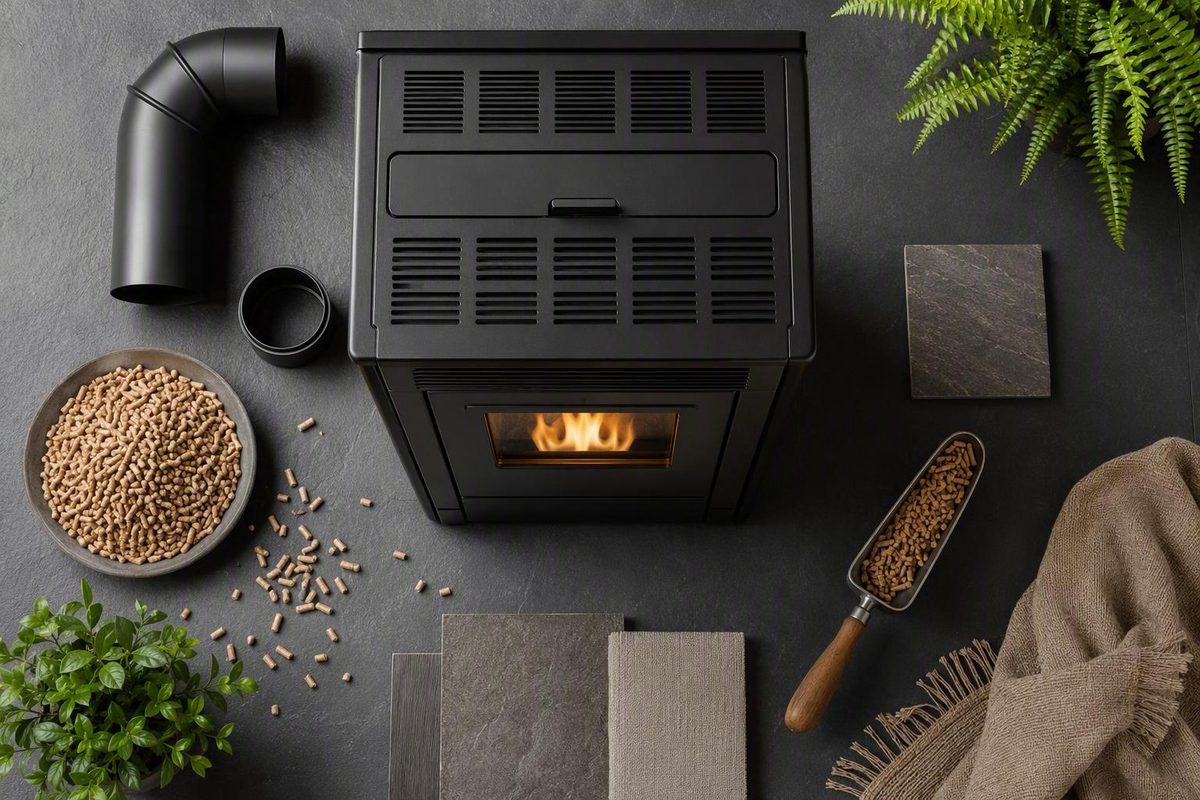
The Harman P61 pellet stove is a freestanding space heater positioned by retailers toward the higher-output end of Harman’s P-Series. Its recurring dealer-reported profile includes a 21,400–60,700 BTU/hr input range, 72-pound hopper, automatic ignition, room-temperature regulation, combustion and distribution blowers, air-wash glass, and a large ash pan. These are useful comparison points, but they are manufacturer-attributed figures repeated by retailers rather than independent measurements in a particular home.
The P61 is most relevant if you want thermostatically regulated heat from a central room and are comfortable with pellet-stove ownership: storing bagged fuel in a dry place, loading the hopper, cleaning the appliance, maintaining electrical power, arranging compliant venting, and hiring qualified installation and service help. A broader review of pellet-stove ownership trade-offs can help determine whether this type of heater suits your routine before you compare individual models.
It is less suitable if you want heat without electricity, cannot store pellets conveniently, do not want recurring burn-pot and ash work, or expect a centrally located space heater to distribute heat like a ducted furnace.
Advertised heating-area figures should not decide the purchase. Retailer pages variously claim up to 2,500 square feet, 1,300–3,500 square feet, and up to 3,900 square feet. Those conflicting sales figures cannot establish whether the stove will heat a specific house or maintain an even temperature in every room.
Short verdict: Continue considering the P61 if all five factors align:
- A heat-loss assessment shows that its usable capacity fits the home.
- The floor plan permits acceptable room-to-room heat movement.
- The proposed location permits a compliant hearth and vent installation.
- Qualified service and revision-correct parts are accessible.
- The complete installed project cost fits the budget.
Do not choose it solely because a seller’s square-foot range includes your home or because its maximum input exceeds the nominal rating of your existing heater.
P61 specifications, with conflicts clearly labeled
The table below summarizes retailer-reported information. It is not a substitute for the rating plate or the owner, installation, and service documents that apply to the exact appliance.
| Specification | Most consistently reported figure | Conflicting figure, if any | Interpretation |
|---|---|---|---|
| Heat input | 21,400–60,700 BTU/hr | Warming Trends lists a 67,600 BTU maximum | The recurring range appears on several dealer pages. The higher maximum is an isolated retailer claim. Input is fuel energy supplied, not guaranteed room output. |
| Advertised heating area | 1,300–3,500 sq. ft. appears repeatedly | Up to 2,500 or 3,900 sq. ft. | Broad sales guidance only; calculate heat loss and evaluate distribution. |
| Hopper | 72 lb. | Usable capacity can vary with pellet shape and density | A larger hopper can reduce loading frequency, but it does not establish typical runtime. |
| Maximum feed rate | 6.6 lb./hr. | Older revisions may differ | Useful for maximum-consumption arithmetic only. |
| Dimensions | About 23.5 in. W × 36.5 in. H × 29.375 in. D | Depth is sometimes rounded to 29.4 or 29⅜ in. | Confirm whether the stated depth includes the appliance’s full projection onto the hearth. |
| Unit weight | About 247 lb. | Another listing reports 250 lb. | Delivery, floor protection, support, and safe handling need advance planning. |
| Efficiency | 79% HHV; 85%–86% LHV | LHV differs by one percentage point | HHV and LHV use different fuel-energy conventions and should not be compared as competing results. |
| Emissions | 1.5 g/hr | None in the supplied dealer pages | Retailer-reported and manufacturer-attributed, not independently verified here. |
| Flue connection | 3-in. rear flue | Installation requirements may vary by revision and route | Outlet size alone does not determine the pipe diameter or design of the full vent system. |
| Controls | Thermostat or room-temperature control | Exact controls may vary by revision | One detailed listing says a remote is not included. |
| Blower | Standard | — | The appliance relies on electrically powered combustion and heat-distribution equipment. |
| Construction | Steel-and-cast-iron firebox; cast-iron burn pot | — | Reported by detailed retailer listings. |
| Model name | Current pages use P61 and P61A | Older material refers to P61-2 and P61-C | Verify the rating plate, serial number, SKU, and matching documents before installing or ordering parts. |
Wood Heat groups the 60,700-BTU maximum, 72-pound hopper, 6.6-pound-per-hour maximum feed rate, 247-pound weight, dimensions, efficiencies, emissions, 3-inch rear flue, standard blower, thermostat control, and lack of an included remote in one detailed P61 retailer specification listing. Warming Trends separately lists the isolated 67,600-BTU maximum and 3,900-square-foot claim on its P61 sales page.
Input BTU is not delivered heat
Dealers repeatedly publish 21,400–60,700 BTU/hr as an input range. One dealer explains that the figure is based on feed rate multiplied by an assumed average pellet energy content. The same page reports 79% HHV efficiency, 85% LHV efficiency, and 1.5 g/hr emissions, while warning that fuel and installation conditions affect results; those figures are summarized in the dealer’s specifications and explanatory footnotes.
Input describes energy entering the appliance in its fuel. It does not mean that the maximum input reaches the room as useful heat. Some energy leaves through the exhaust or is otherwise unavailable. Multiplying maximum input by a listed efficiency can produce a comparison estimate, but it should not be presented as guaranteed output from a real installation.
A stove can therefore carry a 79% HHV figure and an 85% or 86% LHV figure without those numbers contradicting one another. Compare appliances using the same convention.
Physical size and handling
Dealer pages converge at roughly 23.5 inches wide, 36.5 inches high, and 29.375 inches deep, with a listed weight of approximately 247–250 pounds. Embers Living reports the same dimensions and a 250-pound weight on its P61 listing.
Appliance depth includes the entire unit, including the firebox depth and extension onto the hearth Harman Stoves P61 Pellet Stove. Hearth protection, combustible clearances, the rear connector, loading room, door movement, and service access can require substantially more space.
At 247–250 pounds—roughly one-eighth of a US short ton—the stove should not be handled like ordinary furniture. Delivery planning should account for stairs, narrow doors, finished floors, tipping hazards, lifting equipment, and final placement. The installer must determine whether the proposed support and hearth arrangement meet the requirements for the identified model.
Model-name uncertainty matters
Current seller pages are inconsistent about whether the product should be called P61 or P61A. One page is titled “P61” while its URL refers to P61A. A service resource links a parts file named P61-C, and an archived manual covers the P61-2.
Do not assume those labels describe interchangeable appliances.
Before relying on a specification:
- Photograph the complete rating plate.
- Record the full model designation and serial number.
- Confirm the SKU where available.
- Obtain matching owner, installation, and service-parts documents.
- Confirm that every shared P-Series document expressly covers the unit.
- Order parts by verified model and serial applicability—not by “P61” alone.
Will it heat your house? Why square footage is not enough
The advertised coverage figures conflict. Earth Sense says up to 2,500 square feet in its Harman pellet-stove guide. Several dealer pages state 1,300–3,500 square feet, while Warming Trends claims up to 3,900 square feet.
The middle range appears most often, but repetition does not turn a sales range into a heat-load calculation. Forge & Flame expressly says that suitability varies with climate, home efficiency, heater location, and air movement in its P61 product notes.
A pellet stove heats from one location. Nominal capacity can look adequate while poor distribution prevents satisfactory whole-home heating.
Home-suitability checklist
Evaluate each of these factors before treating the P61 as a primary heater:
- Local design temperature: How cold is the outdoor condition at which the heating system must carry the building load?
- Insulation: What are the actual insulation levels in the attic, walls, basement, and rim joists?
- Air leakage: Are there significant drafts around doors, windows, penetrations, or framing transitions?
- Ceiling height: High or vaulted rooms add volume and can hold warm air above the occupied zone.
- Window area and condition: Large amounts of glazing and older windows can increase heat loss.
- Floor plan: Open, connected rooms generally allow easier circulation than corridors and closed rooms.
- Stove location: A central first-floor location may perform very differently from a basement or end room.
- Stair placement: An open stair near the stove may help heat move upstairs; a distant enclosed stair may not.
- Circulation paths: Doorways and appropriately placed fans can help, but they should not be assumed to solve every layout.
- Existing heating zones: Decide which rooms can retain supplemental furnace, boiler, or electric heat.
A professional heat-loss assessment is more useful than matching floor area to a retailer’s range.
Do not compare the P61’s fuel-input rating directly with the nominal output of an old oil furnace, propane heater, or wood stove. The ratings may use different methods, and the older system’s condition, fuel input, cycling, chimney losses, or duct losses may be unknown.
What owner reports can—and cannot—tell you
In a discussion about a 1,600-square-foot, two-level house, one participant thought a P61 might be adequate under favorable conditions because an existing wood stove reportedly heated the home. Another P61 owner described a divided 1,600-square-foot house where a basement installation left distant bedrooms cold during colder weather. The owner attributed the result partly to the divided layout, stair location, and poor insulation. These P61-versus-P68 owner reports are anecdotes, not controlled testing.
The point is not that the P61 will—or will not—heat 1,600 square feet. It is that two houses with identical floor area can have very different heat losses and circulation problems.
Decide what job the stove must perform
The intended role changes the sizing decision:
- Primary space heater: The stove must carry most of the building load, making remote rooms and weak circulation paths critical.
- Supplement to oil or propane: It can heat the open, occupied portion of the house while the central system protects distant rooms and covers peak cold.
- Localized heat: If the goal is comfort in the main living area rather than uniform whole-home temperature, minimum-output comfort may matter more than maximum capacity.
P61 versus a larger model
Do not assume that a larger stove is automatically the safer choice. Compare:
- Calculated design heat loss.
- Desired reserve for unusually cold conditions.
- Minimum-output comfort in the stove room.
- Room-to-room heat movement.
- Appliance and installation cost.
- Local service availability.
- Age, revision, and condition—especially for used equipment.
A larger unit may provide useful reserve, but extra capacity cannot correct a divided layout. The appropriate model is the one that fits both the heating load and the distribution problem.
Price and total installed-cost worksheet
Retailer prices checked on August 24, 2026, varied by seller. Several pages listed or started the P61 at $5,179, while Embers Living listed $5,642 plus $350 fixed shipping. These are advertised appliance prices, not an established installed-cost range.
Forge & Flame describes its $5,179 figure as a product-only starting estimate that excludes delivery, installation, venting, finishing materials, accessories, and applicable taxes. Prices, availability, and project costs can change by date and location.
Because the available evidence does not establish a dependable regional installed-cost range, compare scope-complete written quotes instead.
Installed-cost worksheet
| Line item | Dealer quote | Second quote | Questions to resolve |
|---|---|---|---|
| Appliance and exact SKU | Are both dealers quoting the same revision and finish? | ||
| Freight or local delivery | Are lift-gate service, stairs, threshold delivery, and final placement included? | ||
| Vent components | Which pipe type, diameter, supports, cleanouts, flashing, and termination are included? | ||
| Installation labor | Does labor include assembly, setup, testing, and owner orientation? | ||
| Hearth protection | Is a listed pad included, or is a site-built hearth required? | ||
| Outside-air components | Are they required by the applicable manual or local authority? | ||
| Electrical work | Is a suitable grounded supply available at the required location? | ||
| Permits and inspection | Who applies, pays, and schedules inspection? | ||
| Wall, ceiling, or roof finishing | Who repairs penetrations and finishes visible surfaces? | ||
| Accessories | Which trim, tile, log, extension, sensor, or protective items are included? | ||
| Taxes | Which taxes apply? | ||
| Old-appliance removal | Does removal include disposal and related repairs? | ||
| Startup and testing | What operational or draft checks will the installer perform? | ||
| Warranty service | Who responds if the stove fails after installation? | ||
| Total project price | Is anything required for operation excluded? |
Standard equipment versus options
Dealer listings commonly describe automatic ignition, thermostat-based control, a room sensor, blowers, air-wash glass, a large ash pan, and the 72-pound hopper as standard. One detailed listing says a remote is not included.
Wood Heat displayed these optional prices when checked on August 24, 2026:
- Air-grille trim: $179
- Modern or leaf trim: $369
- Listed decorative tiles: $110–$120
- Ceramic log: $140
- A 22.6-inch hopper extension: $399
Those appliance and option prices appear on the retailer’s P61 product page and should be rechecked when requesting a quote.
Some sellers also show hearth pads as options. Do not assume that any decorative pad automatically meets the floor-protection requirements for the exact appliance and installation.
Normalize every quote before comparing totals. A lower stove price can be offset by freight, a longer vent, electrical work, permit handling, finishing exclusions, or future service travel. Confirm who will perform warranty service, the boundaries of the service territory, and whether installation by another contractor affects support.
Do not budget a tax incentive merely because a retailer links a biomass certificate. A certificate alone does not establish that a particular buyer, purchase, or installation qualifies. Verify current eligibility with the relevant government authority or a qualified tax professional before including an incentive in the budget.
Features, controls, fuel capacity, and everyday operation
Dealer descriptions indicate a conventional analog P-Series operating arrangement rather than a remote-first interface. Reported equipment includes:
- Automatic ignition
- Analog P-Series controls
- Room-sensor or thermostat regulation
- An electrically powered pellet-feed auger
- Combustion and distribution blowers
- A cast-iron burn pot
- No included remote on one detailed listing
A dealer service page identifies the analog panel as shared across the P43, P61, and P68 and provides control and cleaning videos. Its P-Series resource hub also links owner, installation, and service-parts documents, but each resource should be checked for exact-model applicability.
What the physical features do
It is not a promise that the glass will remain clean under every fuel, draft, or operating condition.
The large ash pan collects combustion residue and may reduce how often ash must be carried away. It does not eliminate the need to monitor ash or clean the burn area and exhaust path.
Its presence alone does not prove a specific real-world efficiency or heating result.
The 72-pound hopper offers more storage than a smaller hopper, potentially reducing loading frequency. The amount that fits can vary with pellet density and shape, while consumption depends on heating demand, settings, fuel condition, and stove operation.
Hopper runtime: what can be calculated
Using the reported maximum feed rate:
72 lb. ÷ 6.6 lb./hr. = approximately 10.9 hours
That is maximum-consumption arithmetic, not an expected hopper runtime. It assumes the full nominal hopper quantity is usable and that the stove continuously consumes fuel at the published maximum rate. The evidence does not establish runtime at low burn, under cycling operation, or during a representative winter day.
Actual duration will vary with:
- Building heat loss
- Outdoor temperature
- Thermostat setting and operating mode
- Pellet dimensions and density
- Pellet moisture and general condition
- Appliance cleanliness
- Venting and draft
- How completely the hopper feeds
A hopper extension increases storage; it does not reduce the hourly fuel consumption required for a given firing rate.
Pellet choice and storage
The evidence does not establish that a P61 requires a particular pellet brand or wood species. An individual HVAC technician said P61-C-family stoves do not require a specific brand and recommended dry pellets intended for heating, while describing hardwood as a personal preference rather than a manufacturer rule.
Keep pellets dry and follow the applicable owner’s manual. Moisture-damaged fuel can contribute to ignition or combustion problems, but a failed start should not automatically be blamed on pellets. Cleaning condition, airflow, settings, sensors, electrical components, or installation may also require investigation.
Store bags away from damp floors, rain, and condensation. Plan how bags will be moved and lifted before buying; a large hopper is useful only if it can be filled safely and conveniently.
Electricity and outages
The auger, igniter, controls, and blowers require electricity. Loss of utility power can therefore stop pellet feeding and heat production. General pellet-stove maintenance guidance confirms the use of an electrically powered auger and other powered components in the pellet-stove operating and maintenance overview.
Have safe backup heat available if the stove will be relied upon during freezing weather. Before selecting a battery system or generator, obtain exact-model requirements for startup demand, steady electrical load, grounding, power quality, transfer equipment, and shutdown behavior. The available evidence does not support a universal backup-system size.
Installation planning: model identification comes first
Before selecting vent components or scheduling labor:
- Photograph the rating plate clearly.
- Record the complete model designation.
- Record the serial number.
- Confirm the SKU if buying new.
- Obtain the matching owner’s manual.
- Obtain the matching installation manual.
- Obtain the matching service-parts document.
- Have the dealer or installer confirm that each document applies to the unit.
This checkpoint matters because P61, P61A, P61-C, and P61-2 references appear across available sales and service material. A shared P-Series file may cover several appliances, but its applicability must be verified within the document.
Venting is a system, not just an outlet size
Current detailed dealer listings describe a 3-inch rear flue. That is the appliance connection—not permission to use 3-inch pipe for every installation. The applicable manual and site-specific design govern pipe type, diameter, vertical and horizontal routing, elbows, termination, equivalent length, sealing, cleanout access, and combustion-air provisions.
Retailer descriptions of “direct venting” do not replace a vent plan.
Site-planning checklist
Ask the installer to address:
- Appliance footprint: Include projections, loading room, service access, and door movement.
- Weight and handling: Plan the delivery route and final positioning for a 247–250-pound appliance.
- Hearth protection: Verify material, dimensions, and protection criteria in the applicable manual.
- Combustible clearances: Measure walls, furniture, trim, mantels, shelving, and stored fuel.
- Rear-vent position: Confirm the actual centerline and connector geometry.
- Vent route: Document vertical and horizontal sections, elbows, supports, cleanouts, flashing, and termination.
- Combustion air: Determine what the applicable instructions and local authority require.
- Electrical supply: Confirm the location and requirements from the exact-model documentation.
- Permits and inspection: Identify who obtains permits, pays fees, and schedules inspections.
- Finish work: Assign responsibility for wall, ceiling, roof, weatherproofing, paint, and trim.
- Service access: Leave room to remove panels and reach components that require cleaning or service.
Why an old P61-2 manual cannot govern a current P61 automatically
The archived P61-2 manual demonstrates why revision-specific instructions matter. It contains detailed provisions for floor protection, clearances, vent lengths and sizing, outside air, electrical connection, permits, and mobile-home installations. It also suggests professional installation and service and directs readers to consult local building or fire officials. Those statements appear in the archived P61-2 installation and operating manual.
Those requirements apply to the P61-2 identified by that manual. They must not be copied onto a current dealer-listed P61, P61A, or P61-C unless matching documentation expressly confirms them.
Local requirements also vary. The applicable appliance instructions and the authority having jurisdiction must be reconciled before work begins. Where the correct current manual cannot be obtained, pause the installation rather than filling the gap with requirements from an older revision.
Cleaning, maintenance, and service expectations
A P61 should be treated as an appliance with a maintenance calendar, not a heater that can be filled and ignored. Exact tasks and intervals must come from the manual for the identified unit.
Routine owner attention
Check the stove often enough to notice changes in flame behavior, residue, ash accumulation, or startup. Typical owner-level tasks include:
- Inspecting and cleaning the burn pot when deposits interfere with its openings or normal combustion
- Monitoring ash-pan and firebox accumulation
- Cleaning the glass as needed with an approved method
- Watching for unusual soot, smoke odor, noise, pellet buildup, or delayed ignition
- Confirming that the door and ash-pan areas close normally
- Keeping hopper fuel dry and free of foreign material
There is no universal weekly or monthly ash interval supported for every P61 revision. Fuel ash content, heating demand, pellet throughput, venting, and appliance condition all affect the schedule.
Periodic deeper cleaning
At intervals determined by pellet use, fuel quality, observed accumulation, and the matching instructions, deeper work may include:
- Cleaning the firebox more thoroughly
- Cleaning designated heat-exchange surfaces
- Cleaning owner-accessible exhaust passages
- Removing fly ash from approved access points
- Inspecting accessible gaskets and sealing surfaces
- Cleaning the venting as specified
- Checking that combustion-air openings remain unobstructed
General commercial guidance recommends cleaning the stove and venting after approximately one ton of pellets, subject to fuel quality and the appliance manual. Treat that threshold as an inspection reminder rather than a guaranteed safe interval.
Do not scrape or clean internal components while the stove is operating unless the exact manual expressly permits the procedure and explains how to perform it safely.
Annual or qualified service
A cold-season-preparation or end-of-season service should cover the components specified by the applicable manual, potentially including:
- Combustion and distribution blowers
- Venting and termination
- Door and ash-pan seals
- Sensors and wiring
- Ignition components
- Feed-system condition
- Internal exhaust pathways
- Safety controls
- Signs of corrosion, overheating, smoke leakage, or abnormal wear
Before annual maintenance, allow the appliance to cool, switch it off, and unplug it. Place removed ash in a metal container away from combustible material until completely cool. These shutdown and ash-handling precautions are included in the same general pellet-stove maintenance guidance.
Procedures requiring electrical testing, extensive disassembly, replacement gaskets, or combustion-system knowledge belong with a qualified technician. P-Series videos can help explain basic controls and cleaning, but family-level videos may not show every component or fastener on a particular revision.
When to stop troubleshooting
Stop routine experimentation and contact a qualified technician if the stove develops:
- Persistent heavy soot
- Repeated ignition failure
- Smoke leakage
- Pellet overflow or repeated discharge of partially burned pellets
- Abnormal electrical behavior
- Damaged wiring
- Repeated unexplained shutdowns
- Unusual blower or auger noise
- Signs of overheating
- A fault that immediately returns after normal owner cleaning
Forum discussions may identify inspection questions, but they do not prove a diagnosis. Possible causes discussed by owners—such as sensors, seals, fuel, controls, or ignition components—must not be treated as confirmed defects without testing.
New or used: a final P61 buyer checklist
A new P61 reduces uncertainty about age and wear, but the buyer still needs to verify model identity, installation scope, warranty terms, service coverage, and documentation. A used unit can cost less, but condition and revision matter more than the name on the door.
New-stove checklist
Before paying a deposit, obtain:
- Exact model designation and SKU
- A complete written quote
- Included standard equipment
- Accessories and finishes
- Freight and delivery terms
- Full installation scope
- Permit and inspection responsibility
- Dealer service territory
- Current written warranty documents
- Matching owner and installation manuals
- Identification of the party handling warranty calls
- A written list of exclusions
An appliance-only quote and a finished, permitted installation quote are not comparable until their scopes are normalized.
Used-stove identity and history
For a used P61, verify:
- Rating-plate model designation
- Serial number
- Approximate production date
- Correct owner, installation, and parts documents
- Maintenance and repair records
- Reason for sale
- Whether it was used as a primary or occasional heater
- Installation history
- Availability of revision-correct parts
- Whether any warranty transfers
- Whether a local technician will service that revision
Do not use historical forum prices or old parts estimates as current benchmarks. Used value depends on age, revision, condition, regional demand, included venting, maintenance history, transport cost, demonstrated operation, and probable repair exposure.
Request a cold-start demonstration
Ideally, observe:
- Startup from a cold stove.
- The igniter initiating combustion.
- Pellet feeding and stable flame development.
- Operation under higher heat demand.
- Combustion and distribution blower operation.
- Auger operation without abnormal noise.
- A complete shutdown.
- Automatic relight, if applicable to that unit and operating mode.
A demonstration does not replace professional inspection, but it may reveal problems hidden by an “it worked last winter” statement.
Visual inspection points
Without dismantling electrical or combustion components beyond your competence, inspect:
- Burn-pot condition
- Flame-guide condition and fit
- Door and ash-pan sealing surfaces
- Hopper condition
- Visible wiring and connectors
- Control knobs and panel
- Blower sound and operation
- Auger sound and feed behavior
- Visible vent components
- Smoke staining
- Corrosion or water entry
- Cracked, distorted, or missing internal parts
- Excessive soot or partially burned pellets
One owner reported overfeeding and partially burned pellets after cleaning and trying different fuel. Forum participants proposed several possible checks, but the discussion produced no confirmed repair. The P61 troubleshooting thread is useful for recognizing symptoms—not for proving that a particular component is defective.
Another older P61-2 owner reported inconsistent ignition and soot. Participants speculated about cleaning, igniter performance, sensors, and control electronics, but the excerpt did not establish a diagnosis. Unresolved reports should prompt inspection and testing, not automatic parts replacement.
Final go/no-go test
Proceed only if you can answer yes to all of these:
- The calculated heat need fits the stove’s usable capacity.
- The floor plan offers acceptable heat distribution.
- The site can support a compliant hearth, vent, combustion-air arrangement, and electrical supply.
- A qualified installer and service provider are available locally.
- The complete project cost—not merely the appliance price—is acceptable.
- You are willing to clean the burn pot, manage ash, and arrange deeper maintenance.
- You have dry pellet storage and a practical bag-handling routine.
- You have safe backup heat and an outage plan.
- The exact model revision and matching documents are confirmed.
- For a used stove, its condition and operation have been demonstrated or professionally assessed.
If any answer is no, pause before buying. A lower appliance price or larger square-foot claim cannot compensate for an unsuitable layout, unsupported revision, impractical vent route, or lack of local service.
Evidence-confidence legend
Use this hierarchy when claims conflict:
- Exact-model manual: Best source for installation, operation, safety, maintenance, and parts applicability.
- Repeated dealer-reported specification: Useful for preliminary comparison, but still manufacturer-attributed sales information.
- Isolated dealer claim: Uncertain until corroborated; examples include the 67,600-BTU maximum and 3,900-square-foot claim.
- Owner anecdote: Useful for identifying questions and symptoms, but not for predicting performance or diagnosing faults.
Frequently asked questions
How much does a Harman P61 pellet stove cost?
Retailer prices checked on August 24, 2026, included $5,179 at Warming Trends and $5,642 plus $350 fixed shipping at Embers Living. The first figure appears on the Warming Trends P61 listing, while the latter appears on the Embers Living listing.
These are retailer-specific appliance prices, not typical installed costs. Request a complete quote covering the stove, freight, venting, labor, hearth protection, electrical work, permits, inspection, finishing, options, taxes, and removal of any old appliance.
How many square feet can a Harman P61 heat?
Seller claims conflict. Available pages advertise up to 2,500 square feet, 1,300–3,500 square feet, or up to 3,900 square feet. Forge & Flame publishes the 1,300–3,500-square-foot range while warning that climate, building efficiency, stove location, and air movement affect suitability.
None of those ranges guarantees performance in a particular building. Size the stove using heat loss, climate, insulation, leakage, ceiling height, windows, layout, placement, and circulation—not floor area alone.
How long will the P61’s 72-pound hopper run?
Dealer specifications report a 72-pound hopper and 6.6-pound-per-hour maximum feed rate. Simple division produces:
72 ÷ 6.6 = about 10.9 hours
That is theoretical maximum-consumption arithmetic, not a normal runtime estimate. The available evidence does not establish typical, low-burn, or average hopper duration. All Season’s specifications also caution that pellet density and shape can affect hopper capacity.
Are the P61, P61A, P61-C, and P61-2 the same stove?
Do not assume so. Current sales material uses P61 and P61A, a service-parts file is labeled P61-C, and the archived manual specifically identifies the older P61-2.
Photograph the rating plate, record the full model and serial number, and obtain matching owner, installation, and service-parts documents. The archived P61-2 manual applies to the P61-2 identified in that document, not automatically to another revision.
Does the Harman P61 work during a power outage?
Not in normal operation without an appropriate electrical source. The pellet-feed auger, igniter, controls, and blowers require power, so a utility outage can stop heat production.
Maintain safe backup heat. Before choosing a generator or battery system, obtain exact-model electrical and power-quality requirements from the applicable documentation or a qualified dealer. Do not size backup equipment from a generic pellet-stove estimate.
Bottom line
The Harman P61 merits consideration as a high-input pellet stove with a large reported hopper and thermostat-based operation. It should not be purchased from an advertised square-foot range or base appliance price alone.
A sound decision depends on confirming the exact revision, calculating the home’s heat need, checking room-to-room circulation, obtaining a scope-complete installation quote, locating qualified local service, and accepting the fuel handling, electrical dependence, and recurring maintenance that pellet heat requires.