
Resolute III Top Won’t Come Off? Check Before Using More Force
Identify Resolute III top and tie-rod hardware, understand the limits of cement removal, and know when to stop dismantling.
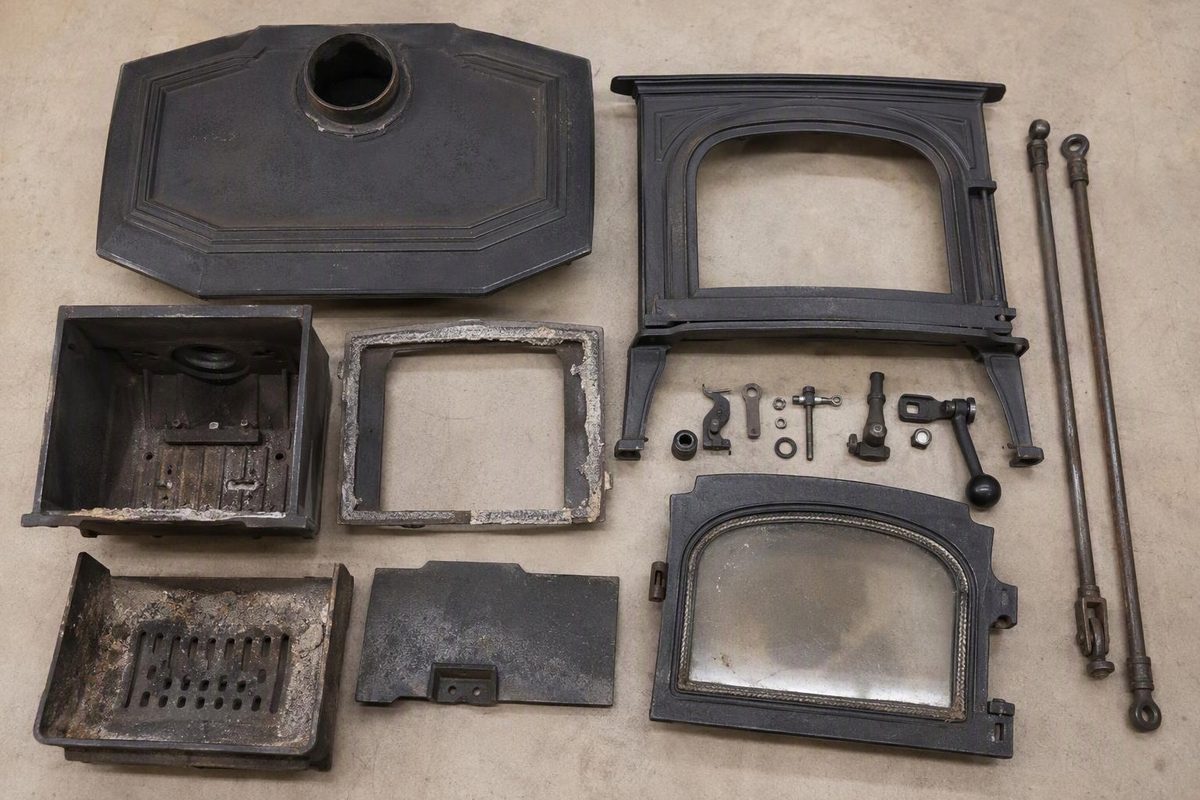
If you have removed the flue-collar screws or cut the long bolts and the top still will not move, stop hammering it. Check the body fasteners separately from the collar hardware, then assess the cemented joint. If the goal is simply to remove the stove, professional handling may be a better next step than further dismantling.
The Resolute III is an older Vermont Castings cast-iron stove, not a pellet stove. Its parts list identifies a set of four tie rods, a separate outer top, and a separate loading griddle—important distinctions when deciding what is still holding the stove together. Resolute III parts list
Confirm the stove and the part you are removing
Woodman’s Parts Plus identifies the Resolute III as manufactured from June 1983 through June 1988, with two front doors, a two-piece fireback and adjustable damper linkage. Model 0042 has glass panels; 0043 does not. Match those details and any available identification plate before using a diagram; do not substitute Resolute Acclaim instructions. Model identification
These references are from the Resolute III parts list:
| Component | Diagram reference | Part number |
|---|---|---|
| Outer top casting | 14 | 1301663 |
| Loading griddle | 21 | 1301674 |
| Flue-collar extension / collar | 15 / 16 | 1301670 / 1301668 |
| Four-piece tie-rod set | 28 | 5007499 |
| Internal baffle | 7 | 1301589 |
The collar screws are listed separately from the tie rods. Removing one group is not proof that the other is released. The diagram is useful for identifying hardware, but it is not a dismantling sequence. These are identification references, not a guarantee of current parts availability. Parts and hardware references
When the outer top is stuck
An owner in r/woodstoving reported this exact situation: drilled collar screws, cut long bolts and a top that remained stuck, with visible fire cement. Replies suggested patient chiselling, but supplied no verified fastener check or model-specific removal sequence. Treat that as community experience, not permission to hit harder. Owner discussion
A cautious next-step checklist is:
- Make the stove cold and stable. Remove cold ash, protect the work area, and photograph the top, collar, inside and underside without tipping the stove. Keep hands out from beneath unsupported castings.
- Account for all four tie rods. Reference 28 identifies the tie-rod set; the list also identifies rods and nuts separately. Before applying force, have any inaccessible or uncertain body attachments checked. If rods have already been cut, do not assume the body is safe to tilt or carry as an intact stove. Have the removal contractor assess how to support it.
- Assess the joint material before disturbing more of it. Rutland says its own cured furnace cement can be removed by scraping or sanding. That does not identify your stove’s old cement or establish a safe removal method for it. Do not use that instruction as justification to sand or grind an unknown joint material. Furnace-cement instructions
- Stop if release requires heavy blows or substantial leverage. Do not drive wedges between the castings to force the top free. Eye protection and gloves do not address airborne dust: Rutland’s current cement carries a crystalline-silica warning. If you cannot identify the old material and arrange appropriate dust controls, leave cement removal to a qualified professional. Product warning
Do not assume cement is the only remaining restraint simply because it is visible.
Will removing the top release everything else?
No—not automatically. The parts list also identifies left and right inserts, upper and lower firebacks, a damper and linkage. Its fireback-kit description includes bolts for the firebacks and both inserts, so those internal components have their own hardware to address. Internal parts and repair-kit contents
A Resolute III owner on Hearth.com also reported a broken insert bolt and a firmly seated baffle obstructing access. That illustrates why a seemingly simple strip-down can become a repair job. Owner’s dismantling experience
If you are replacing the stove, ask the installer or removal contractor to quote removal in its present condition, and tell them about every cut rod or drilled fastener. If you intend to reuse or sell it, stop destructive work and arrange assessment by someone experienced with older Vermont Castings stoves. Do not fire it again until the damaged hardware and disturbed joints have been properly repaired and inspected.